Why Most B2B Demand Engines Are Quietly Failing
B2B demand gen audits reveal a stark reality: 80% of leads never convert to sales, and organizations generate an average of 1,877 leads per month that fail to materialize into revenue. The math is brutal—most B2B companies waste 20-30% of their marketing spend on activities that contribute zero pipeline.
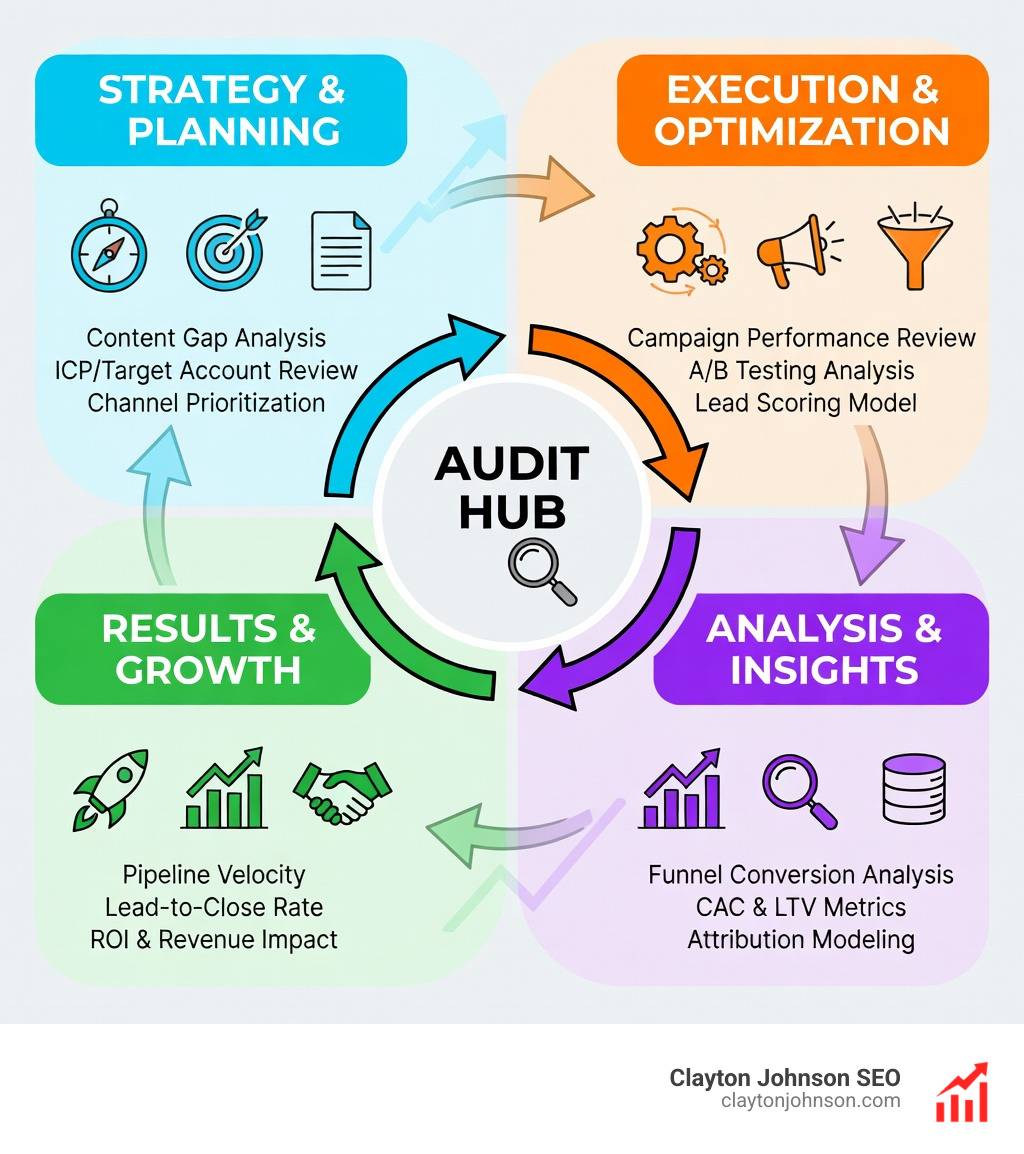
What a B2B Demand Gen Audit Should Cover:
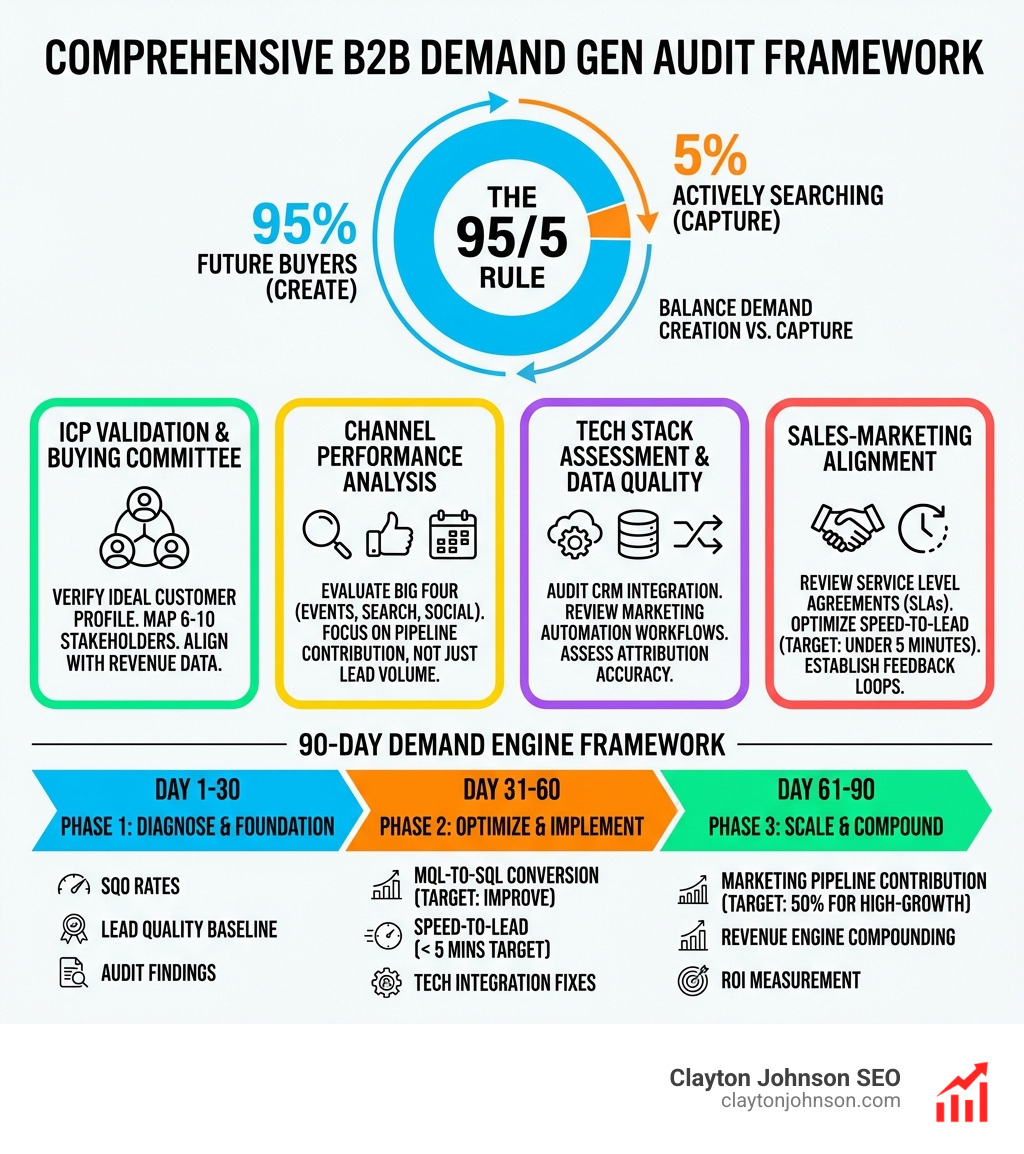
- ICP and Buying Committee Validation – Verify your Ideal Customer Profile aligns with actual revenue data and map the 6-10 stakeholders in the buying committee
- Demand Creation vs. Capture Balance – Assess whether you’re building relationships with the 95% of future buyers or only competing for the 5% actively searching
- Channel Performance Analysis – Evaluate the Big Four (events, search, social) for pipeline contribution, not just lead volume
- Lead Quality and Conversion Metrics – Track SQO rates, MQL-to-SQL conversion, and marketing’s contribution to pipeline (target: 50% for high-growth B2B)
- Tech Stack and Data Quality – Audit CRM integration, marketing automation workflows, and attribution accuracy
- Sales-Marketing Alignment – Review SLAs, speed-to-lead (target: under 5 minutes), and feedback loops
The problem isn’t just volume—it’s systematic misalignment. Marketing chases MQLs while sales complains about quality. Content sits unused because nobody can find it. Agencies optimize for cost-per-lead instead of sales-qualified opportunities. And most critically, teams focus on capturing the 5% of buyers actively searching instead of building trust with the 95% who aren’t ready yet.
I’m Clayton Johnson, and I’ve spent years building SEO-driven demand systems that convert by diagnosing these exact failure points through structured B2B demand gen audits. My approach combines technical SEO depth with strategic positioning to build revenue engines that compound over time, not just fill the top of funnel with junk leads.
B2B demand gen audits terms to remember:
Why B2B Demand Gen Audits are Essential for Revenue Growth
In the current B2B landscape, standing still is the same as moving backward. We see many marketing teams facing budget cuts while being pressured to deliver more leads. However, chasing raw lead volume is a race to the bottom. A B2B demand gen audit is essential because it shifts the focus from vanity metrics to revenue-generating activities.
One of the most critical insights we use is the 95/5 rule. According to research from The B2B Institute, only about 5% of your addressable market is “in-market” to buy right now. The other 95% are future buyers. If your strategy only captures existing demand, you are fighting over a tiny, expensive slice of the pie.
Audits help identify “revenue leaks.” For example, a manufacturing client we analyzed discovered £2.3M in annual pipeline was being lost simply because their technical datasheets weren’t findable by search engines. By conducting growth auditing, we can spot these gaps and reallocate budget from low-impact tactics to high-growth engines. High-growth B2B companies typically see marketing contribute roughly 50% of the new business pipeline. If your numbers are lower, an audit will tell you why.
The 90-Day Framework for Modern Demand Engines
We don’t believe in audits that sit on a shelf. A modern audit should lead directly into a 90-day execution sprint. This framework allows us to fix the foundation, launch pilot campaigns, and then scale what works.
| Feature | Traditional Lead Generation | Modern Demand Generation |
|---|---|---|
| Primary Goal | MQL Volume | Revenue & Pipeline (SQOs) |
| Content Style | Gated PDFs / eBooks | Ungated, Problem-Led POV |
| Buyer Focus | Chasing the 5% (In-market) | Educating the 95% (Out-of-market) |
| Sales Relation | “Throwing leads over the wall” | Shared Growth Council & SLAs |
| Metrics | Cost Per Lead (CPL) | Pipeline Contribution & CAC |
Phase 1: Foundation (Days 1–30)
This phase is about understanding demand generation at its core. We define the Ideal Customer Profile (ICP), validate the buying committee, and set up the measurement framework. We audit your existing data to see where the best customers actually come from.
Phase 2: Launch (Days 31–60)
We roll out the new messaging across the “Big Four” channels. This includes launching SEO-driven content, social proof campaigns, and refined paid search. We also implement a 5-minute speed-to-lead protocol to ensure no opportunity is wasted.
Phase 3: Scale (Days 61–90)
We analyze the first 30 days of data. We reallocate 20-30% of the budget from underperforming channels to the winners. This is where we operationalize successful pilots and build out the long-term demand engine.
Conducting B2B demand gen audits for ICP Validation
A flawed strategic foundation cannot be overcome by tactical excellence. If you are targeting the wrong people, your ads will fail no matter how pretty they look. During B2B demand gen audits, we validate your ICP using actual revenue data.
We look for the “80/20 rule”—the 20% of customers that generate 80% of your revenue. We also account for the fact that B2B purchasing now involves a committee of 6 to 10 stakeholders. An audit ensures your targeting isn’t just focused on one person, but accounts for the influencers, blockers, and decision-makers in that group.
Validating the Buying Committee and Persona Intent
The average B2B buyer conducts 12 online searches before ever engaging with a website. They are self-educating. To win, we must map their journey across the “5 Stages of Awareness.”
We audit your content to see if it answers the “Jobs-to-be-Done” (JTBD) for each persona. Are you providing solution-aware content for the director level and problem-aware content for the managers? By building SEO-driven funnels, we ensure your brand is the one they trust before they even talk to a salesperson.
Balancing Demand Creation vs. Demand Capture
The best demand generation models have the right balance of creation and capture.
- Demand Creation: Educating out-of-market buyers (the 95%) through social engagement, podcasts, and ungated thought leadership.
- Demand Capture: Converting in-market buyers (the 5%) who are actively searching on Google or checking third-party review sites.
According to Cognism’s demand gen research, the priority should be on educating buyers before trying to capture them. If you only focus on capture, your Customer Acquisition Cost (CAC) will skyrocket because you’re competing with every other vendor on the same high-intent keywords.
Measuring ROI through B2B demand gen audits
How do you prove marketing isn’t just a cost center? You track the metrics that the C-suite cares about. We move beyond vanity metrics and focus on Sales Qualified Opportunities (SQOs), pipeline contribution, and incrementality.
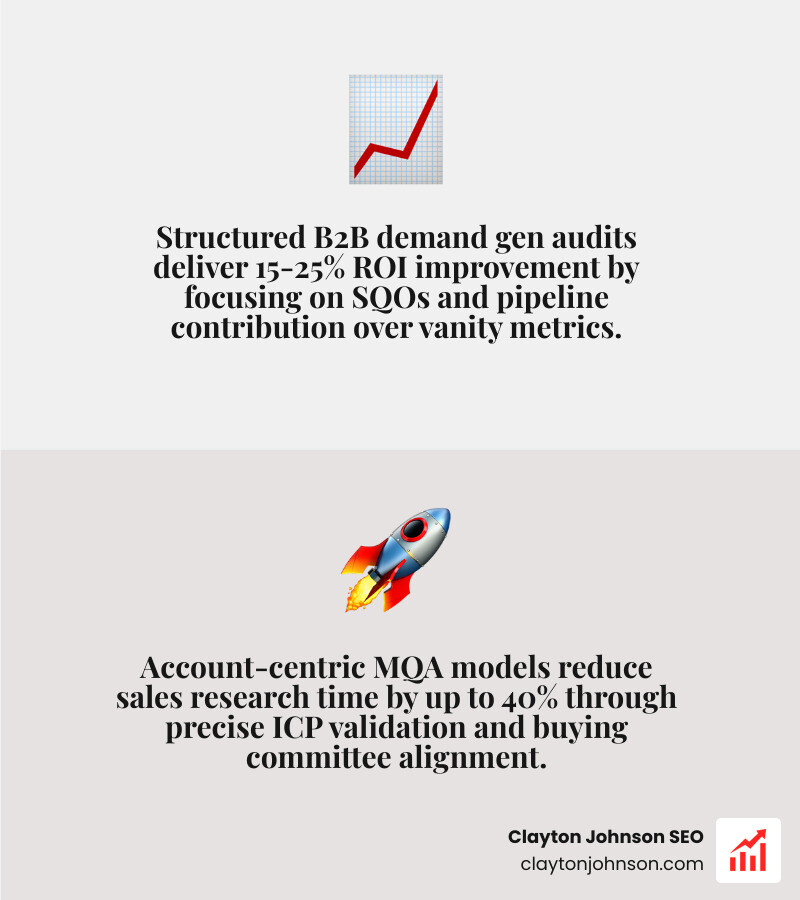
We look for a “Marketing Qualified Account” (MQA) model rather than just individual leads. This account-centric approach can reduce sales research time by up to 40%. We also audit your analytics and data quality to ensure you aren’t “flying blind.” If your CMO doesn’t trust the data, the audit is the first step to fixing the instrumentation.
Auditing the Big Four Channels: Events, Search, and Social
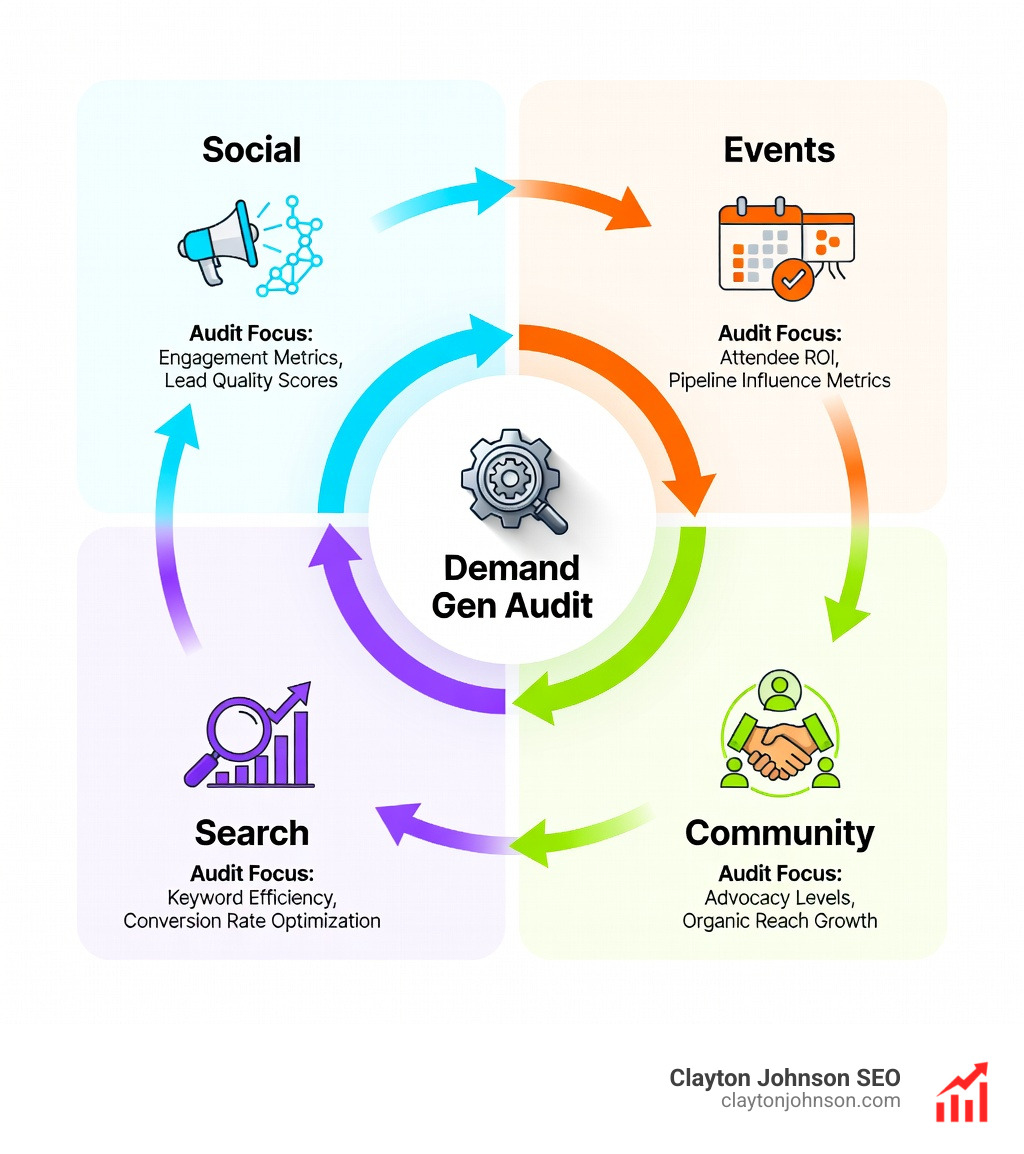
70% of marketing-sourced pipelines come from three main areas: events, search engines, and social platforms. We call these the Big Four (including community).
- Search (SEO + Paid): We look for synergy. Are your paid ads capturing the high-intent traffic while your SEO builds long-term authority?
- Social: We audit for “dark social” impact. Are your executives posting insights that get shared in private Slack groups?
- Events: We evaluate if events are actually creating pipeline or just providing expensive dinners.
- Community: We look for presence in industry groups like Trenches where your buyers actually hang out.
Auditing Content, Tech Stacks, and Team Alignment
Most B2B organizations have no idea how much content they have or how high-quality it is. Research shows that 65% of B2B content goes unused. It’s either unfindable or unusable. We conduct a content audit to identify these “content silos” and repurpose high-performing assets into bite-sized social clips and newsletters.
Alignment is also a process issue. We look for a “Growth Council”—a weekly meeting where marketing, sales, and product teams review a shared dashboard. Without this, marketing will continue to deliver “leads” that sales simply ignores.
Identifying Red Flags in Agency-Partnered Programs
If you work with an external agency, your B2B demand gen audits should include a “Green Flag/Red Flag” assessment.
- Red Flag: The agency focuses on lead volume and CPL without knowing your SQO rate.
- Red Flag: They rely on purchased lists or “shotgun” outreach. 90% of B2B decision-makers never respond to cold outreach.
- Green Flag: The agency anchors their strategy to your revenue goals and uses multi-channel frameworks to lower your CAC.
- Green Flag: They are transparent about data sources and prioritize first-party data.
Technology Stack and Data Quality Assessment
Your tech stack should be an axle, not an anchor. We audit your CRM (Salesforce, HubSpot) and Marketing Automation (Marketo, HubSpot) to ensure data flows seamlessly.
One major trend is the use of AI. Companies using AI-assisted targeting have seen a 30% increase in conversion rates. We check for “data hygiene”—duplicates, invalid emails, and missing fields—which can quietly derail your entire funnel. If your data is messy, your AI personalization will be irrelevant.
Frequently Asked Questions about B2B Demand Gen Audits
What is the difference between a lead gen and a demand gen audit?
A lead gen audit focuses on the “plumbing”—form fills, CPL, and email open rates. A B2B demand gen audit is a holistic look at the entire revenue engine. It evaluates how you create awareness in the 95% of the market that isn’t buying yet and how you convert the 5% that is. It’s the difference between counting “hands raised” and measuring “pipeline built.”
How often should a B2B company conduct a demand gen audit?
We recommend a deep-dive audit at least once a year, with quarterly “pulse checks.” Buyer behavior and search algorithms shift rapidly. If your CAC has risen by 15% quarter-over-quarter, or if your sales team is complaining about lead quality, you need an immediate audit.
What are the most common pitfalls uncovered during an audit?
The most common pitfall is “MQL obsession”—marketing teams being incentivized on lead quantity regardless of quality. Other common issues include 5-second page load speeds (which kill conversions), unfindable technical content, and a lack of formal SLAs between sales and marketing regarding lead follow-up.
Conclusion
A B2B demand gen audit is the first step in transforming your marketing from a cost center into a growth engine. By identifying revenue leaks, validating your ICP, and balancing demand creation with capture, you can build a system that delivers predictable results.
At Clayton Johnson SEO, we specialize in building these engines through data-driven SEO, content systems, and AI-assisted workflows. We don’t just give you a list of problems; we provide a 90-day action plan to fix them.
Ready to stop guessing and start growing? Book a strategy call with us today to see how we can help you build a demand engine that actually scales.