What is AI taxonomy and why should you care?

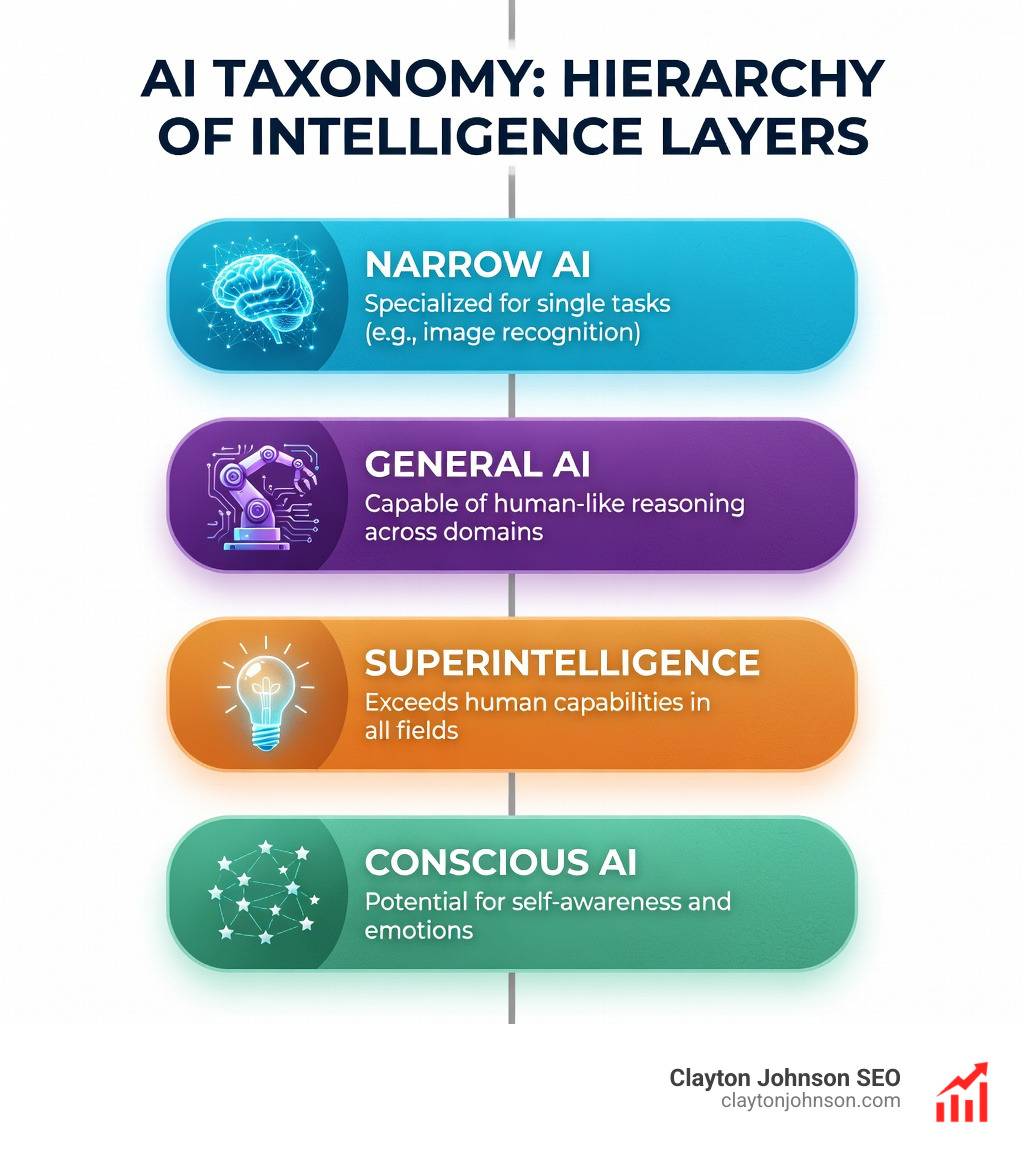
Why Knowing What is AI Taxonomy Gives You a Strategic Edge
What is AI taxonomy is one of those questions that sounds academic but has real operational consequences — especially if you’re building a growth system around AI.
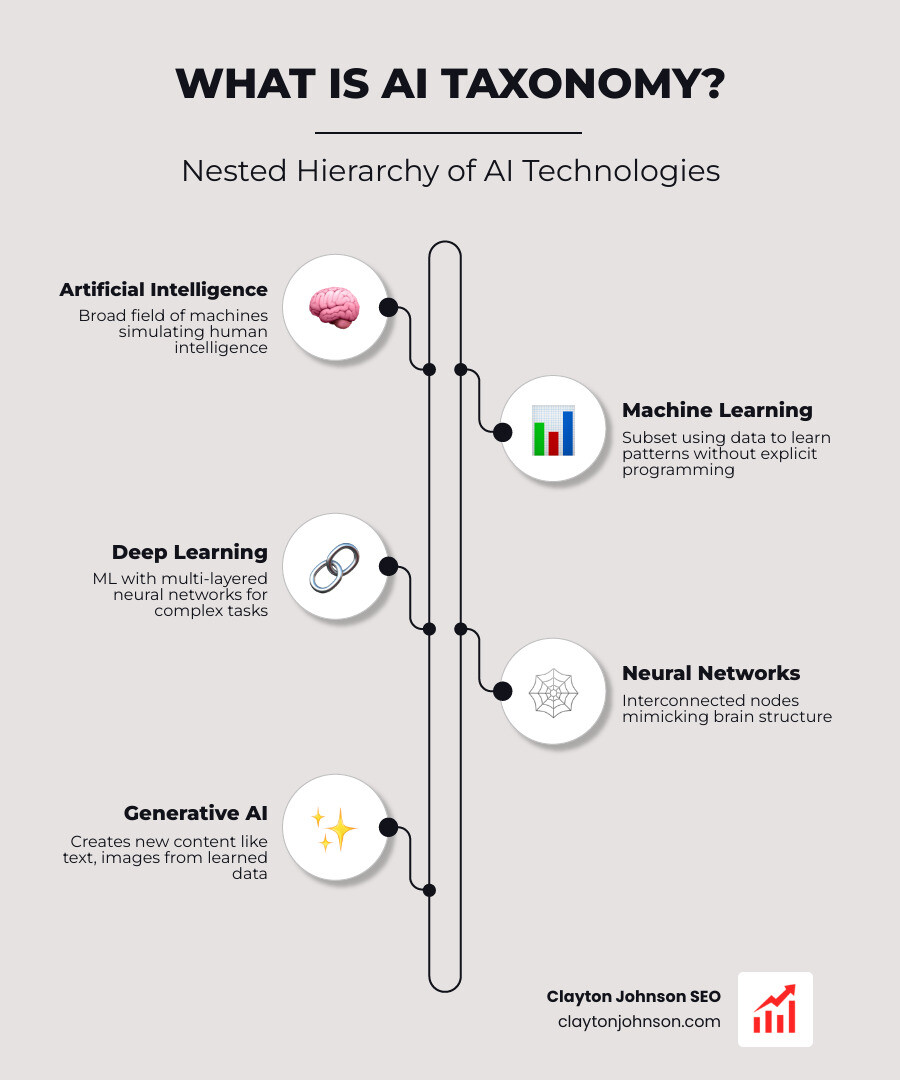
Quick answer: An AI taxonomy is a structured classification system that organizes AI technologies, techniques, and use cases into clear, hierarchical categories. It creates a shared language for understanding how tools like machine learning, deep learning, and generative AI relate to each other.
Here is how the core layers typically stack:
| Layer | What It Covers | Examples |
|---|---|---|
| Artificial Intelligence | Broadest category; machines mimicking human intelligence | Siri, Alexa, expert systems |
| Machine Learning | AI subset; systems that learn from data | Supervised, unsupervised, reinforcement learning |
| Deep Learning | ML subset; multi-layered neural networks | Image recognition, speech models |
| Generative AI | Deep learning subset; creates new content from prompts | ChatGPT, text-to-image tools |
Without a taxonomy, these terms blur together. Teams argue over definitions. Strategies get built on shaky foundations. And AI investments go in the wrong direction.
The problem is not a lack of AI tools. It is a lack of structure around them.
A clear taxonomy changes that. It helps you navigate the landscape, make smarter decisions, and communicate precisely — whether you are a founder evaluating AI vendors, a marketing leader building content systems, or a policy team mapping regulations to capabilities.
I’m Clayton Johnson, an SEO strategist and growth architect who works at the intersection of structured content systems and AI-assisted workflows — and understanding what is AI taxonomy has been foundational to how I help organizations build scalable, authority-driven growth engines. The frameworks in this guide will give you the same strategic clarity I apply across SEO architecture, competitive positioning, and AI integration.
Terms related to What is AI taxonomy:
What is AI Taxonomy and Why Does It Matter?
At its heart, a taxonomy is simply a way of grouping things together based on shared characteristics. In tech, What is AI taxonomy refers to the map we use to navigate the explosion of artificial intelligence tools.
Think of it like a library. Without a classification system, you just have a massive pile of books. You might find what you need by accident, but you can’t build a research strategy. In AI, a taxonomy prevents us from “talking past each other.” When one person says “AI” and another says “Machine Learning,” they might be referring to the same thing—or completely different layers of the stack.
The importance of a robust AI taxonomy spans several areas:
- Common Language: It provides a unified vocabulary for developers, executives, and users.
- Navigation: It helps organizations identify which specific technology (e.g., Natural Language Processing vs. Computer Vision) actually solves their business problem.
- Policy-making and Education: Governments and schools use taxonomies to define what needs regulation or what skills should be taught in STEM degrees.
- Ecosystem Mapping: It allows us to see where a company fits in the broader market, distinguishing between those building core infrastructure and those building applications.
We often interact with these systems through consumer interfaces like Siri or Alexa, but behind those friendly voices is a complex hierarchy of classifications.
Comparing Taxonomy Approaches
Depending on your goals, you might organize AI differently. Here is a comparison of two common frameworks:
| Feature | Technique-Based Taxonomy | Purpose-Based Taxonomy |
|---|---|---|
| Focus | How the AI works (the math/logic) | What the AI does (the outcome) |
| Categories | Neural Networks, Fuzzy Logic, Expert Systems | Content Creation, Forecasting, Robotics |
| Best For | Engineers and Data Scientists | Business Leaders and Policy Makers |
| Example | “We are using a Transformer architecture.” | “We are using a Digital Assistant.” |
Visualizing What is AI Taxonomy Through Nested Hierarchies
One of the most effective ways to understand What is AI taxonomy is through the “Russian Nesting Doll” or concentric circle model. This is often referred to as the Wawiwa Tech hierarchy, which simplifies the jargon into digestible layers.
- Artificial Intelligence (The Outer Layer): This is the broad umbrella. It includes any machine designed to mimic human cognitive functions. Historically, this included “Expert Systems”—rule-based programs that didn’t necessarily “learn” but followed complex “if-then” logic.
- Machine Learning (The Middle Layer): Here, we move from explicit programming to systems that learn from data. Instead of telling a computer exactly what to do, we give it a million examples and let it find the patterns.
- Deep Learning (The Inner Layer): This uses multi-layered neural networks. Think of these as the “Lego bricks” of modern AI. By stacking simple units (perceptrons), we can build structures capable of incredible complexity, like recognizing a face in a crowd.
- Generative AI (The Core): The newest addition to our taxonomy, focusing on systems that don’t just analyze data but create new artifacts—text, images, or code.
Within the Machine Learning layer, we further classify systems by how they are taught:
- Supervised Learning: Learning with a “teacher” (labeled data). The machine knows the “right” answer and adjusts to reach it.
- Unsupervised Learning: Exploring data “without a map.” The machine identifies clusters or anomalies on its own.
We also use the Turing Test as a historical benchmark within this taxonomy—a way to classify if a machine’s output is indistinguishable from a human’s. While modern LLMs often pass this easily, it remains a vital concept for understanding the “Agency” or “Intelligence” level of a system.
Distinguishing Core AI from Enabling Technologies
A common pitfall in defining What is AI taxonomy is confusing the “brain” with the “body.” To build a structured growth architecture, we must distinguish core AI from the technologies that enable or sit adjacent to it.
- Core AI Technologies: These are the algorithms and models. Examples include Computer Vision (seeing), Natural Language Processing (understanding text), and Reinforcement Learning (learning through trial and error to maximize rewards).
- Enabling Technologies: These are the “pipes and power.”
- IoT (Internet of Things): Provides the sensors and data sources that AI analyzes.
- Hardware Infrastructure: The GPUs and specialized chips that provide the “muscle” for deep learning.
- Cloud Computing: The scalable environment where these models are trained and deployed.
By separating these in our taxonomy, we can better understand where the value is being created. For instance, a self-driving car uses Computer Vision (Core AI) but relies on LIDAR sensors (Enabling Tech/IoT) and high-performance onboard processors (Hardware).
Leading Frameworks: From NIST to the UK Layered Model
When we look at how global institutions define What is AI taxonomy, we see a shift toward human-centered and layered approaches. These frameworks move beyond simple technical definitions to look at how AI functions in society.
The NIST Human-Centered AI Use Taxonomy
The National Institute of Standards and Technology (NIST) proposes a taxonomy that focuses on “Human-AI Interaction” (HAII). Unlike traditional software, AI is non-deterministic and can alter human tasks in unpredictable ways.
The NIST AI Use Taxonomy identifies 16 specific “AI Use Activities.” This approach is technique-independent, meaning it doesn’t matter if you’re using a neural network or a simple algorithm; what matters is the outcome.
These 16 activities include:
- Content Creation: Generating text, code, or images.
- Detection: Identifying cyber threats or medical anomalies.
- Forecasting: Predicting sales or weather patterns.
- Digital Assistance: Providing reminders or scheduling.
This framework prioritizes trustworthiness and usability. By classifying AI based on these activities, organizations can better measure if a system is actually helping humans achieve their goals or just adding complexity.
The UK Government Layered Abstraction Model
The UK government takes a more structural view, proposing a five-layer model to coordinate research and investment. They use the analogy of a “chocolate bar” or a “rainbow”—the layers have blurred boundaries but distinct cores.
- Physical Layer: The hardware, materials, and fabrication (e.g., nanotechnology and silicon).
- Functional Layer: The basic building blocks like math operators, logic gates, and artificial neurons.
- Computational Layer: How we label data and structure neural networks (e.g., CNNs or LSTMs).
- Semantic Layer: The “reasoning” layer where rules and symbols are applied to data.
- Agency Layer: The top level where the system makes decisions, sets motivations, and addresses ethics.
This layered taxonomy brief is particularly useful for policymakers. It shows where intervention actually belongs in a complex AI system. For example, a bias issue might sit in the computational layer (like flawed data labeling), while a safety issue might sit in the agency layer (the system is pursuing the wrong objectives).
The European AI Ecosystem and Capability Mapping
In Europe, the focus has been on creating a comprehensive taxonomy to navigate a growing tech talent shortage. Reports indicate that Europe faces a significant gap in STEM degrees, with millions of tech jobs remaining unfilled.
To address this, the European AI Taxonomy Report scanned 35 existing frameworks to build a unified model. This taxonomy focuses on 8 AI Capabilities:
- Computer Vision
- Computer Audition
- Computer Linguistics
- Robotics
- Forecasting
- Discovery
- Planning
- Creation
What makes this model unique is its alignment with NACE codes (the standard for industrial classification in the EU). This allows governments to map AI capabilities directly to specific industries like agriculture or manufacturing, making it easier to track the economic impact of AI.
Practical Applications: Managing and Scaling AI Taxonomies
Understanding What is AI taxonomy isn’t just for researchers; it’s a daily task for data managers. As the amount of information grows, we are increasingly using AI to manage the taxonomies themselves.
Using AI to Build Taxonomies
Tools like Large Language Models (LLMs) and specialized frameworks like BERTopic are changing how we organize data.
- Taxonomy Component Generation: LLMs can quickly draft definitions and suggest “child concepts” for a new category.
- Semantic Embedding: This allows us to map different vocabularies to each other by finding the mathematical “closeness” of terms.
- Auto-tagging: AI can process thousands of documents and automatically apply the correct taxonomic tags.
However, we always recommend a human-AI hybrid approach. AI is great at speed, but it often fails at capturing “tacit knowledge”—the unwritten rules of an organization. A machine might define “Customer Satisfaction” as “when the customer is satisfied,” which is a circular, useless definition. Humans are needed to provide context and ensure the taxonomy aligns with business goals.
Addressing Bias, Ethics, and Governance
Taxonomies are not neutral. How we classify something often reflects our own biases. If an AI taxonomy for “High-Potential Employees” is built on biased historical data, it will continue to exclude certain groups.
- Content Quality: If the training data is poor, the resulting taxonomy will be flawed.
- Governance: There must be a clear process for who can update the taxonomy. In a “Synthetic Taxonomy” (a concept where AI systems evolve like biological species), we must track how models “interbreed” through merging and distillation.
- Scalability: As an organization grows, its taxonomy must be able to handle new categories without breaking the existing structure.
How to Apply What is AI Taxonomy to Business Strategy
For founders and marketing leaders, What is AI taxonomy is a tool for building “structured growth architecture.” At Demandflow.ai, we believe that clarity leads to structure, which leads to leverage.

Here is how you can apply these concepts:
- Reskilling Programs: Use the taxonomy to identify skill gaps. If your team is great at “Content Creation” (GenAI) but lacks “Forecasting” (ML) skills, you know exactly where to focus your training.
- SEO Strategy: By building an Authority-building ecosystem, you can use taxonomic structures to organize your content, ensuring that both search engines and users understand your expertise.
- Competitive Positioning: Use capability mapping to see where your competitors are. If everyone is fighting over “Linguistics,” perhaps there is an opportunity in “Computer Audition” or “Discovery.”
In places like Canada, where 250,000 skilled professionals are needed to fill tech roles, having a clear taxonomy for “tech talent” is the only way to effectively bridge the gap.
Frequently Asked Questions about AI Taxonomy
What is the difference between AI and Machine Learning in a taxonomy?
In a standard taxonomy, Artificial Intelligence is the “parent” category. It refers to the broad goal of creating intelligent machines. Machine Learning is a “child” or subset of AI. It refers to the specific technique of using data and algorithms to allow machines to improve their performance over time without being explicitly programmed for every task.
How does Generative AI fit into an existing AI taxonomy?
Generative AI is a specialized subset of Deep Learning (which is itself a subset of Machine Learning). While traditional AI might classify or predict data (e.g., “Is this a picture of a cat?”), Generative AI creates new data (e.g., “Draw me a picture of a cat in the style of Van Gogh”). In a capability-based taxonomy, it falls under the “Creation” category.
Why is a human-centered approach necessary for AI classification?
A technical taxonomy tells you what a tool is, but a human-centered taxonomy tells you what a tool does for people. Because AI systems are non-deterministic (they can give different answers to the same prompt) and can act with a level of “agency,” we need to classify them based on their impact on human tasks, safety, and trust.
Conclusion
Mastering What is AI taxonomy is the first step toward moving from “tactical chaos” to “structured growth.” Whether you are using the NIST framework to ensure trustworthiness or the European model to map industry capabilities, a taxonomy provides the clarity needed to scale.
At Clayton Johnson SEO and Demandflow.ai, we use these structured strategies to help founders build compounding growth. We don’t just provide tactics; we provide the architecture—the SEO systems, competitive models, and AI workflows—that turn information into authority.
If you are ready to stop guessing and start building a structured growth engine, explore our knowledge base of AI tools or reach out to see how we can implement these systems for your business. Remember: Clarity → Structure → Leverage → Compounding Growth.