Enterprise AI Is Reshaping How Modern Businesses Compete
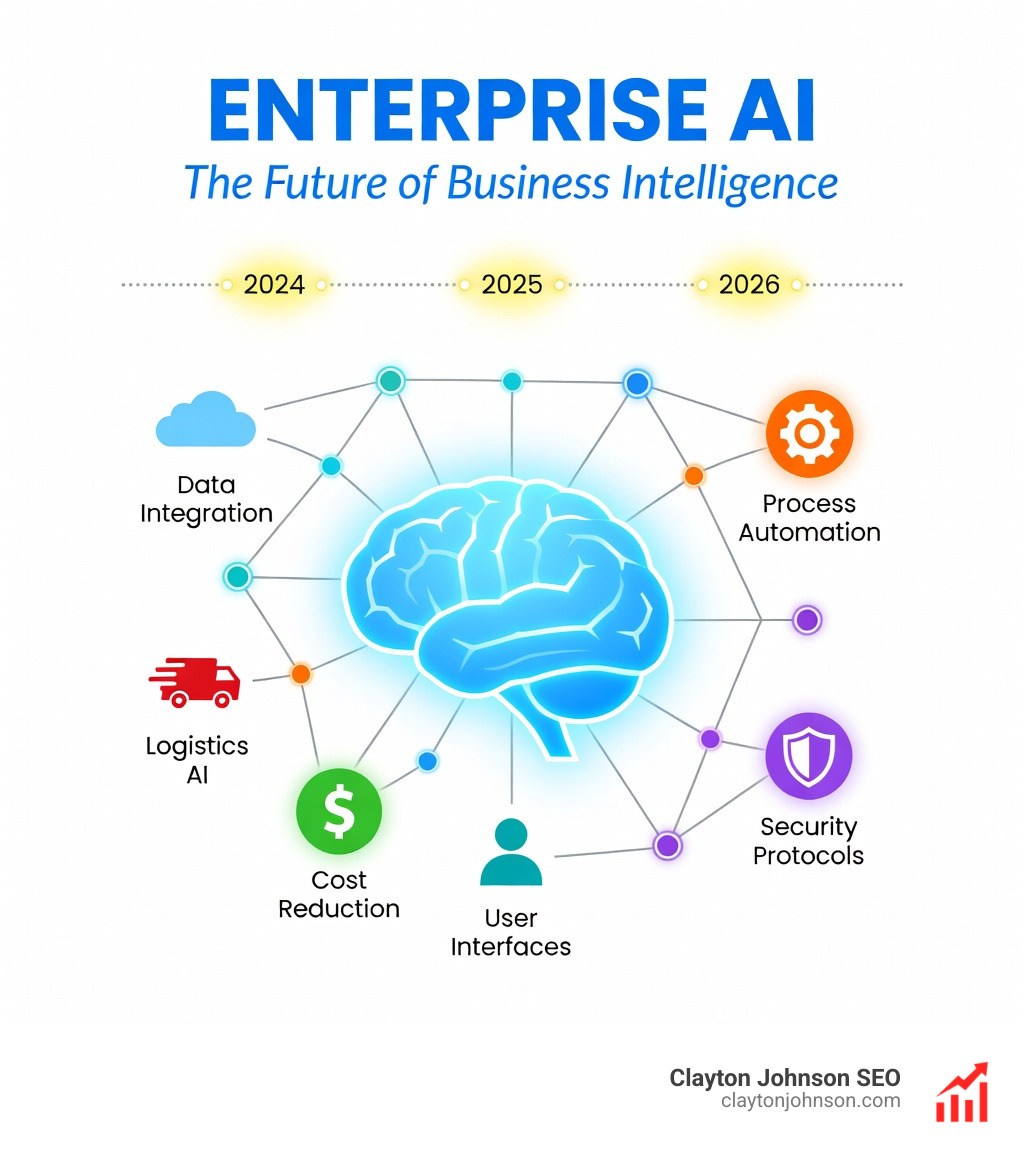
Enterprise AI is the use of artificial intelligence systems — including large language models, machine learning, and AI agents — built specifically for large organizations, integrating with governed data and business workflows to automate decisions, surface insights, and drive measurable outcomes at scale.
Quick answer:
| Question | Answer |
|---|---|
| What is it? | AI systems designed for large-scale business operations |
| How is it different from consumer AI? | Governed, secure, and integrated with enterprise data and workflows |
| How is it different from RPA? | Learns and adapts vs. following fixed rules |
| Who uses it? | Finance, healthcare, manufacturing, retail, and more |
| What does it deliver? | Cost savings, productivity gains, faster decisions, competitive edge |
The numbers tell the story. Workers using AI at work save 40–60 minutes per day on average. Organizations running mature AI programs report 20% cost reductions and error rates cut by nearly 80%. And companies leading in AI adoption are achieving 1.7x revenue growth compared to laggards.
This isn’t a side project anymore. It’s becoming the backbone of how serious organizations operate.
I’m Clayton Johnson — an SEO strategist and growth operator who has spent years building AI-augmented marketing systems and helping organizations turn Enterprise AI from a buzzword into a compounding growth engine. In the sections ahead, I’ll break down exactly what it is, how it works, and how to make it work for you.
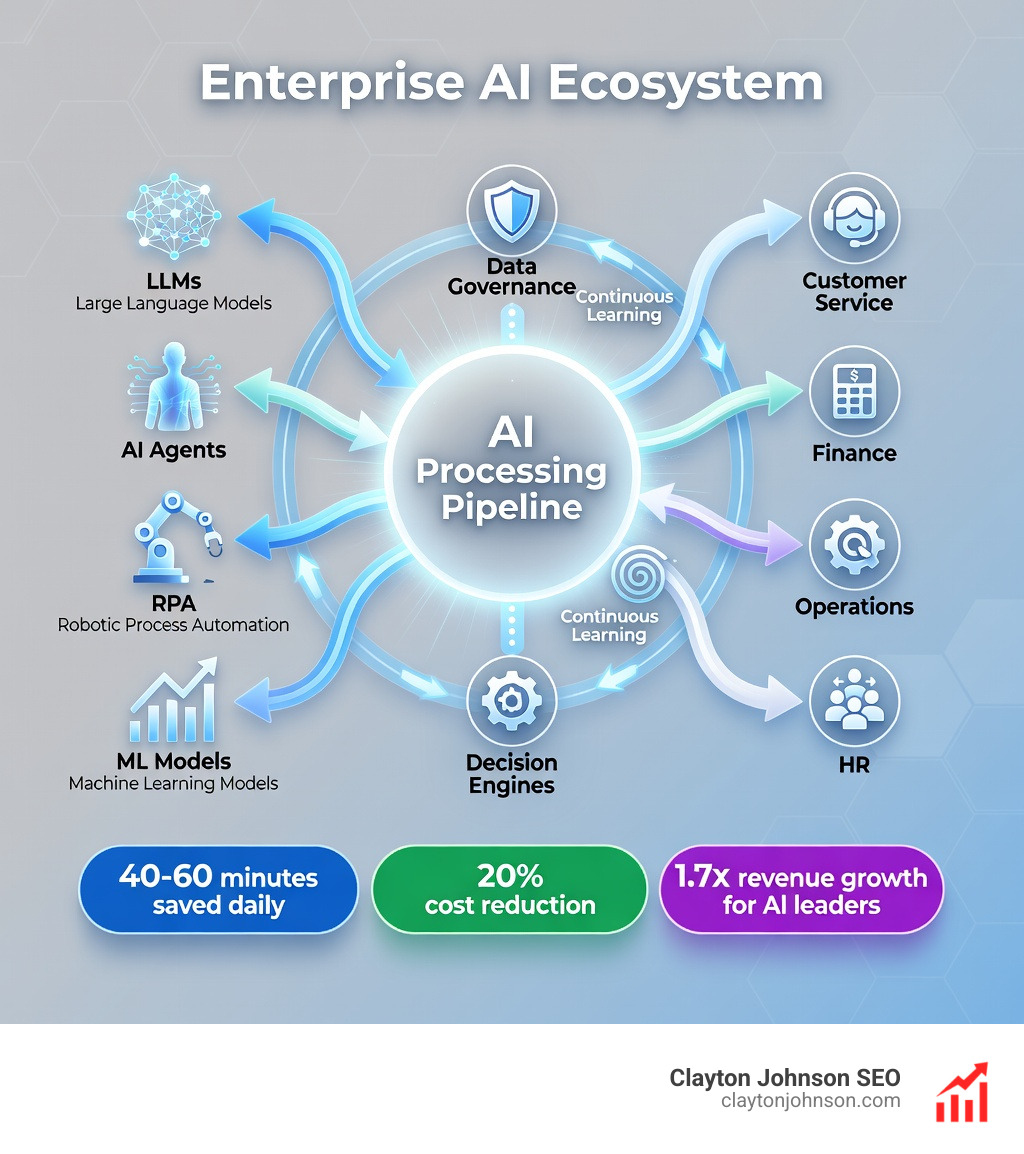
What is Enterprise AI and Why Does It Matter?

In the simplest terms, Enterprise AI is the operational layer where advanced machine learning models intersect with your specific business data and workflows. While consumer AI is great for writing a fun poem or summarizing a recipe, Enterprise AI is built to handle the “heavy lifting” of a corporation. It’s about scalability, reliability, and most importantly, security.
Modern businesses generate a staggering volume of data. Traditional analysis methods often fail because humans simply can’t process information at the speed required to stay competitive. Enterprise AI solves this by revealing hidden patterns and opportunities that would otherwise go unnoticed.
One of the biggest shifts we’re seeing is the transition from “experimentation” to “business model transformation.” It’s no longer about just having a chatbot; it’s about creating an “AI backbone” that powers decision engines across the entire company.
Scalability and Adaptability
Unlike traditional software, Enterprise AI systems are designed to grow with you. They don’t just follow a set of instructions; they learn from the feedback loops and data they process. This makes them significantly more adaptable than older technologies like RPA.
Enterprise AI vs. RPA: A Comparison
Many people confuse Enterprise AI with Robotic Process Automation (RPA). Here is how they stack up:
| Feature | RPA (Traditional Automation) | Enterprise AI |
|---|---|---|
| Core Function | Repetitive, rule-based tasks | Learning, reasoning, and adapting |
| Data Handling | Structured data only | Structured and unstructured data |
| Decision Making | Follows “If/Then” logic | Makes probabilistic decisions based on patterns |
| Flexibility | Brittle; breaks if the process changes | Adaptive; learns from new scenarios |
| Use Case | Data entry, invoice processing | Predictive analytics, autonomous agents |
To dive deeper into the technical definition, you can explore this resource on What is Enterprise AI?
How Enterprise AI Differs from Consumer Tools
The biggest hurdle for most organizations isn’t the AI itself; it’s the risk. If you put sensitive company data into a free consumer tool, you’ve essentially “leaked” that data to the public model. Enterprise AI is built with a “security-first” mindset.
- Governance: These platforms include robust controls to manage who can see what.
- PII Protection: They are designed to scrub or protect Personally Identifiable Information (PII) like payroll slips or health details.
- Model Interpretability: We need to know why an AI made a decision. This is known as Explainable AI, which builds stakeholder trust by making the “black box” of AI transparent.
- Data Sovereignty: Many firms, especially those we work with in Minneapolis and throughout Minnesota, have strict requirements about where their data lives. Enterprise solutions offer private clouds or sovereign options to meet these legal needs.
The Role of Data Management in Enterprise AI
You’ve heard the phrase “garbage in, garbage out.” In Enterprise AI, this is the absolute truth. Successful AI isn’t just about the model; it’s about the data infrastructure supporting it.
Data silos are the enemy of progress. If your marketing data can’t “talk” to your sales data, your AI will be half-blind. Leading organizations are moving toward a “living AI backbone” where data flows are converged and standardized. This involves:
- Quality Engineering: Ensuring data is clean and accurate.
- Metadata Tracking: Knowing where data came from and how it has changed (lineage).
- Interoperability: Making sure different systems can work together.
Effective management also requires a strong framework. We recommend checking out our guide on Artificial Intelligence / AI Governance to understand how to manage these risks.
Top Solutions Powering the Modern Organization
Choosing the right platform can feel like being a kid in a very expensive candy store. The “best” solution depends on your specific needs, but there are several heavy hitters currently leading the market.
- Salesforce Einstein: Launched in 2016, this is a powerhouse for CRM-driven insights. It delivers predictive analytics and automation directly within the Salesforce ecosystem.
- Microsoft Copilot: This tool integrates generative AI directly into Microsoft 365 apps, helping workers generate content, analyze data, and automate mundane tasks.
- Google Cloud AI: Known for high performance and reliability, Google offers scalable and secure platforms that help businesses stay competitive through advanced machine learning.
- IBM watsonx: IBM has a long history in the field, and their watsonx portfolio is designed to process vast amounts of data for complex business applications.
- NVIDIA: Beyond just hardware, NVIDIA offers a comprehensive ecosystem of enterprise-grade software and models to boost efficiency across industries.
- H2O.ai: A leader in 13 top enterprise AI solutions, they provide flexible, scalable platforms that include high-performance computing capabilities through NVIDIA RAPIDS integration.
For those looking to build their own internal stack, we have outlined AI Infrastructure Best Practices for Smart Organizations to help you get started.
Evaluation Criteria for an Enterprise AI Platform
When you’re shopping for a vendor, don’t just look at the shiny features. Focus on these core criteria:
- Vendor Roadmap: Does the company have a plan for the next 5 years? AI moves fast; you don’t want a tool that will be obsolete in six months.
- Total Cost of Ownership (TCO): Consider not just the license fee, but the cost of data integration, talent, and compute power.
- Security Certifications: Look for SOC2, HIPAA, or GDPR compliance depending on your industry.
- Integration Flexibility: Can it connect to your existing ERP or CRM? Tools like Azure AI Foundry allow you to build and manage custom agents for specific use cases.
The ROI of Intelligence: Benefits and Real-World Impact
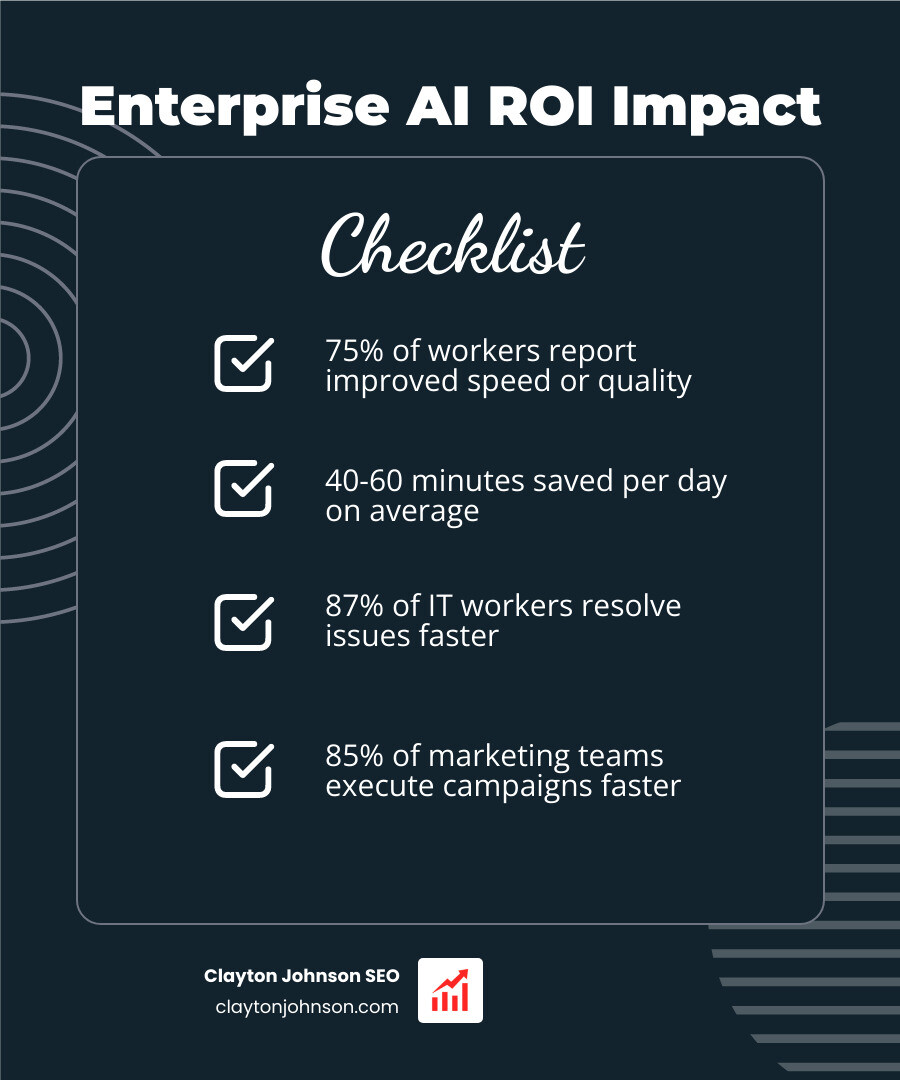
The return on investment for Enterprise AI is becoming impossible to ignore. It’s not just about “saving time”; it’s about compounding advantages.
Key Statistics on AI Impact:
- Time Savings: 75% of workers report improved speed or quality, saving an average of 40-60 minutes per day.
- Efficiency: 87% of IT workers report faster issue resolution, and 85% of marketing teams execute campaigns faster.
- Cost Reduction: Configurator tools have delivered 20% cost savings and slashed workflow times in half.
- New Capabilities: 75% of users report being able to complete tasks they previously couldn’t perform, such as non-technical staff using AI for coding.
To see how this fits into a broader business plan, read our Enterprise AI Strategy 101.
Industry Use Cases for Enterprise AI
We are seeing Enterprise AI transform every sector it touches. Here are a few standout examples:
- Finance: Companies are using AI agents to investigate trade breaks. One firm, SS&C GlobeOp, achieved a 20% increase in breaks resolved on “day zero” with 100% accuracy.
- Healthcare: AI is being used for clinical decision support and managing vast amounts of patient data securely.
- Manufacturing: AI customer growth in the technology and manufacturing sectors has reached 11x year-over-year.
- Customer Service: Salesforce Agentforce and similar tools allow for autonomous support. For instance, ABANCA responded 60% faster to customer inquiries using AI agents for email handling.
- Retail/Consumer Goods: Coca-Pacific Partners manages 450 automations handling 13 million tasks, saving millions of euros and reducing error rates by 80%.
Overcoming the Challenges of Adoption

While the benefits are huge, the road to implementation is often paved with challenges. Many organizations fall into the “DIY Trap”—trying to build their own AI platform from scratch.
The DIY Risk
Building an internal Enterprise AI platform is exponentially more complex than building a CRM or ERP. Some experts estimate the number of software API connections can approach 10^13. This creates extreme brittleness. Many Fortune 500 companies have spent hundreds of millions of dollars over several years with no deployed applications because they underestimated the data integration effort.
Other common challenges include:
- The Talent Gap: Demand for AI engineering talent has more than doubled since 2023.
- Data Silos: As mentioned, if data isn’t integrated, the AI is useless.
- Brittleness: If the underlying data structure changes, a poorly built AI can fail completely.
To mitigate these risks, follow a Responsible AI Framework: 5 Key Principles for Success.
Security, Compliance, and Governance
In a professional setting, “good enough” security isn’t enough. You need:
- Audit Trails: A record of every decision the AI made and why.
- Role-Based Access: Ensuring only authorized personnel can access sensitive models.
- Policy Guardrails: Hard limits on what the AI can and cannot do.
- Data Locality: Ensuring data stays within your required geographic boundaries (like right here in Minnesota).
A Strategic Roadmap for Successful Implementation
How do you actually get started? We recommend a phased approach.
- Define Organizational Goals: Don’t use AI just for the sake of it. Are you trying to reduce costs, improve customer experience, or innovate faster?
- Develop a Data Strategy: Assess your data preparedness. Do you have high-quality, accessible data?
- Assemble a Cross-Functional Team: You need data scientists, IT professionals, and domain specialists (the people who actually do the work the AI will assist).
- Draw Up a Plan: Define your technology stack, including cloud environments and supercomputing platforms.
- Launch a Pilot Program: Test the AI in a controlled environment. This is where you identify “brittleness” before it affects the whole company.
- Deploy and Integrate: Move from the pilot to full integration with existing systems like your CRM or ERP.
- Continuously Improve: AI is not “set it and forget it.” Use feedback loops to monitor performance and retrain models as needed.
For a deeper dive into this process, check out Scaling AI: A Strategic Framework for Modern Organizations.
Frequently Asked Questions
What is the difference between Enterprise AI and RPA?
RPA is like a digital factory worker—it follows a strict set of rules to perform repetitive tasks. Enterprise AI is like a digital knowledge worker—it can handle unstructured data (like emails or documents), learn from new information, and adapt its behavior without needing a human to rewrite its code.
How secure is Enterprise AI for sensitive data?
When implemented correctly, it is highly secure. Unlike consumer tools, Enterprise AI solutions use encryption, private cloud deployments, and strict role-based access controls. They also provide audit logs so you can see exactly how your data is being used.
What are the latest trends in Enterprise AI?
- Agentic AI: Autonomous agents that can plan and execute multi-step tasks.
- Generative AI: Using LLMs to create content and analyze data.
- Explainable AI: Tools that help humans understand AI decision-making.
- Reasoning Tokens: A massive increase in the “thinking” power of models (consumption has increased 320x recently).
Conclusion
At Clayton Johnson, we believe that the true power of AI isn’t found in a single tool, but in a structured growth architecture. We are building Demandflow.ai to provide founders and marketing leaders with a structured strategy and growth operating system.
By combining actionable strategic frameworks with AI-augmented marketing workflows, we help businesses move beyond simple tactics to achieve compounding growth. Whether you are looking for SEO strategy or a full competitive positioning model, the goal is the same: Clarity, Structure, Leverage, and Growth.
If you’re ready to turn Enterprise AI into your company’s secret sauce, explore our Artificial Intelligence / Enterprise AI resources and let’s start building your structured growth infrastructure today.