Why AI for SEO Optimization Is the New Competitive Baseline
AI for SEO optimization is the practice of using artificial intelligence to improve how your content is discovered, ranked, and cited — across both traditional search engines and AI-powered answer platforms like Google AI Overviews, ChatGPT, and Perplexity.
How to optimize content for AI search — quick answer:
- Structure your content with clear headings, short paragraphs, and self-contained answer blocks
- Target conversational, intent-driven queries rather than standalone keywords
- Implement schema markup (FAQPage, HowTo, Article, Organization)
- Demonstrate E-E-A-T with author credentials, citations, and first-party data
- Write extractable passages — one idea per paragraph, direct answers first
- Maintain technical SEO fundamentals — fast load times, clean HTML, mobile-first architecture
- Track AI visibility — monitor brand citations in AI Overviews, ChatGPT, and Perplexity, not just rankings
Search has fundamentally changed. Google processes 8.5 billion searches per day — and AI-generated answers now appear in over 13% of those queries. Perplexity matches Google’s top 10 domains in over 91% of cases. Over 65% of searches end without a click.
Ranking on page one is no longer enough. Your content needs to be cited inside AI-generated answers — or you’re invisible where decisions are being made.
The gap between brands that understand this and brands that don’t is widening fast.
I’m Clayton Johnson — an SEO strategist focused on building scalable, AI-augmented search visibility systems that convert traffic into compounding business growth through AI for SEO optimization. I’ve engineered structured content architectures and authority frameworks across 50+ business models, helping founders and marketing leaders move from reactive tactics to measurable, system-driven search dominance.
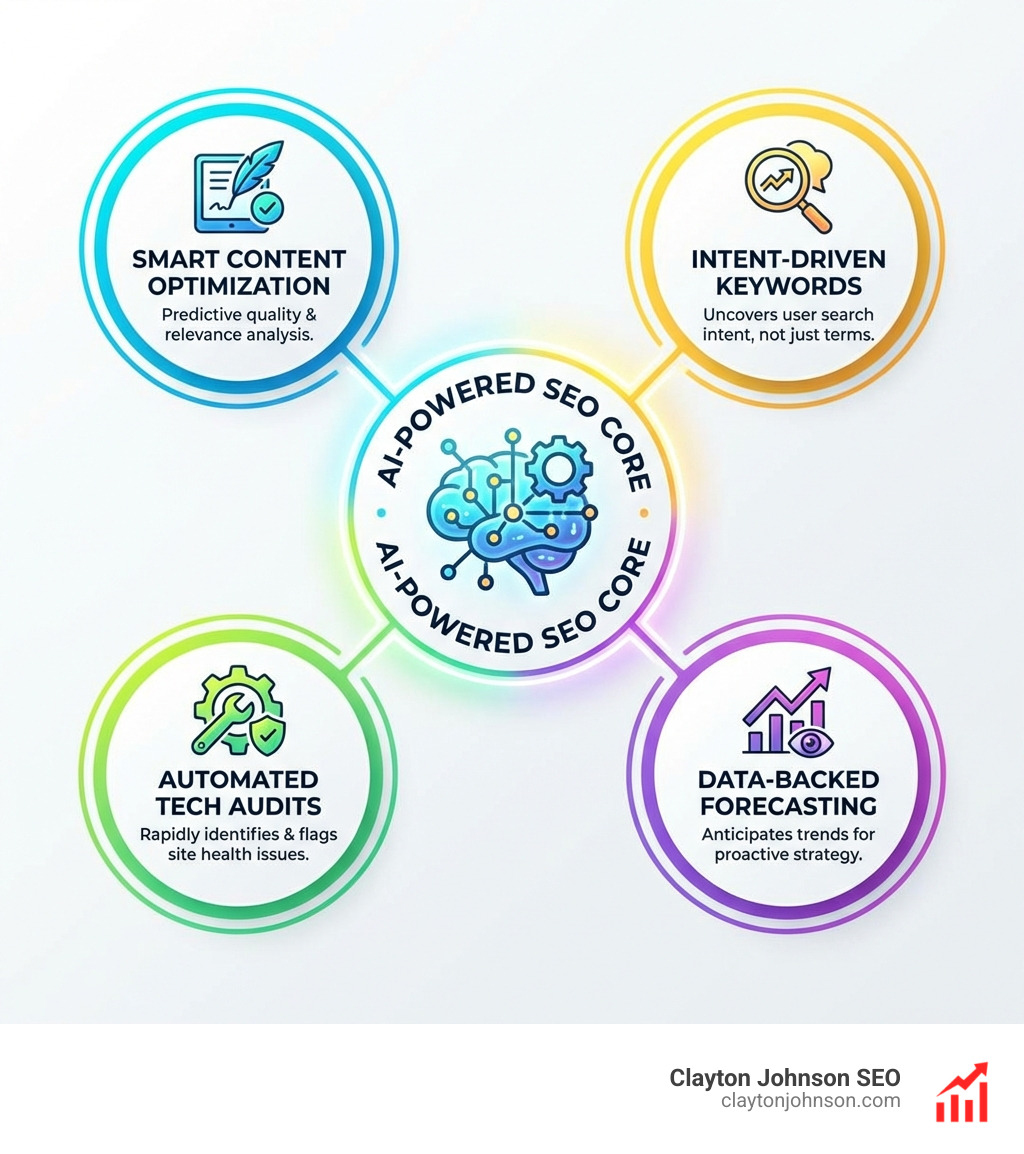
Relevant articles related to ai for seo optimization:
The Core Pillars of AI for SEO Optimization
When we talk about ai for seo optimization, we aren’t just talking about a faster way to write blog posts. We are talking about a fundamental shift in how search engines “read” and “reward” information. Traditional SEO was a game of matching keywords to indices; AI SEO is a game of matching entities to intent.
To win, you must understand the three core pillars that modern search models use to evaluate your site:
- Entity Clarity: Search engines no longer just see words; they see “entities” (people, places, things, concepts). If you search for “Apple,” the AI needs to know if you want the fruit or the tech giant. We optimize for this by using clear, unambiguous language and linking concepts together.
- Semantic Structure: This is the “map” of your content. By using a logical hierarchy of headings (H1, H2, H3) and internal links, you help AI models understand the relationship between different topics.
- Information Gain: This is a crucial concept. AI search engines like Google’s SGE (Search Generative Experience) look for new information. If your article just repeats what is already on the top 10 results, why would an AI cite you? You need proprietary data, unique insights, or a fresh perspective.
Traditional SEO vs. AI SEO
| Feature | Traditional SEO | AI SEO (GEO/AEO) |
|---|---|---|
| Primary Goal | Rank in the top 10 blue links | Be the cited source in an AI answer |
| Focus | Keywords and backlinks | Entities, intent, and extractability |
| Content Unit | The entire page | The “passage” or “answer block” |
| User Path | Click through to website | “Zero-click” visibility or “Educated Click” |
Modern search relies on Retrieval-Augmented Generation (RAG). This means the AI doesn’t just “know” things; it retrieves snippets from the web to generate an answer. If your content isn’t “machine-liftable,” it won’t be retrieved. Understanding the Search Engine Optimization history shows us that while the technology changes, the goal of providing the best answer remains the same.
Leveraging AI for SEO Optimization in Keyword Research
The days of looking at a static list of “high volume, low difficulty” keywords are over. AI for SEO optimization allows us to move into predictive analytics and intent clustering.
Instead of targeting “Minneapolis SEO,” we use AI to identify the “intent clusters” around that term. Are users looking for a service, a job, or a definition? AI models analyze SERP features and query logs to predict what a user actually wants to see.
- Topic Modeling: We use AI to identify all the sub-topics required to achieve “topical authority.” If you want to rank for “Real Estate Marketing,” an AI might tell you that you also need to cover “Lead Generation,” “CRM Systems,” and “Local SEO.”
- Long-Tail Variants: AI is exceptional at finding conversational queries. With the rise of voice search and ChatGPT, people ask full questions. We optimize for these long-tail variants to capture traffic that competitors miss.
Best Practices for AI for SEO Optimization and Content Creation
Creating content for AI is about balance. You need to write for the human reader while ensuring a machine can easily parse your data.
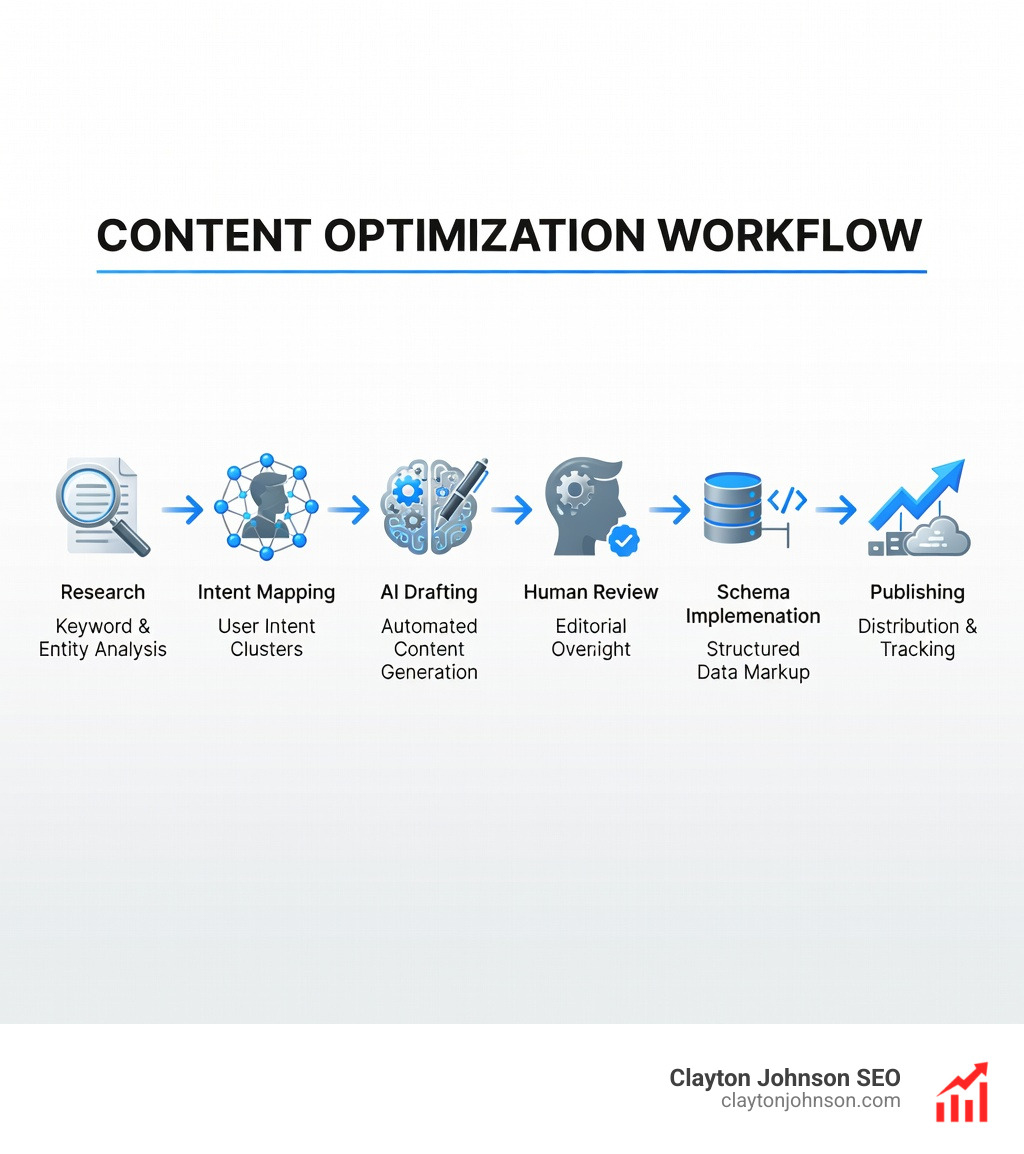
- Extractable Passages: Think of your content as a series of LEGO blocks. Each paragraph should ideally cover one main idea. Lead with a 40-60 word definition or direct answer. This makes it much easier for Google’s AI Overviews to “lift” your content and cite you as the source.
- Factual Precision: AI models are trained to spot consensus. If you make wild, unsubstantiated claims, you risk being downranked. Use numerical data, cite authoritative sources, and maintain a neutral, professional tone.
- Machine Scannability: Use bulleted lists, comparison tables, and clear H2/H3 structures. Machines love structured data.
- Human-in-the-Loop: While we use AI to generate outlines or first drafts, human oversight is non-negotiable. Google’s guidance on AI-generated content makes it clear: they reward high-quality content, however it is produced, but they penalize manipulative, low-effort spam.
How to Build an AI-Ready Content Strategy
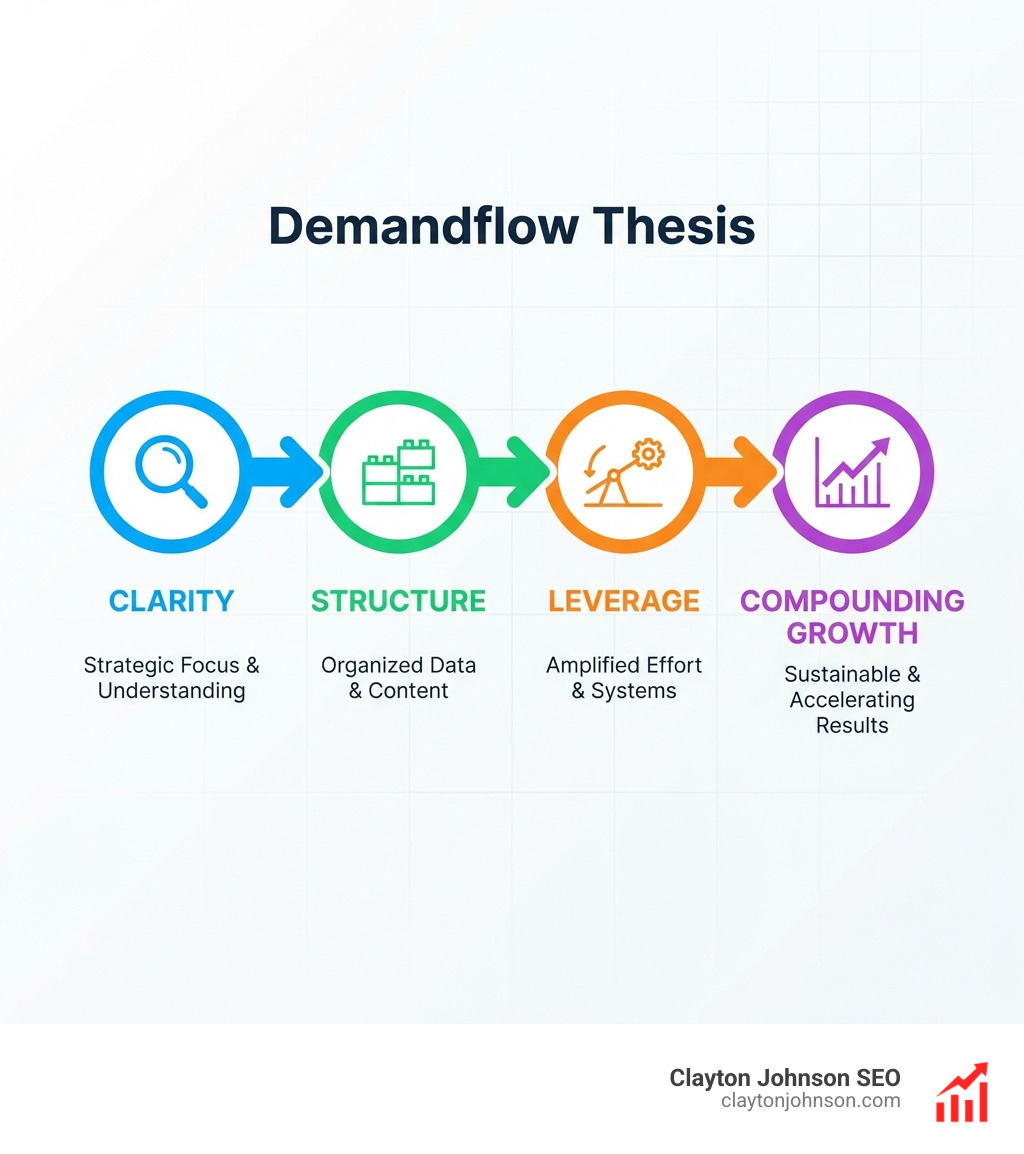
To build a strategy that lasts, you need a “Structured Growth Architecture.” At Demandflow, we believe that clarity leads to structure, which leads to leverage.
An AI-ready strategy focuses on these quality factors:
- Proprietary Data: Share your own case studies and internal statistics.
- First-Party Insights: What does your team know that no one else does?
- Technical Health: If a bot can’t crawl your site efficiently, it can’t cite you.
- Author Credentials: Make sure every piece of content is linked to a real person with verifiable expertise.
For businesses looking to scale, More info about AI SEO services can help bridge the gap between basic content and a fully optimized AI ecosystem.
Optimizing for AI Overviews and SGE
Google’s Search Generative Experience (SGE) has introduced the “Zero-Click Search” era. According to SparkToro, 58.5% of US Google searches now end without a click. This sounds scary, but it’s actually an opportunity for “Generative Engine Optimization” (GEO).
When your brand is cited in an AI Overview, you earn an “Educated Click.” The user has already seen your answer, trusts your brand, and clicks through to your site with high intent to convert. To increase your citation probability:
- Target “Snippet-Friendly” Questions: Look for “What is,” “How to,” and “Best [Product] for [User]” queries.
- Use Standalone Answer Blocks: Place a concise summary at the top of your articles.
- Optimize for Knowledge Panels: Ensure your Organization schema is robust so AI understands who you are and what you do.
The Role of E-E-A-T in AI Search
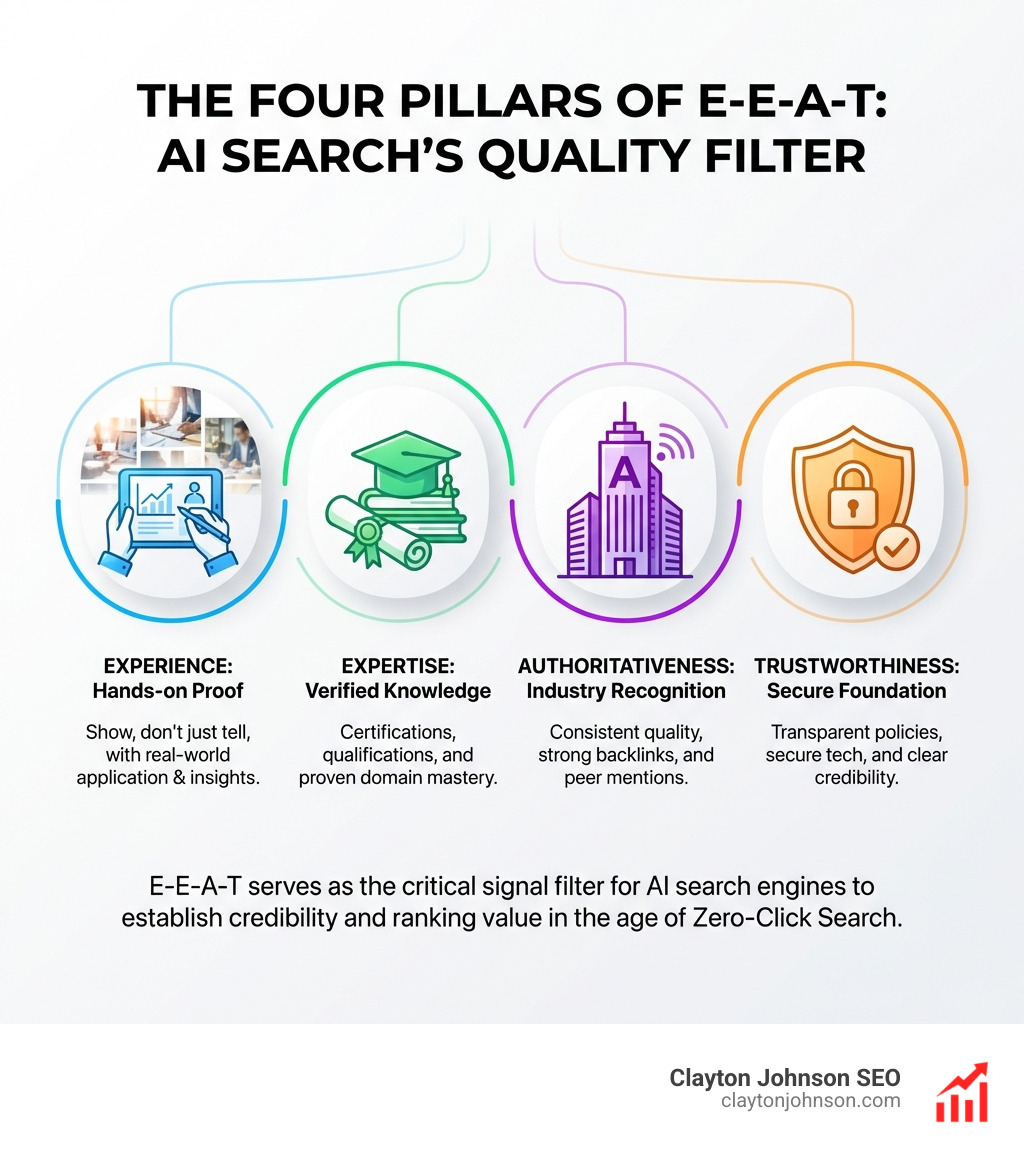
E-E-A-T (Experience, Expertise, Authoritativeness, and Trustworthiness) is the “filter” AI search engines use to separate signal from noise. In an era where anyone can generate 100 blog posts in an hour, Google uses E-E-A-T to decide who to trust.
- Experience: Show, don’t just tell. Use phrases like “In our experience testing this…” or “When we implemented this for a client in Minneapolis…”
- Expertise: Link to author bios that showcase certifications, awards, and years in the industry.
- Authoritativeness: This is built through consistent, high-quality backlinks and being mentioned by other authoritative sites in your niche.
- Trustworthiness: Maintain technical security (HTTPS), clear contact information, and a transparent privacy policy.
This is especially critical for YMYL (Your Money, Your Life) topics like finance or health. AI will rarely cite a source that doesn’t have a high E-E-A-T score in these sensitive areas.
Essential Tools for Modern Search Visibility
You can’t do ai for seo optimization manually at scale. You need a tech stack that acts as your “Growth Infrastructure.”
- Semantic Optimization Tools: Platforms like Surfer SEO or Clearscope help you align your content with the “entities” that search engines expect to see. They analyze the top-ranking pages and give you a checklist of terms to include.
- AI Search Analytics: Tools like Rankscale.ai or SE Ranking’s AI Overview Tracker allow you to see if you are actually appearing in AI-generated results. Standard rank trackers often miss this.
- Comprehensive SEO Suites: Semrush and Ahrefs remain the gold standards for backlink analysis and technical audits. Semrush One, in particular, has built-in features for tracking AI visibility.
- Content Orchestration: This is where Demandflow shines. We don’t just give you a tool; we give you a structured strategy. By combining taxonomy-driven SEO with AI-augmented workflows, we ensure every piece of content serves a specific growth objective.
Frequently Asked Questions about AI SEO
Will SEO still exist in the next decade?
Absolutely. However, it will look very different. SEO is evolving from “Search Engine Optimization” to “Search Experience Optimization.” As long as people are looking for information, businesses will need to optimize how that information is found. The 3 trillion searches conducted annually suggest that search isn’t going anywhere—it’s just moving into new interfaces.
Can AI-generated content rank on Google?
Yes. Ahrefs’ study of 600,000 pages confirmed that AI-generated content doesn’t hurt your rankings as long as it is helpful and optimized properly. Google penalizes “spammy” content intended to manipulate rankings, regardless of whether a human or a bot wrote it. The secret is adding “Information Gain”—the unique value that an AI can’t invent on its own.
What is the difference between SEO and GEO?
Traditional SEO focuses on ranking a URL in a list of links. GEO (Generative Engine Optimization) focuses on getting your brand’s information included and cited within an AI’s generated response. SEO is about the “click”; GEO is about the “citation.”
Conclusion
The transition to ai for seo optimization is not a trend — it is a requirement for survival in the modern digital landscape. By focusing on entity clarity, structured data, and high-authority content, you can turn search into a compounding asset for your business.
At Clayton Johnson SEO, we don’t just offer tactics. We build the “Structured Growth Architecture” your company needs to dominate. Whether you are a founder in Minneapolis or a marketing leader looking for national expansion, our frameworks are designed to deliver leverage and measurable ROI.
Ready to future-proof your visibility?
Stop chasing the algorithm. Start building infrastructure.