Why Competitive Intelligence Positioning Determines Who Wins the Market
Competitive intelligence positioning is the practice of using systematically gathered and analyzed competitor and market data to define where your brand stands — and where it should stand — relative to the competition.
Here’s what it covers at a glance:
- What it is: Turning public and internal data about competitors, customers, and markets into actionable strategy
- Why it matters: 84% of CEOs rank competitor information as critical to profit growth
- Where it lives: Most commonly in marketing (46% of firms) or sales (14%), though optimal placement depends on your decision-making structure
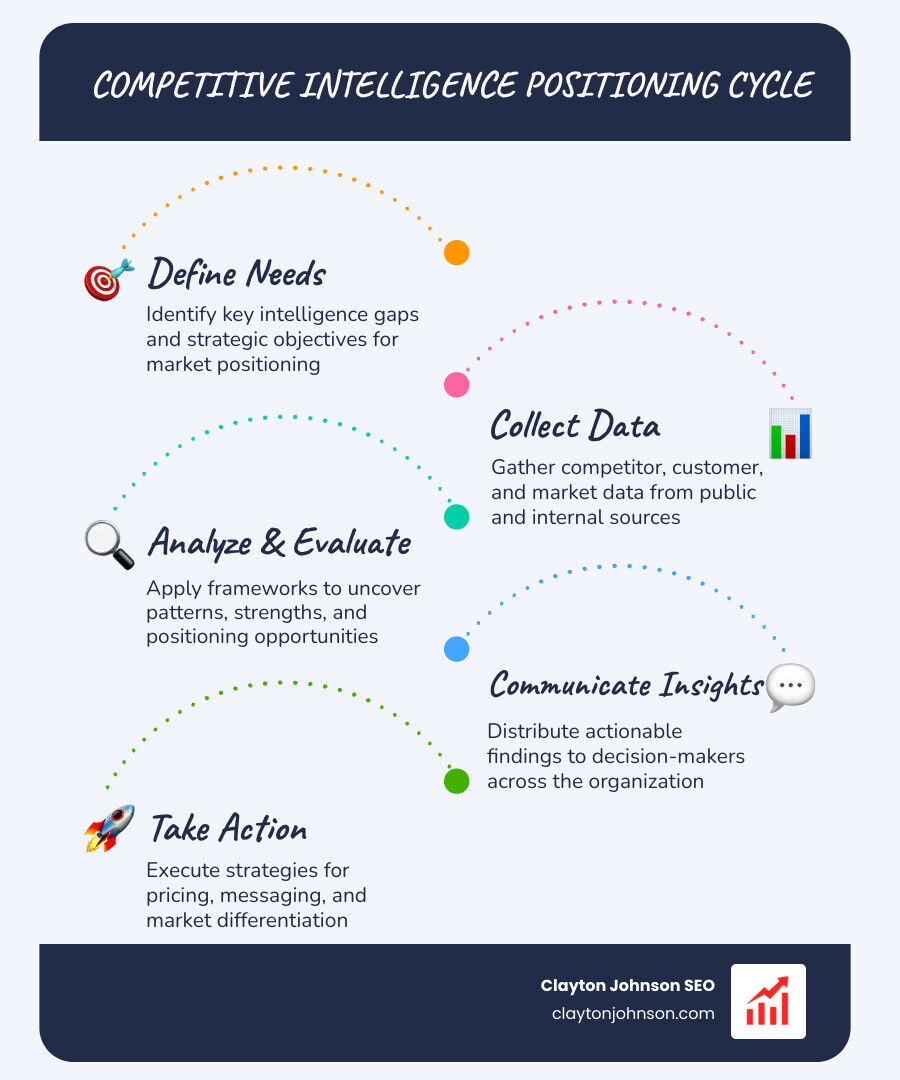
- How it works: A five-phase cycle — define needs, collect data, analyze, communicate, act
- The payoff: Organizations with high CI activity report 37% higher product quality and a 68% increase in business performance
Most founders and marketing leaders already know their competitors exist. The problem is they’re reacting to them instead of anticipating them. They’re watching pricing pages and reading press releases, but they’re not connecting those signals to a positioning strategy that actually moves revenue.
That gap — between data and decision — is exactly where competitive intelligence positioning breaks down.
The truth is, 94% of businesses invest in competitive intelligence in some form. But investment alone doesn’t create advantage. Without a structured approach to gathering, analyzing, and acting on that intelligence, most organizations are still guessing.
This guide is built to change that.
I’m Clayton Johnson — SEO strategist and growth architect. My work sits at the intersection of technical SEO, strategic positioning, and AI-assisted marketing systems, and competitive intelligence positioning is one of the core frameworks I use to help founders and marketing leaders build demand engines that compound over time. Let’s walk through how to build yours.
Quick competitive intelligence positioning terms:
- Zero Click Search
- zero-click search traffic impact
Defining the Landscape: CI vs. BI vs. MI
To master competitive intelligence positioning, we first need to clear up the alphabet soup of business data. While many people use Market Intelligence (MI), Business Intelligence (BI), and Competitive Intelligence (CI) interchangeably, they serve very different masters.
Business Intelligence is backward-looking and internal. It tells us how many widgets we sold last month and what our churn rate looks like. It’s about optimizing our own house. Market Intelligence is the broad view—it looks at industry trends, demographic shifts, and the general “weather” of the business world.
Competitive Intelligence, however, is the “special ops” of the three. It is the use of public sources to develop data regarding competition, competitors, and the market environment, which is then transformed by analysis into actionable intelligence for decision-making. Research shows that 94% of businesses invest in competitive intelligence because they realize that winning isn’t just about being good; it’s about being better (or different) than the other guy.
The Core Differences
The primary differentiator for CI is where the data comes from and how it’s applied to strategic planning. While BI relies on internal databases and CRM logs, CI hunts in the external environment. We look at:
- Regulatory Filings: SEC disclosures and financial reports that reveal a competitor’s debt structure or investment priorities.
- Hiring Patterns: Are they suddenly hiring 50 AI engineers? They’re likely building a new product feature.
- Customer Feedback: What are their users complaining about on review sites? That’s our entry point for differentiation.
By transforming this raw data into competitive intelligence positioning, we stop looking at what happened and start predicting what will happen.
Strategic vs. Tactical Competitive Intelligence Positioning
Not all intelligence is created equal. We divide CI into two main buckets: the “now” and the “next.”
| Feature | Tactical CI | Strategic CI |
|---|---|---|
| Focus | Short-term wins | Long-term market dominance |
| Typical Goal | Winning a specific sales deal | Entering a new market or pivoting |
| Examples | Pricing adjustments, promo tracking | Identifying market disruptions, M&A |
| Primary User | Sales and Marketing reps | CEO and Board of Directors |
Tactical CI helps your sales team handle objections in real-time. Strategic CI helps you decide if you should even be selling that product five years from now. If you’re looking for tactical steps to launch your Compete Program, you need to balance these two. Too much tactics and you’re a hamster on a wheel; too much strategy and you’re a philosopher with no revenue.
Leveraging Competitive Intelligence Positioning for Product Shifts
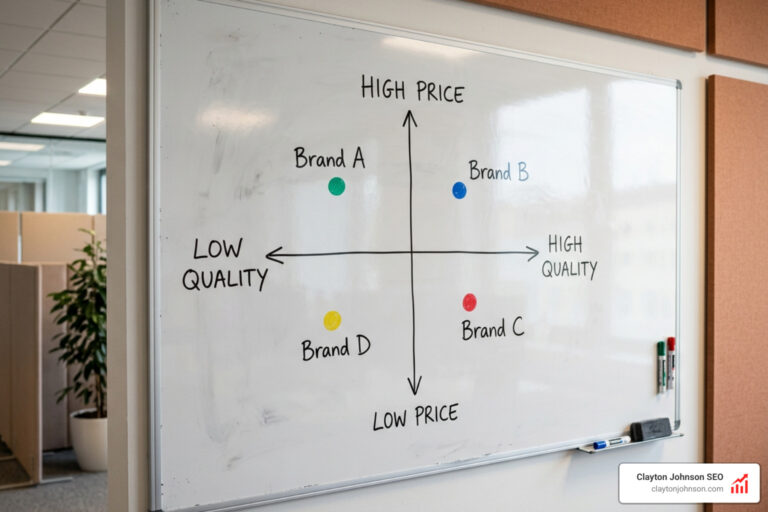
One of the most powerful uses of CI is guiding major product or pricing shifts. When we see a competitor move toward a “premium-only” model, it creates a “white space” in the mid-market that we can claim.
Take the famous case of Unbounce. They realized the “landing page builder” market was becoming a commodity. By using CI to listen to customer pain points and competitor feature bloat, they repositioned into “conversion intelligence.” They didn’t just change their copy; they changed their category. This allowed them to implement value-based pricing rather than competing on who has the cheapest monthly sub.
Core Principles of Effective Strategy
Before you start scraping websites, you must establish your “Rules of Engagement.”
- Ethical and Legal Compliance: We never use industrial espionage. CI is about analyzing public signals. If you have to break a password or lie about who you are to get the data, it’s not CI—it’s a liability.
- Data Reliability: One tweet from a disgruntled ex-employee isn’t intelligence; it’s gossip. We cross-check data from multiple sources (e.g., a job posting + a patent filing + a customer review) to ensure accuracy.
- Counterintelligence: 94% of businesses are doing this. You need to be careful about what you put out. Are your job descriptions giving away your product roadmap?
Where to Position the CI Function in Your Organization
The “where” matters as much as the “what.” If the CI team is buried in the IT department, the sales team will never see the insights. If it’s only in the CEO’s office, the product team won’t know what features to build.
Research shows that 46% of firms position CI in marketing, while 14% put it in sales. Surprisingly, only 30% of firms have a formalized internal CI department. The “best” spot is usually at the locus of decision-making.
- Centralized: One team serves the whole company. Great for consistency and “global vision,” but can become a bottleneck.
- Decentralized: Every department does its own research. This is fast but leads to “data silos” where marketing and sales are looking at two different versions of the truth.
- Hybrid: A central “center of excellence” sets the standards, but specialists live within the marketing and sales teams.
In-sourcing vs. Outsourcing
Should you build this yourself? About 69% of companies that used outside help for their intelligence reported positive results.
- In-sourcing is best for protecting core competencies and ensuring the team understands the “soul” of the company.
- Outsourcing is fantastic for gaining external objectivity or accessing specialized data tools that are too expensive for a single firm to buy.
The Role of Senior Leadership
A CI program without a “champion” at the top will fail. 84% of CEOs view competitor information as critical to profit growth, yet many fail to provide the budget or authority the CI function needs. Effective CI must be demand-driven. This means leadership defines the “Key Intelligence Questions” (KIQs) they need answered to make the next big bet.
The Step-by-Step Process for Competitive Intelligence Analysis
Ready to move from theory to action? Follow this structured flow to build your competitive intelligence positioning model.
- Objective Setting: Don’t just “track competitors.” Decide why. Are you trying to reduce churn? Increase your win rate in sales?
- Competitor Identification: You have direct competitors (who sell what you sell) and indirect competitors (who solve the same problem differently). Use win-loss analysis to see who is actually taking money out of your pocket.
- Data Normalization: Raw data is messy. You need to clean it and categorize it so you can compare “apples to apples.”
Looking for tactical steps to launch your Compete Program? Check out our nine steps to ensure you don’t miss the foundational work.
Data Collection and Interpretation
We use two types of sources:
- Primary: Interviews with customers, feedback from your sales reps (the “field intelligence”), and attending industry conferences.
- Secondary: Financial reports, blogs, social media, and technical whitepapers.
Once you have the data, apply a framework. A SWOT (Strengths, Weaknesses, Opportunities, Threats) is a classic, but PESTLE (Political, Economic, Social, Technological, Legal, Environmental) is better for identifying long-term market disruptions.
Integrating Competitive Intelligence Positioning into SEO Strategy
This is where we at Demandflow see the most “compounding growth.” Your SEO strategy shouldn’t just be about high-volume keywords; it should be about competitive intelligence positioning.
- Keyword Gaps: What terms are your competitors ranking for that you’ve ignored?
- Customer-Centric Research: Use tools to see the exact language customers use when they are unhappy with a rival. Build content that answers those specific frustrations.
- Untapped Opportunities: If all your competitors are writing “top 10” lists, you should write a deep-dive “Technical Guide.”
By building a “Content Architecture” based on competitor weaknesses, you don’t just get traffic—you get the right traffic.
Modern Tools and Data Sources for Real-Time Insights
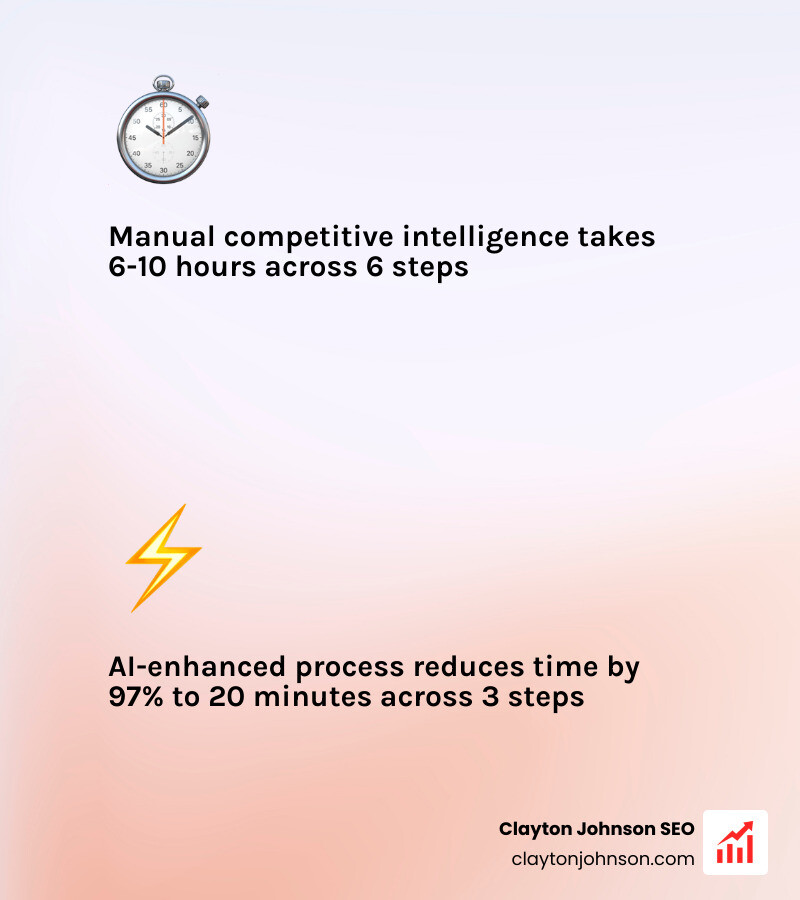
In the modern landscape, manual research is a death sentence. Markets move too fast. You need AI-powered solutions to do the heavy lifting.
User review sites like Capterra are goldmines of competitive intelligence because they provide unfiltered “voice of the customer” data. If you see a recurring complaint about a competitor’s “clunky interface,” that becomes your primary messaging pillar: “The intuitive alternative.”
Continuous Monitoring and Adaptation
CI is not a one-time project; it’s a living system.
- Real-time alerts: Set up triggers for pricing changes or new feature launches.
- Hiring patterns: Monitor LinkedIn for “surges” in specific departments.
- Technographic data: See what tools your competitors are adding to their tech stack.
To see this in action, learn how Alex McDonnell puts competitive intel into action on Spotify. He emphasizes that the goal isn’t to have the most data—it’s to have the most useful data for your sellers.
Measuring ROI and Overcoming Common Challenges
How do you know if your competitive intelligence positioning is working?
Organizations engaging in high levels of CI activity show a 37% higher product quality, which is associated with a 68% increase in business performance. That’s your ROI.
However, you will face hurdles:
- Information Overload: More data isn’t better. Focus only on the signals that impact your KIQs.
- Data Silos: If the sales team has great intel but doesn’t share it with product, the company loses.
- Stakeholder Relevance: Marketing needs different insights than the CEO. Tailor your reports.
Overcoming Implementation Hurdles
To succeed, you must move toward formalization. Only 12.4% of firms have a formalized CI process, which is why most companies are struggling. Start with “time-boxed” projects. Instead of trying to track everything, spend two weeks answering one specific question: “Why are we losing deals to Competitor X?”
Use “Myth-busting” sessions to challenge internal assumptions. Often, a company thinks they have no competitors, but CI reveals that customers are using “manual workarounds” or “Excel sheets” to solve the problem. Those are your real competitors.
Frequently Asked Questions about Competitive Intelligence
What is the difference between competitive analysis and intelligence?
Analysis is a snapshot in time—like a single SWOT chart. Intelligence is a continuous process of gathering, analyzing, and acting on data to maintain a long-term edge.
What does a competitive intelligence analyst do?
They are the “custodians” of market data. They gather info from public sources, filter out the noise, and translate it into “Battlecards” for sales or strategic recommendations for leadership.
Why is CI critical in the IT industry?
In tech, innovations happen weekly. If you aren’t tracking competitor tech stacks and patent filings, you can be disrupted overnight by a startup you didn’t even know existed.
Conclusion
Stop guessing. The data is out there, hidden in plain sight within SEC filings, customer reviews, and LinkedIn job boards. By building a structured competitive intelligence positioning framework, you transform from a reactive player into a market leader.
We believe that clarity leads to structure, and structure leads to compounding growth. We don’t just provide tactics; we provide the “growth architecture” founders need to win. Whether it’s through SEO strategy or AI-augmented workflows, the goal is the same: use intelligence to claim your spot in the market.
Ready to sharpen your edge? Learn more about SEO and competitive positioning and start building your structured growth engine today.