Core SEO Strategies Wealth Managers Need to Dominate Search
To move from invisible to in-demand, we have to recognize that wealth management is classified by Google as YMYL (Your Money or Your Life) content. Because your advice directly impacts a person’s financial stability, Google holds your website to the highest possible standard of E-E-A-T (Experience, Expertise, Authoritativeness, and Trustworthiness).
If your site looks like a template from a decade ago, or if your content is generic “Retirement 101” fluff, Google’s algorithms will simply ignore you. We focus on building durable systems that signal professional authority at every turn.

The Three Pillars of Wealth Management SEO
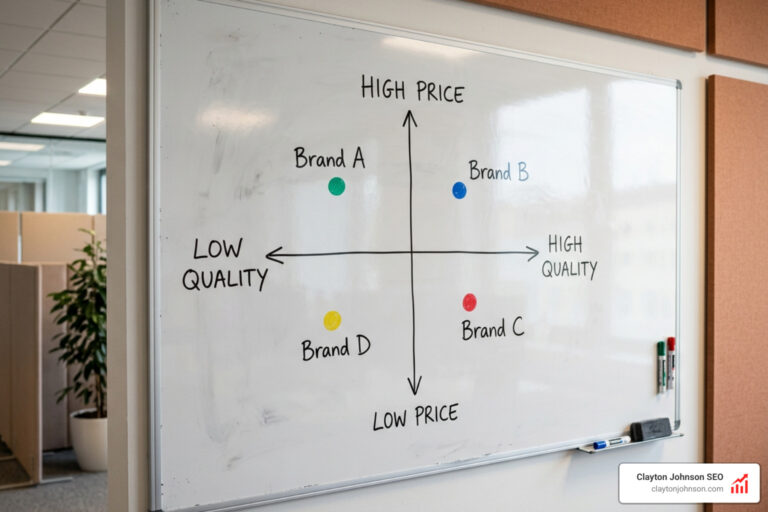
We categorize SEO strategies wealth managers use into three distinct buckets. Most firms fail because they try to compete in the “Broad” bucket without the “Local” or “Niche” foundation.
| Strategy Type | Focus Keywords | Difficulty | Best For |
|---|---|---|---|
| Local SEO | “Wealth manager in [City]” | Medium | Capturing regional HNW prospects |
| Niche SEO | “Financial advisor for surgeons” | Low | Dominating a specific high-value demographic |
| Broad SEO | “Investment strategies” | High | Building long-term brand awareness (Hardest) |
To satisfy Google’s YMYL standards, every page on your site must be backed by credentialed expertise. This means your “About” page shouldn’t just be a list of hobbies; it needs to highlight your CFP® or CFA qualifications and link to verifiable third-party sources.
Mastering Local SEO Strategies Wealth Managers for Multi-Location Growth
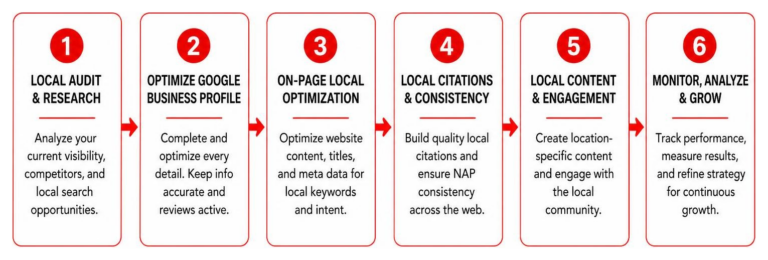
For many wealth managers, the most immediate path to ROI is local search. When a prospect in your city searches for a “fiduciary advisor,” you need to be in the “Map Pack”—the top three local listings.
The cornerstone of this is your Google Business Profile. It isn’t enough to just “claim” it. You must optimize it with detailed service descriptions. Instead of just selecting “Financial Planning,” use specific terms like “Multi-Jurisdictional Tax Planning” or “Alternative Investment Strategies.” This provides immediate differentiation from generic competitors.
If you serve multiple locations, avoid the “one-page-fits-all” trap. We recommend creating dedicated location pages that highlight local landmarks, specific client types in that area, and local professional associations. For a deeper dive, check out our guide on SEO strategies for wealth managers demystified.
Building E-E-A-T with High-Intent Content and Compliance
Content is where most wealth managers get nervous. “Will compliance approve this?” is the question that kills many great marketing ideas. However, high-quality content is the only way to build topical authority.
We suggest focusing on “Service + Problem” content. Instead of writing “Our Estate Planning Services,” write “How to Minimize Estate Taxes on Inherited IRAs.” This targets high-intent searchers who have a specific problem they need solved.
- Credentials Matter: Feature your CFP® or CFA designations prominently. Google looks for these signals to verify expertise.
- Compliance-First: Always include necessary disclosures. Reference FINRA marketing rules and IRS tax guidelines to ensure your content is accurate and defensible.
- Case Studies: While you must be careful with testimonials, you can share anonymous “Client Scenarios” that illustrate how you solved a complex problem.
Building this library of content is essential for a guide to growing your wealth management client base, as it serves as a 24/7 sales team that educates prospects before they ever pick up the phone.
Technical Foundations and AI-Ready SEO Strategies Wealth Managers
You could have the best financial advice in the world, but if your site takes 10 seconds to load on a mobile device, no one will ever see it. Technical SEO is the “plumbing” of your digital presence.
A site audit of a typical mid-sized firm often reveals a “Site Health” score around 75%, while the top-ranking competitors are consistently at 92% or higher. Common issues include broken links, missing meta-tags, and slow page speeds. In fact, many analyzed wealth sites score as low as 46/100 on Google Page Speed Insights. We aim for under 2.5 seconds.
Essential Technical Checklist:
- SSL Certificates: Non-negotiable for trust. Use Google Analytics to track how users move through your secure site.
- Schema Markup: This is “code for robots.” It tells Google exactly what your credentials are, where your office is located, and what services you offer.
- AEO (Answer Engine Optimization): With the rise of AI search like ChatGPT and Gemini, your content needs to answer questions directly. Use H2 and H3 headers that mirror the questions your clients actually ask.
For those just starting, our beginners guide to wealth manager seo covers these technical basics in plain English. You can also monitor your progress by performing a Google Search Console setup to see exactly which queries are driving traffic.
Measuring Success and Scaling Your Inbound Pipeline
In wealth management, traffic is a vanity metric. What matters is Lead Quality and AUM Potential. We’ve seen firms receive 500 clicks a month and generate zero revenue, while others receive 50 clicks and land a $10M client.
SEO for wealth managers is a compounding asset. Unlike paid ads, which stop the moment you stop paying, organic search builds equity over time.

The Realistic Timeline for Compounding Organic Growth
One of the biggest reasons firms quit SEO is unrealistic expectations. You aren’t going to rank #1 for “wealth management” in 30 days. Here is the reality of the timeline:
- Months 0–3 (Foundation): Technical fixes, site speed optimization, and keyword mapping. You might see a slight bump in “branded” searches (people searching for your firm name).
- Months 3–6 (Local Gains): Your Google Business Profile starts appearing in local searches. You begin to see 1-2 qualified inquiries.
- Months 6–12 (Inbound Leads): Content starts ranking for long-tail questions. A mid-sized RIA can realistically see 6–12 qualified organic leads per month by month nine.
- Months 12+ (Authority): Your site becomes a “lead machine.” Traffic grows exponentially as Google recognizes you as a topical authority.
To see how this works in practice, read our breakdown on how to rank higher and make your wealth manager seo pay dividends.
High-Quality Backlinks and Authority Building in Finance
Backlinks (links from other websites to yours) are like “votes of confidence” in Google’s eyes. In the financial niche, quality is infinitely more important than quantity. One link from a major industry publication is worth more than 1,000 links from random blogs.
Where to get high-quality links:
- Industry Directories: Ensure you are listed in the NAPFA advisor search, the CFP Board, and the FPA.
- Local Authority: Join your local Chamber of Commerce and Better Business Bureau. These are powerful local signals.
- Niche Guesting: Write for regional business journals or niche publications (e.g., a dental association blog if you target dentists).
We help firms navigate this through our financial-services/wealth-managers/ specialized strategy, ensuring every link earned is compliant and authoritative.
Lead Generation and Conversion Optimization for HNW Prospects
Getting the traffic is only half the battle. You have to convert that anonymous visitor into a lead. High-net-worth individuals are notoriously private. They won’t fill out a “Contact Us” form just to get a generic newsletter.
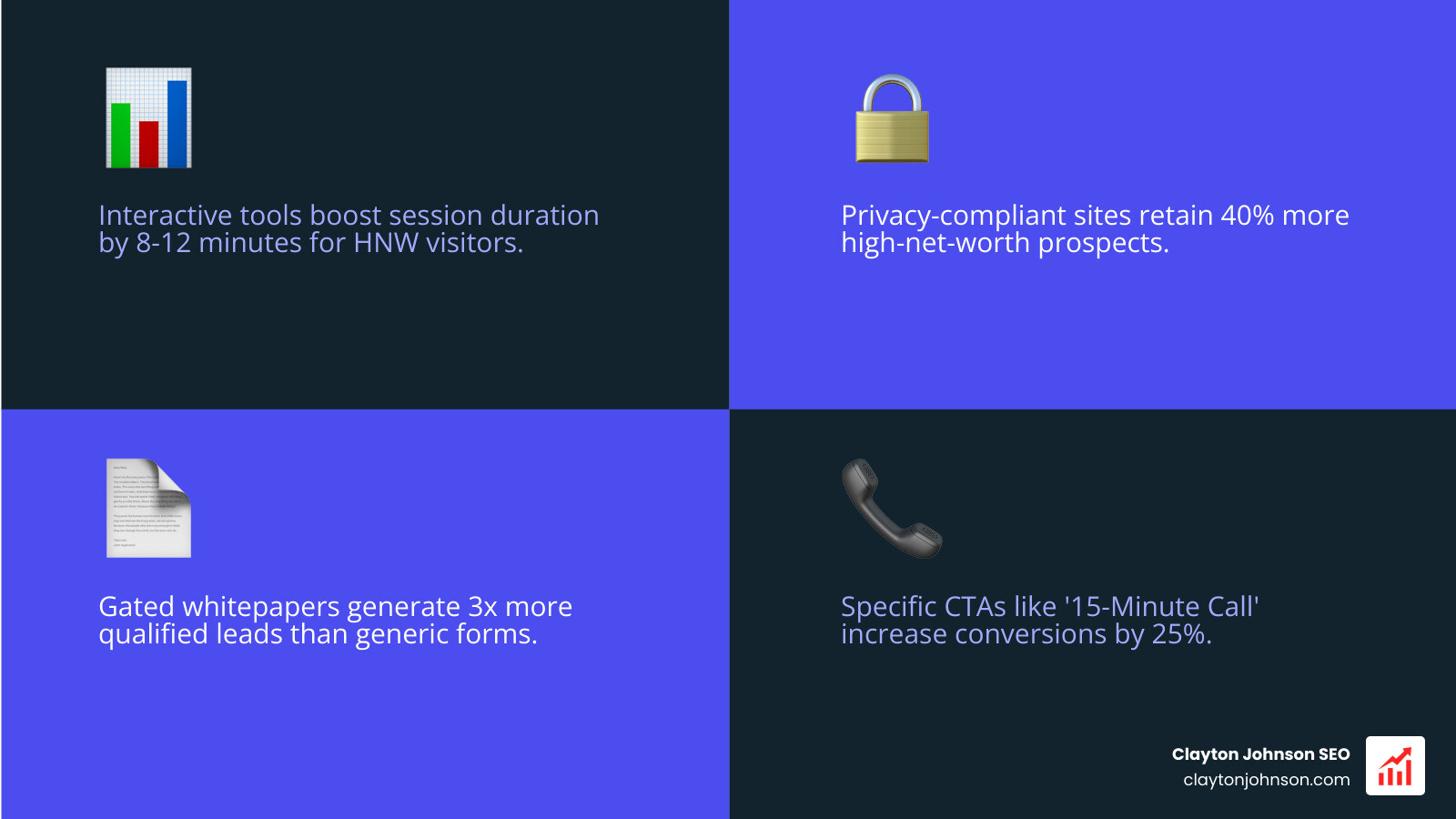
Instead, offer value. Use interactive tools like retirement calculators or inheritance tax estimators. These tools often have high engagement—we’ve seen session durations of 8-12 minutes for truly relevant content.
Conversion Tips for Wealth Managers:
- Privacy-First: Use privacy-compliant analytics and display security badges. HNW prospects will abandon a site if they feel their data is being tracked invasively.
- Gated Whitepapers: Offer a deep-dive PDF on a complex topic like “The 10 Biggest Mistakes in Multi-Generational Wealth Transfer” in exchange for an email.
- Clear CTAs: Don’t just say “Contact Us.” Use “Schedule a 15-Minute Introductory Call.” It feels lower risk and more professional.
For more on turning visitors into clients, see our beginners-guide-to-financial-advisor-lead-generation.
Conclusion: Building Your Durable Growth Engine
SEO is not a “set it and forget it” project. It is a strategic system that requires clarity, structure, and leverage. At Clayton Johnson SEO, we don’t just chase keywords; we build taxonomy-driven content ecosystems that turn fragmented marketing into a coherent growth engine.
If you are tired of being invisible and ready to build a system that attracts high-net-worth clients while you sleep, it’s time to change your approach. Stop competing for broad terms and start dominating the niche and local queries that your ideal clients are actually searching for.
Are you ready to scale your inbound pipeline? Contact Clayton Johnson today to discuss a structured strategy framework for your firm.