Why Most Strategies Fail Before They Even Start
Strategy execution alignment tips are what separates companies that hit their goals from the 90% of executives who don’t.
Here are the most important ones at a glance:
- Use a scoring framework (like AHP) to rank projects by strategic fit
- Weight your goals so every team knows what matters most
- Close the communication gap — 95% of employees don’t know their company’s strategy
- Align job design and budgets to actual strategic priorities
- Kill zombie projects that consume resources but deliver no strategic value
- Measure alignment continuously with KPIs and real-time data, not just at planning time
- Build a culture of accountability where execution is everyone’s job
Most organizations don’t fail because they lack a strategy. They fail because the strategy breaks down the moment execution begins.
The gap between formulation and execution is where growth dies. Leadership agrees on a direction in the boardroom. But by the time that direction reaches frontline teams, it’s been filtered, diluted, or forgotten entirely.
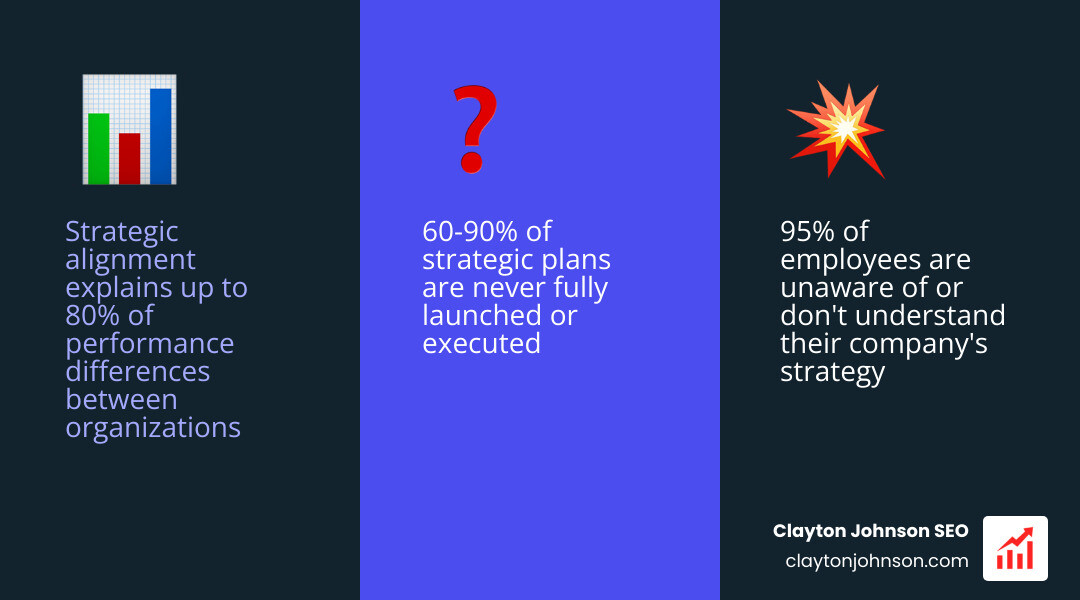
The numbers are stark. Research shows strategic alignment explains up to 80% of the performance difference between organizations. Yet 95% of employees are unaware of or don’t understand their company’s strategy. And between 60% and 90% of strategic plans are never fully launched.
That’s not a strategy problem. That’s an alignment problem.
The good news? Alignment is a skill you can build — and a process you can systematize.
Essential strategy execution alignment tips for Business Growth
When we talk about strategic alignment, we aren’t just talking about everyone nodding their heads in a meeting. We are talking about the tight synchronization between your mission, your resources, and your daily operations.
It is a startling reality that strategic alignment explains up to 80% of the performance difference between organizations. If your team is rowing in different directions, it doesn’t matter how hard they pull; the boat just spins in circles.
In our organizational alignment guide, we highlight that alignment is a dynamic verb, not a static noun. It requires constant adjustment to prevent “strategic drift”—that slow, quiet process where your activities gradually move away from your actual goals.
| Feature | Strategically Aligned Organizations | Misaligned Organizations |
|---|---|---|
| Project Success | 57% more likely to deliver benefits | High failure rates; “pet projects” thrive |
| Resource Use | Allocated to high-impact goals | Spread thin across “everything is a priority” |
| Employee Clarity | High; workers see their impact | Low; 95% unaware of strategy |
| Decision Making | Based on data and strategic fit | Based on seniority or “who shouts loudest” |
The stakes are high. Companies that master these strategy execution alignment tips increase their value by an average of 40%. Without it, you risk becoming part of the 48% of organizations that fail to reach even half of their strategic targets.
Use AHP to Quantify and Prioritize Strategic Fit
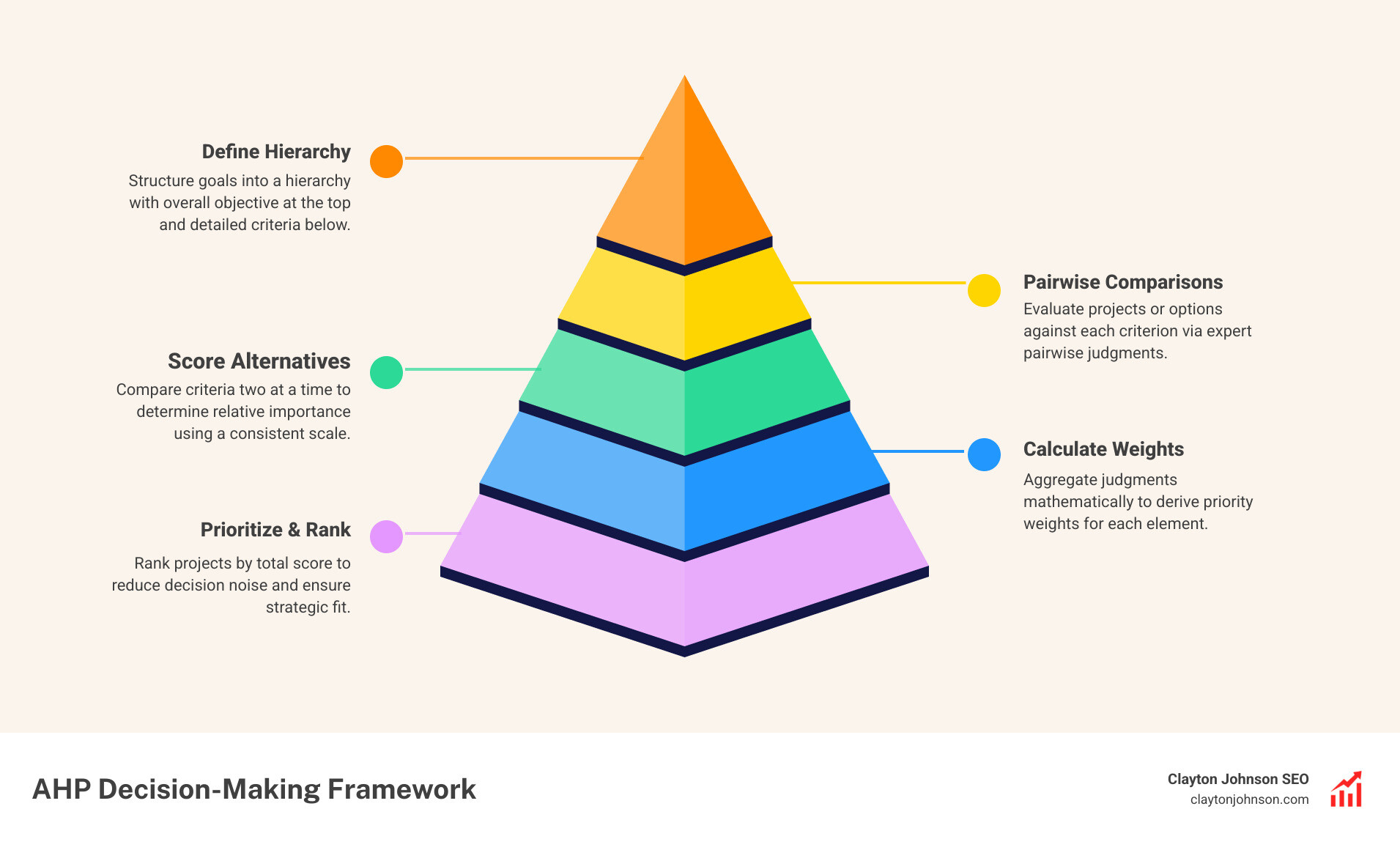
One of the biggest hurdles in execution is “noise”—the random variability in human judgment. To fix this, we recommend using the Analytic Hierarchy Process (AHP). This is a structured technique for organizing and analyzing complex decisions.
Instead of just guessing which project is “more important,” AHP uses pairwise comparisons. You take two goals and ask, “Which is more important for our growth?” By doing this systematically, you create a weighted mathematical model of your strategy.
According to research from the Economist Intelligence Unit, this level of rigor is what separates the top 10% of performers. When we help clients with portfolio strategy, we focus on moving away from spreadsheets (which are often the wrong tool for this job) and toward tool-backed decision processes.
How to implement AHP-led alignment:
- Engage the C-Suite: Have the leadership team weight the strategic goals.
- Use Experts, Not Requesters: Have independent subject matter experts score projects against those goals to avoid “gaming the system.”
- Reduce Noise: Involve at least three people in the scoring process to cancel out individual biases.
Bridge the Communication Gap with strategy execution alignment tips
If 95% of your employees don’t understand the strategy, you don’t have a strategy; you have a secret.
Clear communication is the bridge between a boardroom vision and frontline reality. In companies with weak execution, 71% of employees feel that strategic decisions are second-guessed. In strong-execution companies, that number drops significantly because the “Why” is clear.
We need to move beyond the “annual roadshow” and create a shared strategic narrative. This is a “North Star” vision that is narrow enough to provide direction but broad enough to allow for team autonomy.
Effective Communication Channels for Alignment:
- Town Halls: Not for lectures, but for connecting daily wins to the big picture.
- Visual Strategic Maps: Digital dashboards that show how projects ladder up to goals.
- Internal OKR Tracking: Ensuring operational alignment by making every team’s objectives visible to everyone else.
Consistent messaging from leadership is non-negotiable. If the CEO says “Customer First” but the managers reward “Speed Above All,” the strategy will fail.
Align Job Design and Resources with strategy execution alignment tips
You cannot execute a new strategy with old job descriptions.
One of our favorite tools for this is the Job Design Optimization Tool (JDOT), developed by Robert Simons at Harvard. It looks at four “spans”: Control, Accountability, Influence, and Support. If you ask an employee to be accountable for a strategic outcome but give them zero influence over the resources needed to get there, you’ve designed a job for failure.
Resource allocation is where the “rubber meets the road.” Strategy is, quite literally, what you fund. If your budget doesn’t reflect your stated priorities, your strategy is just a wish list.
At Clayton Johnson SEO, we often see this in marketing. A company wants “Authority Building,” but they allocate 90% of their budget to short-term PPC ads. That is a resource misalignment. For those looking for a more coherent approach, exploring SEO services that focus on technical architecture and content ecosystems can help realign those resources toward long-term growth.
Resource Alignment Checklist:
- RACI Matrix: Clearly define who is Responsible, Accountable, Consulted, and Informed for every strategic initiative.
- Zero-Based Budgeting: Don’t just copy last year’s budget. Start from your strategic goals and fund what moves the needle.
- Talent Optimization: Ensure your “A-Players” are working on your “A-Priorities,” not stuck maintaining legacy systems.
Foster a Culture of Accountability and Execution
“Culture eats strategy for breakfast,” as the saying goes. But we prefer to say that culture is the engine of strategy.
Look at Microsoft’s transformation. You can watch Satya Nadella talk about purpose culture and growth mindset to see how shifting from “know-it-alls” to “learn-it-alls” changed their execution speed.
A culture of execution requires psychological safety—the ability for a mid-level manager to say, “This project isn’t working,” without fear of retribution. In fact, projects initiated by mid-level management are 4x more likely to succeed because they are closer to the operational reality.

Building the Culture:
- Celebrate the “No”: Reward leaders who identify and stop projects that no longer fit the strategy.
- Empowerment: Give teams the autonomy to make decisions within the framework of the North Star vision.
- Accountability: Use peer recognition systems that highlight behaviors aligned with strategic principles, not just hitting a number.
Measure Performance and Eliminate Zombie Projects
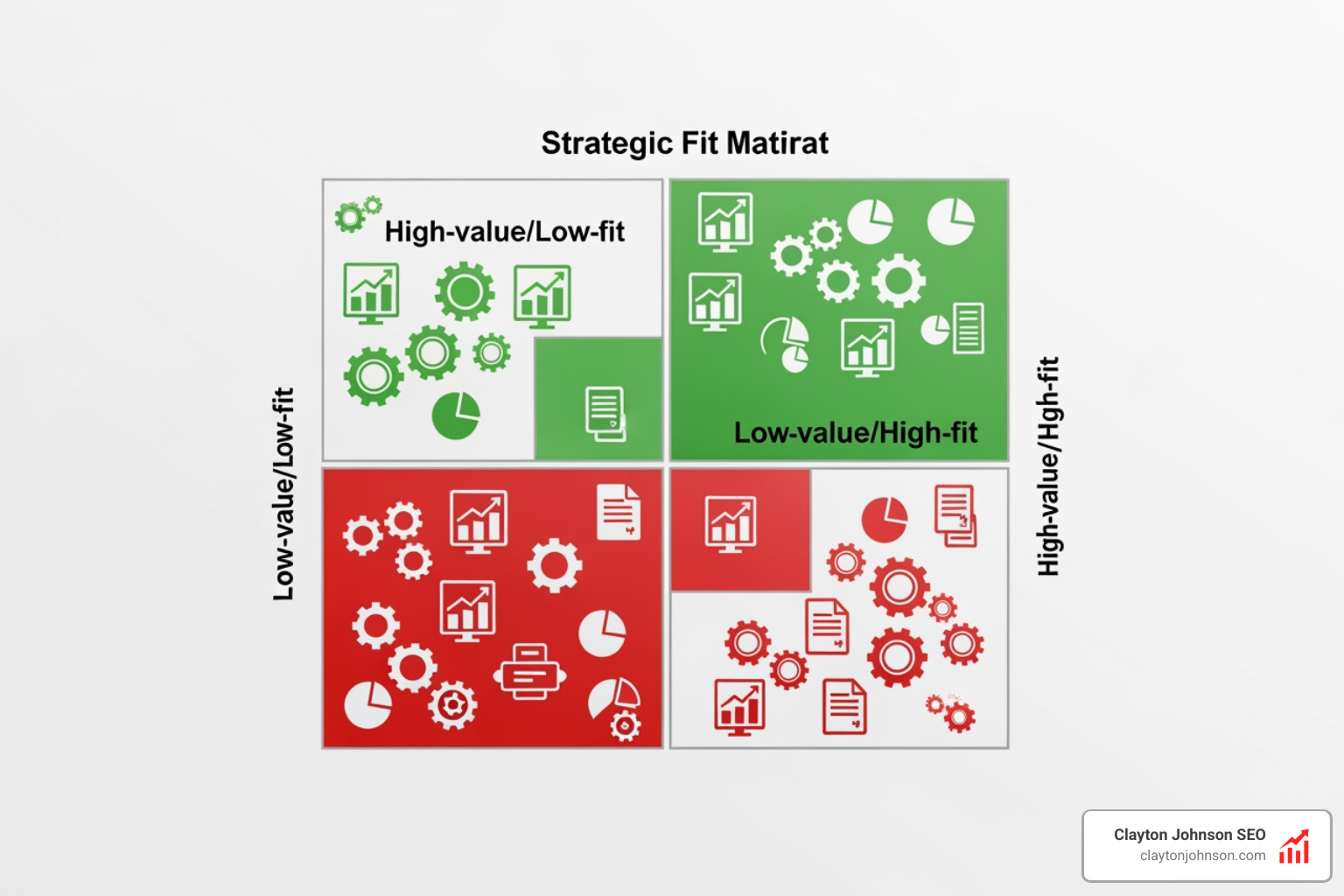
Typical portfolios have 20% of projects that are so badly aligned they should be stopped immediately. These are “Zombie Projects”—initiatives that keep shuffling along, eating brains (and budgets), but delivering no actual value.
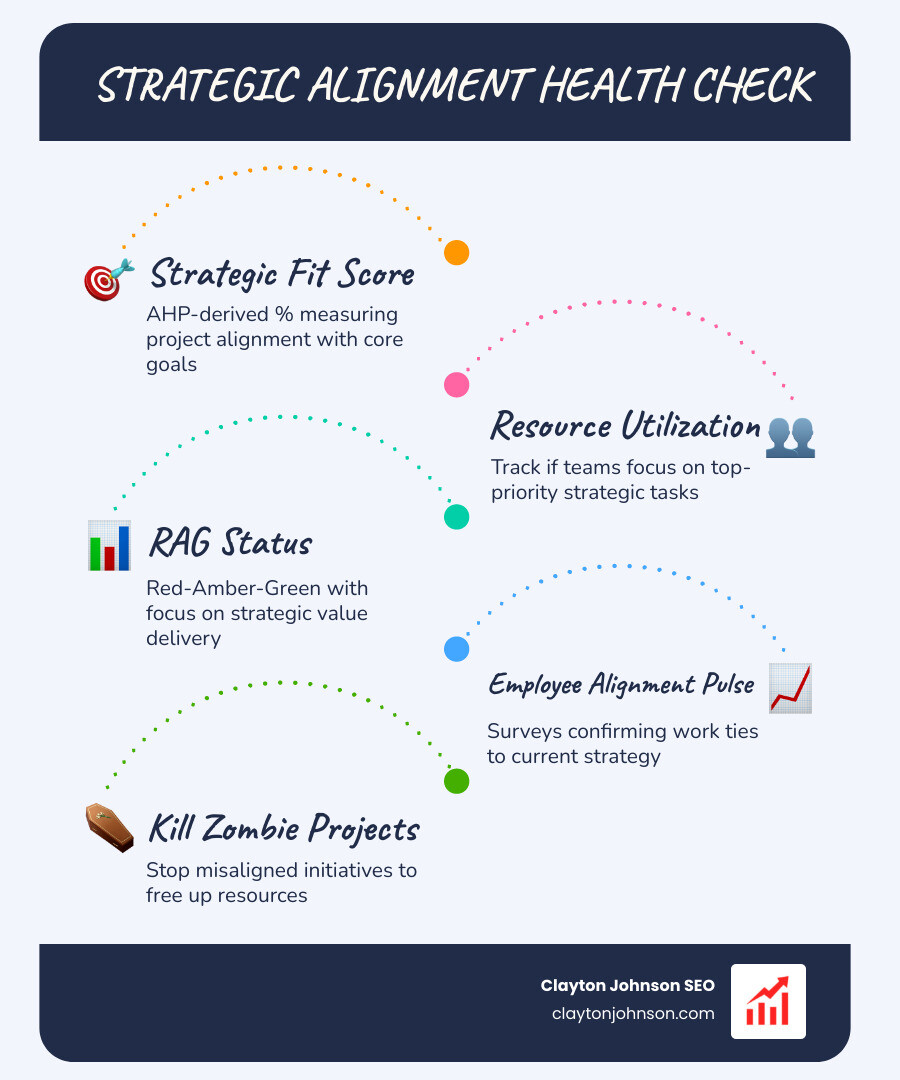
To keep your execution healthy, you need a “Strategic Health Check.” This involves moving beyond lagging financial metrics and looking at real-time execution data.
Strategic Alignment Metrics to Track:
- Strategic Fit Score: The AHP-derived percentage of how well a project aligns with goals.
- Resource Utilization: Are your people actually working on the top-priority tasks?
- RAG Status (Red-Amber-Green): But with a twist—don’t just track “On Time,” track “Strategic Value Delivery.”
- Employee Alignment Pulse: Regular surveys asking if employees understand how their work contributes to the current strategy.
If a project’s business case has slipped or the market has shifted, have the courage to kill it. This frees up resources for the initiatives that will actually drive compounding growth.
Conclusion: Building Durable Systems for Strategic Success
At Clayton Johnson SEO, we believe that clarity leads to structure, which leads to leverage, which ultimately leads to compounding growth. We don’t just advise on these strategy execution alignment tips; we build the durable systems that operationalize them.
Whether it’s through technical SEO architecture, AI-augmented marketing workflows, or structured strategy frameworks, our goal is to turn fragmented efforts into coherent growth engines. Strategy execution isn’t a one-time event; it’s a capability that you build into the very fabric of your organization.
Stop chasing tactics and start building systems. If you’re ready to align your team and finally execute the strategy you’ve worked so hard to craft, contact us today. Let’s turn your strategic intent into measurable business impact.