AI Strategy and Implementation for People Who Hate Jargon

Introduction
In today’s rapidly evolving business landscape, AI strategy and implementation is no longer just a forward-thinking idea—it’s a strategic necessity. However, the path to success isn’t paved with more tools; it’s paved with better questions. Without the right strategy, even the most advanced AI tools can fall short of their potential, leading to “shiny object syndrome” where resources are drained without a clear return. Many leaders feel the pressure to innovate but lack the architectural blueprint to ensure that innovation translates into bottom-line growth.
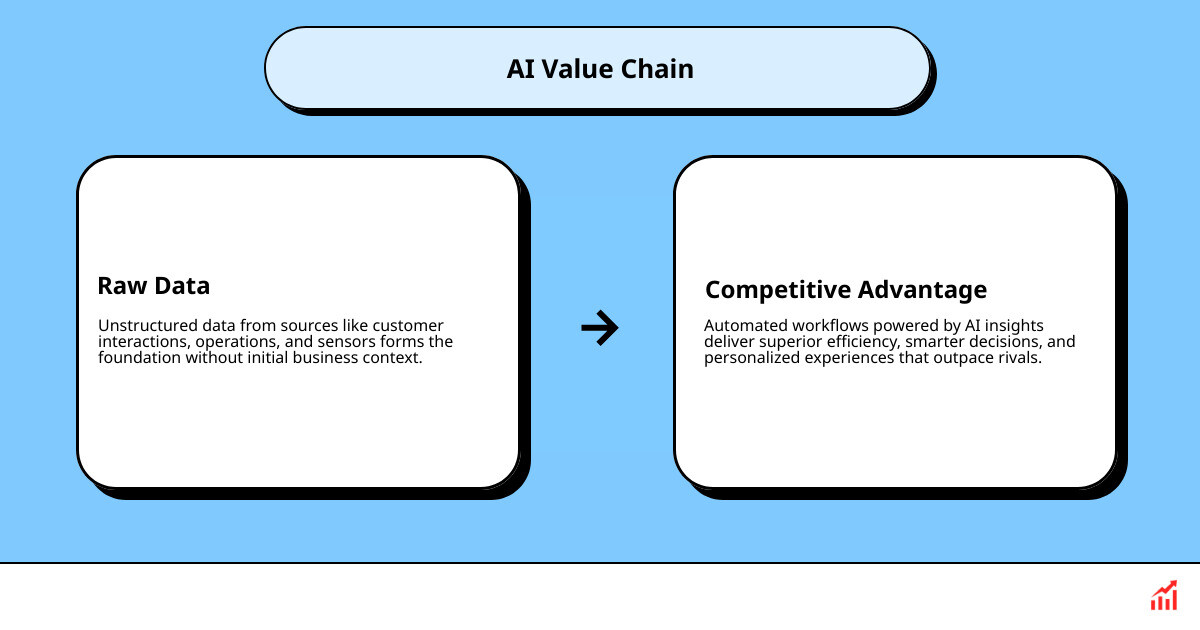
To truly capitalize on the power of AI, we must approach deployment with a solid plan. This means moving beyond isolated experiments and toward a cohesive AI-powered success model. Organizations that effectively implement AI achieve improved decision-making, increased efficiency, cost savings, and personalized customer experiences. The goal is to transform AI from a technical curiosity into a core engine of your business operations, ensuring every automated workflow serves a specific, measurable objective.
The Strategic Necessity and Maturity of AI
The gap between “using AI” and “having an AI strategy” is widening. While more than 60% of organizations now have generative AI use cases in production—a 4X increase in the last 12 months—only 35% have a formal strategy. This lack of structure is why many initiatives stall at the pilot phase, failing to scale because they weren’t built on a foundation of long-term business goals. Without a strategy, AI becomes a series of disconnected tactics rather than a unified growth system.
To understand where you stand, we look at the three stages of AI maturity:
| Maturity Stage | Characteristics | Business Impact |
|---|---|---|
| Wave 1: Point Solutions | Using AI for specific, isolated tasks (e.g., writing an email or summarizing a meeting). | Incremental productivity gains. |
| Wave 2: System Solutions | AI integrated across entire workflows (e.g., an AI agent managing lead qualification to CRM entry). | Significant operational efficiency and cost reduction. |
| Wave 3: Transformation | Reimagining the entire business model around AI capabilities. | Fundamental competitive advantage and new revenue streams. |
Moving through these stages is essential for scaling AI: a strategic framework for modern organizations. By treating AI as a core component of your growth architecture, you create a system where efficiency and decision-making improve over time. If you’re wondering why your brand needs an AI growth strategy right now, the answer lies in the compounding nature of AI. Those who build the infrastructure today will have a data moat that competitors cannot easily cross. This moat is built not just on the tools you use, but on the proprietary data and custom workflows you develop to solve unique customer problems.
A Practical Roadmap for AI Strategy and Implementation
We don’t believe in five-year plans for technology that changes every five weeks. Instead, we advocate for a 90-day roadmap that prioritizes the benefits of AI go far beyond just automation. A structured approach allows for agility, enabling your team to pivot as new capabilities emerge while staying focused on the primary objectives.
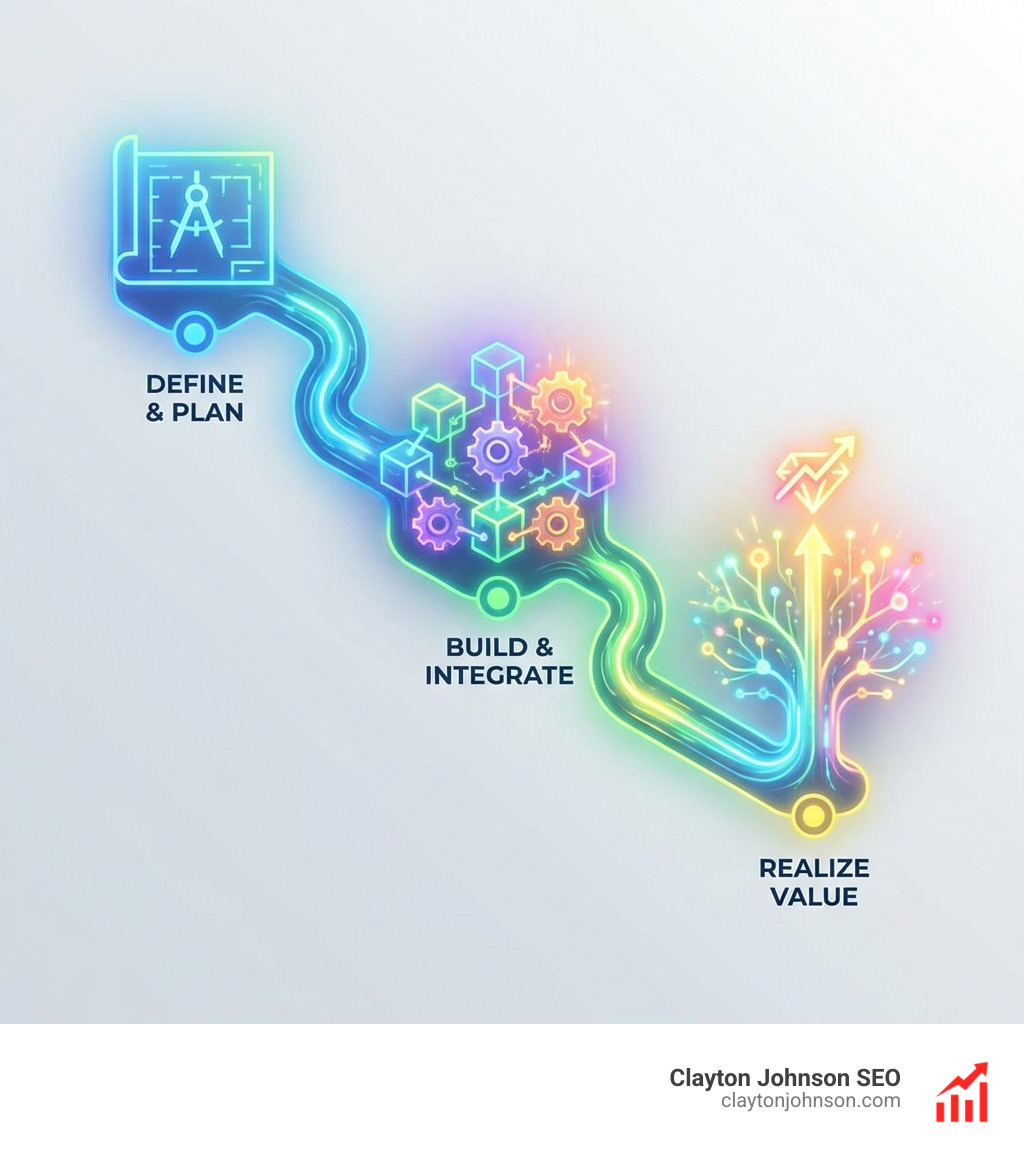
A successful enterprise AI strategy 101 starts with high-impact, low-risk use cases. This allows your team to gain “quick wins,” building the internal trust necessary for larger transformations. Our 90-day framework is broken down into three distinct phases:
- Month 1: Assessment & Setup: Identify the bottlenecks in your current workflows and select the AI tools that address them directly. This is where you audit your data quality and ensure your infrastructure is ready.
- Month 2: Training & Adoption: Focus on the human element. Train your team on the new tools and integrate them into daily routines. This phase is about overcoming the initial learning curve.
- Month 3: Measurement & Scaling: Analyze the results of your pilot programs. If a tool is working, scale it across the department. If not, refine the approach or move to the next priority.
Step 1: Aligning Business Goals with AI Strategy and Implementation
The strongest AI strategies don’t actually mention AI in the first sentence. They start with the business “North Star.” As noted in Artificial Intelligence and Business Strategy, AI should function as fuel for your existing KPIs.
We start by asking: “What problem are we trying to solve?” Whether it’s reducing churn, accelerating content production, or optimizing supply chain resilience, the technology must serve the objective. A top-down mandate for leadership to identify AI opportunities within their own divisions ensures that the strategy isn’t just an “IT project,” but a core business driver. When leadership is aligned, the entire organization understands that AI is a tool for empowerment, not just a cost-cutting measure.
Step 2: Data Infrastructure and Security
You cannot build a high-performance AI engine on a foundation of “trash” data. Currently, 84% of leaders admit their data strategies need a complete overhaul for successful AI implementation. Without clean, accessible data, AI models will produce hallucinations or irrelevant insights.
Key areas for AI infrastructure best practices for smart organizations include:
- Data Quality: Unifying disconnected systems into a single source of truth (like a centralized CRM). This prevents data silos that hinder AI performance.
- Security: Addressing the 41% of SMBs who express security concerns. This involves using tools that meet General Data Protection Regulation (GDPR) standards and carry SOC 2 compliance.
- Accessibility: Ensuring the right people have access to the right data without compromising privacy. This requires a robust governance model that balances innovation with protection.
Overcoming Challenges: Talent, Tools, and Governance
The biggest hurdle in AI strategy and implementation isn’t the code—it’s the culture. Change management is often overlooked, yet it’s the #1 reason AI tools sit unused. Employees often fear that AI will replace them, which leads to resistance. To overcome this, the strategy must emphasize AI as an “augmented intelligence” that handles the mundane, allowing humans to focus on high-value creative and strategic work.

Successful adoption requires:
- Leadership Vision: Senior leadership support is the single most predictive factor for AI success. Leaders must model the use of these tools and clearly communicate the “why” behind the implementation.
- Talent Development: You must invest in training your team to use these tools effectively. This isn’t a one-time workshop; it’s a continuous process of upskilling as the technology evolves.
- The Right Tooling: We recommend starting with established platforms that offer “AI-ready” ecosystems. This includes Microsoft Azure for enterprise-grade infrastructure, Gemini for content and creative workflows, and Zapier for connecting fragmented apps.
For those looking deeper into the technical side, our guide on artificial intelligence/enterprise AI explores how to bridge the gap between sci-fi dreams and scalable realities. By choosing tools that integrate seamlessly with your existing CRM and marketing stack, you reduce friction and accelerate the time-to-value.
Affordable AI Strategy and Implementation for Small Businesses
You don’t need a Fortune 500 budget to win at AI. Small businesses can compete by being more agile and making decisions faster than their larger counterparts. An affordable strategy involves using low-code or no-code tools to automate repetitive tasks, allowing a lean team to achieve massive output.
Start by identifying where you spend the most “dumb time”—tasks like invoice classification, lead routing, or basic customer queries. By using data-driven decisions to pick your tools, you can achieve a productivity boost that allows a small team to punch way above its weight class. The key is to focus on automation that directly impacts customer satisfaction or lead conversion.
Governance, Ethics, and Responsible AI
As we integrate AI, we must remain vigilant about trust. At least 25% of customers don’t trust AI enough yet. To build that trust, your strategy must include:
- Bias Recognition: Understanding that data reflects biases and taking active steps to mitigate them. This ensures your AI outputs are fair and representative.
- Transparency: Being honest with customers about when and how AI is being used. Whether it’s a chatbot or an automated recommendation engine, transparency builds long-term loyalty.
- Frameworks: Adopting the NIST AI Risk Management Framework to ensure your implementation is safe and ethical.
Building a responsible AI framework isn’t just about compliance; it’s about protecting your brand’s long-term reputation in a world where ethics are a competitive differentiator.
Frequently Asked Questions about AI Strategy
How do I measure the ROI of AI?
ROI in AI isn’t always immediate cash in the bank, though that is the ultimate goal. We measure it through a combination of hard and soft metrics:
- Efficiency Gains: Reduction in manual hours for a specific process. For example, if AI reduces content production time by 50%, those hours can be reinvested into strategy.
- Accuracy Improvements: Lower error rates in forecasting, data entry, or customer support routing.
- Customer Impact: Improvements in Net Promoter Score (NPS), faster response times, and higher conversion rates due to personalization.
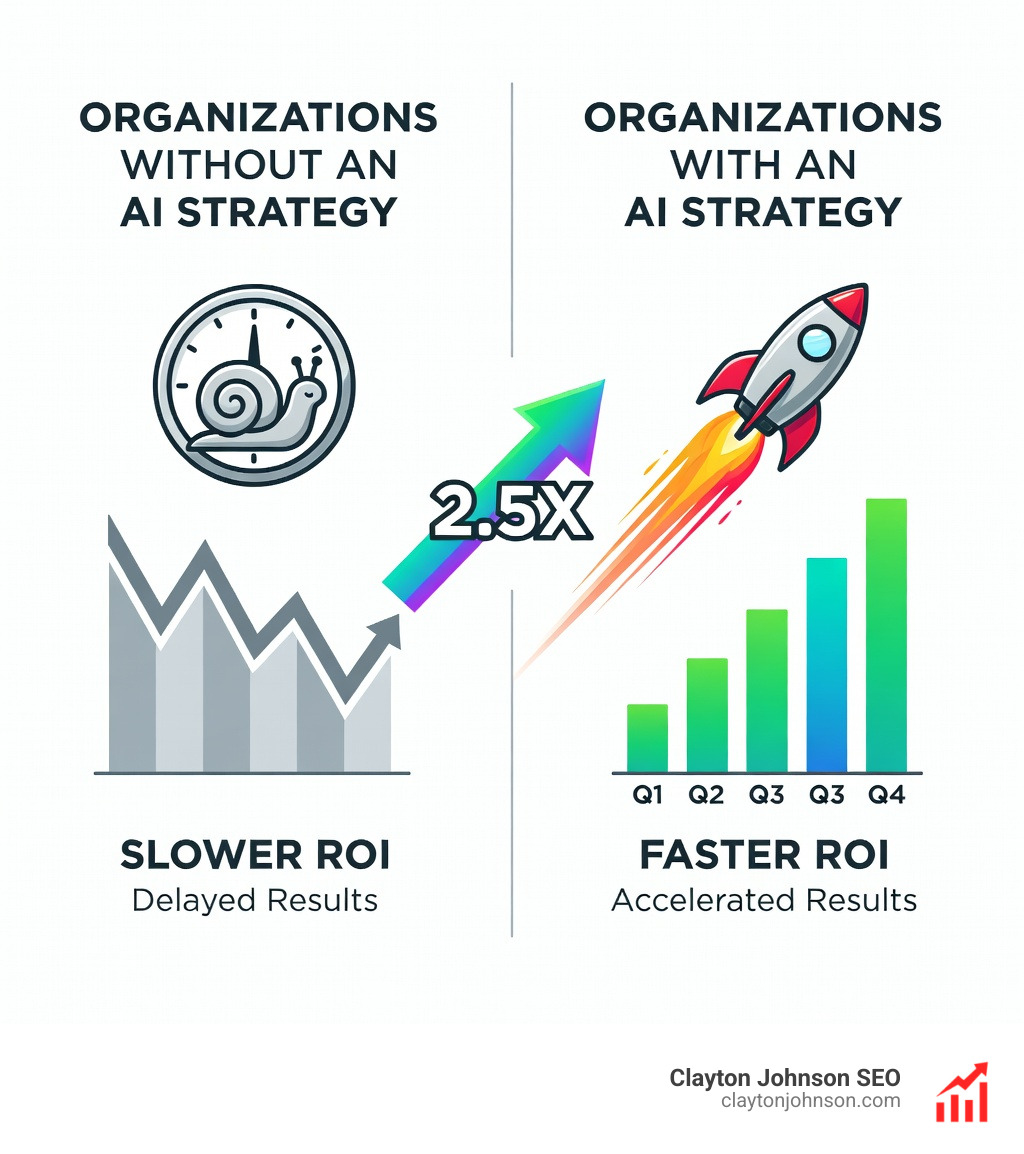
Interestingly, 78% of companies with a formal strategy see ROI much faster than those without one. For a deeper dive, check out our resource on enterprise-ai-strategy-financial-metrics.
What are the most common mistakes in AI implementation?
The most frequent “AI killers” we see are:
- Shiny Object Syndrome: Buying a tool because it’s popular or has a flashy demo, not because it solves a specific business problem.
- Poor Data Quality: Feeding an AI bad data and expecting good results. This is the “garbage in, garbage out” principle.
- Ignoring the Human Element: Failing to reskill the workforce or explain why the AI is being introduced. Without buy-in, even the best tools will fail to gain traction.
How long does it take to see results from an AI strategy?
With a focused 90-day roadmap, you can see “Wave 1” results (point solution wins) within the first 30 to 60 days. These are usually productivity boosts in specific departments. However, true “Wave 3” transformation—where your business model begins to evolve and you create new revenue streams—is a continuous journey of compounding growth that typically takes 12 to 18 months of consistent execution.
Conclusion
At Clayton Johnson, we believe that most companies don’t lack the will to innovate—they lack the structured growth architecture to make it happen. Through Demandflow.ai, we help founders and marketing leaders move from fragmented tactics to taxonomy-driven SEO systems and AI-augmented workflows. Our approach is designed to turn complexity into clarity, ensuring that every technological investment contributes to a scalable system.
Whether you are in Minneapolis or operating globally, the goal remains the same: Clarity → Structure → Leverage → Compounding Growth. By building a foundation of structured data and strategic intent, you move beyond the hype and into real-world results. If you’re ready to move from sci-fi dreams to scalable realities, it’s time to build an AI strategy that actually works.