How to Choose Your Next AI Decision Tool

Understanding AI Decisioning: Beyond Generative Content
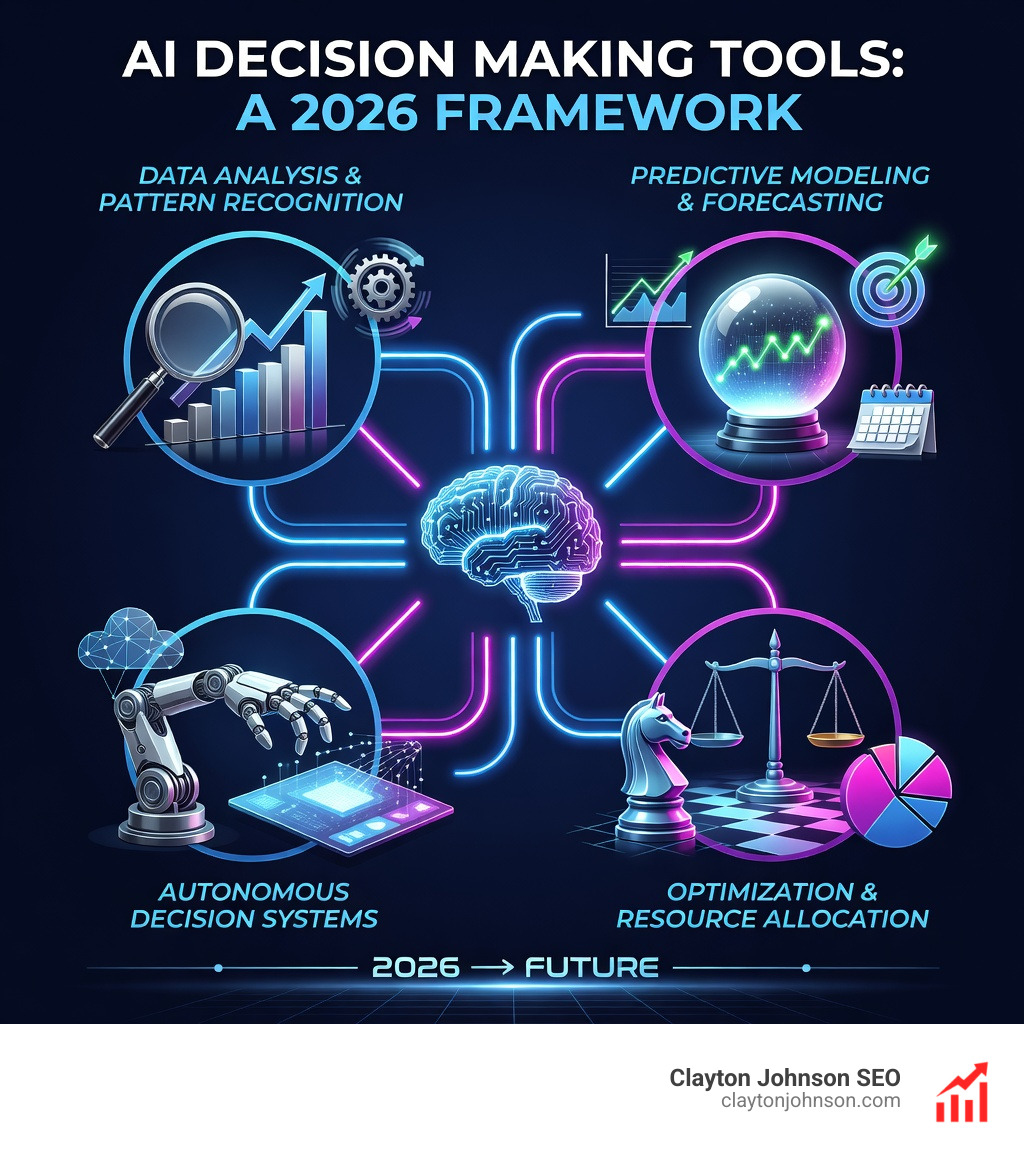
AI decision making tools are systems that use machine learning, reinforcement learning, and large language models to automate, augment, or architect complex business decisions at scale. Here’s what they do:
- Automate routine decisions: Handle millions of micro-decisions per second (pricing, routing, fraud detection)
- Augment human judgment: Surface hidden patterns, simulate scenarios, and recommend actions with explainability
- Architect choice environments: Generate novel options, anticipate outcomes, and continuously optimize decision quality
Top categories:
- Predictive AI platforms (IBM Watson, H2O.ai, DataRobot) — forecast outcomes and automate workflows
- Decision intelligence systems (IBM Decision Intelligence, Aera Decision Cloud) — integrate AI, rules, and real-time data
- Agentic frameworks (OpenAI AgentKit, ChatGPT Atlas) — deploy autonomous agents that reason and take action
- Low-code decisioning tools (Rationale, Copilot Studio) — accessible to non-technical teams
According to McKinsey, companies that personalize decisions can drive 40% more revenue than those that don’t. Uber handles over 10 million decisions per second to manage ride ETAs, driver matching, and fraud detection. AI decisioning shifts organizations from reactive, spreadsheet-driven choices to proactive, data-driven architectures.
The challenge isn’t whether to adopt AI decision tools — it’s choosing the right one for your strategic context, technical readiness, and growth stage.
I’m Clayton Johnson, an SEO and growth strategist who helps founders build structured systems for measurable growth. I’ve worked extensively with AI decision making tools to optimize strategic planning, content architecture, and competitive positioning frameworks for businesses scaling from $500K to $20M ARR.
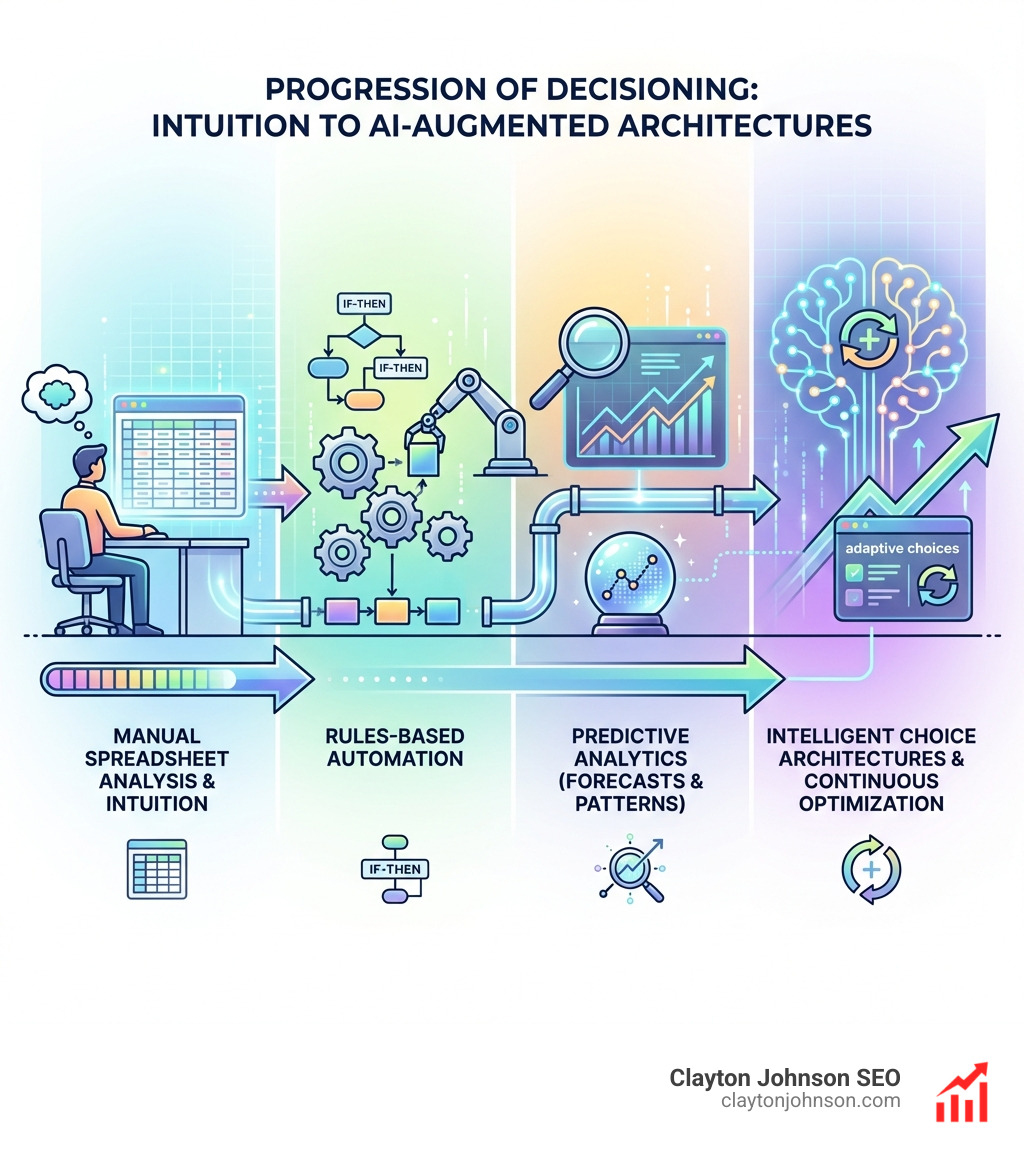
Most people think of AI as a tool for writing emails or generating images. While Generative AI is impressive, “AI Decisioning” is where the real business value lies. It is the shift from AI as a creator to AI as a strategist.
Traditional business intelligence tells you what happened in the past. AI decisioning tells you what to do next. It operates at an “atomic level,” meaning it can make millions of individual decisions about a single customer, product, or transaction in real-time. This is why AI decision making tools are becoming essential for competitive advantage.
Consider the scale of modern business. Humans working in spreadsheets cannot possibly manage the granularity required for hyper-personalization. McKinsey research on personalization revenue shows that companies getting this right drive 40% more revenue. They aren’t just sending “better emails”; they are using AI to decide exactly when to send them, which offer to include, and what price point will convert.
A prime example is Uber’s 10 million decisions per second. Uber doesn’t have a human dispatcher matching every rider. Their AI handles ETAs, fraud detection, and driver routing simultaneously. This real-time optimization is the difference between a seamless experience and a logistical nightmare.
Top AI decision making tools for Strategic Growth
Choosing the right tool depends on your organization’s technical maturity. We have categorized the leading providers to help you evaluate which fits your current growth operating system.
| Provider | Primary Strength | Best For |
|---|---|---|
| IBM Decision Intelligence | Governance & Explainability | Enterprise-grade regulated industries |
| Microsoft AI Framework | Ecosystem Integration | Teams already using M365 and Azure |
| Rationale | Strategic Analysis (SWOT/Pros & Cons) | Founders and managers making complex trade-offs |
| Insight7 | Qualitative Data Analysis | Customer research and pain point identification |
| Aera Decision Cloud | Supply Chain & Operations | Large-scale logistics and inventory management |
| SAS Intelligent Decisioning | High-speed Analytical Deployment | Financial services and fraud detection |
Key Features of Modern AI decision making tools
When evaluating these platforms, we look for several “must-have” capabilities that differentiate a professional tool from a basic chatbot:
- Explainability: You shouldn’t just get an answer; you should get the why. Leading tools provide a “Decision Assistant” that traces the logic from data input to recommended action.
- Low-code Modeling: You shouldn’t need a PhD in Data Science to use these. Modern tools allow business users to translate policy into decisions without writing code.
- Real-time Analytics: The ability to ingest data from sources like Snowflake or Google BigQuery and output a decision in milliseconds.
- Hybrid AI Engines: Combining the creative power of LLMs with the rigid logic of business rules and predictive machine learning models.
Leading Providers and Notable AI Agents
The market is moving toward “Agentic Workflows”—AI agents that don’t just suggest but actually do.
- OpenAI AgentKit & ChatGPT Atlas: These tools allow you to build agents that reason and take action across web tasks, summarizing content and automating multi-step workflows.
- Jina AI (Rationale): This tool focuses on structured decision-making. Whether you are deciding to switch your tech stack or hire a new lead, it uses SWOT and Causal Chain analysis to give you a 360-degree view.
- DataRobot & H2O.ai: These platforms democratize data science, allowing teams to upload datasets and automatically generate predictive models for churn, fraud, or demand forecasting.
For businesses focused on the digital side of growth, integrating these tools into your SEO content marketing strategy can help you decide which topics will drive the highest ROI based on competitive intelligence rather than guesswork. If you need help structuring this data, you can find more info about analytics and data services on our main site.
The Mechanics of Choice: Agents, LLMs, and Reinforcement Learning
To choose the right tool, it helps to understand the “engine” under the hood. Most AI decision making tools rely on a combination of three technologies:
- Large Language Models (LLMs): These provide the contextual understanding. They “read” your business policies and customer feedback to understand the nuance of a situation.
- Reinforcement Learning: This is the “learning” part. The AI makes a decision, observes the outcome (did the customer buy?), and adjusts its logic to improve the next decision.
- AI Agents: These are the “workers.” They use APIs to interact with your other software—like your CRM or inventory system—to execute the decision.
We call this new paradigm “Intelligent Choice Architectures.” Instead of just giving you a “Yes” or “No,” the AI designs the environment in which you make decisions. It generates novel options you might not have considered and illuminates hidden trade-offs.
This often requires a shift in “Decision Rights.” In the past, a manager made every call. Today, we use the BXT (Business-Experience-Technology) framework to decide which decisions should be automated (high volume, low risk) and which should remain human-led (low volume, high strategic impact).
Building a Fear-Free AI Decision-Making Strategy
The biggest barrier to adopting AI decision making tools isn’t the technology—it’s the “fear response.” When humans feel their authority is being challenged by a machine, the prefrontal cortex (the rational part of the brain) can shut down, leading to a fight-or-flight response.
To build a successful strategy, we recommend the 80/20 rule: Let AI handle the 80% of routine, data-heavy work (the “intern” tasks), leaving the last 20% of high-level judgment to humans. This reduces the workload to one-fifth while keeping humans in control.
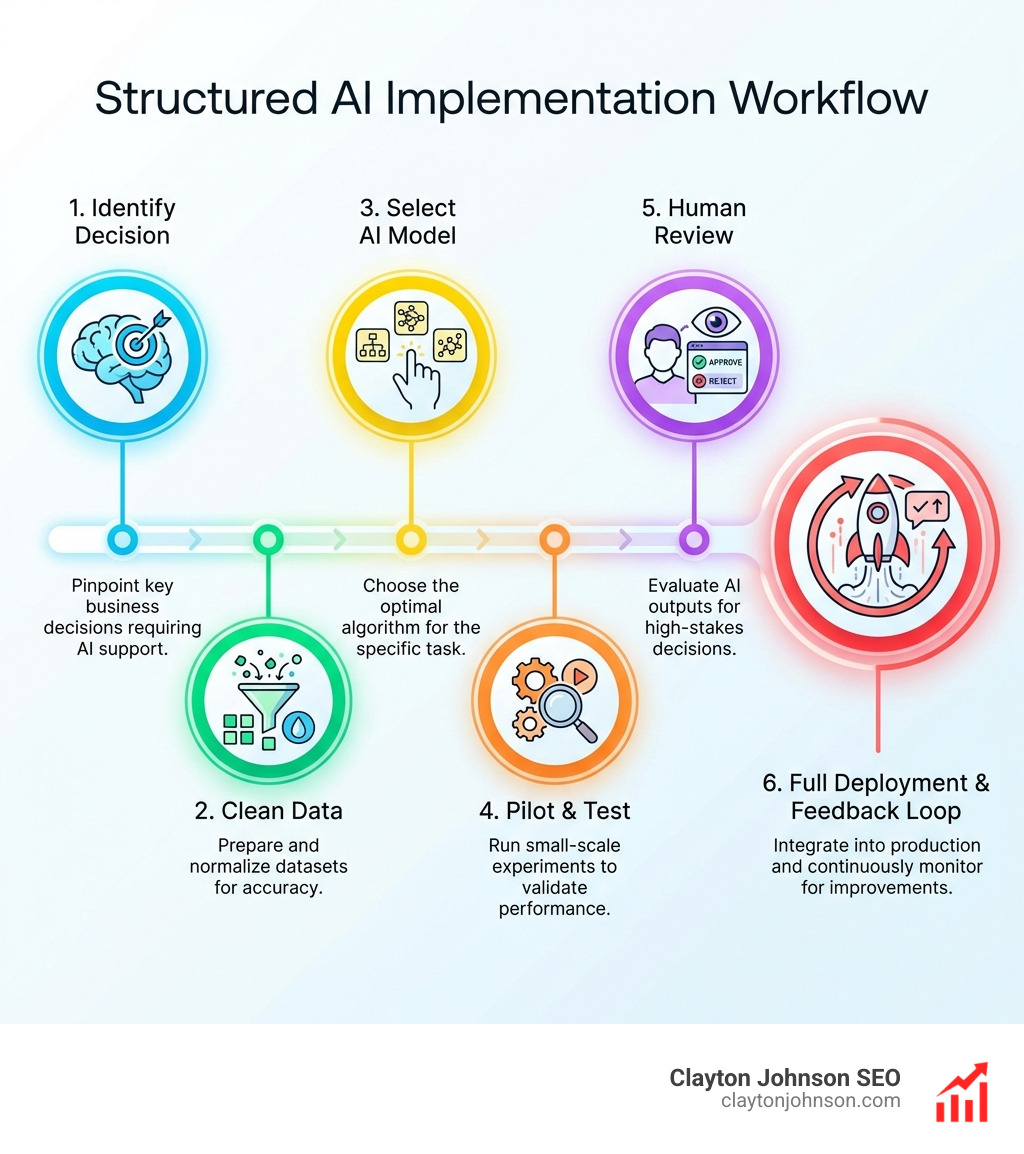
Implementation Steps:
- Define the Decision, Not the Tool: Start by identifying a decision you make frequently that lacks clarity or takes too much time.
- Data Governance: Ensure your data is “clean.” AI is only as good as the information it consumes.
- Build a Feedback Loop: Every AI decision should be measured. If the AI recommends a price change, did revenue actually go up?
- Human-in-the-loop: For high-stakes decisions (like healthcare or legal), always have a human review the AI’s “prescriptive recommendation” before it is finalized.
Overcoming Challenges with AI decision making tools
Adoption isn’t always smooth sailing. Here are the common pitfalls we see:
- Data Silos: If your marketing data doesn’t talk to your sales data, the AI will make decisions based on an incomplete picture.
- Algorithmic Bias: AI learns from historical data. If that data contains past human biases, the AI will replicate them. Regular audits are essential.
- Technical Readiness: Does your team have the skills to manage these tools? You don’t need to be a developer, but you do need “AI literacy.”
- Explainability: Never use a “black box” system. If you can’t explain why a decision was made to a stakeholder or regulator, you shouldn’t be using it.
Frequently Asked Questions about AI Decision Tools
What is the difference between AI decisioning and generative AI?
Generative AI creates content (text, images, code). AI decisioning uses data to choose the best course of action. While Generative AI might write a marketing email, AI decisioning decides which customer should receive it and when.
How do AI tools reduce human bias in strategic planning?
Humans are prone to “confirmation bias” and “loss aversion.” AI decision tools evaluate data based on objective mathematical models and programmed rules, helping to surface options that a human might ignore due to emotional attachment or tradition.
Can small businesses afford enterprise-grade decision AI?
Yes. The “democratization” of AI means that tools like Rationale or Insight7 are available for a monthly subscription fee, often starting under $20. You no longer need a Silicon Valley budget to use the same technology as Uber or Netflix.
Conclusion
The goal of implementing AI decision making tools isn’t just to work faster—it’s to achieve strategic leverage. By automating the millions of micro-decisions that clog up your day, you free your mind to focus on the high-level “structured growth architecture” that leads to compounding growth.
At Clayton Johnson, we believe that clarity leads to structure, and structure leads to leverage. Whether you are in Minneapolis or scaling a remote team, the right AI tools act as a “sharp sidekick,” cutting through the noise so you can act with confidence.
If you are ready to stop guessing and start scaling with a structured growth operating system, work with me to build your custom growth infrastructure.