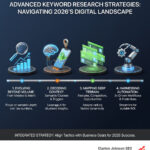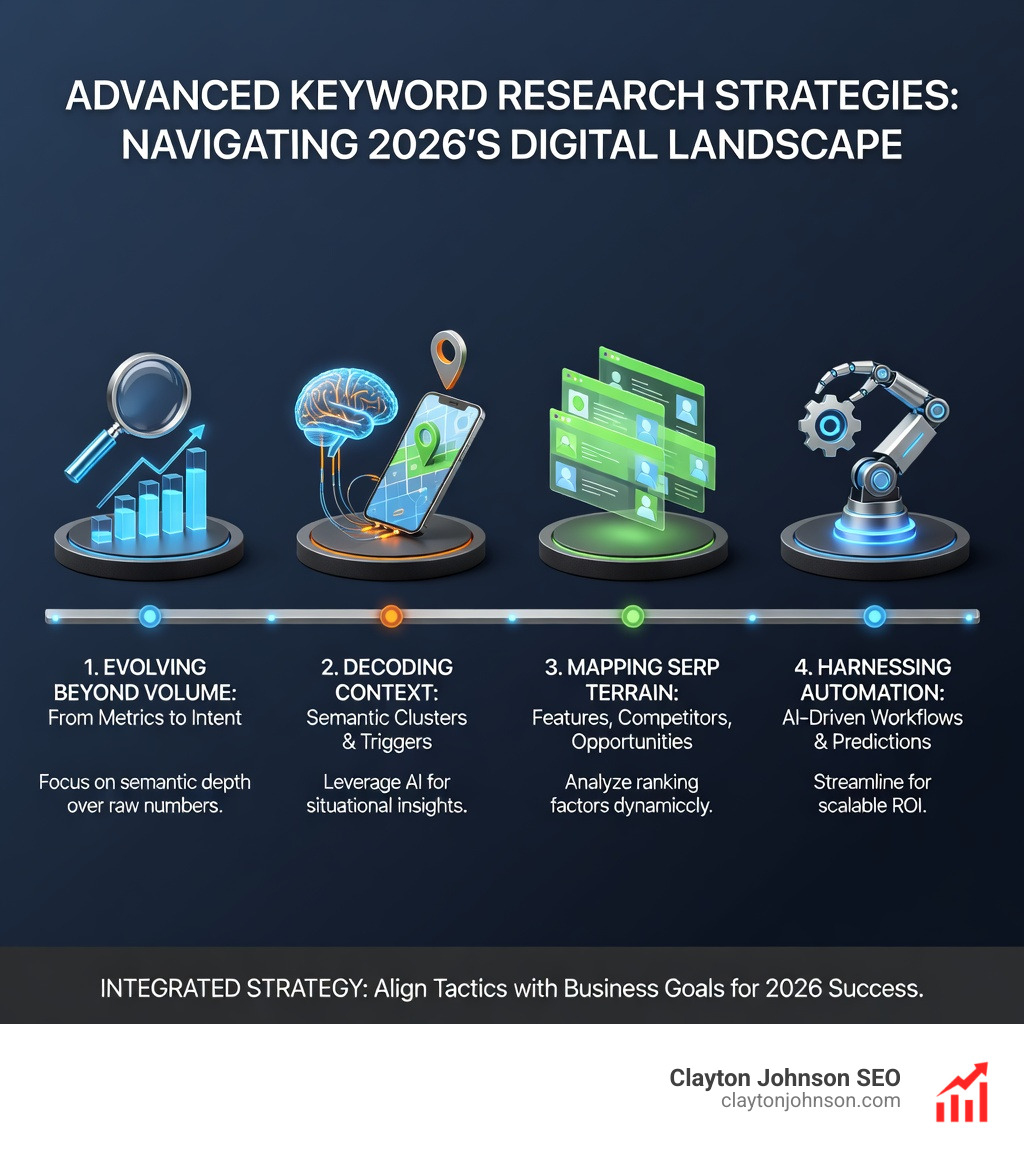
Advanced keyword research strategies are the difference between guessing what your audience searches for and knowing exactly how to get in front of them at the right moment.
Here’s a quick snapshot of the core strategies covered in this guide:
| Strategy | What It Does | Best For |
|---|---|---|
| Long-tail keyword targeting | Captures 70% of search traffic with lower competition | New sites, niche topics |
| AI-powered clustering | Groups keywords by semantic meaning and intent | Topical authority building |
| Competitor gap analysis | Finds keywords rivals rank for that you don’t | Fast wins |
| Zero-volume keyword grouping | Aggregates 12+ low-volume terms for collective traffic | Emerging topics |
| GSC hidden query mining | Surfaces high-impression, low-click opportunities | Quick CTR gains |
| Forum and community mining | Extracts real language from Reddit, Quora, GA4 | Long-tail discovery |
| New site advantage targeting | Finds keywords where young domains rank on page 1 | Low-competition entry |
Most SEO guides stop at “find keywords with high volume and low competition.” That’s table stakes.
The reality? 70% of all search traffic comes from long-tail keywords. And yet most content teams chase the same 10 head terms their competitors already dominate. They ignore intent. They publish content that ranks for nothing.
The opportunity isn’t in the obvious keywords. It’s in the gaps.
Gaps in your competitor’s content. Gaps in SERP coverage. Gaps between what users are actually asking in forums and what anyone has bothered to write.
This guide covers the full stack – from keyword types and intent mapping to AI-powered clustering, community mining, competitor exploitation, and funnel alignment.
I’m Clayton Johnson, an SEO strategist focused on building scalable traffic systems and structured content architectures that compound over time – and advanced keyword research strategies sit at the core of every growth system I build. Let’s get into the framework that turns keyword research from a guessing game into a precision engine.
The Framework of Advanced Keyword Research Strategies
To master advanced keyword research strategies, we must first move beyond the idea that all keywords are created equal. In our work at Clayton Johnson SEO, we categorize search terms not just by what they say, but by the role they play in your growth architecture.
- Head Terms: These are broad, one-to-two-word phrases like “SEO” or “Marketing.” They have massive volume but are incredibly competitive and often lack clear intent.
- Body Keywords: Two-to-three-word phrases like “SEO strategies” or “content marketing guide.” These offer a balance of decent volume and more specific intent.
- Long-tail Keywords: These account for 70% of all search traffic. They are longer, highly specific phrases (e.g., “advanced keyword research strategies for B2B SaaS”). While individual volumes are lower, they convert significantly better.
- LSI (Latent Semantic Indexing) Keywords: These are conceptually related terms that help search engines understand context. If you’re writing about “Apple,” LSI terms like “iPhone,” “Tim Cook,” or “Cupertino” tell Google you aren’t talking about fruit.
- Zero-volume Keywords: These are the “hidden gold.” They show 0 searches in tools like Ahrefs or SEMrush, but they represent emerging trends or highly specific queries that people are actually typing.
Understanding the relationship between these types is critical for SEO 101 and beyond.
Decoding User Intent with Advanced Keyword Research Strategies
Search engines have evolved from matching strings of text to understanding human needs. We break intent into four core categories:
- Informational: The user wants to learn something (“how to do keyword research”).
- Navigational: The user is looking for a specific brand or site (“Clayton Johnson SEO”).
- Commercial Investigation: The user is comparing options (“SEMrush vs Ahrefs”).
- Transactional: The user is ready to pull the trigger (“buy SEO audit”).
Success comes from Winning the AI Search Era with Intent-Based Keyword Research. If you target a transactional keyword with an informational blog post, you will likely never rank—or if you do, your bounce rate will be astronomical. For a deeper dive, check out What is Informational Intent Anyway.
| Keyword Type | Search Volume | Competition | Conversion Potential |
|---|---|---|---|
| Head Terms | Very High | Massive | Low |
| Body Keywords | Moderate | High | Medium |
| Long-tail | Low | Low | High |
| Zero-volume | “Zero” | Near Zero | Very High |
Avoiding Common Keyword Research Pitfalls
Even seasoned pros fall into traps. The most dangerous is high-volume obsession. Chasing a keyword with 50,000 searches sounds great until you realize the Keyword Difficulty (KD) is 90 and the intent is too broad to convert.
We also see many people ignoring intent entirely or optimizing for competitor-specific terms they can’t realistically win. Avoid using misspellings (Google fixes these automatically now) or irrelevant phrases just because they are easy to rank for. If it doesn’t align with your business goals, it’s vanity traffic.
Leveraging AI and Semantic Search for Topical Authority
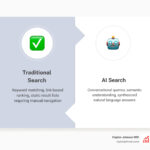
The search landscape is shifting toward Semantic SEO. This means Google isn’t just looking for your keyword; it’s looking for entities and their relationships. By using Finding Keywords with AI is Easier Than You Think, we can map out entire topical universes.
Technologies like BERT and MUM allow Google to understand the nuance of language, while AI Overviews (formerly SGE) provide direct answers based on the most authoritative sources. To win here, you need to be the “Knowledge Graph” for your niche.
Automating Workflows via Advanced Keyword Research Strategies
At Clayton Johnson SEO, we use AI to handle the “grunt work” of SEO. Instead of manually sorting 5,000 keywords in a spreadsheet, we use Automate Your Success Using AI-Driven Keyword Optimization to cluster terms by intent automatically.
This allows for predictive analysis—forecasting which topics will trend before the volume hits the standard tools. This is the core of an AI Search Keyword Strategy that builds long-term leverage. For more on the technical shift, see The Future of Search with AI-Powered Keyword Research.
Optimizing for Voice and Conversational Queries
Voice search is no longer a gimmick; it’s a primary search method. People don’t type “best Minneapolis SEO”; they ask, “Who is the best SEO expert in Minneapolis?”
To optimize for this:
- Use natural, conversational language.
- Target question-based keywords (Who, What, Where, When, Why).
- Implement FAQ formatting to win featured snippets.
- Focus on localized voice search—especially important if you’re a business in Minneapolis, Minnesota.
Exploiting Competitor Gaps and the New Site Advantage
One of the most effective advanced keyword research strategies is finding what your competitors missed. We don’t just look at direct competitors; we look at partial competitors—sites that solve the same problem but sell a different product.
By performing a content gap analysis, we can identify keywords where your rivals rank but you have no content. This is a roadmap for fast wins.
Targeting Keywords Where New Websites Rank
This is a “ninja” tactic we love. Use tools to find keywords where websites under 2 years old (or with a low Domain Rating) are ranking on the first page.
If a brand-new site can rank for a term, it’s a signal that the competition is weak and Google is desperate for fresh, high-quality content. You can verify domain ages using WHOIS data to confirm these “weak” spots in the SERPs. This is a cornerstone of Advanced Keyword Research: Tips for Finding Untapped Keywords.
Reverse-Engineering Weak Ranking Signals
Sometimes, Google ranks a site because it’s the “least bad” option. Look for:
- Outdated forums from years ago.
- Low-engagement Reddit threads with only 1-2 comments.
- Quora questions that don’t fully answer the user’s query.
When you see these ranking in the top 5, it’s an invitation to create a comprehensive, modern page that provides a 10x better experience.
Mining Zero-Volume and Long-Tail Queries from User Communities
Standard keyword tools are often 3-6 months behind reality. To find what people are searching for right now, we go to the source: user communities.
- Reddit & Quora: Search for your main topic and look for recurring questions. These are often the best source for long-tail, conversational keywords.
- GA4 Site Search: Look at what people are typing into the search bar on your own site. This is direct feedback on what your current audience can’t find.
- Google Trends: Use Google Trends to spot seasonal spikes and emerging topics before they show up in traditional keyword tools.
For a list of the best tools to help with this, see Why Your SEO Strategy Needs These Long-Tail Keyword Tools Right Now.
Leveraging Google Search Console for Hidden Gems
Your best keyword data is already in your Google Search Console (GSC). We look for high-impression, low-click queries. These are terms where you are appearing in search results but people aren’t clicking.
Often, this means you have “accidental” rankings. By creating a dedicated page for that specific query, you can turn those impressions into a flood of traffic. This is a much faster way to grow than starting from scratch.
Organizing for Impact: Clustering, Mapping, and Funnel Alignment
Once you have your keywords, you need a structured growth architecture. This is where most companies fail. They have a list of keywords, but no system to implement them.
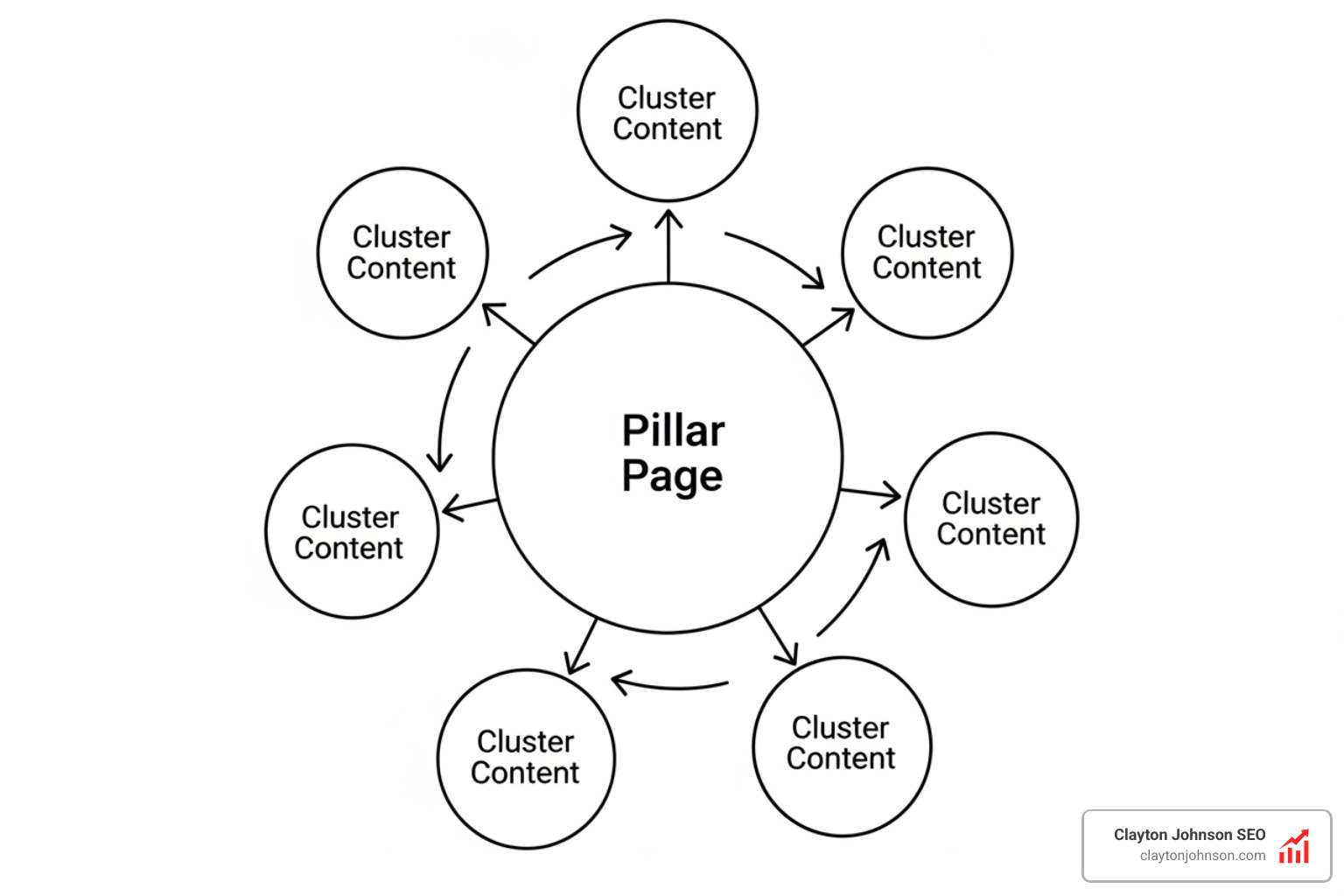
Keyword clustering is the process of grouping related keywords together so one page can rank for dozens of terms. Keyword mapping ensures that every page on your site has a unique purpose and doesn’t compete with your other pages (cannibalization).
Building Pillar-Cluster Architectures
This is how we build topical authority. You create a comprehensive Pillar Page that covers a broad topic in depth, then create smaller “cluster” articles that dive into specific sub-niches.
The magic is in the internal linking. By linking these pages together, you signal to Google that your site is an authority on the entire entity, not just a single keyword. For a simpler explanation, see Pillar Pages and Topic Clusters Explained for Mere Mortals.
Aligning Keywords to the Sales Funnel
Your keyword strategy must match your customer’s sophistication.
- Top of Funnel (ToFu): Problem-specific queries (“why is my traffic dropping?”).
- Middle of Funnel (MoFu): Solution-oriented (“best SEO audit tools”).
- Bottom of Funnel (BoFu): Decision-maker needs (“Clayton Johnson SEO pricing”).
By mapping these to a content matrix, you ensure you have the right content for every stakeholder at every stage of the buying journey.
Frequently Asked Questions about Advanced Keyword Research
How do I find keywords with zero search volume that actually drive traffic?
Look at forums like Reddit or your GSC “Performance” report for queries with high impressions but no reported volume in tools. These are often high-intent, low-competition gems.
What is the best way to assess keyword difficulty accurately?
Don’t just trust a KD score. Look at the top 10 results. Are they huge brands? Is the content actually good? If you see forums or low-quality blogs, the “real” difficulty is lower than the tool suggests.
How often should I refresh my keyword research strategy?
We recommend a deep dive every 4-6 months. Search behavior changes, new competitors emerge, and Google’s algorithms are constantly shifting.
Conclusion
Mastering advanced keyword research strategies isn’t about finding a single “magic” word. It’s about building a structured growth infrastructure that understands intent, exploits competitor gaps, and leverages AI to stay ahead of the curve.
Success requires constant measurement, tracking your rankings, and adapting to algorithm changes in real-time. At Clayton Johnson SEO, we build these systems through Demandflow.ai to turn SEO into a predictable revenue driver.
Ready to stop guessing? Get started with an AI Search Keyword Strategy today and start building your own search engine dominance.