Stop Guessing and Start Measuring Your AI Visibility Today

Why Your Brand’s AI Visibility Matters More Than You Think
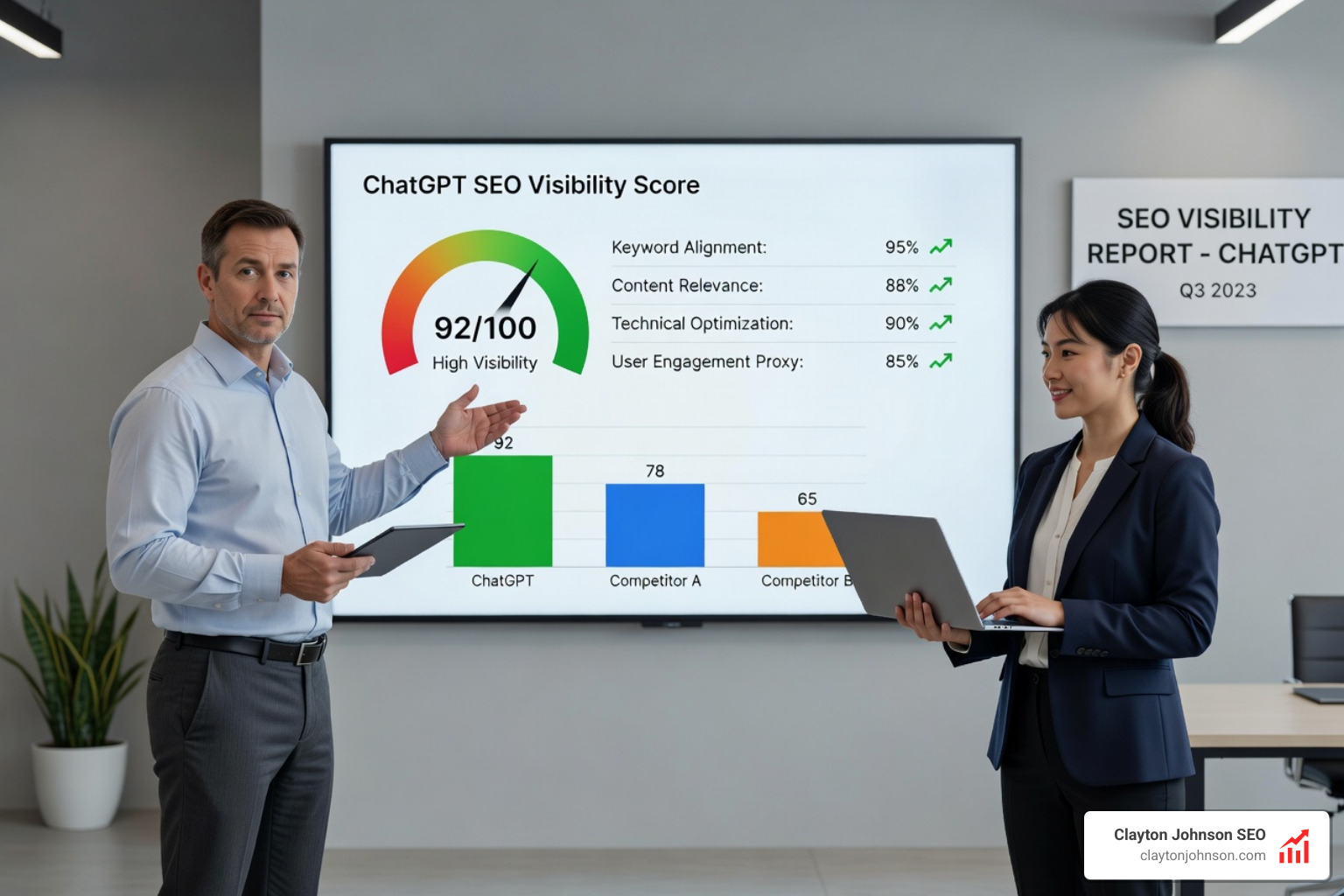
ChatGPT SEO visibility score measures how often your brand appears in AI-generated answers compared to competitors. Here’s what you need to know:
- What it measures: Brand mentions, citations, sentiment, and share of voice in ChatGPT responses
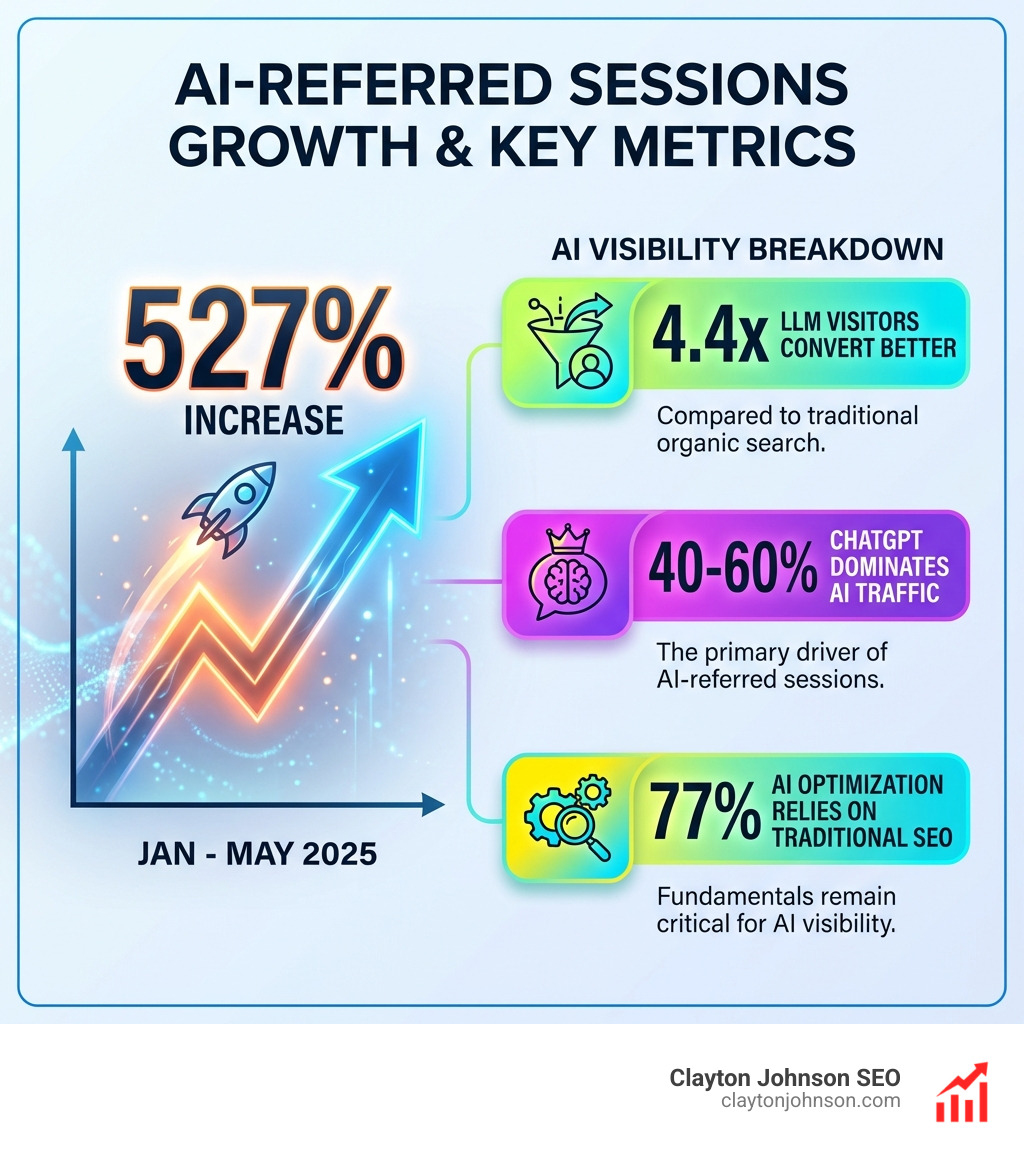
- Why it matters: AI-referred sessions jumped 527% between January and May 2025, and LLM visitors convert 4.4 times better than traditional organic search
- Key difference: ChatGPT cites pages ranking in positions 21+ nearly 90% of the time—flipping traditional SEO priorities
- How to track it: GA4 custom channels, manual prompt testing, or specialized AI visibility tools
Most marketing leaders still measure success using Google rankings and organic traffic. But there’s a problem: millions of people now start their research in ChatGPT instead of Google.
When ChatGPT recommends your competitor but not you, potential customers never even visit your website. They’ve already made their decision inside the AI conversation.
The gap is widening fast. Legal, finance, healthcare, and insurance already account for 55% of all LLM-driven sessions. For some SaaS companies, AI traffic represents just 0.5% of visitors but drives 12.1% more signups than traditional search.
You can’t optimize what you don’t measure.
Traditional analytics miss AI visibility entirely. GA4 shows referral clicks, but not the hundreds of times ChatGPT mentioned your brand without sending traffic. LLM tracking tools show citations, but not which ones actually convert.
You need both. And you need a systematic approach to improve your position.
I’m Clayton Johnson, and I help founder-operators build measurable growth systems that align SEO strategy, content architecture, and AI visibility into a cohesive demand engine. Over the past year, I’ve worked with marketing leaders to track and improve their ChatGPT SEO visibility score as AI search reshapes discoverability.
This guide will show you exactly how to measure your brand’s presence in AI responses, interpret what the data means, and take strategic action to improve your visibility before your competitors do.
Understanding the ChatGPT SEO Visibility Score
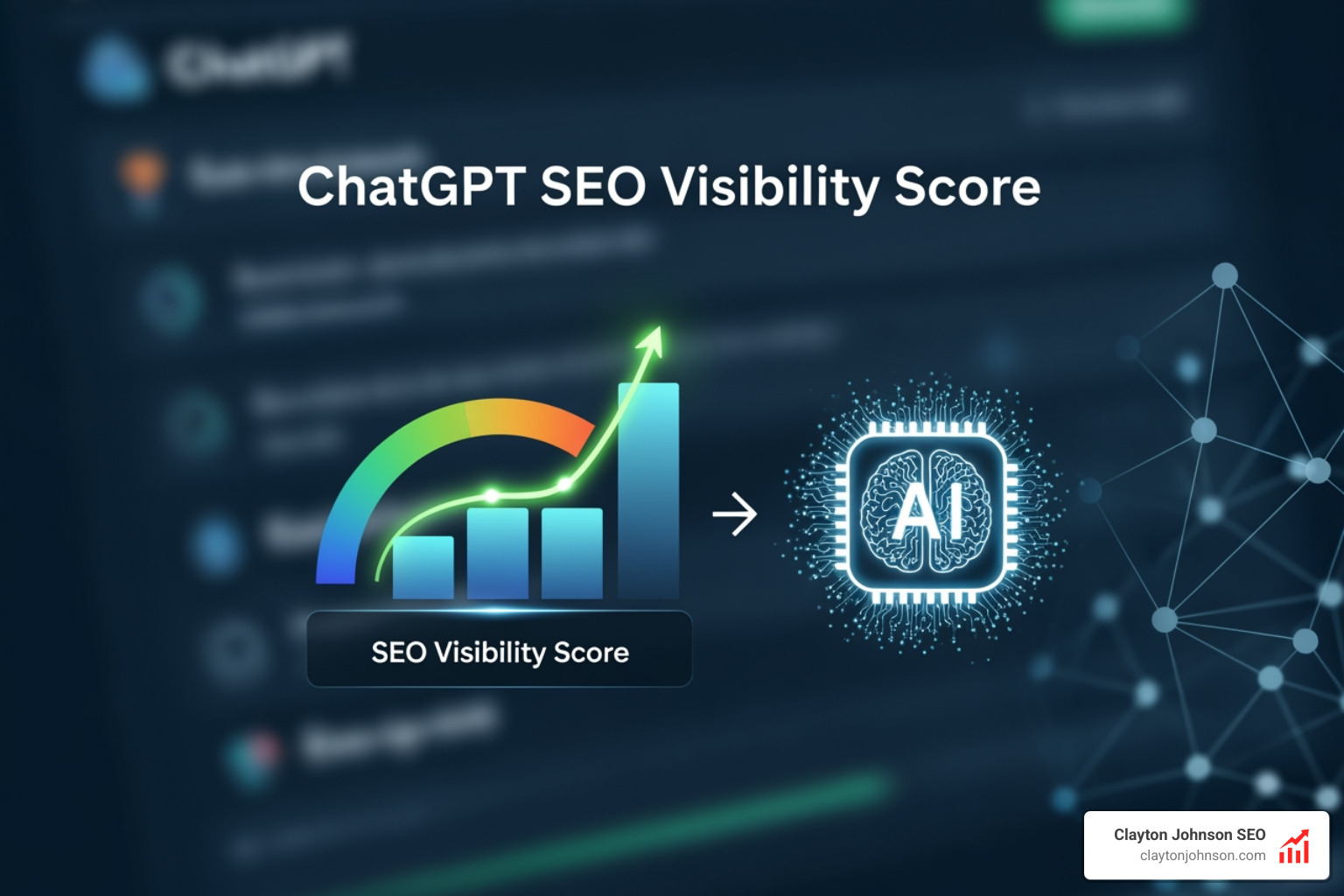
When we talk about a ChatGPT SEO visibility score, we aren’t just looking at a single number on a dashboard. We are looking at the digital heartbeat of your brand within the world’s most popular Large Language Model (LLM).
Think of this score as your “AI Share of Voice.” It represents the frequency and quality of your brand’s appearances in ChatGPT’s conversational outputs. Unlike a Google rank—where you’re either #1 or you’re not—AI visibility is about being part of the narrative. If someone asks, “What’s the best SEO strategy for a SaaS startup in Minneapolis?” and ChatGPT mentions our framework, our visibility score goes up.
This is critical because AI traffic behaves differently. While it might represent a smaller slice of the total traffic pie right now, it drove 12.1% more signups for companies like Ahrefs, even when it only accounted for 0.5% of total visitors. That is the power of a high visibility score: it captures users at the peak of their intent.
To truly understand your score, you need to look at:
- Brand Mentions: How often your name appears in responses.
- Citations: How often ChatGPT links back to your specific pages as a source.
- Sentiment: Whether the AI is recommending you as a leader or mentioning you as a “budget option.”
- Topic Dominance: Which specific keywords or “narrative drivers” you own within the AI’s knowledge base.
For more insights on how we integrate these metrics into a broader growth strategy, check out our analytics and data services.
Why Your ChatGPT SEO Visibility Score Predicts High-Intent Conversions
The math is simple: LLM visitors are pre-qualified. By the time someone clicks a link in a ChatGPT response, they have already had a “conversation” about their problem. The AI has acted as a digital consultant, narrowing down the options.
Research shows that AI-referred sessions jumped 527% across tracked websites in early 2025. But the real kicker is the conversion rate. Visitors from LLMs convert 4.4 times better than traditional organic search visitors.
Why? Because the trust has already been established. When ChatGPT cites your content, it’s giving you a third-party endorsement that carries significant weight. If your ChatGPT SEO visibility score is high, you aren’t just getting “traffic”; you’re getting “future customers” who are already convinced of your expertise. This is why we prioritize conversion optimization services alongside AI tracking—to ensure that when these high-intent visitors land, they have a clear path to becoming a lead.
How ChatGPT Retrieves and Cites Information
To improve your score, you have to understand how the “brain” works. ChatGPT doesn’t just “know” things; it retrieves information through three primary channels:
- Training Data: This is the massive “offline” library the model was built on. It has a knowledge cutoff, meaning it won’t know about the blog post you published yesterday unless it uses the next two methods.
- Web Browsing (via Bing Search): For ChatGPT Plus and Enterprise users, the model can search the live web. It uses the Bing Search API to find current information, visit pages, and synthesize answers.
- GPTBot: This is OpenAI’s specific web crawler. If you block GPTBot in your robots.txt, you are essentially telling ChatGPT, “Don’t cite me.”
Here is the most shocking part of the research: ChatGPT primarily cites pages ranking in positions 21+ nearly 90% of the time.
Let that sink in. In traditional SEO, if you’re on page three of Google, you’re invisible. In ChatGPT, being on page three might actually make you more likely to be cited if your content is better structured for AI extraction than the “big players” on page one.
How to Measure Your Brand Presence in AI Responses

Measuring your AI presence isn’t as straightforward as checking a rank tracker—yet. Because LLM outputs are “non-deterministic” (meaning the same prompt can yield different answers), we use a combination of manual and automated methods.
If you’re feeling overwhelmed by the technical shift, our SEO consultant services can help you build the right measurement infrastructure.
Setting Up GA4 to Track AI Referral Traffic
Google Analytics 4 (GA4) doesn’t have an “AI Traffic” button out of the box. Most AI traffic gets dumped into “Referral” or “Direct.” To see your ChatGPT SEO visibility score in action, you need to create a Custom Channel Group.
We recommend using a specific regex pattern to catch traffic from ChatGPT, Perplexity, Claude, and others. Here’s a basic workflow:
- Go to Admin > Data Settings > Channel Groups.
- Create a new group called “AI Search.”
- Define the channel using a regex filter for the source. Include terms like
chatgpt|openai|perplexity|anthropic|google-it. - Build an Exploration Report to see which landing pages these visitors are hitting.
This helps you see the “clicks,” but remember: AI visibility is often “zero-click.” People get the answer and move on. That’s why we also track citations. Our SEO content marketing services focus on creating the kind of “cite-worthy” data that ensures your brand stays in the conversation even if the user doesn’t click through immediately.
Top Methods to Audit Your ChatGPT SEO Visibility Score
How do you know if you’re winning? Use these three auditing methods:
- Manual Prompt Testing: Ask ChatGPT 10-15 high-intent questions your customers might ask. For example: “Who are the top SEO experts in Minneapolis?” or “What is the best structured growth architecture for a startup?” Document how often you appear.
- Automated Tracking Tools: Tools like SE Visible, ZipTie.dev, or Otterly AI can automate thousands of these prompts and give you a numerical visibility score (usually 0-100).
- Citation Analysis: Look at who the AI is citing if it’s not you. Research shows ChatGPT cites Wikipedia for 48% of references, while Perplexity leans heavily on Reddit (46.7%). If your competitors are being cited through a third-party review site, that’s your “visibility gap.”
| Method | Best For | Effort Level |
|---|---|---|
| Manual Testing | Quick pulse check, understanding tone | Low |
| GA4 Custom Channels | Tracking actual conversions and clicks | Medium |
| Specialized Trackers | Competitive benchmarking and scale | High |
Strategies to Optimize Content for AI Citations
If you want a high ChatGPT SEO visibility score, you have to stop writing for “keywords” and start writing for “entities” and “answers.” At Clayton Johnson SEO, we call this building “structured growth architecture.”
Technical Accessibility and GPTBot
The first step is making sure the AI can actually see you.
- Robots.txt: Ensure you are allowing
User-agent: GPTBot. If you block the crawler, you’re opting out of the future of search. - IndexNow: Use this to notify Bing (which powers ChatGPT’s web search) the second you update content.
- Bing Webmaster Tools: This is no longer optional. Since ChatGPT relies on the Bing index for real-time browsing, your performance in Bing directly impacts your AI visibility.
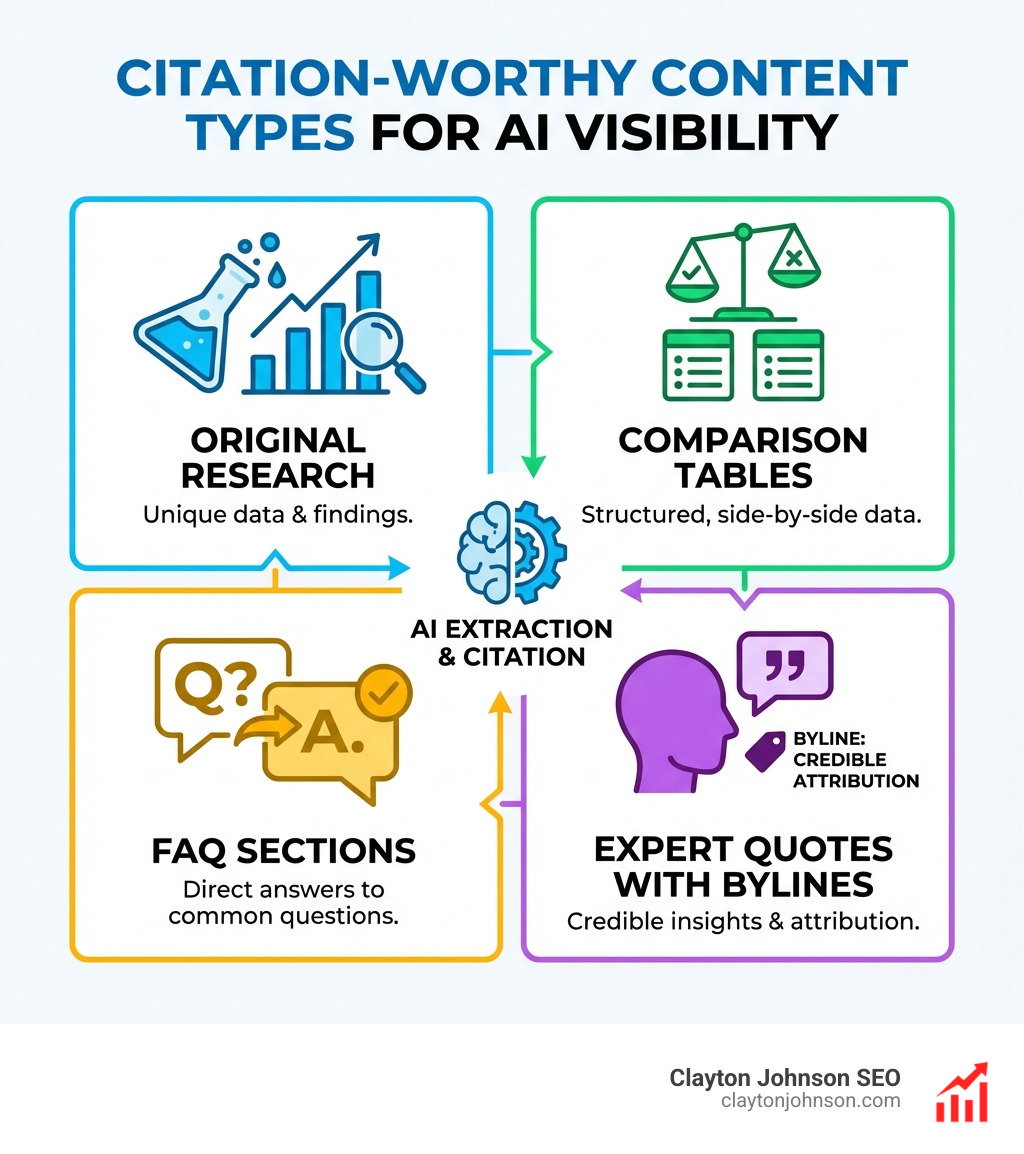
Structuring Content for AI Extraction
AI models love structure. They don’t want to dig through 2,000 words of fluff to find a price or a feature list.
- The BLUF Method: “Bottom Line Up Front.” Put your direct answer in the first 60 words of the section.
- Direct Answer Headers: Instead of a header like “Our Process,” use “How Does Our Structured Growth Architecture Work?”
- Schema Markup: Use JSON-LD (Article, FAQ, and Product schema) to give the AI a “cheat sheet” of your data.
- Numerical Facts: AI models love specific data. Instead of saying “We help companies grow,” say “Our clients see a 527% jump in AI-referred sessions.”
AI Visibility vs. Traditional SEO: A New Playbook
Is traditional SEO dead? No. In fact, 77% of AI optimization still relies on strong traditional SEO fundamentals like site speed and mobile friendliness. However, the overlap isn’t 1:1.
A study on the 62% overlap between Google and ChatGPT visibility found that being #1 on Google only gives you a about a 60% chance of being the top recommendation in ChatGPT. This means 40% of the time, ChatGPT is looking for something Google isn’t—namely, semantic relevance and directness.
This new playbook is called Generative Engine Optimization (GEO). While SEO focuses on “ranking,” GEO focuses on “influence.”
The Role of Custom GPTs and Plugins
One of the best ways to “force” a high ChatGPT SEO visibility score is to build your own Custom GPT.
- Branded Assistants: You can create a GPT that is trained specifically on your white papers, case studies, and pricing.
- Knowledge Bases: By uploading your proprietary frameworks to a Custom GPT, you ensure that anyone using that tool gets your exact methodology.
- API Actions: Advanced Custom GPTs can connect to your live data, allowing users to check stock, book consultations, or run diagnostics in real-time.
For founders, this is the ultimate “moat.” It’s not just about being found; it’s about providing a branded utility that competitors can’t replicate.
Benchmarking Against Competitors in AI Search
In the AI world, you need to know your “Share of Model.”
- Sentiment Analysis: Does ChatGPT describe your brand as “premium” or “affordable”? Does it mention your customer service as a pro or a con?
- Narrative Drivers: What are the common questions people ask that lead to your brand? If ChatGPT always mentions you for “SEO strategy” but never for “content architecture,” you have a narrative gap.
- Topic Gaps: Use tools to find “Topic Opportunities”—prompts where your competitors appear, but you are missing.
Frequently Asked Questions about AI Visibility
How long does it take to see results in ChatGPT?
Typically, you can see initial changes in how ChatGPT mentions your brand within 14 to 30 days of updating content and ensuring it’s indexed in Bing. Significant traffic and conversion shifts usually take 60 to 90 days.
Can I appear in ChatGPT if I don’t rank on Google page one?
Absolutely. Research confirms that ChatGPT cites pages in positions 21-100 nearly 90% of the time. If your content is the most direct and well-structured answer to a prompt, the AI will prioritize it over a “general” high-ranking page.
Does ChatGPT use Google or Bing for its web searches?
ChatGPT primarily uses Bing Search for its real-time web browsing capabilities. This is why optimizing for Bing Webmaster Tools is a core pillar of any AI visibility strategy.
Conclusion
The era of “guessing” at your digital impact is over. The ChatGPT SEO visibility score is the new frontier for brands that want to stay relevant in a world where AI is the first point of contact for consumers.
At Demandflow.ai, we don’t just chase “blue links.” We build structured growth architecture. We help you move from the chaos of random tactics to a compounding growth engine where your SEO, content, and AI visibility work in perfect harmony.
The shift to AI search is a “zero-sum” game. There are only a few citation spots available in a ChatGPT response. If you aren’t measuring and optimizing your presence today, you’re effectively handing those leads to your competitors.
Ready to stop guessing? Let’s build your growth infrastructure together.