The Best Marketing Examples to Spark Your Creativity


What Are the Best Marketing Examples You Can Learn From?
The best marketing examples share one thing in common: they connect with real people in ways that feel genuine, not manufactured. Here are the standout campaigns worth studying:
| Campaign | Brand | Why It Works |
|---|---|---|
| “You’re Not You When You’re Hungry” | Snickers | Universal insight adapted across 58 markets |
| #GuacDance Challenge | Chipotle | UGC drove 430M video starts + record digital sales |
| Share a Coke | Coca-Cola | Personalization at scale, 19% sales lift in China |
| Real Beauty | Dove | Challenged cultural norms, built emotional loyalty |
| New Face of Legs | CeraVe | Turned a viral meme into a phased product campaign |
| Just Do It | Nike | Emotional storytelling tied to a universal mindset |
| #carnavalvrij | Bavaria | Reached 25% of the Dutch population with local humor |
| Bird of the Week | RSPB | 190% follower growth using meme culture + education |
Most brands chase clever ideas. The best ones start with a deep understanding of their audience — then build campaigns that feel inevitable in hindsight.
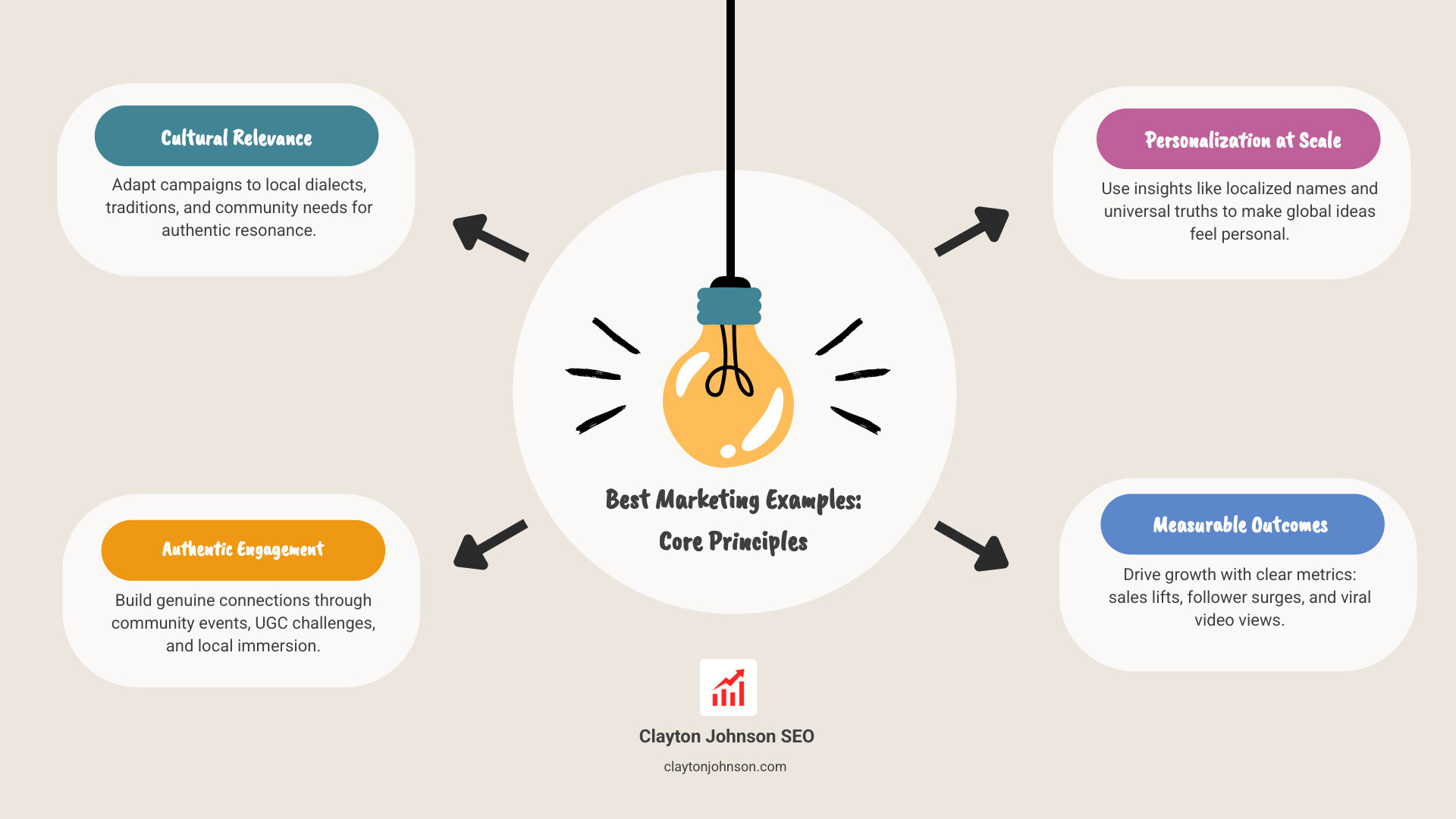
Whether you’re a local restaurant or a global brand, the principles behind these campaigns are transferable. Cultural relevance, authentic community engagement, and clear measurable outcomes are what separate forgettable ads from campaigns people actually talk about.
I’m Clayton Johnson, an SEO strategist and demand generation expert who has spent nearly two decades studying what makes marketing actually work — including the best marketing examples that drive compounding visibility and revenue growth. The patterns you’ll see in this article directly inform how I help brands build scalable systems that attract high-value clients.
Hyperlocal and Cultural Best Marketing Examples

When we talk about the best marketing examples, we often look at global giants, but the real “secret sauce” often lies in hyperlocal execution. Local marketing is the art of immersing a brand within a specific community. It’s not just about changing a zip code in an ad; it’s about understanding regional nuances and cultural adaptation.
Many national brands struggle to feel “human” at a local level. To solve this, we must move away from generic messaging and toward Market Positioning Strategy that respects the local voice.
| Element | Hyperlocal Campaign | National Campaign |
|---|---|---|
| Primary Goal | Community trust & foot traffic | Brand awareness & reach |
| Messaging | Dialect, local landmarks, specific needs | Universal truths, broad appeals |
| Scaling | Centralized framework, local impact | Uniform execution across all markets |
| Measurement | Local sales uplift, community sentiment | Global impressions, market share |
Community-Driven Best Marketing Examples
One of the most effective ways to build authority is to solve a real community need. Take The Big Biscuit’s Stuff the Bus campaign. While many brands do school supply drives, they made a critical decision: every single donation stays hyperlocal to the specific school district where that individual restaurant sits. This turns a corporate initiative into a neighborhood mission.
Similarly, Gymshark’s Londrette pop-up solved a very specific athlete pain point. They created a retro laundrette/tailor shop where Hyrox athletes could get their achievement patches stitched onto their gear. It wasn’t just a store; it was a service that recognized the community’s hard work.
For those in the hospitality space, Restaurant Marketing thrives on this type of local engagement. When we align our brand with the specific school districts or local events our customers care about, we stop being a “chain” and start being a neighbor.
Cultural Resonance and Dialect
True cultural relevance goes beyond translation—it requires transcreation. IKEA Malaysia provided one of the best marketing examples of this by using local dialect wordplay to launch a new store. By playing on phrases like “Kay Kia” (chick) and “Lo Kha Kia” (tall guy), they made a Swedish furniture giant feel like a local comedian.
In India, Taj Mahal Tea created a Guinness World Record billboard called “Megh Santoor.” This wasn’t just a sign; it was an environmentally interactive installation that played classical music when it rained. By celebrating the monsoon season—a time deeply cherished in Indian culture—they turned a weather event into a brand symphony.
We also see this in the beer industry. The Dutch brand Bavaria launched the #carnavalvrij campaign, petitioning for official days off during local carnival celebrations. It reached nearly a quarter of the Dutch population because it tapped into a specific regional desire for celebration. This is how you use Market Positioning Strategy to become culturally indispensable.
Scaling Impact Through Global Systems and AI

Scaling a “local” feel across 50+ markets requires more than just a big budget; it requires flexible Growth Systems. The goal is to maintain a core brand identity while allowing for product localization that resonates with different audience insights.

Adapting Global Campaigns for Local Markets
The Snickers “You’re not you when you’re hungry” campaign is a masterclass in global-to-local execution. It ran for years across 58 markets. While the core “hangry” insight is universal, the execution was hyper-localized. In the U.S., they used Betty White; in other markets, they used local celebrities that fit the same “disturbed by hunger” archetype.
McDonald’s is another titan of menu adaptation. They don’t just sell Big Macs; they sell local favorites like the McSpicy in India or regional sandwiches in Europe. This shows that the product itself is a marketing channel.
Coca-Cola’s Share a Coke campaign took this a step further by printing 250 of the most common millennial names on bottles. When they launched this in China, sales volume increased by 19%. They didn’t just use names; they used localized nicknames and social media integration to turn a beverage into a social currency.
User-Generated Content and Viral Best Marketing Examples
If you want your brand to grow without a massive ad spend, you need a Social Media Growth Plan that leverages user-generated content (UGC).
Chipotle’s #GuacDance challenge is a legendary example. By encouraging fans to show off their dance moves for National Avocado Day, they generated over 250,000 video submissions and 430 million video starts. It resulted in their highest digital sales day in company history.
Other brands like GoPro use their GoPro Awards to keep a constant stream of high-quality content flowing. By incentivizing creators to submit their best clips, they build a community while showcasing the product’s capabilities. Even Olipop saw massive success by amplifying the organic #SleepyGirlMocktail trend, resulting in 570 million media impressions without a single dollar of paid spend.
AI-Augmented Creativity and Personalization
AI is no longer just for data crunching; it’s a tool for high-level creativity. Coca-Cola’s “Create Real Magic” campaign allowed fans to use DALL-E and ChatGPT to generate original artwork inspired by the brand. The best submissions were featured on billboards, turning customers into digital artists.
Nike used an AI Content Strategy to pit Serena Williams against her younger self in a simulated match. By analyzing 20 years of footage, they created a “Never Done Evolving” campaign that was both a technical marvel and an emotional tribute.
Carvana took personalization to the extreme by creating 1.3 million unique AI-generated video ads. Each video was tailored to a specific customer’s car-buying journey. This level of mass personalization is only possible through AI SEO Workflow integrations that automate the heavy lifting of content creation.
Building Authority and Brand Trust
In an era of skepticism, transparency is a competitive advantage. The Ordinary (DECIEM) built massive trust by selling high-quality ingredients at fair prices and documenting exactly why those prices were possible. Their Secret Ingredient Store pop-up reinforced this by visualizing the costs of celebrity endorsements—showing stacks of fake money to represent what other brands spend on “hype” instead of product.
This approach aligns with the “service recovery paradox.” Research suggests that if a company fixes a problem exceptionally well, the customer ends up liking them more than if the problem never happened. By proactively admitting industry flaws, brands like The Ordinary and Dove (with their Real Beauty campaign) position themselves as the honest alternative.
At Clayton Johnson SEO, we apply these same principles of transparency and authority to search. We don’t just chase clicks; we build scalable traffic systems based on SEO Content Marketing that proves value before asking for a sale.
How to Measure Success in the Best Marketing Examples

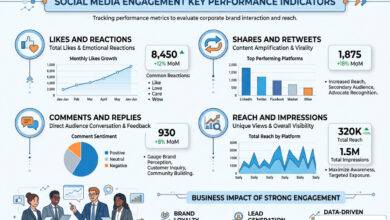
A campaign is only as good as the data behind it. When analyzing the best marketing examples, we focus on three main pillars:
- Engagement Metrics: Are people talking back? For example, the Calvin Klein x Bad Bunny campaign generated 3.7 million likes and 56 million views in just 48 hours.
- Sales Uplift: Did the cash register ring? NYX France’s #TrueIDCard campaign led to a 20% sales increase—their best month ever—by addressing a real social issue regarding ID photos.
- Loyalty and Advocacy: Will they stay? A fifth of KFC fans say they are likely to advocate for the brand if they feel a personal relationship with it.
Audience Insights Drive the Engine
The difference between a viral hit and a “meh” ad is often Customer Segmentation Product Insight.
For instance, Heinz and Lick paint collaborated because they found that 39% of condiment buyers are also interested in DIY and home improvement. This isn’t a random pairing; it’s a data-backed brand extension. Similarly, Hilton’s 10-minute TikTok video worked because they knew 44% of their target travelers were already watching long-form video content.
By using Buyer Personas, we can predict which “weird” ideas will actually resonate. Whether it’s CeraVe partnering with Michael Cera or Mercedes-Benz launching the #MBStarChallenge (which saw a 66.3% increase in ad recall), the success always stems from a deep understanding of audience behavior.
Key Takeaways for Your Next Campaign
If you want to create one of the best marketing examples of the future, keep these principles in mind:
- Centralize the Program, Localize the Impact: Build a framework that allows local managers to make a difference in their own school districts or neighborhoods.
- Use AI for Leverage, Not Just Automation: Use AI Marketing Software to create personalized experiences at a scale humans can’t reach alone.
- Action Over Words: Build trust by showing your work. Use transparency as your primary Brand Positioning tool.
- Embrace the “Service Recovery Paradox”: Don’t be afraid to address industry problems or customer pain points head-on.
- Measure What Matters: Focus on sales and loyalty, not just vanity impressions.
Ready to build your own high-performance marketing engine? At Clayton Johnson SEO, we specialize in turning fragmented efforts into coherent growth systems. Whether you need a Step-by-Step Guide to Winning Social Media Campaigns or a complete SEO Content Strategy, we build the architecture that makes growth inevitable.
Don’t just post and pray. Build a system that compounds. Explore our Strategic Frameworks today and start creating marketing that people actually remember.