Why Answer Engines Are Redefining Growth Strategy
Perplexity for growth hacking represents a fundamental shift in how startups acquire, activate, and retain users—not through traditional search optimization alone, but by engineering visibility inside AI-generated answers that millions of users now trust more than blue links.
Quick Answer: How to Use Perplexity for Growth Hacking
- Optimize for citations — Structure content with answer-first formatting, schema markup, and citation-ready snippets under 25 words
- Target AI-crawlable domains — Publish on Reddit, Medium, GitHub, and Quora where Perplexity’s retrieval layer shops for answers
- Leverage the Search API — Automate competitive intelligence, market research, and real-time trend analysis to stay ahead
- Build shareable knowledge assets — Use Perplexity Pages and Spaces to create user-generated SEO loops
- Engineer growth loops — Combine conversational engagement, freemium conversion, and multi-platform distribution for compounding results
The scale tells the story: Perplexity processes massive query volume and has become one of the most-used answer engines—because its experience was engineered for habit formation through compounding loops that turn single searches into sustained workflows.
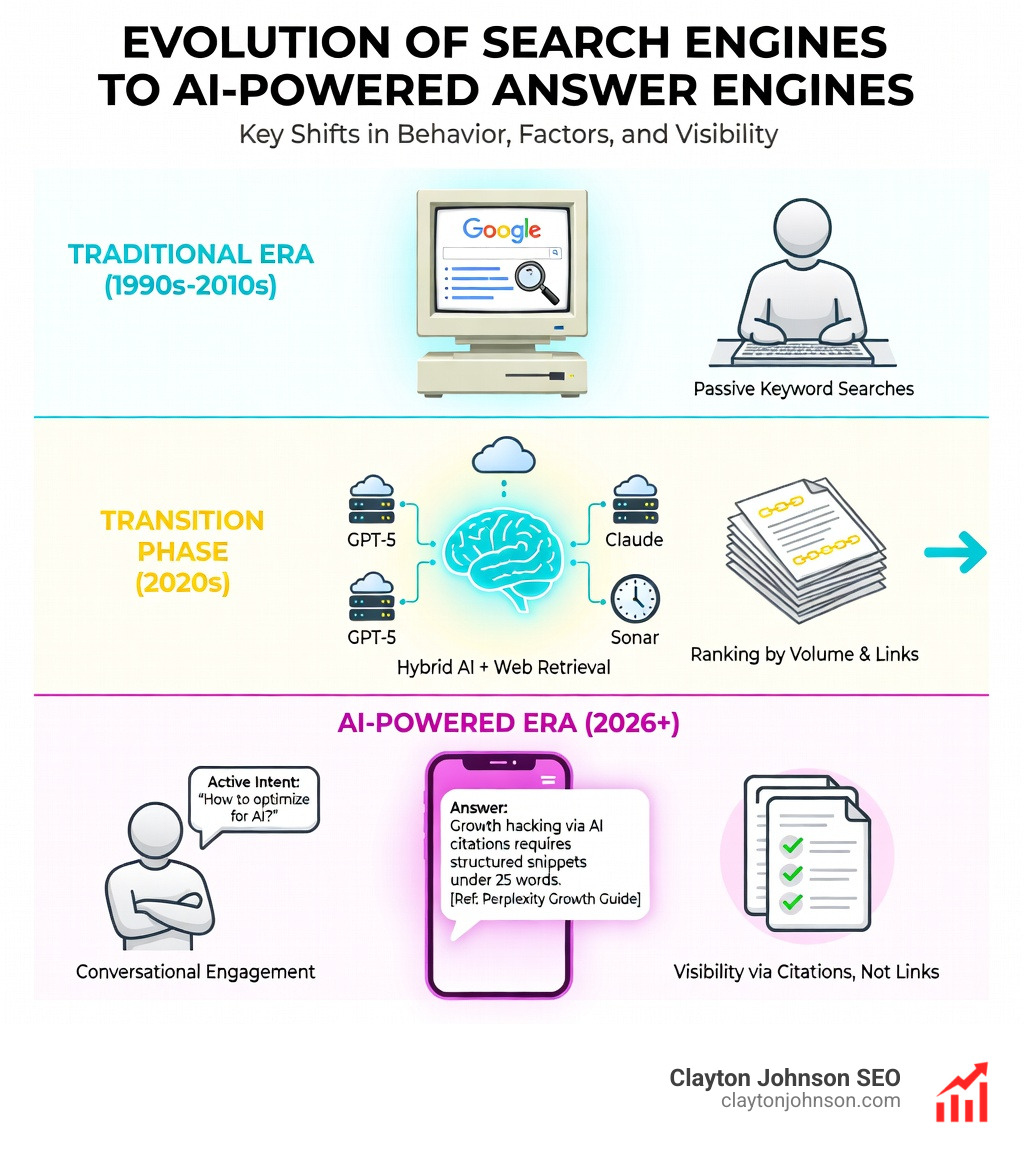
While most companies treat AI search as a future concern, early adopters are already capturing citations inside the answers that shape buying decisions. Perplexity doesn’t just surface links—it synthesizes information and recommends solutions, positioning cited sources as the primary answer rather than one option among many.
The platform uses multiple large language models (GPT, Claude, Gemini, Grok, and its proprietary Sonar model) combined with real-time web search to deliver responses users actually trust. Unlike Google’s link-heavy results or ChatGPT’s often-unsourced outputs, Perplexity provides inline citations that drive referral traffic and brand authority.
For growth-focused founders, this creates three immediate opportunities:
- Visibility compression — As AI answers replace traditional SERPs, being cited once matters more than ranking #5
- Intent capture — Conversational search reveals deeper user needs than keyword queries alone
- Distribution leverage — Content that answers AI queries compounds through multiple platforms simultaneously
But here’s what most miss: optimizing for Perplexity isn’t about gaming algorithms—it’s about building content architecture that AI platforms naturally want to cite. This means structured data, topical authority clusters, and answer-oriented formatting that serves both humans and retrieval systems.
I’m Clayton Johnson, and I’ve spent the past several years helping founders engineer scalable SEO systems and AI-assisted marketing workflows that drive measurable pipeline growth. Understanding Perplexity for growth hacking means recognizing that traditional search optimization must evolve into answer-engine optimization—and the companies that adapt first will capture disproportionate market attention.
Discover more about Perplexity for growth hacking:
- Perplexity
- Perplexity AI interactive tools
- Perplexity AI marketing workflows
The Rise of the Answer Engine: Perplexity AI Explained
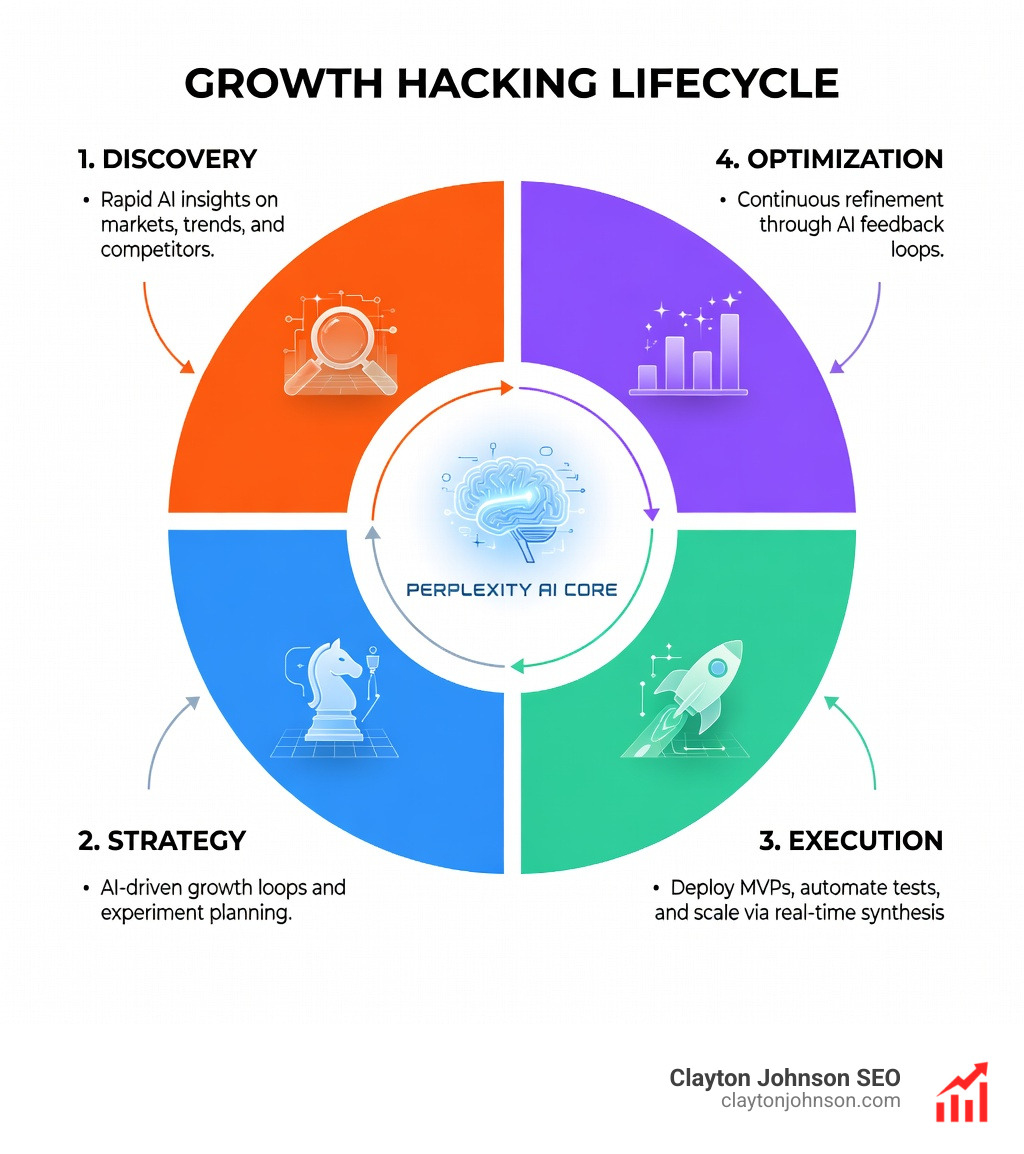
Perplexity AI didn’t just appear out of thin air; it was forged by some of the brightest minds in the AI space. Founded by Aravind Srinivas, Denis Yarats, Johnny Ho, and Andy Konwinski, the team brought heavy-hitting experience from OpenAI, Meta, Quora, and Databricks. Their goal was simple yet audacious: to challenge Google’s monopoly by building a search engine that actually answers questions instead of just listing links.
When Perplexity launched its AI-powered answer engine, it immediately differentiated itself through a citation-first model. While ChatGPT can be prone to “hallucinations” (making things up), Perplexity provides verifiable sources for every claim. This focus on trust helped it rapidly become one of the most visible answer engines in the market.
| Feature | Perplexity AI | Google Search | ChatGPT |
|---|---|---|---|
| Primary Output | Synthesized Answer | List of Links | Conversational Text |
| Real-time Web Access | Yes (Core feature) | Yes (AI Overviews) | Limited/Plugin-based |
| Citations | Inline & Verifiable | Site Titles/Snippets | Often Missing |
| Business Model | Subscription/Shopping | Advertising | Subscription |
| Search Intent | Informational/Research | Navigational/Commercial | Creative/Productivity |
Leveraging Perplexity for growth hacking in Market Research
For us growth hackers, Perplexity is the ultimate weapon for real-time market intelligence. Because it indexes the live web, you can spot trends as they happen. Want to know what people are saying about a competitor’s new launch on Reddit and X? Perplexity aggregates that sentiment in seconds.
With the launch of Comet, its first browser with AI search, Perplexity has embedded itself directly into the user’s workflow. As a growth tool, you can use Comet to:
- Analyze consumer sentiment across multiple platforms simultaneously.
- Identify content gaps by seeing which questions Perplexity struggles to answer authoritatively.
- Monitor competitor positioning by querying how AI models describe your rivals’ unique selling propositions (USPs).
Reverse-Engineering the Perplexity Growth Machine
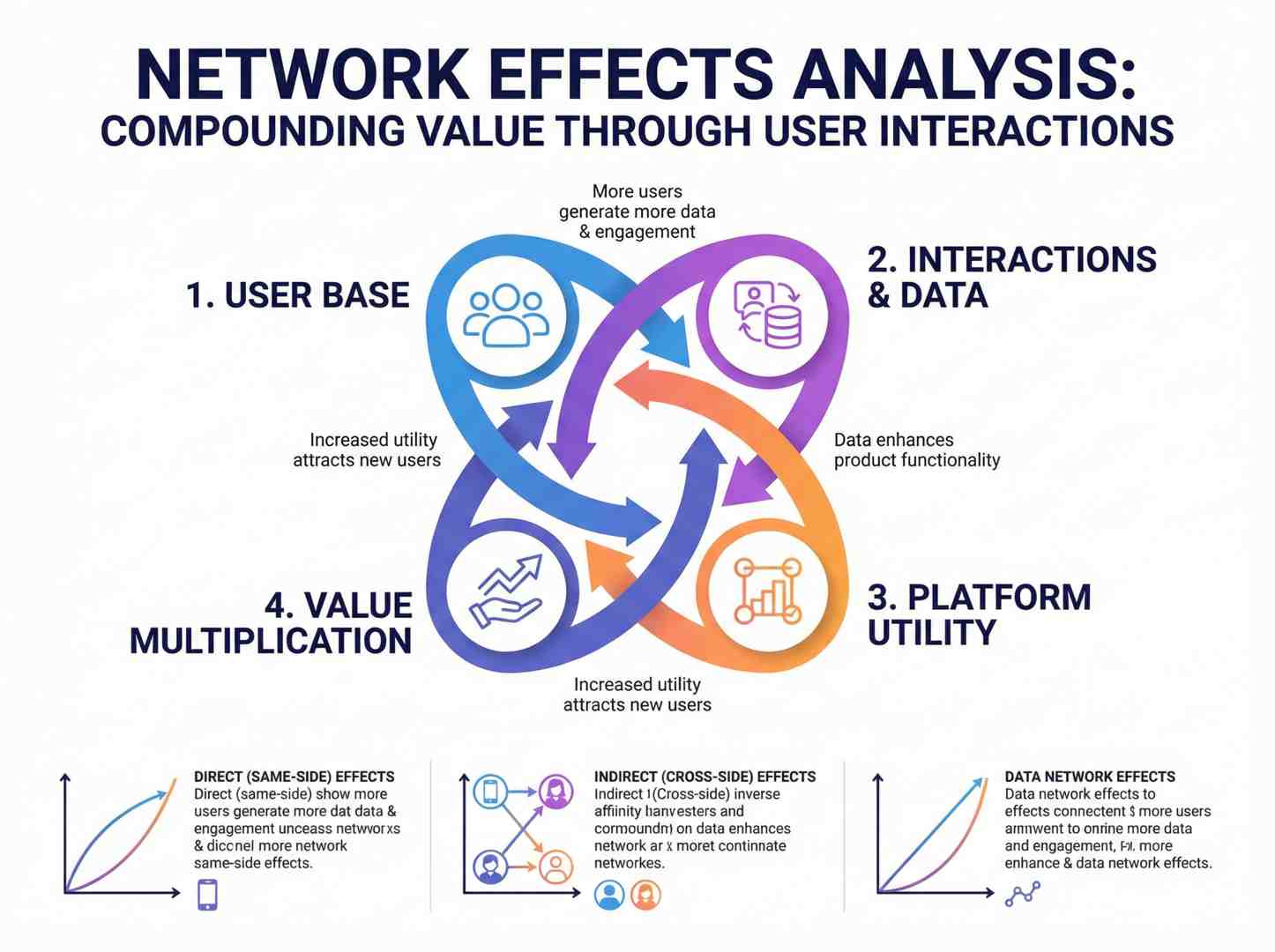
Perplexity’s rise to a large, highly engaged user base wasn’t just due to a great product—it was driven by six compounding growth loops. Unlike a traditional linear funnel where you pay for every user, these loops create a self-reinforcing engine.
- The Curiosity Loop: Users ask a question, get a great answer, and are immediately prompted with “Related Questions,” extending session times and deepening engagement.
- The Shareable Knowledge Loop: Users turn research into public “Pages” that can index on search engines, bringing in new organic traffic.
- The Freemium Conversion Loop: Powerful free features drive virality, while power users upgrade to Pro for advanced models.
- The AI Data Feedback Loop: Every user interaction refines their “modern PageRank,” making the engine smarter with every query.
- The Multi-platform Distribution Loop: Launches on iOS, Android, and Chrome extensions help intercept users wherever they browse.
- The Hype & Media Loop: Bold moves and high-profile narratives generate outsized PR and keep the product in the public conversation.
If you’re looking for more info about SEO content marketing, you’ll see that Perplexity’s strategy is essentially “Product-Led SEO” on steroids. They don’t just wait for people to find them; they create assets that people want to share.
The Shareable Knowledge Loop
The most potent weapon in Perplexity’s arsenal is User-Generated SEO. Through features like Perplexity Pages, users can transform a thread of research into a beautiful, shareable webpage.
- Perplexity Pages: These allow users to publish reports that are highly crawlable by search engines. This creates a “parasite SEO” effect where Perplexity’s high domain authority helps user content rank, which in turn drives more users back to Perplexity.
- Collaborative Spaces: This turns a “single-player” search experience into a “multiplayer” one. Teams can share research folders, which is a massive retention hook for enterprise users.
- Discovery Feed: By showcasing trending queries (e.g., “What is the least visited country?”), Perplexity creates a “timeline for knowledge” that encourages habitual browsing.
Technical SEO for Perplexity for growth hacking

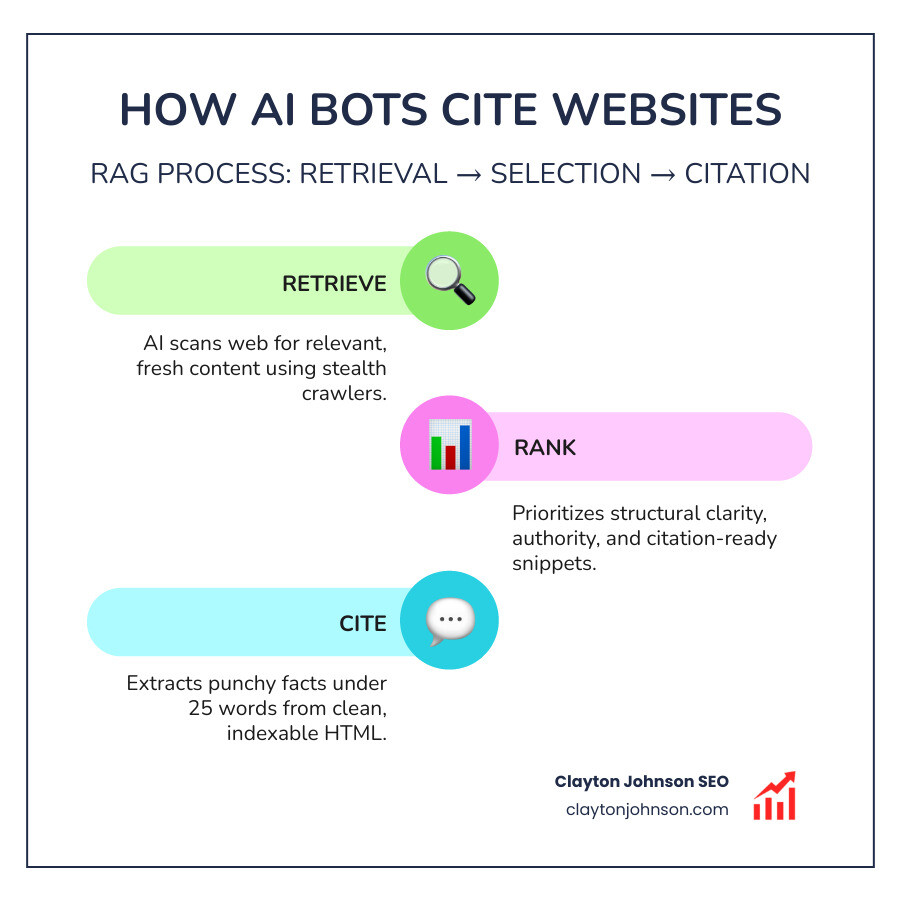
In Perplexity for growth hacking, traditional keyword stuffing is dead. We are now in the era of Generative SEO (GEO) or Answer Engine Optimization (AEO). Perplexity uses Retrieval-Augmented Generation (RAG), which means it “retrieves” facts from the web and “generates” a summary. To be the one it cites, you need to be “retrieval-friendly.”
A study on page authority and citations shows that while authority matters, content freshness and structural clarity are the primary predictors of getting cited. Perplexity prefers “citation-ready snippets”—short, punchy sentences (ideally under 25 words) that are easy for an LLM to extract.
The Golden Rules of Answer-First Formatting:
- Lead with the Answer: Don’t bury the lead. Put the direct answer to the user’s likely question in the first paragraph.
- Use Structured Data: Implement FAQ, HowTo, and Organization schema.
- Target “Index-Favorite” Domains: Perplexity loves citing Reddit, Quora, Medium, and GitHub. If you can’t rank your own site yet, get your brand mentioned on these platforms.
Optimizing for Stealth Crawlers and Retrieval
Perplexity uses its own crawlers (PerplexityBot) and sometimes spoofs user agents to bypass restrictive robots.txt files—a tactic that has stirred controversy with platforms like Cloudflare. To stay in their good graces and ensure you are cited, you must make your site a “clear read” for their bots.
- Robots.txt: Ensure you aren’t accidentally blocking PerplexityBot. Check Perplexity’s resources on crawlers for the latest IP ranges to whitelist.
- Content Clusters: Build deep topical authority. If you want to be cited for “SaaS growth hacking,” you need a pillar page supported by 10-20 cluster articles all interlinked.
- Clean HTML: Avoid heavy Javascript that hides content. Perplexity needs to see the text immediately.
Advanced Growth Tactics Using the Perplexity Search API
The real “god mode” for Perplexity for growth hacking is the Perplexity Search API. For about £4 per 1,000 requests, you get access to a real-time web index that has already been processed by an AI. This isn’t just a list of links; it’s a stream of structured intelligence.
By integrating this with your growth stack, you can move from reactive marketing to proactive marketing. For founders, this is the core of “structured growth architecture.” If you need more info about SEO consultancy, you’ll find that the most advanced agencies are now using APIs to automate the research phase of content creation.
Building Proactive Marketing Workflows
We use the Perplexity API to build “Market-Adaptive Strategies.” Here are some high-impact use cases:
- Automated Competitive Intelligence: Set up a script that queries Perplexity every week: “What are the top 3 complaints about [Competitor Name] on social media this week?” Use the output to trigger targeted ad campaigns.
- Real-Time Content Ideation: Feed the API trending topics in your niche and ask it to identify “unanswered questions.” This ensures your content calendar is always ahead of the curve.
- Dynamic Sales Briefs: Before a sales call, use the API to pull the prospect’s latest news, financial reports, and recent LinkedIn posts into a one-page brief.
- Demandflow Integration: At Demandflow.ai, we use these real-time data flows to fuel our growth operating system, ensuring founders are making decisions based on today’s market, not outdated assumptions.
Frequently Asked Questions about Perplexity
How does Perplexity differentiate from Google?
Google is a link engine; Perplexity is an answer engine. Google wants you to click on ads; Perplexity wants to give you the information immediately with citations. While Google is moving toward AI Overviews, Perplexity’s entire architecture is built around conversational research and verifiable sources, making it much more efficient for deep learning and complex tasks.
Is Perplexity for growth hacking better than ChatGPT?
For growth hacking, yes. ChatGPT is a “closed book” (its training data has a cutoff), whereas Perplexity is an “open book” with real-time web access. When you’re researching competitors or trends, you need to know what happened ten minutes ago, not two years ago. Perplexity’s citation model also makes it much more reliable for business intelligence.
How can I track my brand’s visibility on Perplexity?
Unlike Google Search Console, there isn’t a direct “Perplexity Console” yet. However, you can track mentions by:
- Using the Perplexity API to search for your brand and count citations.
- Monitoring referral traffic from
perplexity.aiin your analytics. - Using AI-tracking tools like Surfer’s AI Tracker to see if your site appears in specific query responses.
Conclusion
Mastering Perplexity for growth hacking isn’t just a tactical advantage—it’s a strategic necessity in the AI-first era. By understanding the compounding growth loops that built Perplexity into a $20 billion giant, we can apply those same principles of leverage, structure, and trust to our own businesses.
At Clayton Johnson and Demandflow.ai, we believe that clarity leads to structure, and structure leads to compounding growth. Whether you are optimizing your technical SEO for RAG retrieval or building automated intelligence workflows via the Search API, the goal is the same: to become the “authoritative answer” in your market.
If you’re ready to stop chasing tactics and start building structured growth infrastructure, we can help. From more info about conversion optimization to full-scale AI-augmented marketing systems, the future belongs to those who adapt to the answer engine revolution.