Why the Business Model Canvas Belongs in Every Strategist’s Toolkit
The Business Model Canvas is a one-page strategic framework that maps how your business creates, delivers, and captures value — across nine interconnected building blocks.
Here’s a quick snapshot of what it covers:
| Building Block | What It Answers |
|---|---|
| Customer Segments | Who are you serving? |
| Value Propositions | What problem do you solve? |
| Channels | How do you reach customers? |
| Customer Relationships | How do you keep them? |
| Revenue Streams | How do you make money? |
| Key Resources | What do you need to deliver value? |
| Key Activities | What must you do well? |
| Key Partnerships | Who helps you operate? |
| Cost Structure | What does it cost to run? |
It was created by Alexander Osterwalder and popularized in the bestselling book Business Model Generation. Today it’s practiced by millions — from early-stage founders to Fortune 500 teams at companies like Microsoft, Coca-Cola, and Nestlé.
What makes it powerful isn’t just the structure. It’s the speed. You can map an entire business model in a single session — and iterate just as fast when the market shifts.
I’m Clayton Johnson — SEO strategist and growth architect. I work with founder-operators and marketing leaders to build structured growth systems, and the Business Model Canvas is one of the core frameworks I use to diagnose how value flows (or breaks down) inside a business. It’s where strategy gets visible.
What is the Business Model Canvas?
At its simplest, the Business Model Canvas (BMC) is a visual chart that describes a firm’s or product’s value proposition, infrastructure, customers, and finances. It provides a common language for everyone in the room — from the CEO to the intern — to discuss the business without getting lost in 50-page business plans that nobody actually reads.
Think of it as the “architectural blueprint” for your revenue. If you were building a house in Minneapolis, you wouldn’t just start nailing boards together; you’d look at a blueprint. The BMC is that blueprint for your business logic.
The tool was originally proposed by Alexander Osterwalder, based on his PhD thesis supervised by Yves Pigneur. They eventually realized that the world didn’t need another academic paper; it needed a practical tool. They co-founded Strategyzer and published Business Model Generation, a book that changed how we think about strategy.
You can Download the official Business Model Canvas template to get started. For a deeper look at how this fits into our broader strategy philosophy, check out our strategic-frameworks/business-model-canvas/ page.
The Origins and Global Impact
The Business Model Canvas wasn’t just cooked up in a lab by two guys. It was co-created by 470 practitioners from 45 countries. This massive collaborative effort ensured the tool was grounded in real-world application, not just theory.
Its impact has been staggering:
- Practiced by millions worldwide.
- Available in 36 languages, making it a truly global standard.
- Adopted by giants like Intel, 3M, and MasterCard.
- Ranked No. 4 among the top 50 management thinkers worldwide (Alex Osterwalder).
Whether we are working with a local startup in the Twin Cities or a global enterprise, the BMC helps us cut through the noise. It transforms the abstract notion of a business “model” into something tangible.
The Nine Building Blocks of the Business Model Canvas
To master the canvas, you have to understand its layout. It’s not just a random collection of boxes. The layout is designed to show how different parts of your business interact.
The canvas is split into two main sections:
- The Right Side (The Front Stage): This represents the “Value” and the “Customer.” It’s about desirability.
- The Left Side (The Back Stage): This represents the “Infrastructure” and “Efficiency.” It’s about feasibility.
- The Bottom: This is the “Financial” foundation — your cost structure and revenue streams. This is about viability.
Customer-Facing Building Blocks of the Business Model Canvas
The right side of the canvas focuses on the customer and the value you bring to them. This is often where we start because, without a customer and a reason for them to buy, the rest of the canvas doesn’t matter.
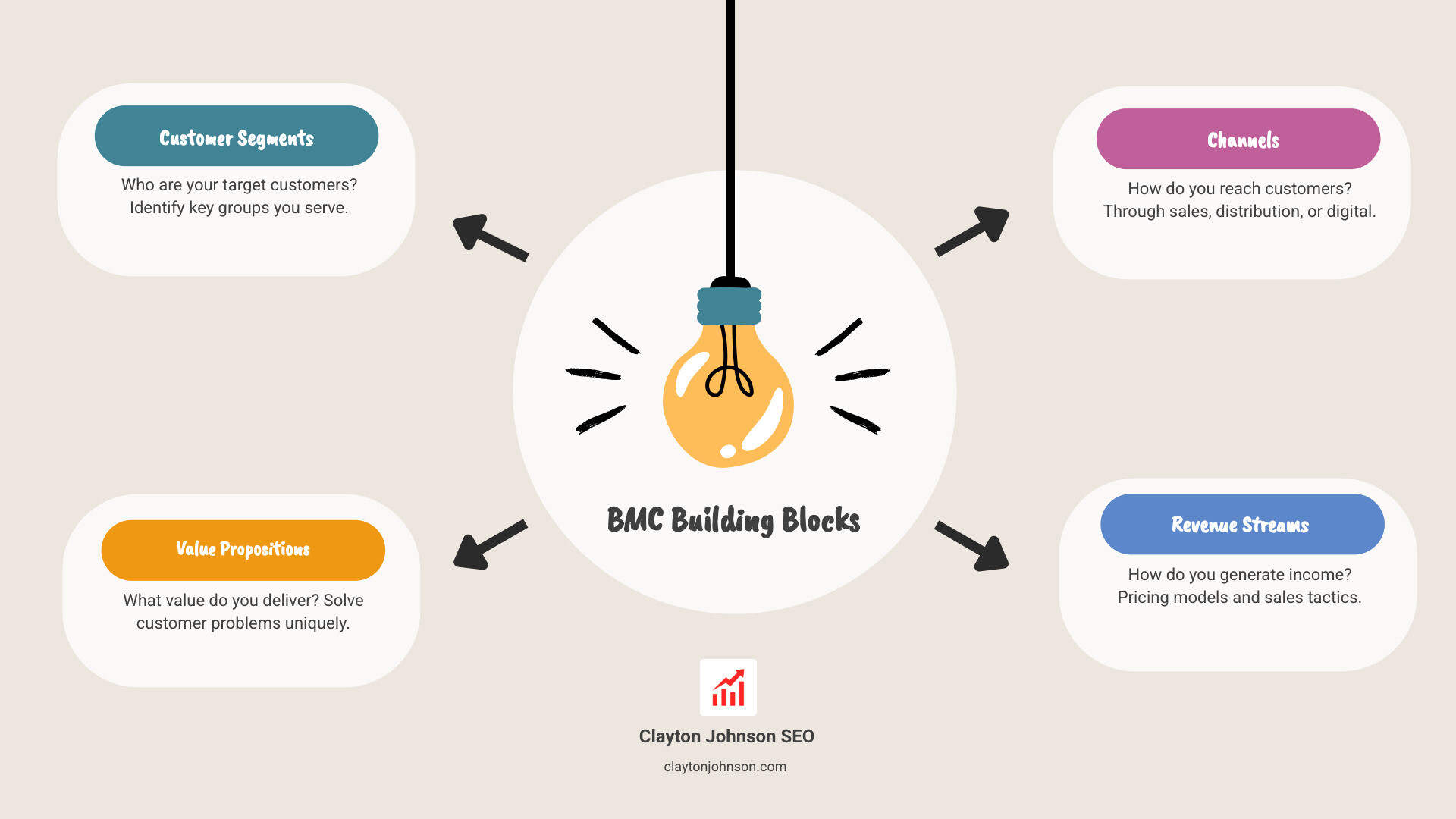
- Customer Segments: These are the different groups of people or organizations your company aims to reach and serve. Are you targeting the mass market or a niche? In our work with the-essential-guide-to-bmc-customer-discovery/, we emphasize that if you try to serve everyone, you often end up serving no one.
- Value Propositions: This is the heart of the canvas. It describes the bundle of products and services that create value for a specific Customer Segment. Why should someone buy from you instead of a competitor in Minnesota? Is it price, performance, or a unique experience?
- Channels: How do you communicate with and reach your customers? This includes everything from your website and social media to physical storefronts or partner distributors.
- Customer Relationships: This describes the types of relationships a company establishes with specific Customer Segments. Is it high-touch personal assistance or automated self-service?
- Revenue Streams: This represents the cash a company generates from each Customer Segment. How are they paying? Subscriptions? One-time fees? Licensing?
We dive deeper into the marketing side of these blocks in our guide on mastering-bmc-channels-and-relationships-for-better-marketing/.
Infrastructure and Financial Building Blocks of the Business Model Canvas
Once we know who we are serving and what we are selling, we have to figure out how to actually do it. This is the “Back Stage” of your business.
- Key Resources: The most important assets required to make a business model work. This could be physical (factories), intellectual (patents), human (experts), or financial.
- Key Activities: The most important things a company must do to make its business model work. For a software company, this is coding. For a consulting firm, it’s problem-solving.
- Key Partnerships: The network of suppliers and partners that make the business model work. We often help clients determine how-to-choose-the-right-key-partners-in-bmc/ to reduce risk and acquire resources.
- Cost Structure: All costs incurred to operate a business model. Are you cost-driven (like a low-cost airline) or value-driven (like a luxury hotel)?
For those looking to tighten the belt, we have a deep-dive-into-bmc-cost-structure-and-expense-management/ that provides actionable strategies for managing these numbers.
How to Fill Out Your Canvas Step-by-Step
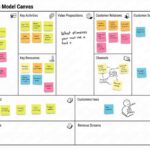
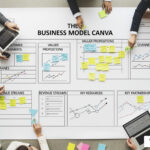
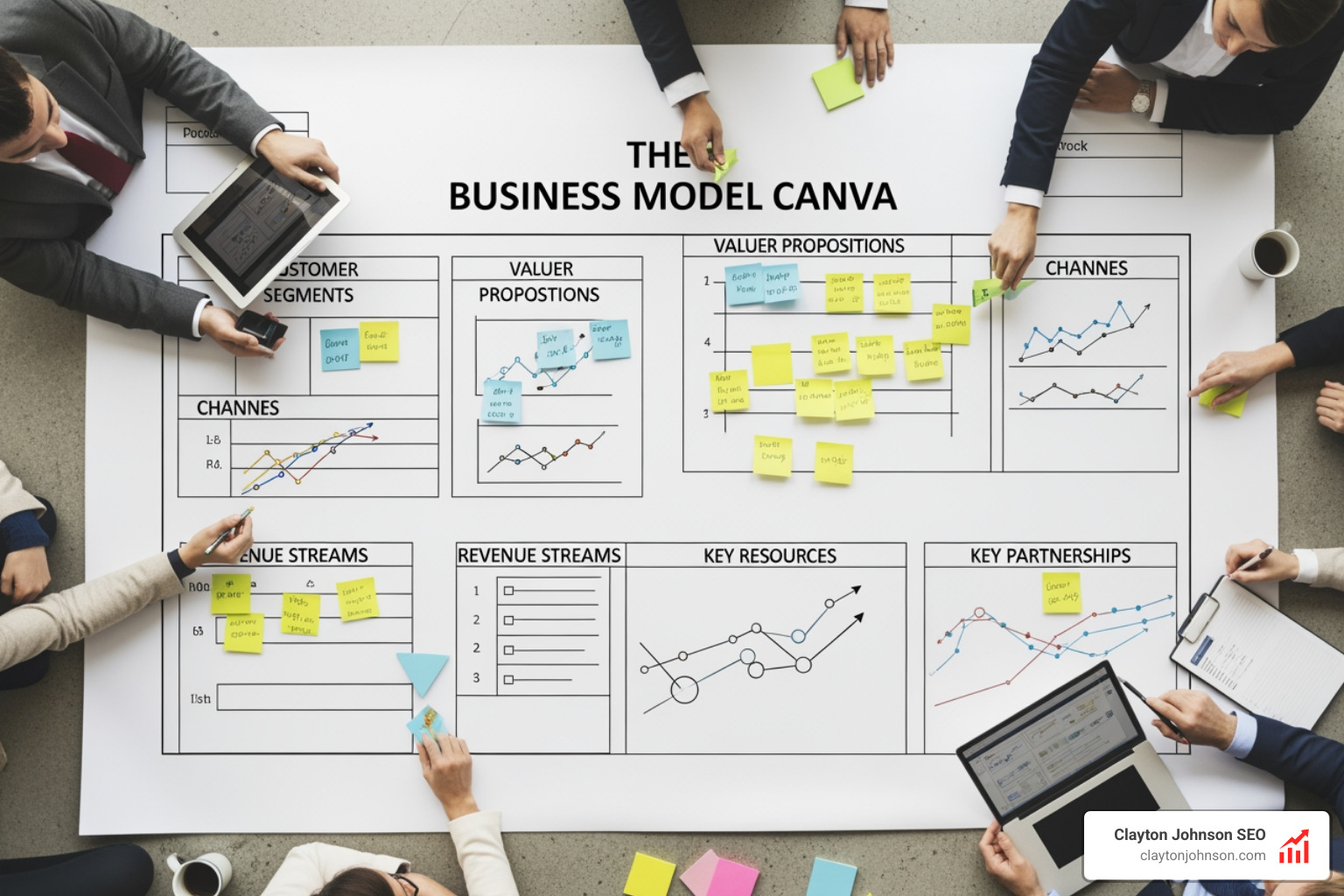
Filling out a Business Model Canvas isn’t a solo sport. It’s a team activity. We recommend printing a giant version of the canvas and sticking it on a wall in your office.
Here is the workflow we typically follow:
- Identify Customer Segments: Start by listing your top 3 customer segments. Who brings in the most revenue? Who are you most excited to serve?
- Define the Value Proposition: For each segment, what is the #1 problem you solve?
- Map the Channels: How do those customers find you? How do you deliver the product?
- Establish Relationships: What kind of vibe do you have with your customers? Is it a “we’re best friends” high-touch model or a “set it and forget it” automated model?
- List Revenue Streams: How does the money actually move from their pocket to yours?
- Identify Key Resources and Activities: What do you need to have and what do you need to do to deliver that value?
- Select Key Partners: Who do you need to work with to make this happen?
- Calculate Cost Structure: What are the big-ticket items on your expense report?
Treat this as a series of hypotheses. You aren’t writing these in stone; you’re writing them on sticky notes. If a customer segment doesn’t work out, you pull the note off and try another.
For more on this visual mapping process, see our guide on how-to-visualize-your-business-with-bmc-mapping/. If you are running a team session, you’ll want to read the-ultimate-canvas-workshop-facilitation-guide-for-pros/.
Collaboration and Digital Tools
While we love physical sticky notes, the world has gone digital. If your team is spread across the Twin Cities or the globe, you need tools that support real-time brainstorming.
- Strategyzer Platform: The gold standard for professional business modeling.
- Confluence Whiteboards: You can Create a business model canvas in Confluence whiteboards for free, which is great for teams already in the Atlassian ecosystem.
- Canva: Excellent for creating high-resolution, presentation-ready canvases for stakeholders.
The goal is to move from “I think our business works like this” to “We all see that our business works like this.”
BMC vs. Lean Canvas: Choosing the Right Framework
A common question we get is: “Should I use the Business Model Canvas or the Lean Canvas?”
The Lean Canvas, created by Ash Maurya, is an adaptation of the BMC specifically for startups. While the BMC is great for any business, the Lean Canvas focuses more on “Problem-Solution Fit.”
| Feature | Business Model Canvas | Lean Canvas |
|---|---|---|
| Primary Focus | Strategic management & existing businesses | Startups & entrepreneurship |
| Key Components | Partnerships, Activities, Resources | Problem, Solution, Key Metrics, Unfair Advantage |
| Goal | Value creation & capturing | Risk management & validation |
| Best For | Established companies or complex models | Early-stage ideas & fast iteration |
If you are a tech founder, you might find the Lean Canvas more intuitive for those early days of searching for a market. We break down the nuances in mastering-the-lean-startup-model-canvas-for-new-ventures/ and show you how-to-blend-lean-startup-and-bmc-for-success/.
Strategic Integration and Common Pitfalls
The BMC is powerful, but it’s not a silver bullet. To get the most out of it, we integrate it with other strategic tools.
- Value Proposition Canvas: This tool “zooms in” on the Customer Segment and Value Proposition blocks to ensure you are actually building something people want.
- SWOT Analysis: Use the BMC to perform a SWOT analysis. What are the strengths of your revenue streams? What are the weaknesses in your cost structure? Check out the-ultimate-guide-to-bmc-swot-integration-canvas/ for a template.
- Digital Transformation: Use the canvas to map out how new technology can disrupt your existing model. See digital-innovation-via-the-business-model-canvas/ for more.
Mistakes to Avoid in Business Modeling
We have seen a lot of canvases in our time, and most people make the same few mistakes:
- Static Thinking: Treating the canvas as a one-time exercise. It should be a living document that changes as you learn.
- Lack of Validation: Just because you wrote it on a sticky note doesn’t mean it’s true. You have to get out of the building and talk to customers.
- Over-Complexity: If your canvas is so crowded that nobody can read it, it has failed its primary purpose: simplicity.
- Siloed Development: Having one person create the canvas in a vacuum. Strategy is a team sport.
- Ignoring Competition: Mapping your own model is great, but have you mapped your competitor’s model? It’s a fantastic way to find gaps in the market.
For tech startups specifically, we developed the-definitive-bmc-tech-startup-template-for-scalable-growth/ to help avoid these traps.
Frequently Asked Questions about the BMC
What is the main purpose of the Business Model Canvas?
The main purpose is to provide a visual, concise way to describe, design, and pivot a business model. It replaces long, text-heavy business plans with a single-page roadmap that highlights the interdependencies between different parts of the business.
How does the BMC support business pivoting?
Because the BMC is visual and uses sticky notes (physically or digitally), it allows teams to quickly swap out assumptions. If your “Channels” aren’t working, you can easily visualize how changing to a new channel impacts your “Cost Structure” and “Customer Relationships.” It’s built for agility.
Can the BMC be used for existing large organizations?
Absolutely. In fact, many Fortune 500 companies use it to manage a portfolio of business models. They use it to “exploit” their current successful models while “exploring” new, disruptive models for the future.
Conclusion
The Business Model Canvas is more than just a template; it’s a mindset. It forces us to stop thinking about our business as a list of tasks and start thinking about it as a system of value.
At Clayton Johnson, we believe that clarity leads to structure, and structure leads to compounding growth. We use frameworks like the BMC to build the “growth architecture” that modern companies need to thrive. Whether we are refining your SEO strategy or architecting your entire market position, we focus on the leverage points that move the needle.
If you are ready to stop guessing and start building a structured growth system, we are here to help. Master your strategic frameworks today and see how a little bit of structure can lead to a lot of growth.