Search intent targeting is the practice of aligning your content with the actual goal behind a search query — not just the keywords themselves.
Here’s a quick breakdown of what that looks like in practice:
| Intent Type | What the User Wants | Example Query |
|---|---|---|
| Informational | Learn something | “what is search intent” |
| Navigational | Find a specific site | “Google Search Console login” |
| Commercial | Compare before buying | “best SEO tools” |
| Transactional | Complete a purchase or action | “buy SEO audit template” |
| Local | Find something nearby | “SEO agency near me” |
| Generative AI | Get a tangible output | “write a meta description for X” |
The idea is simple: match what your page delivers to what the searcher actually wants. When you do, Google rewards you with rankings. When you don’t, your content gets buried — no matter how well-written it is.
And the stakes are real. One landing page that was realigned to match search intent generated 516% more traffic in under six months — not from more content, but from better intent alignment.
Yet most founders and marketing teams are still publishing content that ranks for the right keywords but answers the wrong question. Traffic exists, but it doesn’t convert. Pages exist, but they don’t satisfy. That’s an intent problem, not a content problem.
I’m Clayton Johnson — an SEO strategist and growth architect who has built scalable traffic systems around search intent targeting for founders and marketing leaders across dozens of business models. This guide is the structured framework I use to turn fragmented content into a compounding demand engine.
The Core Pillars of Search Intent Targeting
At its heart, search intent targeting isn’t just an SEO “tactic”; it is the bridge between a user’s problem and your solution. Google’s business model depends entirely on providing the most relevant result for every query. If Google fails to satisfy the user, the user goes elsewhere. This is why relevance is the North Star of Google’s ranking algorithm.
Relevance and User Satisfaction
When we talk about SEO 101, we often focus on backlinks and technical health. But Google has evolved. Through semantic search, Google now understands the context and relationships between words. It doesn’t just look for “coffee shop”; it looks for “coffee shop near me” and understands you probably want a map, not a history of espresso.
The Quality Rater Guidelines and “Needs Met”
Google employs thousands of human search quality raters to evaluate its results. These raters follow the Search Quality Evaluator Guidelines, which feature a “Needs Met” rating scale. This scale ranges from “Fails to Meet” to “Fully Meets.”
If your page provides a high-level overview when the user wanted a specific tool, you “Fail to Meet” the intent. To rank consistently, our goal is to achieve a “Fully Meets” rating by obsessing over user satisfaction.
Understanding the Six Types of Search Intent
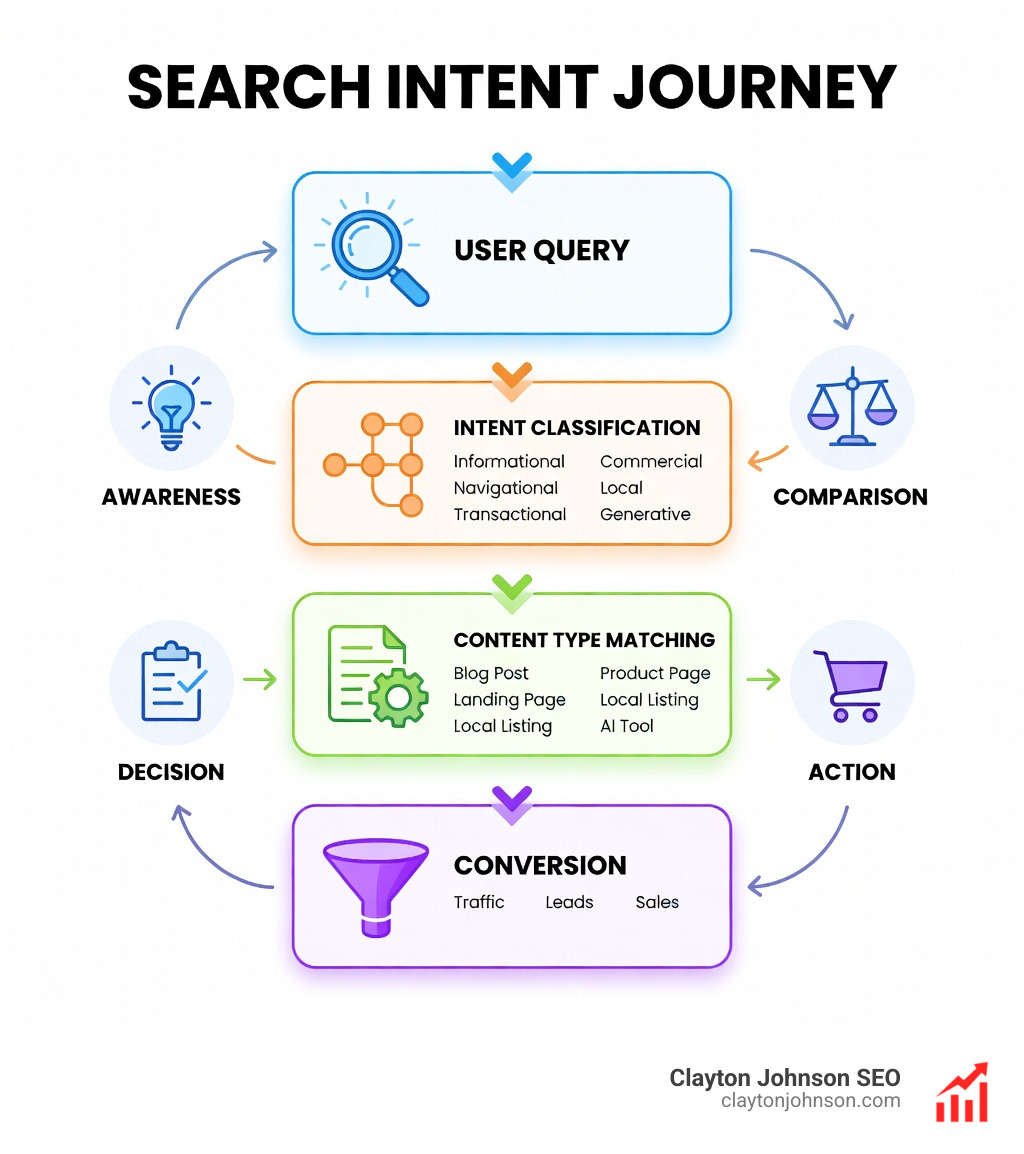
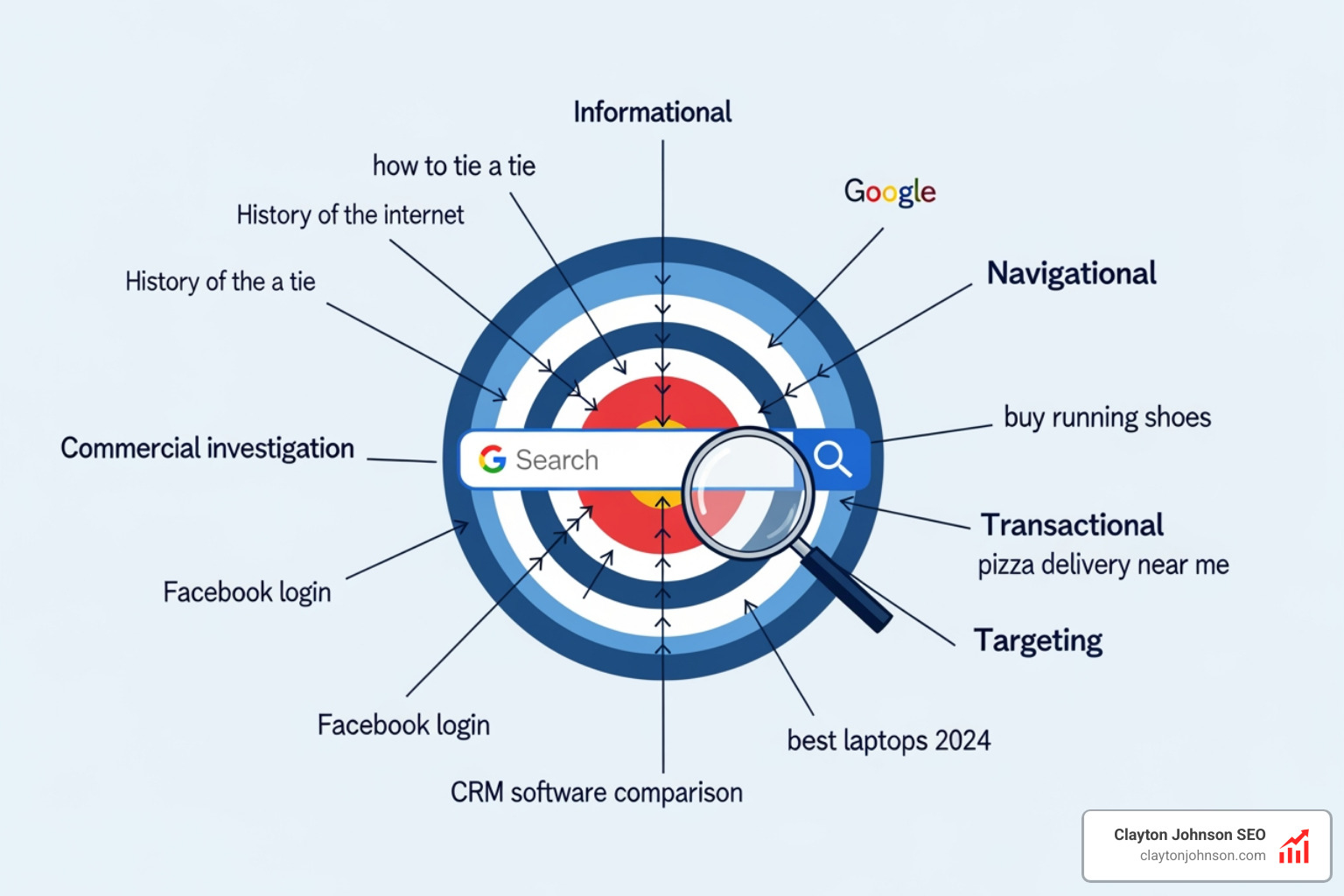
Historically, SEOs focused on four buckets of intent. However, as user behavior shifts and AI enters the fray, we now recognize six distinct types of intent that drive the modern web. Understanding these is the first step in winning the AI search era with intent-based keyword research.
- Informational Intent: The searcher is looking for knowledge. These queries account for roughly 70% of all searches. They want to know “how to,” “what is,” or “why.” For a deeper dive, check out our guide on what is informational intent anyway.
- Navigational Intent: The user is trying to get to a specific “destination” on the web. They might type “LinkedIn login” or “Clayton Johnson SEO blog.”
- Commercial Intent: The user is in the “investigation” phase. They know they want to buy something but haven’t decided which one. They use terms like “best,” “review,” or “vs.”
- Transactional Intent: This is the “buy” phase. The user is ready to pull out their credit card. Modifiers include “price,” “coupon,” “order,” or “buy.”
- Local Intent: The user needs a physical solution nearby. This is heavily driven by mobile search, where 40% of people search only on their smartphones.
- Generative AI Intent: This is the newest category, accounting for 37.5% of queries in tools like ChatGPT. The user isn’t just looking for a link; they want a tangible output like “create a Python script” or “draft a meal plan.”
Aligning Content with the Three Cs of Search Intent Targeting
Identifying the intent type is only half the battle. To rank, you must align your content with the “Three Cs.” This framework ensures you aren’t bringing a knife to a gunfight.
- Content Type: What is the dominant type of page on the SERP? Is it a blog post, a product page, a category page, or a landing page? If the top 10 results are all blog posts and you try to rank a product page, you are fighting an uphill battle.
- Content Format: How is the information structured? Is it a “how-to” guide, a listicle, a comparison table, or a video? For “best” queries, listicles almost always win.
- Content Angle: What is the “hook”? For many queries, the angle is “freshness” (e.g., “Best Laptops”). For others, it might be “for beginners” or “low cost.”
By performing a Search Intent and SEO: A Quick Guide analysis of the SERP, we can mirror these patterns to ensure our content feels “right” to both Google and the user.
How to Identify and Analyze User Intent
You don’t need a crystal ball to figure out what users want; Google shows you exactly what it thinks the intent is through its SERP features. When you see a Featured Snippet, Google is telling you the intent is informational and the user wants a quick answer. When you see a Shopping Carousel, the intent is transactional.
Reading the SERP Features
- Featured Snippets: Signal a clear “know” intent.
- Knowledge Panels: Indicate the user wants factual, entity-based data.
- People Also Ask (PAA): These are gold mines for finding keywords with AI is easier than you think. They reveal the “micro-intents” and follow-up questions users have.
- Local Packs: Signal a “visit-in-person” intent.

The Psychology of Query Language
The way people phrase things matters. “Dog food ingredients” (informational) has a very different intent than “buy dog food” (transactional). As search professionals, we must look at the Why Search Intent Is the Secret to Superior Keyword Research and understand the user psychology behind the modifiers.
Leveraging Tools for Search Intent Targeting
While manual review is essential, scaling search intent targeting across thousands of keywords requires a structured growth architecture. This is why we built Demandflow.ai.
Most companies don’t lack tactics; they lack a growth operating system. By using tools like Google Search Console and specialized intent widgets, we can track “SERP volatility.” High volatility often means Google isn’t sure what the intent is, which is a signal for us to be more precise in our targeting.
For those just starting, why-your-seo-strategy-needs-these-long-tail-keyword-tools-right-now provides a list of resources to help automate intent detection and traffic share analysis.
Analyzing Keyword Modifiers for Intent Classification
Modifiers are the “tells” in a poker game. They reveal the searcher’s hand:
- Informational: how, what, who, guide, tips, ideas.
- Commercial: best, top, vs, review, comparison.
- Transactional: buy, price, coupon, shipping, cheap.
- Navigational: [brand name], [product name] login.
By filtering your keyword lists for these triggers, you can quickly categorize your entire content map.
Optimizing Content for Every Stage of the Marketing Funnel
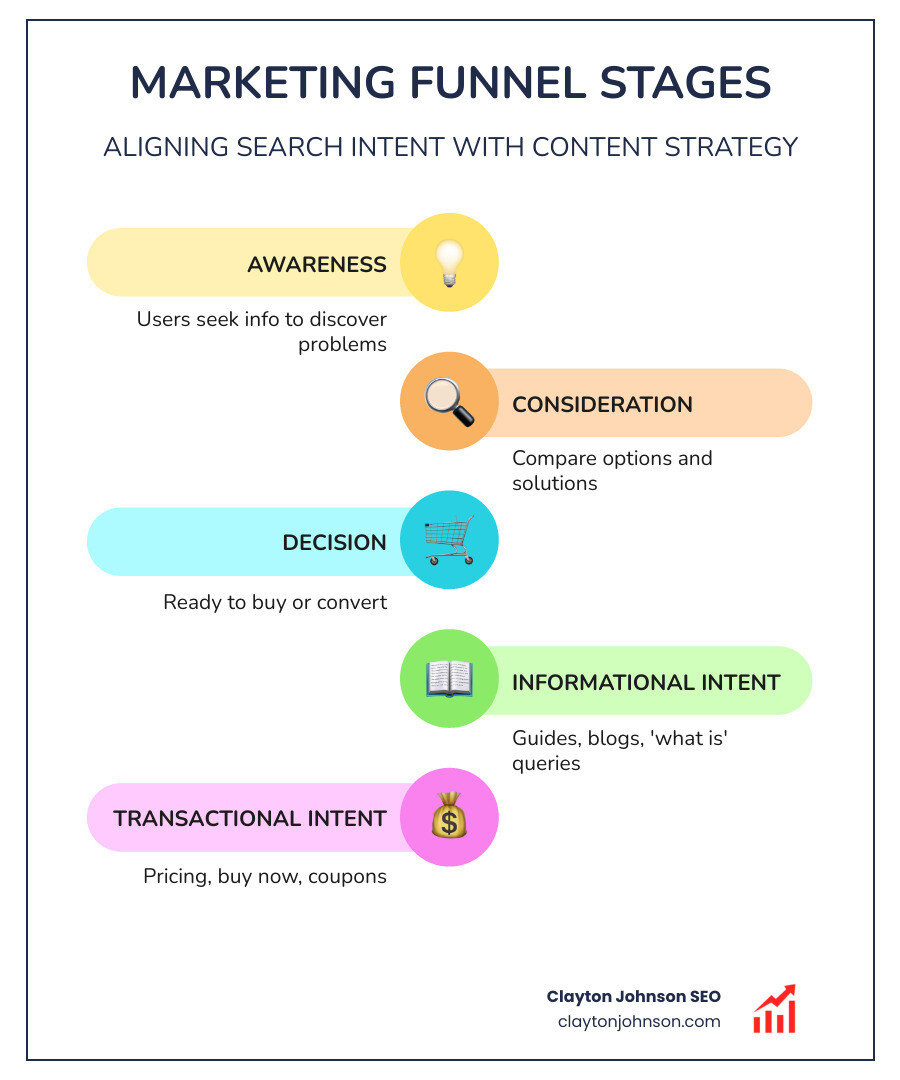
Search intent targeting is the engine that moves users through your marketing funnel. If you only target transactional keywords, you’re fighting for the 1% of the market that is ready to buy right now. To build a sustainable brand, you must target the entire journey.
| Funnel Stage | Intent Type | Content Example | Goal |
|---|---|---|---|
| Awareness | Informational | “What is demand generation?” | Brand discovery |
| Consideration | Commercial | “Best demand gen software” | Problem/Solution fit |
| Decision | Transactional | “Demandflow.ai pricing” | Conversion |
Using pillar pages and topic clusters explained for mere mortals, we can create a web of content that captures a user at the awareness stage and guides them toward a decision.
SEO Ranking Factor #1 is Satisfaction. If a user finds your informational guide helpful, they are much more likely to trust your transactional recommendation later.
Satisfying Generative and AI-Driven Intent
The rise of ChatGPT and AI Overviews has created a new challenge: “Prompt Intent.” Users now expect tangible outputs. They aren’t just looking for a “how-to” on meal prepping; they want the AI to generate the meal plan for them.
This shift requires a new ai-search/keyword-strategy. We must optimize for LLM (Large Language Model) visibility by focusing on authoritative mentions, structured data, and high-quality backlinks. The future of search with AI-powered keyword research is about being the source of truth that AI tools cite when they generate answers.
Handling Mixed and Ambiguous Search Intent
Sometimes, a keyword doesn’t have a clear winner. Take the query “Mercury.” Does the user want the planet, the element, the car brand, or the Freddie?
This is “ambiguous intent.” Google handles this by showing a “fragmented” SERP with a mix of results.
- Dominant Intent: The most likely goal (usually the planet).
- Common Intent: Other frequent goals (the element).
- Minority Intent: Less common goals (the car).
When targeting these keywords, don’t try to “hedge” and cover everything. Pick the specific sub-intent that aligns with your business and optimize hard for that. If you are a science blog, ignore the cars and the singers.
Best Practices for Intent-Based Content Audits
Optimization isn’t a “one-and-done” task. Intent can shift over time. A query that used to be informational might become transactional as a new product category matures.
Identifying Intent Mismatch
The biggest red flag for intent mismatch is “pogo-sticking”—when a user clicks your result, realizes it doesn’t solve their problem, and immediately bounces back to the SERP. This destroys your rankings.
Check your Google Analytics for:
- High Bounce Rate: Are they leaving immediately?
- Low Dwell Time: Are they actually reading the content?
- Low Conversion: Are you offering a “buy now” CTA to someone who just wanted to “know how”?
The 19-Step Audit
When we audit content for our clients in Minneapolis, we use a structured system inspired by how to optimize for search intent: 19 practical tips.
- Re-evaluate the SERP: Has the dominant content type changed?
- Check the 3 Cs: Is your angle still relevant?
- Optimize Title/Meta: Do they signal the right intent?
- Enhance Readability: Use 14px+ fonts, clear subheadings, and short paragraphs.
- Add Visual Intent: Are your images high-quality and supportive? 30% of shoppers won’t buy if images are poor.

Frequently Asked Questions about Search Intent
How does Google determine search intent?
Google uses a combination of historical data, user interaction signals (like click-through rates and pogo-sticking), and advanced AI like RankBrain and BERT to understand the context of a query. It essentially “tests” different results to see which ones satisfy users the best over time.
What are the most common keyword modifiers for transactional intent?
The most powerful transactional modifiers include “buy,” “order,” “discount,” “coupon,” “shipping,” “price,” “for sale,” and “cheap.” These signals indicate the user has reached the bottom of the funnel.
Can a single keyword have multiple search intents?
Yes. This is called “mixed intent.” For example, someone searching for “SEO software” might be looking for a list of options (commercial) or a specific tool to log into (navigational). Google usually shows a mix of reviews and direct product pages for these queries.
Conclusion
Mastering search intent targeting is the difference between a website that just “gets traffic” and a business that generates demand. It requires moving away from fragmented tactics and toward a structured growth architecture.
At Clayton Johnson SEO, we help founders and marketing leaders build these systems through Demandflow.ai. By combining taxonomy-driven SEO with AI-augmented workflows, we turn search intent into a compounding asset for your brand.
If you’re ready to stop guessing and start building a structured growth infrastructure, it’s time to master your AI search strategy. Let’s build something that actually satisfies the user — and your bottom line.