Why the AI Growth Operating System Is Redefining How Businesses Scale
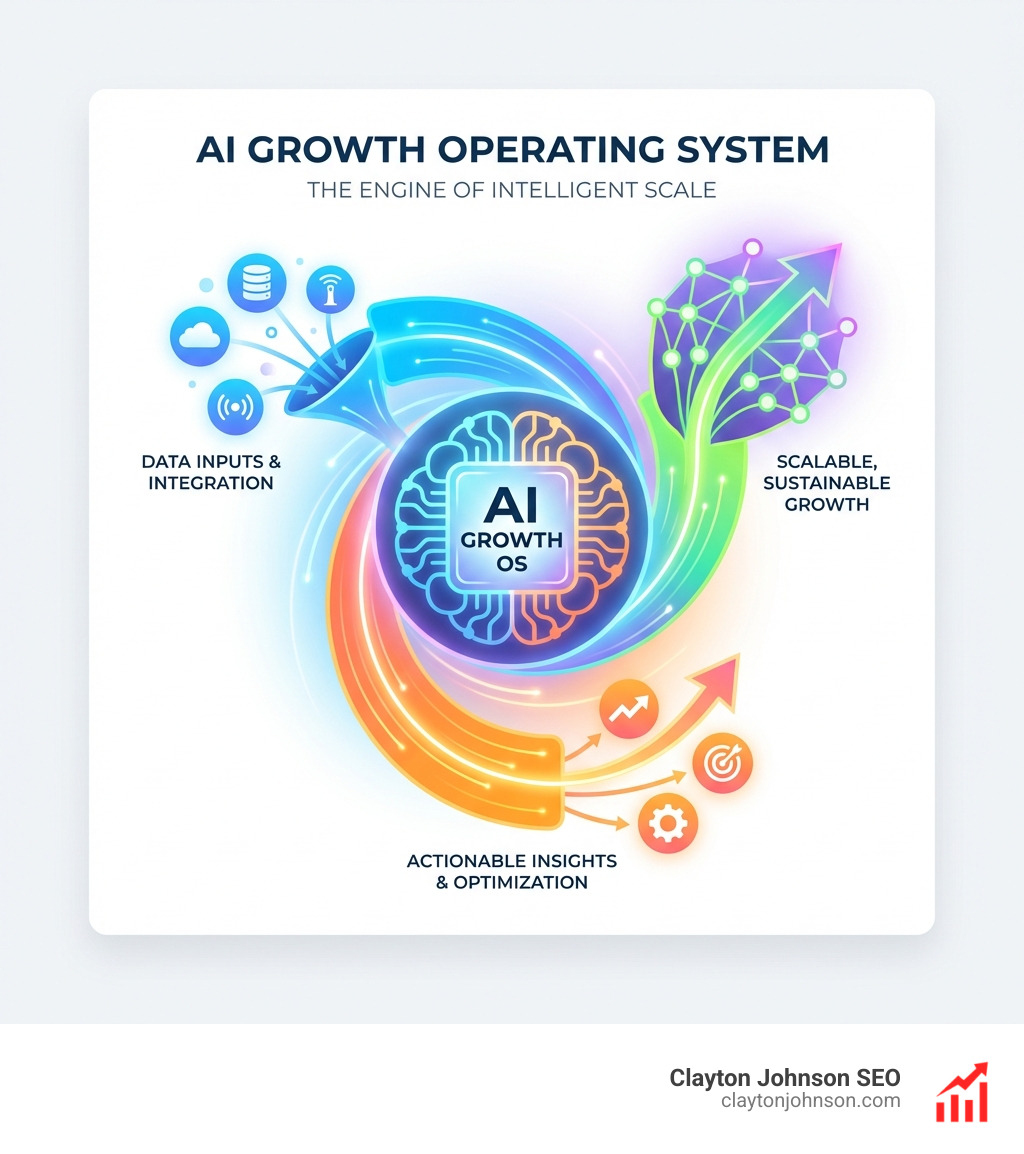
An AI growth operating system (AI GOS) is a unified intelligence layer that connects your data, workflows, and autonomous AI agents into a single, coordinated system — replacing the fragmented stack of legacy software tools that slow growth down.
Quick answer for decision-makers:
| What it is | What it does | Why it matters |
|---|---|---|
| Unified AI orchestration layer | Connects data, agents, and business logic | Replaces siloed SaaS tools |
| Neurosymbolic + agentic AI | Plans, acts, and learns across workflows | Drives revenue, margin, and speed |
| Enterprise-owned intelligence | Encodes your operational DNA | Builds compounding competitive advantage |
Here is the uncomfortable truth: 88% of organizations now use AI regularly, yet nearly two-thirds have not scaled it beyond isolated experiments. Tools are everywhere. Systems are not.
The gap is not access to AI. It is architecture.
Most companies bolt AI onto broken workflows. They run a chatbot here, automate a report there. Shadow AI spreads across teams without strategy. Customer acquisition costs keep climbing. Marketing goes stale. And despite all the tooling spend — enterprise software now costs $8,700 per employee per year — growth stays slow and siloed.
The businesses pulling ahead are not using more tools. They are building systems.
That shift — from disconnected AI experiments to a structured, sovereign, compounding growth architecture — is exactly what an AI growth operating system makes possible.
“AI is moving from a static chat interface to an active participant in work. The competitive frontier is now about orchestration, control, and a model’s ability to operate as a reliable agent.” — a16z Infrastructure
I’m Clayton Johnson, an SEO strategist and growth operator who builds AI-augmented marketing systems and scalable growth architectures for founders and marketing leaders navigating this exact transition. My work with AI growth operating system design sits at the intersection of technical SEO, structured workflow automation, and strategic positioning — helping teams move from tactical AI use to systemic leverage.
Simple guide to ai growth operating system terms:
Defining the AI Growth Operating System: Beyond Traditional Enterprise Software
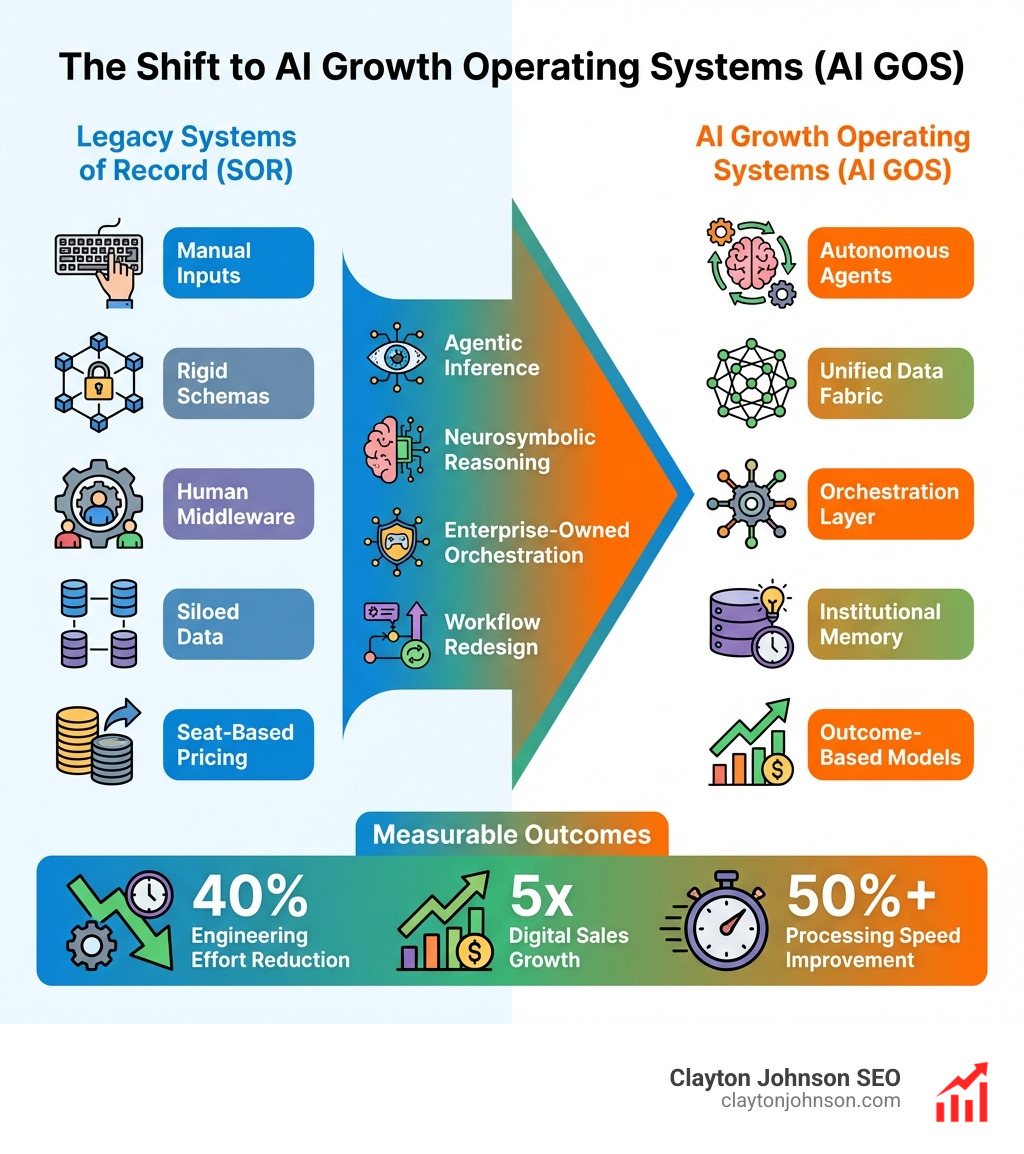
For decades, we’ve relied on Systems of Record (SORs) like Salesforce, SAP, and Workday. These platforms were designed to store data, but they were never designed to think. They rely on manual inputs, rigid schemas, and “human middleware”—employees who spend 180 hours a year just fighting with legacy software to get work done.
An ai growth operating system (AI GOS) represents a fundamental replatforming. It is what experts call a System of Intelligence. Unlike an SOR, which just sits there holding data, an AI GOS is an active participant. It uses neurosymbolic AI—a powerful blend of neural networks (for pattern recognition) and symbolic reasoning (for structured logic)—to actually execute business functions.
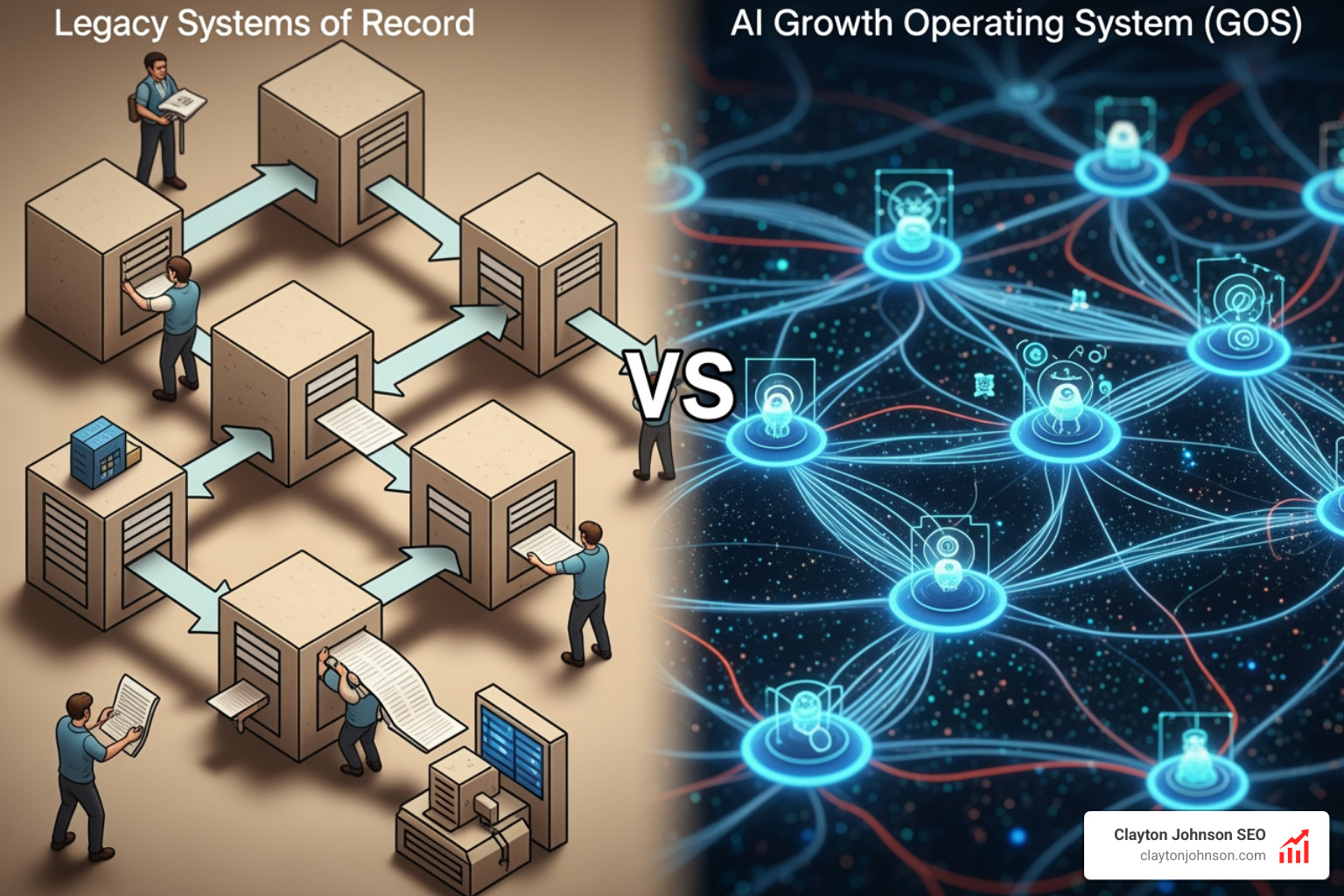
The difference is stark. In a traditional setup, if a server goes down or a lead comes in, a human has to bridge the gap between systems. In an AI GOS, the system understands the context. It connects the “dots” across your entire organization, building a unified knowledge graph that compounds in value the more you use it.
The Shift Toward Reasoning and Agency
We are moving past the era of “chatting” with AI. The new frontier is agentic inference. According to a 100 trillion token study by a16z and OpenRouter, the fastest-growing behavior in AI isn’t simple prompting—it’s developers building workflows where models act in extended sequences.
These systems don’t just give you a paragraph of text; they plan, retrieve context from APIs, revise their own work, and iterate until a complex task—like a multistep engineering design or a multi-channel marketing launch—is finished. This is the “executive function” of the modern enterprise.
Why Your Brand Needs an AI Growth Operating System
If your growth is too slow, your insights are trapped in silos, or your marketing feels generic, you are likely suffering from a lack of structured growth architecture.
Traditional playbooks—quarterly campaigns and annual cycles—cannot keep pace with a market where competitors optimize creative at speeds that make planning obsolete. You need a system that learns your company’s DNA and powers scalable, repeatable workflows. This isn’t just about productivity; it’s about survival in an age of agentic commerce where AI assistants are the ones making purchase decisions.
| Feature | Legacy System of Record (SOR) | AI Growth Operating System (GOS) |
|---|---|---|
| Primary Goal | Data Storage & Compliance | Revenue Growth & Execution |
| Input Method | Manual Human Entry | Autonomous Data Ingestion |
| Logic Type | Rigid, Hard-coded Rules | Fluid, Reasoning-based AI |
| User Role | Data Entry / Operator | Orchestrator / Strategist |
| Value Moat | Data Lock-in | Institutional Memory & Velocity |
The Core Architecture: Neurosymbolic AI and Agentic Orchestration
The “magic” under the hood of an ai growth operating system isn’t just one large language model (LLM). It is the combination of different AI types. Generative AI is great for creativity, but it can hallucinate. That’s why an effective GOS uses neurosymbolic AI to ground that creativity in structured logic and real-world business rules.
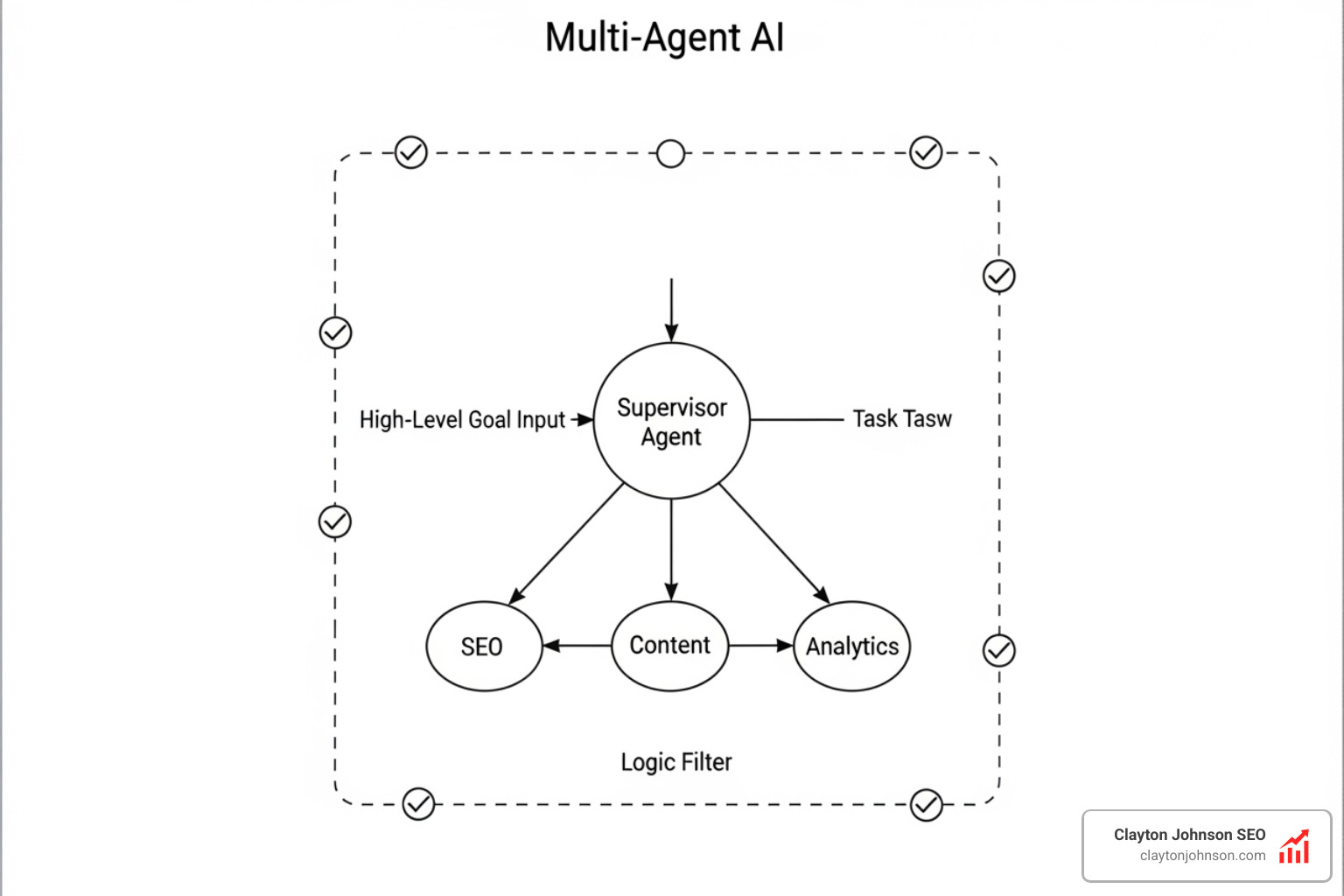
This architecture creates a unified data and reasoning engine. It allows you to ingest internal data—90% of which is usually unstructured and “invisible”—without needing a five-year digital transformation project.
Why Orchestration Sovereignty is the Heart of an AI Growth Operating System
One of the biggest risks today is ceding control of your “intelligence layer” to external vendors. If a frontier model provider (like OpenAI or Anthropic) owns your orchestration logic, your operational DNA becomes their product.
For true operational alignment, enterprises must own their orchestration layer. This means:
- Model Abstraction: The ability to swap models (GPT-4 to Claude to a local Llama 3) without breaking your workflows.
- Edge AI Processing: Using Small Language Models (SLMs) for local tasks to ensure data sovereignty and lower costs.
- Portable Intelligence: Storing your business rules and coordination patterns in your own infrastructure, not a vendor’s black box.
Building the Business Context Fabric
An AI GOS works because it has a “Context Fabric.” This is a dynamic knowledge graph that connects people, processes, and outcomes. When an agent acts, it isn’t just guessing; it’s referencing your institutional memory. It knows your brand voice, your historical winning experiments, and your specific customer personas.
Measurable Impact: How AI Systems Rewire the P&L
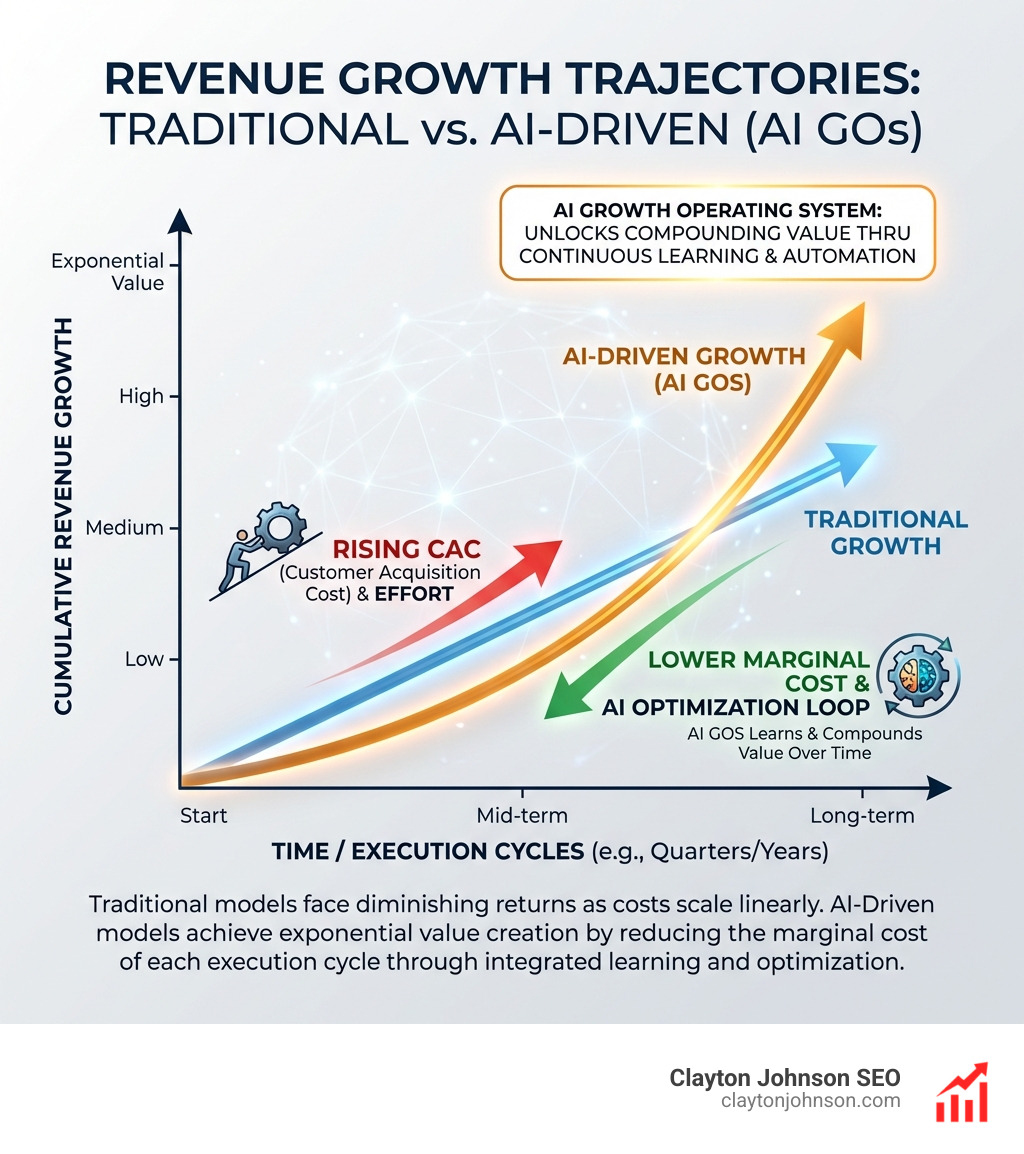
We aren’t just talking about “saving time.” We are talking about moving the needle on the P&L. Research from BCG shows that agentic systems are already delivering massive wins:
- A shipbuilder cut engineering effort by 40% and lead time by 60%.
- A telco saw a 5x jump in digital sales using agentic assistants.
- A payroll provider improved processing speed by over 50% using supervisor agents.
Scaling Success with an AI Growth Operating System Roadmap
To get these results, you can’t just buy a tool. You need a roadmap. We recommend the CRAFT Cycle for operationalizing AI:
- Clear Picture: Define the process and the desired outcome.
- Realistic Design: Create a minimum viable AI solution.
- AI-ify: Build the automation using prompts or agents.
- Feedback: Test, iterate, and improve.
- Team Rollout: Launch and maintain.
This follows the 10/20/70 rule of AI transformation: 10% is about the algorithms, 20% is the tech backbone, and 70% is about your people and processes.
From Task Automation to Systemic Leverage
Most people use AI for “tasks” (write an email, summarize a doc). But the real “arbitrage” happens when you automate entire systems. This creates “infinite time” for your team to do the work only humans can do—strategy, empathy, and high-level decision-making.
As Bessemer Venture Partners notes, the next competitive frontier is workflow automation. It gives your internal team “technical superpowers,” allowing a 10-person team to scale with the leverage of a 100-person organization.
Navigating the Risks: Sovereignty, Trust, and the Human Element
The biggest barrier to an ai growth operating system isn’t the technology—it’s trust. How do you supervise something designed to work autonomously?
We use a “Trust Protocol” for graduated autonomy:
- Shadow Mode: The agent works in the background, and humans compare its output to their own.
- Supervised Autonomy: The agent acts, but a human must click “approve” before it goes live.
- Guided Autonomy: The agent operates within strict guardrails, escalating only complex cases.
- Full Autonomy: The agent handles the entire workflow autonomously for low-risk, high-volume tasks.

Without this structure, you end up with “Shadow AI”—employees using unvetted tools that leak sensitive data and create governance nightmares.
The New Roles of the Agentic Era
As you implement an AI GOS, your organizational chart will shift. You’ll see the rise of:
- The Chief AI Officer (CAIO): Setting the vision and governance.
- AI Operators: Specialists who build and maintain the “playbooks” the AI runs.
- GTM Engineers: A hybrid role bridging engineering and revenue operations.
This shift moves employees from being “doers” to “managers of systems.” It’s a hard truth about the 7S model: your structure must follow your strategy.
Frequently Asked Questions about AI Growth Operating Systems
What is the difference between an AI GOS and a standard LLM?
Think of an LLM (like GPT-4) as the “engine.” An ai growth operating system is the entire car. An LLM provides raw reasoning capability, but the GOS provides the dashboard, the fuel (your data), the GPS (your business logic), and the specialized agents that actually turn the wheels to execute workflows.
How does an AI GOS impact workforce size?
It’s less about “replacement” and more about “rebalancing.” While some entry-level roles may decrease, there is a massive surge in demand for “AI orchestrators”—generalists who can manage human-agent teams. AI-native firms are already seeing 25–35x more revenue per employee because their people are amplified by systems, not bogged down by manual tasks.
Why is ‘Enterprise as Code’ necessary for this system?
“Enterprise as Code” means turning your messy human intuition into clear specifications. AI cannot automate a process that isn’t defined. By codifying your operations, you make your business “legible” to AI, allowing the system to read, execute, and optimize your growth with the same precision developers use to ship software.
Conclusion: The Path to Compounding Growth
The era of “bolting AI on” is over. To win in a landscape of agentic commerce and AI-driven search, you don’t need more tools—you need a structured growth architecture.
At Clayton Johnson SEO, we are building Demandflow.ai to solve this exact problem. We combine actionable strategic frameworks with taxonomy-driven SEO systems and AI-augmented workflows to help you build a system that doesn’t just work—it compounds.
Whether you are in Minneapolis or scaling a national brand, the goal is the same: Clarity → Structure → Leverage → Compounding Growth.
If you’re ready to move beyond tactics and start building your growth system, it’s time to stop renting your intelligence and start owning your operating system.
Modern SEO Authority Tiers for AI Visibility
If your business isn’t visible in traditional rankings and AI Overviews, you are invisible. Our scalable authority framework ensures your brand is cited where decisions are being made.
- Foundation Authority ($1,997/mo): 1 DR45+ PR link & 2 AI-optimized articles.
- Growth Authority ($2,997/mo): 2 DR45+ PR links & 4 articles. Momentum for AI visibility.
- Competitive Authority ($3,997/mo): 3 DR45+ PR links & 6 articles. Capture AI Overviews.
- Expansion Authority ($4,997/mo): 5 DR45+ PR links & 10 articles. Ecosystem development.
- Scale Authority ($6,997/mo): 7 DR45+ PR links & 14 articles. Multi-topic cluster growth.
- Market Leader Authority ($9,997/mo): 10 DR45+ PR links & 20 articles. Durable market dominance.