What Are the Social Media Marketing Steps? (Quick Answer)
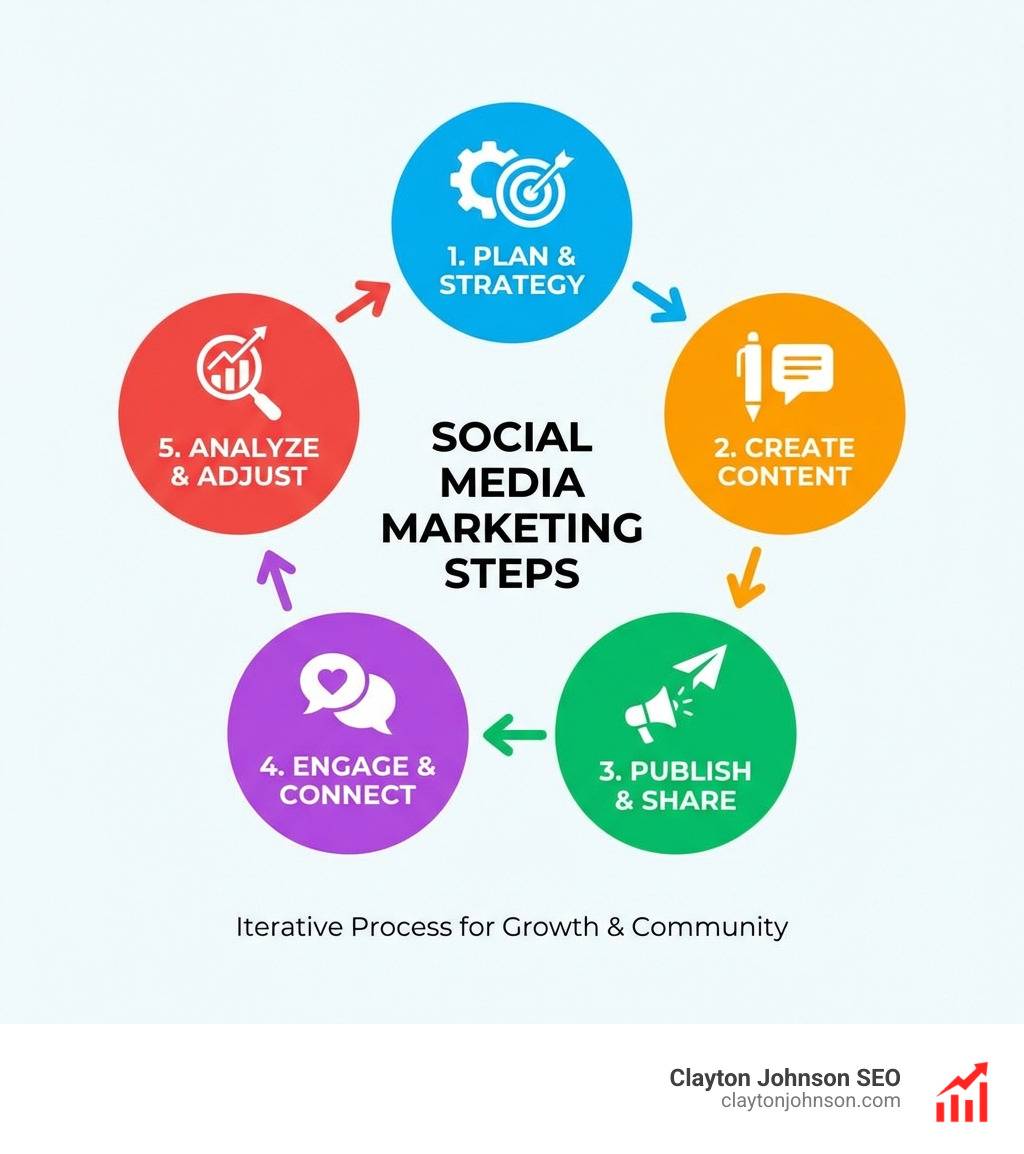
Social media marketing steps are the core actions you take to build a strategy that grows your brand, attracts the right audience, and drives measurable results.
Here are the essential steps:
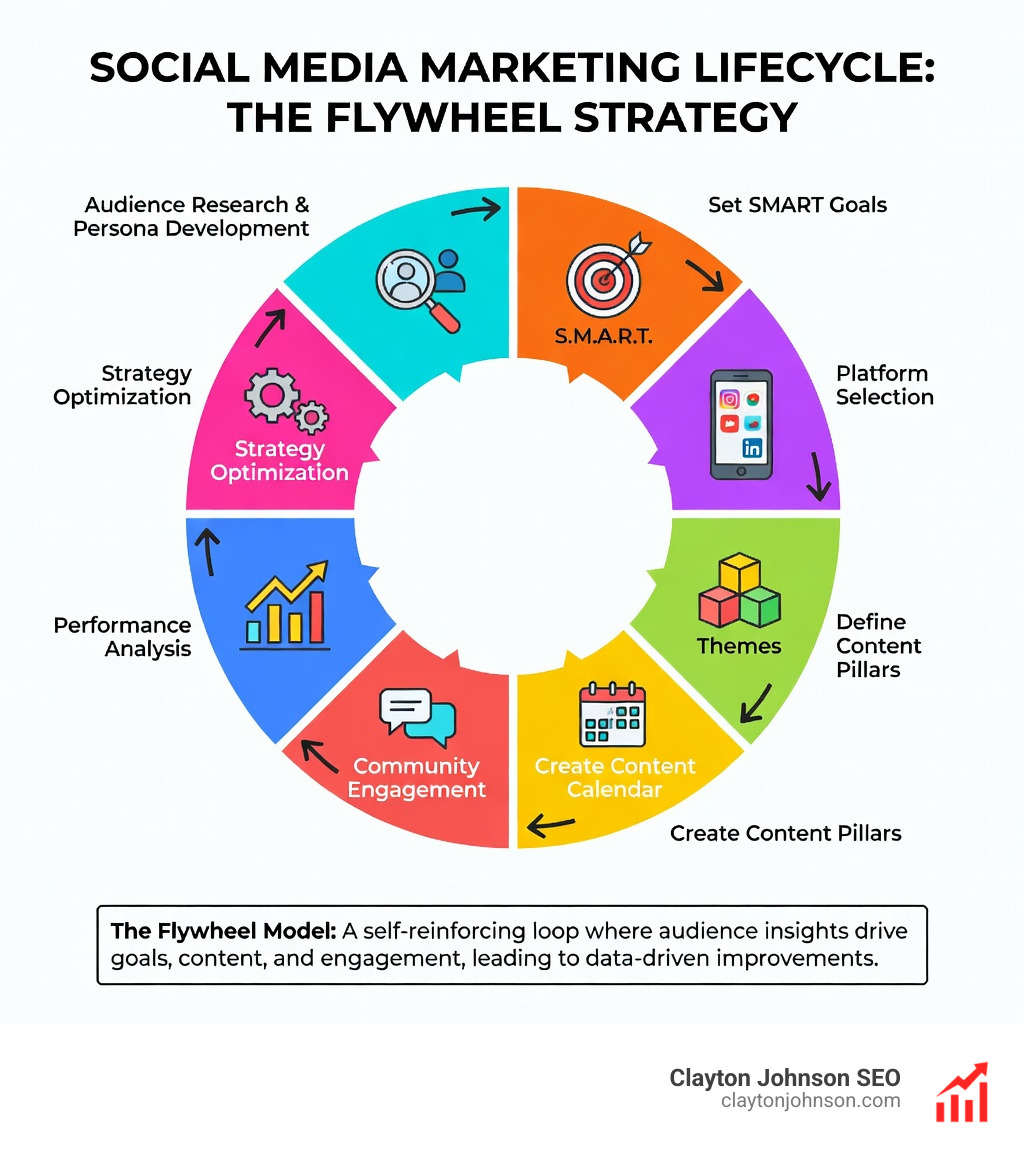
- Conduct a social media audit — review what’s working and what isn’t
- Define your target audience — build detailed personas based on demographics, pain points, and behavior
- Set SMART goals — specific, measurable, achievable, relevant, and time-bound
- Choose the right platforms — focus on where your audience actually spends time
- Identify content pillars — establish 3-5 core themes that define your brand’s content
- Build a content calendar — plan and schedule posts for consistency
- Engage your community — respond, ask questions, and build two-way dialogue
- Track and optimize — measure performance and adjust based on real data
With over 4.70 billion active social media users globally — and 13.5 new users joining every second — the opportunity for brands on social media has never been larger. But opportunity without structure is just noise.
Most brands jump straight to posting. They create content without a clear goal, pick platforms without knowing their audience, and wonder why results don’t come.
The brands that win on social media don’t post more. They plan better.
A well-built social media strategy is the difference between content that compounds and content that disappears. It connects your daily posts to your bigger business goals — driving traffic, building loyalty, and generating real revenue.
“Engagement is the currency of social media.” — A principle echoed consistently across the marketing community.
And the data backs it up: Millennials are 62% more loyal to brands that directly engage with them on social networks. That loyalty doesn’t happen by accident. It’s the result of deliberate, structured strategy.
I’m Clayton Johnson — an SEO and growth strategist who has built scalable marketing systems across 50+ business models, including data-driven frameworks that connect social media marketing steps to measurable revenue outcomes. In this guide, I’ll walk you through the exact process modern brands use to turn social media from a time sink into a compounding growth engine.
Quick social media marketing steps terms:
Phase 1: Foundation and Audience Intelligence

Before you ever draft a caption or film a Reel, you must understand the landscape. Most companies don’t lack tactics—they lack structured growth architecture. Phase 1 is about building that architecture by looking at where you are and who you are talking to.
We start with a social media audit. This isn’t just a “check-up”; it’s a deep dive into your current presence. Which networks are you active on? Are your profiles optimized with the right bios and URLs? Which posts actually got people talking? If you aren’t tracking your results, you are operating with “blinders on,” missing out on mountains of actionable insights from real people.
Next, we identify audience personas. We don’t just guess that our customers are “middle-aged homeowners.” We look for real-world data. We want to know their:
- Demographics: Age, location, job title, and income.
- Pain Points: What problems do they have that we can solve?
- Emotional Triggers: What motivates them to click “buy” or “share”?
- Platform Behavior: Where do they hang out when they want to be entertained versus educated?
By engaging in social media listening, we can find out what people are saying about our industry or competitors. This intelligence allows us to refine our SEO content marketing to ensure that our social efforts support our broader search visibility.
Understanding Your Target Audience
Research from the Pew Research Center found that the majority of U.S. adults are active on social media, with YouTube and Facebook leading the pack. But “everyone” is not your audience.
We use social analytics to segment our users. For example, Jugnoo, an Uber-like service, used Facebook Analytics to discover that 90% of their referring users were between 18 and 34, and 65% were on Android. By narrowing their focus to this specific group, they achieved a 40% lower cost per referral. That is the power of audience intelligence.
Defining SMART Goals for Social Media Marketing Steps

If you don’t know what success looks like, you’ll never find it. We use the SMART framework to ensure our social media marketing steps lead to actual business growth.
- Specific: Instead of “get more followers,” we say “increase LinkedIn engagement rate.”
- Measurable: We track metrics like click-through rate (CTR), reach, and total shares.
- Achievable: Is it realistic to grow 10,000 followers in a week? Probably not. Aim for steady, compounding growth.
- Relevant: Does this social goal help our conversion optimization? If it doesn’t align with business objectives, forget it.
- Time-bound: Set a deadline, like “by the end of Q3.”
Common goals include brand awareness, lead generation, and customer satisfaction. By defining these early, we can calculate true ROI and move beyond “vanity metrics” like likes that don’t pay the bills.
Aligning Social Media Marketing Steps with Business Growth
Social media is a critical component of a multichannel marketing strategy. It should function as the “top of the funnel,” widening your reach and feeding your growth system.
When we align social actions with business growth, we look at revenue impact. Are social followers becoming newsletter subscribers? Are they clicking through to product pages? This strategic roadmap ensures that every post is a brick in your brand’s authority-building ecosystem.
Strategic Platform Selection and Content Pillars
You don’t have to be everywhere. In fact, spreading yourself too thin is a recipe for burnout. It is better to excel on one or two platforms than to be mediocre on five.
| Platform | Dominant Age Group | Dominant Gender | Organization Usage |
|---|---|---|---|
| 25 – 34 | 77% Women / 61% Men | 89% | |
| YouTube | 25 – 34 | 46% Women / 16% Men | 67% |
| 18 – 24 | 44% Women / 36% Men | 84% | |
| TikTok | 18 – 24 | 24% Women / 17% Men | 30% |
| 25 – 34 | 26% Women / 31% Men | 87% |
Before you set up your social profiles, you need to identify your content pillars. These are 3-5 core themes that define your niche. For a haircare brand, pillars might be “Hair Growth Tips,” “Product Tutorials,” and “Customer Success Stories.” Pillars provide guardrails—they make it simple to decide what to create and what to ignore.
Choosing the Right Social Media Marketing Steps for Your Platform
Each platform has its own “vibe” or subculture. LinkedIn is professional and authority-driven; TikTok is raw, authentic, and .
We also consider SEO importance. Platforms like YouTube and Pinterest are essentially search engines. Using the right keywords in your bios and captions helps you get discovered organically. Furthermore, we always recommend choosing a platform you actually enjoy. If you hate making videos, TikTok will feel like a chore, and your audience will sense that lack of authenticity.
Execution: Calendars, Community, and AI Workflows

Execution is where strategy meets the real world. We use a content calendar to maintain consistency. Without a calendar, you’re just posting randomly, which is a fast track to failure.
- Content Batching: Don’t create one post a day. Set aside one day a month to film 20 videos or write 30 captions. This creates “social media muscle” and saves hours of time.
- AI Workflows: We leverage AI-augmented marketing workflows to generate ideas, draft copy, and optimize posting times. This isn’t about replacing creativity; it’s about scaling it.
- Community Engagement: Social media is a two-way dialogue. Millennials report being 62% more loyal to brands that engage them directly. Respond to comments, ask questions in your Stories, and share user-generated content (UGC).
Optimizing Your Social Media Marketing Steps Through Analytics
You cannot improve what you do not measure. We use analytics and data to track our performance weekly.
We look for:
- UTM Parameters: To see exactly which social posts are driving website traffic.
- Reach and Impressions: Are we growing our footprint?
- Engagement Rate: Are people actually interacting with our content?
If a certain content pillar is underperforming after a few months, we pivot. A great social media strategy is never set in stone; it is a “forever-updating document” that adapts to trends and data.
Frequently Asked Questions about Social Strategy
What is the difference between a social media strategy and a content calendar?
Think of the social media strategy as your big-picture roadmap—it’s the “why” and the “how” of your presence. The content calendar is the daily schedule—it’s the “what” and the “when.” You need the strategy to ensure the calendar is actually moving you toward your business goals.
How many social media platforms should a business be on?
When starting, focus on one platform. Master it, build an audience, and then repurpose that content for other channels. It is much better to have one thriving community than four ghost towns. Quality and consistency always beat quantity.
How long does it take to see results from a new social strategy?
Patience is key. Most social media strategies need at least three months to show real impact. Social media is a compounding asset; the more you engage and provide value, the faster your authority grows over time.
Conclusion
Success on social media doesn’t come from chasing every new trend or “going viral” by accident. It comes from structured growth architecture. By following these social media marketing steps—from deep audience research to data-driven optimization—you build a system that generates compounding inbound demand.
At Clayton Johnson SEO, we help brands build these authority-building ecosystems. We believe that clarity leads to structure, and structure leads to leverage. Whether you are looking for SEO services or a complete social media marketing strategy, our goal is to help you achieve durable market dominance.
Ready to turn your social presence into a growth engine? Let’s build your structured growth infrastructure together.