Why So Many Beginners Struggle with Where Start AI Journey
Where start AI journey is one of the most searched questions in tech right now — and for good reason. AI skills are in high demand, and the career upside is real.
Here is a quick-start answer to get you moving:
- Learn Python basics — syntax, functions, and data structures
- Master core libraries — NumPy, Pandas, and Matplotlib
- Build small ML projects — spam detector, house price predictor
- Use structured curriculums — Microsoft AI-For-Beginners, Google AI Essentials
- Join a community — Kaggle, Discord, or OpenAI Academy
- Progress to deep learning — PyTorch or TensorFlow tutorials
- Explore generative AI — Hugging Face, prompt engineering, LLMs
The opportunity is significant. AI engineers earn a median salary of $136,620 per year, and the field is projected to grow 23% over the next decade. But most beginners get stuck before they ever write a single model — overwhelmed by conflicting roadmaps, math anxiety, and tutorial fatigue.
The truth is you do not need a PhD to start. You need a clear path and the discipline to follow it.
I’m Clayton Johnson, an SEO strategist and growth systems architect who has spent years integrating AI-assisted workflows into marketing and content operations — making “where start AI journey” a question I help founders and growth leaders answer in a structured, systems-first way. In this guide, I’ll walk you through a practical, no-fluff roadmap to go from curious beginner to confident AI builder.
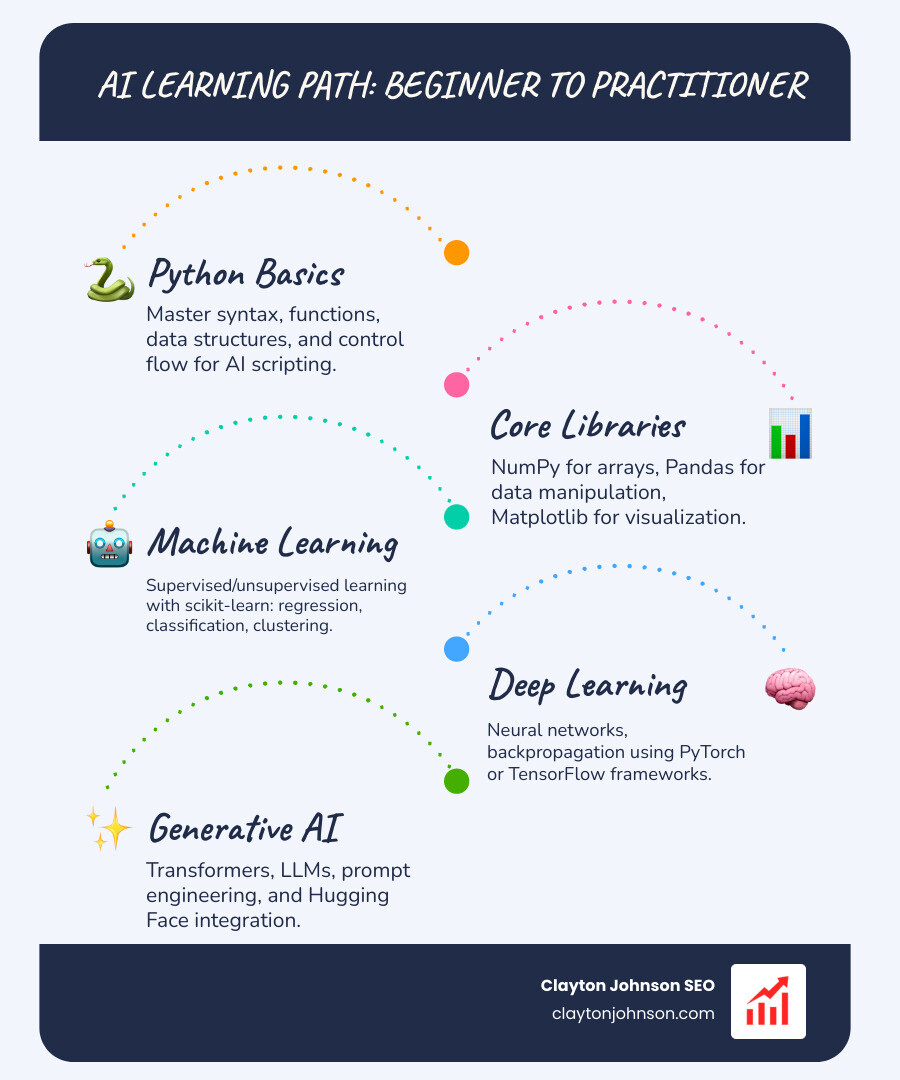
Where start AI journey terms to learn:
Essential Prerequisites: Where Start AI Journey Foundations
Before you dive into the deep end of neural networks, we need to talk about the “boring” stuff. Except, it isn’t actually boring once you see how it powers the magic of AI. Many beginners ask if they need to be a math genius. The short answer is no. You need “functional math literacy,” not a PhD in theoretical physics.
The Mathematical Pillars
To understand how an AI “learns,” you need to understand the language it speaks. We recommend focusing on these three areas:
- Linear Algebra: This is the heart of AI. Since data is often represented as matrices (grids of numbers), you need to know how to manipulate them.
- Calculus: Specifically, you want to understand “gradients.” This is how an AI model knows it made a mistake and figures out how to improve.
- Probability and Statistics: This helps you understand uncertainty. AI isn’t about 100% certainty; it’s about finding the most likely answer.
If you want to go deep into the theory, the Deep Mathematics behind deep learning is the gold standard, but don’t let it intimidate you. You can learn these concepts as you go.

The Best Programming Language for Beginners
If you are wondering where start AI journey in terms of code, there is only one real answer: Python.
Why Python?
- Readability: It reads almost like English.
- Community: If you have a bug, someone on Stack Overflow has already solved it.
- Library Ecosystem: Python has the best “plug-and-play” tools for AI.
While some researchers use R for pure statistics, Python is the undisputed king for building actual AI applications. It is adaptable, simple, and the primary language for almost all groundbreaking AI work happening today.
Core Data Science Libraries to Master
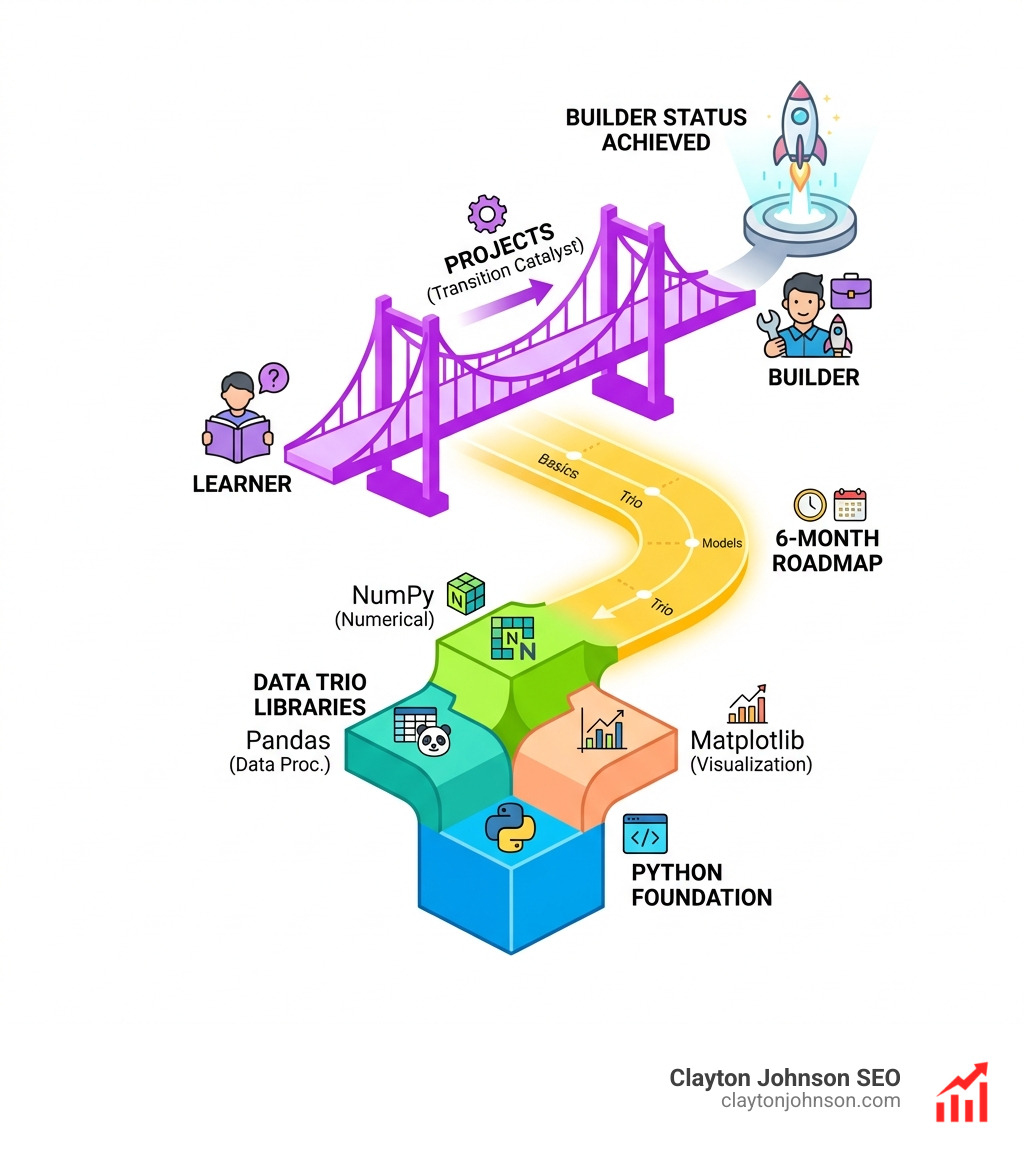
Once you have the basics of Python down, you need to learn the “Data Trio.” These libraries are the bread and butter of any AI practitioner:
- NumPy: Used for high-performance scientific computing and matrix manipulations.
- Pandas: Think of this as “Excel on steroids.” It allows you to clean, filter, and analyze massive datasets with a few lines of code.
- Matplotlib: This is for data visualization. You can’t improve a model if you can’t see what the data is doing.
Mastering these three is a non-negotiable step in your where start AI journey. Without them, you’re trying to build a house without knowing how to use a hammer.
The 6-Month Technical Roadmap for Beginners
Learning AI is a marathon, not a sprint. We’ve seen many people burn out because they tried to learn everything in a weekend. Instead, follow a structured timeline that balances theory with hands-on building.

Month 1-2: Python and Data Fundamentals
Start with the basics. Don’t touch a neural network yet. Learn how to write loops, functions, and classes in Python. Then, dive into Pandas and NumPy. Your goal here is to be able to take a messy CSV file and turn it into a clean, visualized report.
Month 3-4: Understanding Where Start AI Journey with Machine Learning
Now we get into the “Classic” AI. This is where you learn algorithms that have been around for decades but still run most of the world.
- Supervised Learning: Teaching a model with labeled data (e.g., “This is a picture of a cat”).
- Unsupervised Learning: Letting the model find patterns on its own (e.g., “Group these customers by their buying habits”).
- Scikit-learn: This is the library you will use. It’s incredibly beginner-friendly and covers everything from regression to clustering.
A great resource for this phase is the Machine Learning for Beginners Curriculum. It’s a 12-week, 24-lesson program that is completely free.
Month 5-6: Transitioning to Deep Learning and Neural Networks
This is the “Deep” part of Deep Learning. You’ll start building neural networks—models inspired by the human brain.
- Perceptrons: The basic building block of a neural network.
- Backpropagation: The math trick that allows networks to learn.
- Frameworks: You’ll need to choose between PyTorch and TensorFlow. Our advice? Flip a coin. Both are industry standards, and the concepts you learn in one will easily transfer to the other.
Essential Tools and Structured Curriculums
You don’t need a supercomputer to start your where start AI journey. Most of the tools you need are free and run in your browser.
Development Environments
| Tool | Best For | Pros |
|---|---|---|
| Jupyter Notebooks | Experimentation | Great for visualizing data and writing code in “chunks.” |
| VS Code | Production Code | The professional standard for building full applications. |
| Google Colab | Free GPU Access | Allows you to train heavy models using Google’s hardware for free. |
Leveraging Generative AI and Large Language Models
The world has changed with the rise of Large Language Models (LLMs). While classic ML is still vital, many beginners now want to jump straight into Generative AI.
- Prompt Engineering: Learning how to talk to AI to get the best results.
- Transformers: The architecture behind GPT.
- Hugging Face: This is the “GitHub of AI.” It’s a massive library where you can find pre-trained models for almost anything—from text generation to image recognition.
Structured Learning Paths from Industry Leaders
Don’t reinvent the wheel. Use the paths created by the companies that built the technology:
- Microsoft Learn: Offers deep dives into Azure AI and foundational curriculums.
- Google Cloud Skills: Excellent for learning how to deploy AI at scale.
- AWS Skill Builder: Focuses on cloud-native AI services like Amazon Bedrock.
- OpenAI Academy: A newer resource designed to democratize AI knowledge through community and expert-led workshops.
Hands-on Experience: Projects and Communities
You can read all the books in the world, but you won’t be an AI engineer until you build something. The goal is to move from “Tutorial Hell” (watching videos) to “Project Heaven” (building things).

Building Your First Where Start AI Journey Project
Start small. Your first project doesn’t need to change the world; it just needs to work. Here are some classic “Rite of Passage” projects:
- Spam Detector: Use Natural Language Processing (NLP) to classify emails as spam or not.
- House Price Prediction: Use regression to predict prices based on square footage and location.
- Sentiment Analysis: Build a tool that reads tweets and decides if the user is happy or angry.
- MNIST Digits: The “Hello World” of computer vision—teaching a computer to recognize handwritten numbers.
The Role of Community and Accountability
AI can be lonely and frustrating when your code won’t run. That’s why community is vital.
- Kaggle: This is a site for data science competitions. Even if you don’t win, looking at the “Notebooks” of winners is an education in itself.
- Discord Servers: Join the official AI Discord servers (like the one for Microsoft’s AI for Beginners) to meet other learners.
- Local Hubs: If you are in the Minneapolis, Minnesota area, look for local groups. The Minneapolis.AI hub and the Minnesota Carlson School often have resources or events for those looking to network in the Twin Cities.
Frequently Asked Questions about Starting in AI
How long does it realistically take to learn AI basics?
If you can dedicate 10-15 hours a week, you can gain a solid foundational understanding in 3 to 9 months. This includes being able to clean data, build basic models, and understand the terminology. Mastery, however, is a lifelong pursuit because the field moves so fast.
Should I start with math or coding first?
We advocate for a coding-first approach. If you spend six months just doing calculus, you’ll likely get bored and quit. Start by writing Python code that actually does something. When you get curious about why it works, that’s when you dive into the math.
What are the most common beginner mistakes?
- Tutorial Hell: Watching 50 hours of video without typing a single line of code.
- Over-complicating the Math: Thinking you need to be a math genius before you can import a library.
- Ignoring Data Cleaning: In the real world, 80% of the job is cleaning messy data, not building “cool” models.
- Lack of Projects: Having a certificate but no GitHub portfolio to show what you can actually build.
Conclusion
The where start AI journey is not about having a special talent; it is about having a structured strategy. Just like we teach at Clayton Johnson and Demandflow.ai, success comes from building a “growth architecture.” In AI, that architecture is built on Python, functional math, and consistent project work.
As you progress, you’ll find that AI isn’t just a technical skill—it’s a leverage point. Whether you are using it to automate SEO workflows or building the next great app, the keys are clarity and structure.
Your next steps:
- Pick one Python course today and finish the first module.
- Bookmark the Microsoft or Google curriculums mentioned above.
- Join a community like Kaggle or a Discord server for accountability.
If you want to see how we use these technologies to build structured growth systems for founders and marketing leaders, check out Demandflow.ai. We believe that clarity leads to structure, and structure leads to compounding growth.
Check out More info about SEO and AI tools to see how these worlds collide.