Why Content Chaos Is Costing You Visibility and Leads
structured content systems are frameworks that organize information into modular, reusable components — separated from design and enriched with metadata — so content can be created once and delivered consistently across every channel, platform, and device.
Here is what a structured content system does for your business:
- Organizes content into defined building blocks (like product descriptions, FAQs, or policy sections) stored in labeled fields
- Separates content from presentation so the same information flows to your website, mobile app, email, voice assistant, and beyond
- Enables content reuse of up to 60%, cutting duplication and saving your team significant time
- Makes content machine-readable so AI tools, search engines, and automation workflows can process it accurately
- Speeds up translation and localization by up to 70% by translating only unique components, not repeated text
- Improves SEO through structured data and schema markup that helps search engines understand exactly what your pages mean
- Prepares your content for AI by providing clean, organized inputs that reduce errors and hallucinations in AI-generated outputs
The core problem most growing businesses face is simple: content gets trapped in silos. Updates are slow, brand messaging drifts across channels, and no one on the team can find — or reuse — what already exists. As Gartner notes, 89% of companies plan to compete primarily on customer experience, yet most are still managing content the hard way.
I’m Clayton Johnson, an SEO strategist with nearly two decades of experience building scalable content architectures, and I’ve seen how structured content systems transform content from a maintenance burden into a compounding growth engine. In the sections ahead, I’ll walk you through exactly how to build one — even if you’re starting from scratch.
Why Your Business Needs Structured Content Systems
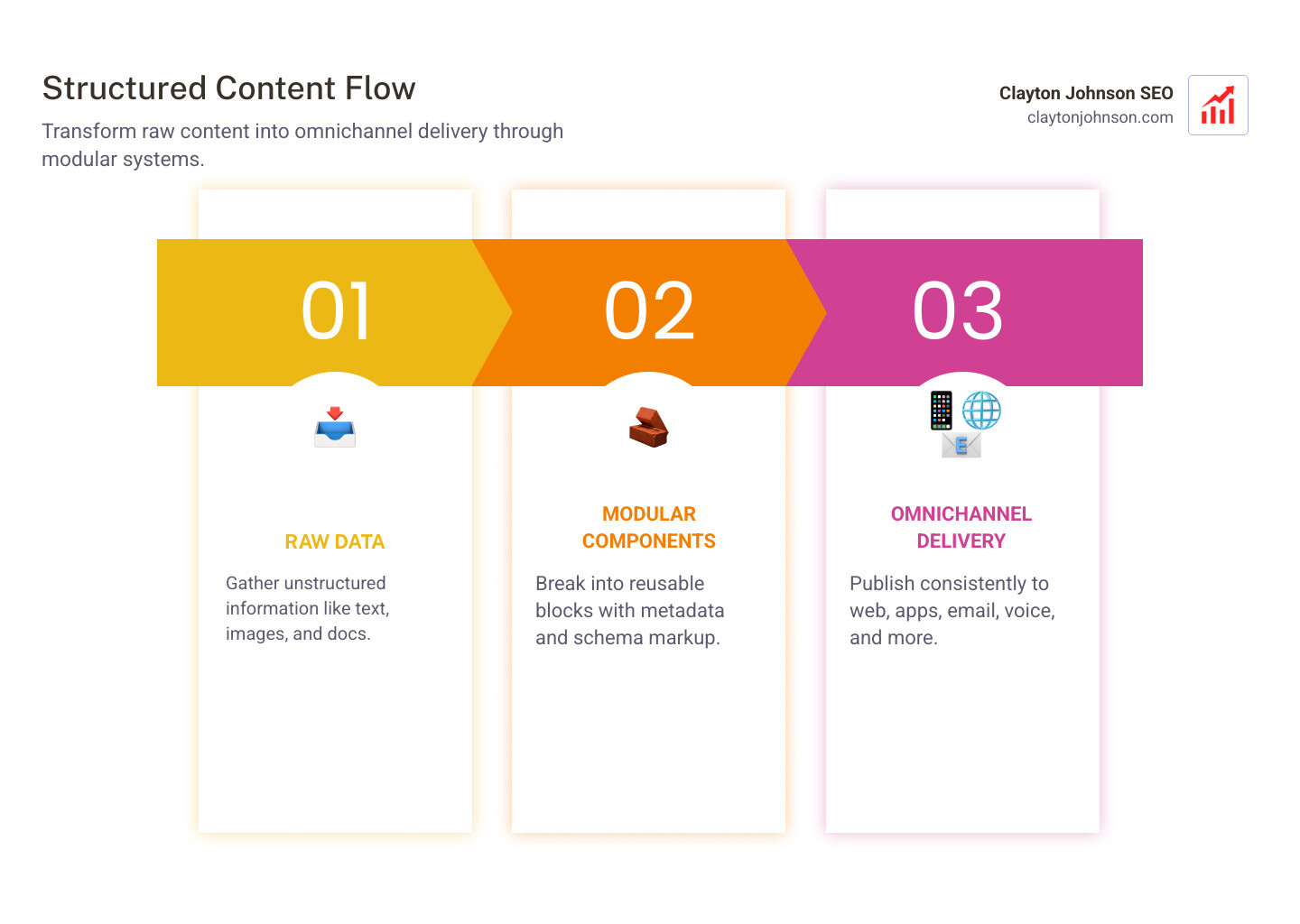
If we think of traditional content like a finished, printed book, structured content is more like a bucket of LEGO bricks. With a book, the information is stuck in one format. If you want to move a chapter to a website, you have to copy, paste, and reformat it. If you want to turn it into a mobile app alert, you start over.

structured content systems allow us to treat information as data. Instead of “pages,” we think in “components.” This shift enables the COPE principle: Create Once, Publish Everywhere. This isn’t just a fancy acronym; it’s a survival strategy for the modern web. When we break a product description into its name, price, specs, and benefits, we can feed those exact pieces into a website, an e-commerce app, a smart speaker, and a printed catalog simultaneously.
The business benefits are massive. For one, translation and localization efficiency skyrockets. Instead of translating the same “Contact Us” paragraph across 50 different pages, we translate it once in the system, and it updates everywhere. Research shows this can make the localization process 70% faster.
Furthermore, we are in an era where Gartner customer experience benchmarks show that nearly 90% of companies are competing on how they treat their customers. A huge part of that experience is consistency. If your website says one thing and your mobile app says another because a manual update was missed, you lose trust. Structured systems eliminate that drift by ensuring a single source of truth.
Finally, metadata enrichment makes our content “smart.” By tagging content with attributes like “audience: beginner” or “product_type: industrial,” we enable machine-readability. This allows algorithms to serve the right content to the right person at the right time without a human having to manually curate every single interaction.
Improving Efficiency with Structured Content Systems
When we talk about efficiency, we often think about doing things faster. But in content management, true efficiency is about doing things fewer times.
By using componentized authoring, our teams stop “wrangling chaos” and start building assets. Instead of writing a full article as one giant block of text, we write a headline, a summary, the body, and a call-to-action as separate fields. This allows for workflow automation. For example, when a new product spec is updated in the database, a structured system can automatically trigger updates across every marketing channel.
We also gain the ability for safe experimentation with content models. Using environments like Dev, Test, and Live, teams can try out new ways of organizing data without breaking the public-facing website. This reduces the fear of “breaking the site” and allows for much faster innovation.
Redundancy reduction is another huge win. We’ve all seen it: three different departments create three slightly different versions of the same “About Us” section. This is a waste of resources. A structured system forces us to establish a single source of truth. If you want to learn more about how to organize these labels and categories, check out our guide on how to build a content taxonomy that doesn’t suck.
The Impact of Structured Content Systems on SEO and UX
SEO isn’t just about keywords anymore; it’s about entities and relationships. Search engines want to know what a thing is, not just what words are on the page.

When we use structured content systems, we make it incredibly easy to implement schema markup. This is the “hidden” code that tells Google, “This is a recipe, it takes 20 minutes, and it has 400 calories.” This leads to rich snippets — those fancy search results with star ratings and images that get much higher click-through rates.
Beyond just “looking cool” in search, structure helps with entity distinctness. By clearly defining our content types, we help search engines build a knowledge graph of our brand. For a deep dive into this, see our article on mastering AI SEO taxonomy systems.
From a User Experience (UX) perspective, structure reduces friction. Think about a travel website. If the content is structured, a user can filter by “beachfront,” “pet-friendly,” and “under $200” because those are specific data fields. If the content was just a bunch of unstructured blog posts, that kind of filtering would be impossible.
To help manage this at scale, tools like the Awesome SEO plugin for Strapi can automate technical tasks like XML sitemap generation and structured data implementation, ensuring your search engine visibility remains high without manual grunt work.
Preparing for AI and Advanced Personalization
AI is hungry for data, but it’s a picky eater. If you feed an LLM (Large Language Model) a messy, unstructured PDF, it might “hallucinate” or get facts wrong. This is the “garbage in, garbage out” problem.
structured content systems provide the clean, labeled data that AI needs to function correctly. When we use Vertex AI integration or similar tools, we can automate metadata tagging and SEO optimization. Because the AI knows exactly what each field represents (e.g., this is the “Legal Disclaimer,” this is the “Product Price”), it can generate summaries or translations with 100% accuracy.
Using formats like JSON Schema ensures that when an AI or an external application requests data, it receives it in a predictable, strict format. This is vital for semantic search — where the goal is to understand the intent behind a query rather than just matching words.
We also advocate for the human-centered approach to AI taxonomy. While the machines do the heavy lifting of processing, humans must define the structure to ensure it aligns with real-world business goals. This synergy reduces hallucinations and ensures that AI-driven personalization feels helpful, not creepy.
Implementing a Structured Strategy Framework
Moving from chaos to structure doesn’t happen overnight, but the roadmap is clear. It starts with a shift in mindset: we are no longer “webpage designers”; we are “information architects.”
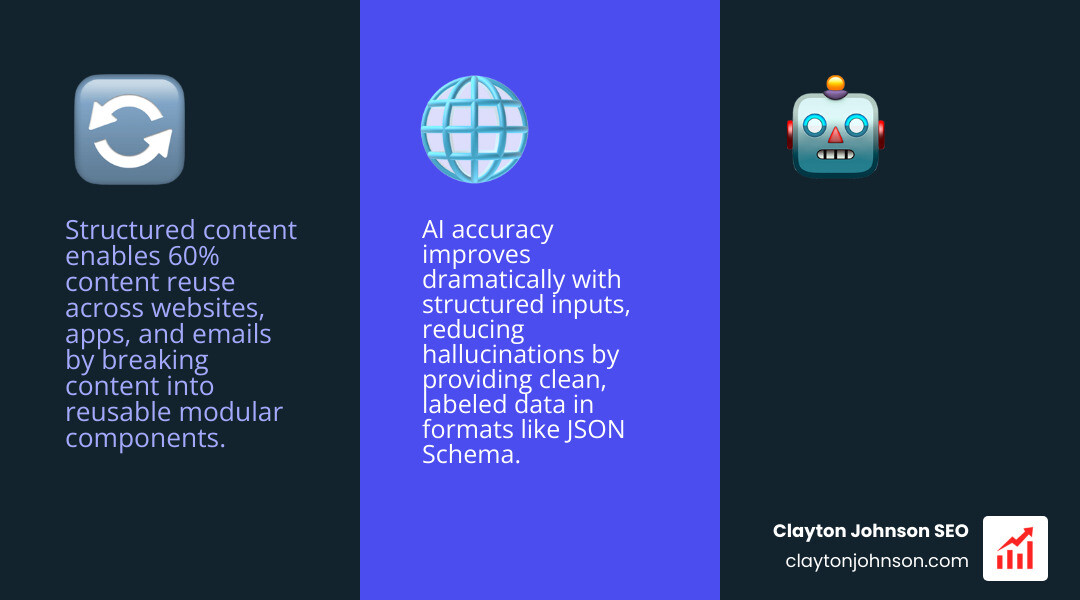
The foundation of this framework is the headless CMS. Unlike a traditional CMS that ties your content to a specific layout, a headless CMS acts as a content repository that serves data via an API. This API-first architecture is what allows us to be truly omnichannel. Whether you’re sending data to a website, a smartwatch, or a refrigerator screen, the core content remains the same.
We also have to consider governance and standards. In certain sectors, this isn’t just about efficiency — it’s about the law. For example, HIPAA and GDPR compliance requires that medical or personal data be handled with extreme care. Structured systems make it easier to track where data is stored and who has access to it, creating a clear audit trail.
Content Modeling: The Crucial First Step
Before you touch a single line of code or buy a CMS subscription, you need a content model. This is the “skeleton” or blueprint of your system.
Content modeling involves three main things:
- Content Types: What are the “things” we talk about? (e.g., Products, Authors, Locations, Lessons)
- Attributes: What pieces of info do those things have? (e.g., a “Product” has a “SKU,” a “Price,” and a “Material”)
- Relationships: How do these things connect? (e.g., an “Author” is linked to a “Blog Post”)
A common mistake is letting tools dictate your structure. We always say: stop messing up your site structure with AI taxonomy tools. You should define your semantic structure based on your business goals first.
Once the model is defined, we set validation rules. For example, “The ‘Price’ field must be a number and cannot be empty.” This ensures that no matter who is entering the data, the integrity of the system remains intact. This prevents the “broken site” issues that plague unstructured systems where someone might accidentally paste an entire image into a “Title” field.
Essential Tools for Managing Structured Data
The “stack” you choose will determine how much leverage you actually get.
- Headless CMS: Platforms like Strapi or Contentful are the gold standard. They allow you to define complex content models and serve them via API. You can browse the Strapi marketplace for plugins like the Scheduler to automate when your structured components go live.
- DatoCMS: If you need a more “Notion-like” writing experience but with deeply typed JSON outputs, DatoCMS features are excellent for handling complex embeds like galleries and polls as structured blocks.
- Portable Text: This is an open specification for rich text that treats formatting as data. Instead of messy HTML, it uses JSON, making it easy to turn one piece of text into HTML, Markdown, or even SSML for voice assistants.
- Unified Collective: This ecosystem of tools (like Remark or Rehype) allows us to parse and transform content effortlessly. It’s the “Swiss Army knife” for developers working with Unified collective standards.
For enterprise-level needs, a Component Content Management System (CCMS) might be necessary. These are designed for massive technical documentation where you might be managing thousands of tiny “chunks” of information for things like automotive manuals or medical device guides. Regardless of the tool, the goal is always the same: building a robust AI content strategy that scales.
Scaling Growth with Clayton Johnson SEO
At Clayton Johnson SEO, we don’t just “do SEO.” We build growth engines. We believe that strategy without a system is just a wish.
Our approach focuses on building scalable traffic systems that rely on the very structured content systems we’ve discussed here. By aligning your strategic roadmap with a technical architecture that supports internal linking and taxonomy-driven ecosystems, we create compounding growth.
Instead of chasing the latest algorithm update, we build durable frameworks. We have a library of strategic frameworks for over 50 business models that help founders and operators move from fragmented efforts to a coherent system.
If you’re tired of “content chaos” and want to build a system that delivers measurable outcomes, it’s time to move toward structure. Clarity leads to structure, structure leads to leverage, and leverage leads to growth.
Ready to stop wrangling and start scaling? Contact us for system building and let’s turn your content into your most valuable data asset.