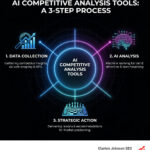
The way we look at our rivals has fundamentally shifted. For decades, competitive research was a static exercise—a “snapshot” taken once a quarter (or once a year) and buried in a PowerPoint deck. By the time you read it, the competitor had already changed their pricing, launched a new feature, or pivoted their messaging.
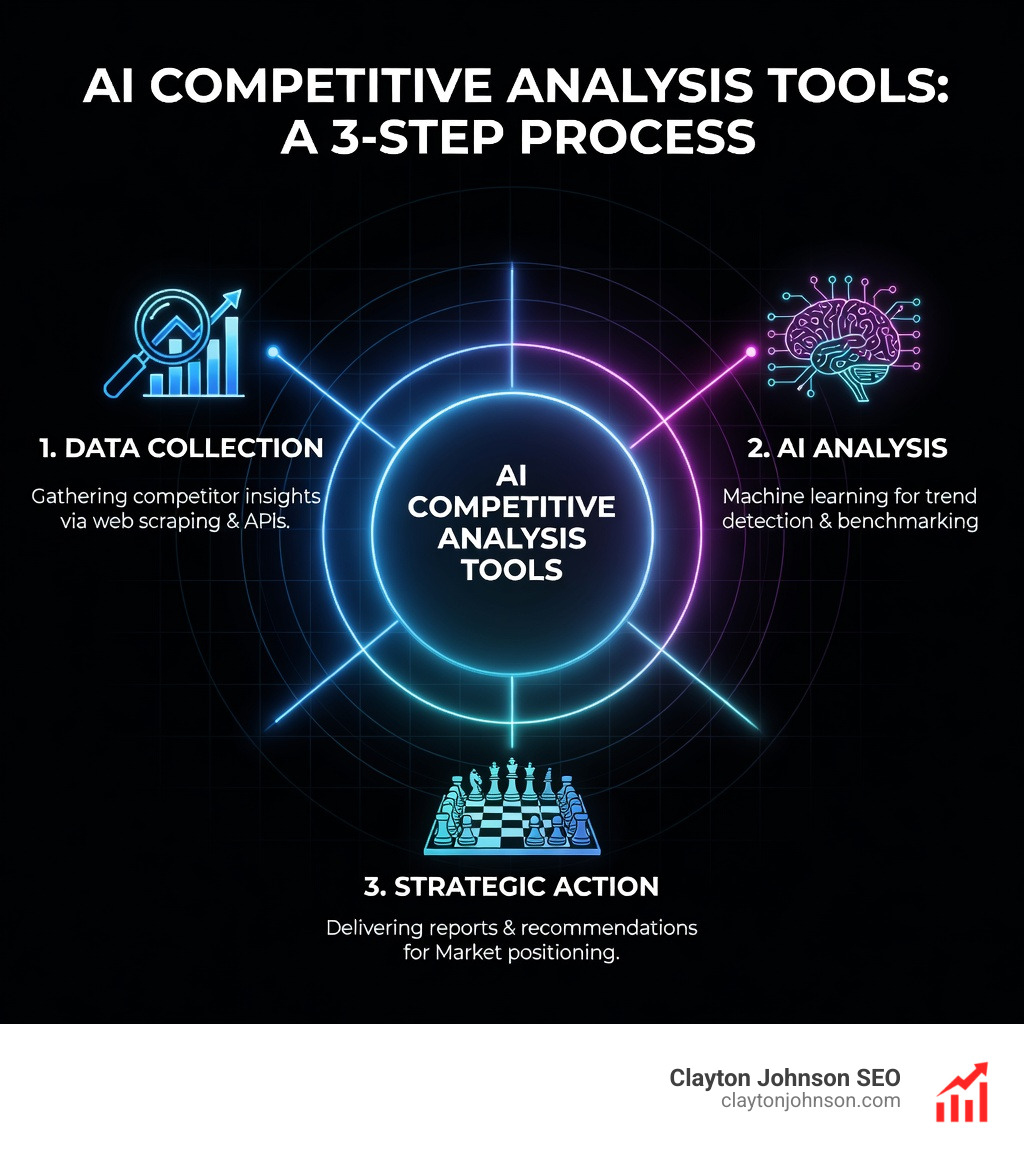
AI competitive analysis tools have turned this snapshot into a live movie. Instead of manual data entry, we now have agentic workflows that crawl the web, monitor social sentiment, and analyze unstructured data like earnings call transcripts or glassdoor reviews to find the “why” behind a competitor’s move.
The core difference in modern intelligence lies in three areas:
- Real-Time Monitoring: Tools now flag “anomalies.” If a competitor suddenly removes a “Pricing” page or changes their H1 header, AI alerts you instantly.
- Unstructured Data Processing: AI can read 1,000 customer reviews on G2 or Capterra and summarize the top three reasons people are switching away from your rival.
- Predictive Analytics: By analyzing historical patterns in ad spend and hiring (via job boards), AI can predict which market segment a competitor is about to attack.
Understanding these shifts is the first step in learning how to think about competitive pressure effectively. You aren’t just watching them; you are building strategic frameworks for competitive analysis that allow for proactive counter-moves.
Top AI Competitive Analysis Tools for Market Dominance
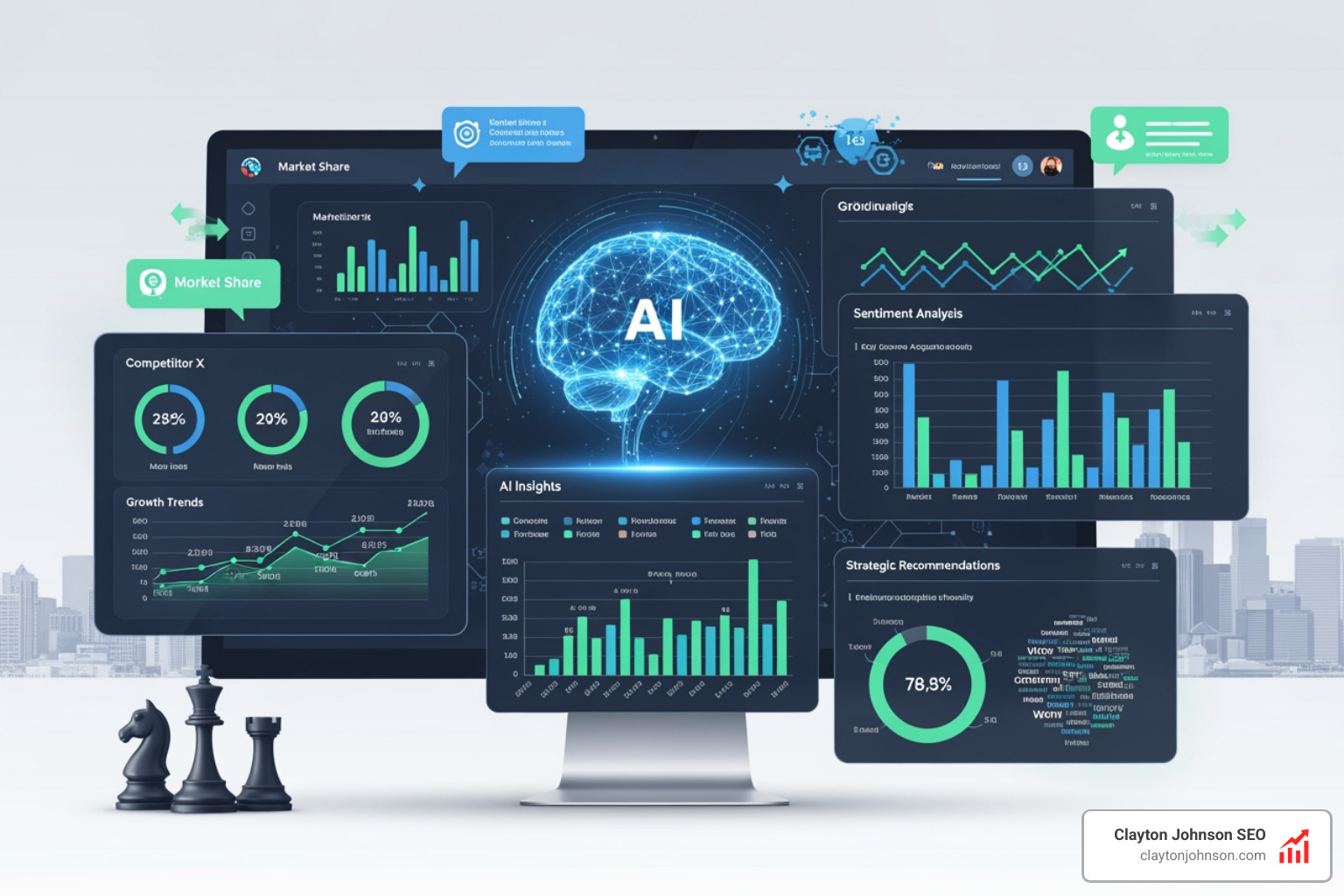
To win your market, you need a “single source of truth.” You can’t rely on fragmented guesses. The following table breaks down the heavy hitters in the AI intelligence space.
| Tool | Primary Use Case | AI Feature | Pricing Model |
|---|---|---|---|
| Similarweb | Market Intelligence | Gen AI Intelligence & AI Trend Analyzer | Flexible / Tiered |
| Kompyte | Sales Enablement | GPT-powered Battlecards & Summaries | Subscription |
| Crayon | Competitive Intelligence | Messaging Anomaly Detection | Custom Enterprise |
| Klue | Enterprise Strategy | Compete Agent (Gen AI for Slack/CRM) | Custom Enterprise |
| Competely.ai | Instant Research | 100+ Data Point Automated SWOT | Monthly Subscription |
| Beam.ai | Agentic Workflows | Multi-Agent Research Coordination | Usage-based |
When we talk about market dominance, Similarweb provides comprehensive market intelligence and traffic signals that are unmatched. They analyze 2 TB of data per day, giving you a god-mode view of where your competitor’s traffic is coming from and—more importantly—where it’s going.
For teams that need to keep their sales force updated, Kompyte automates competitor updates into a single dashboard. It pulls from websites, reviews, and even job openings to ensure your team never gets blindsided in a pitch.
Specialized AI Competitive Analysis Tools for SEO and Content
SEO is a zero-sum game. If your competitor moves up, you move down. Traditional SEO tools have integrated deep AI layers to help you spot these shifts before the traffic drops.
- Semrush: Beyond standard keyword tracking, Semrush tracks competitor rankings and visibility in AI-generated answers. Their AI Visibility toolkit benchmarks how often your brand appears in ChatGPT or Google AI Overviews compared to rivals.
- Ahrefs: This is the gold standard for backlink and organic gap analysis. Ahrefs identifies organic keyword opportunities and traffic estimates by looking at the “Content Gap”—the keywords your competitors rank for, but you don’t.
- BuzzSumo: Perfect for content strategy, it uses AI to surface the top-performing content themes for any topic, showing you exactly what kind of engagement your competitors are getting across the web.
If you are tired of losing the search battle, you need to stop letting your rivals win with a competitive content gap finder to identify the low-hanging fruit they’ve missed.
Leveraging Generative AI Competitive Analysis Tools for Strategic Insights
You don’t always need a $1,000/month subscription to get genius-level insights. General-purpose Large Language Models (LLMs) can be incredibly powerful AI competitive analysis tools if you provide them with the right data.
- Perplexity: Think of this as a research engine. It cites its sources in real-time, making it excellent for finding recent news, co-founder interviews, or pricing changes that haven’t hit the major databases yet.
- Google NotebookLM: You can upload competitor PDFs, whitepapers, and earnings transcripts. It creates a “grounded” AI that only answers questions based on those specific documents, preventing “hallucinations.”
- ChatGPT (Plus): By using the “Analyze Data” feature, you can upload a CSV export from Semrush or Similarweb and ask, “Based on this data, what are the top 3 weaknesses in my competitor’s SEO strategy?”
We recommend using AI competitive insights to outsmart your rivals by feeding these models your Ideal Customer Profile (ICP). Ask the AI: “As a [Job Title], why would I choose Competitor A over my brand?” The answers will help you learn how to score your brand with AI-powered competitive analysis objectively.
How to Prompt AI for Competitive Intelligence
The secret to looking like a genius isn’t the AI itself—it’s the prompt. If you ask a generic question, you get a generic answer. To get deep intelligence, you need to use specific data-driven prompts.
The Sitemap Strategy
Every website has a sitemap.xml. Feed this link to an AI like ChatGPT or Claude and use this prompt:
“Analyze this sitemap and my competitor’s sitemap. Compare the number of industry-specific landing pages, geographic focus, and content formats (e.g., case studies vs. blogs). Generate a bar chart showing the gaps where I am under-indexed.”
The Messaging Heatmap
Take a full-page screenshot of a competitor’s homepage (use a tool like Snagit). Upload it to an AI and prompt:
“Based on the attached screenshot and my uploaded Persona/ICP, create a table rating how well this messaging addresses the persona’s top 5 pain points. Use a 1-5 star rating system.”
Specialized platforms also automate this. Crayon uses AI to track messaging changes and market anomalies, while Klue delivers competitive insights directly into Slack and CRM workflows, ensuring that the intelligence actually gets used by the people who need it.

Best Practices for Validating AI-Generated Insights
AI can be a “hallucination machine” if left unchecked. To look like a genius, you must be right. Here is how we ensure 90%+ accuracy in our competitive intelligence:
- Source Provenance: Never accept a “fact” from an AI without a link. Tools like Perplexity and Semrush are excellent because they cite the specific page where the data was found.
- Data Normalization: Different tools might report traffic differently. Always use one tool as your “baseline” for numbers and another for “trends.”
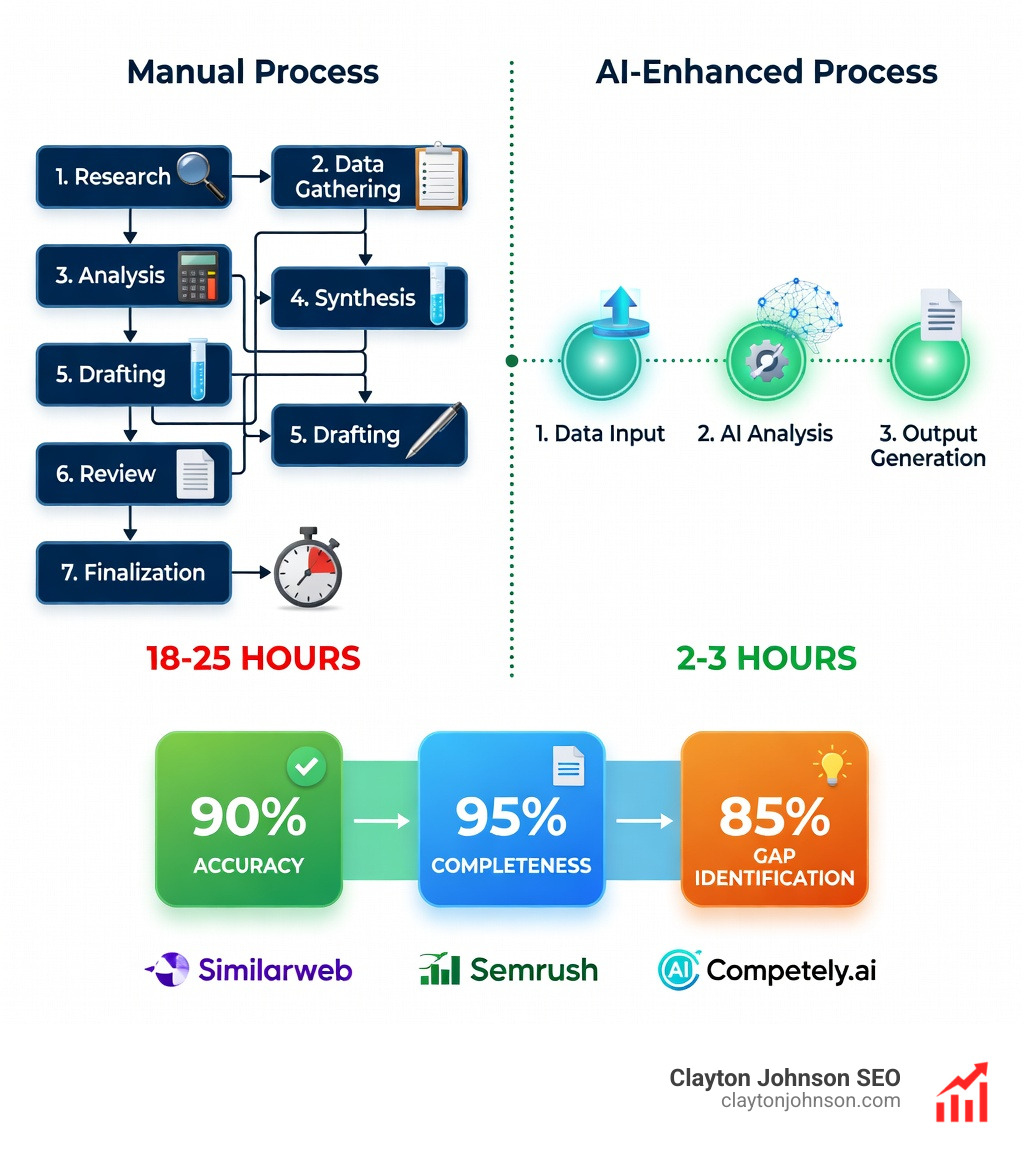
- Human-in-the-Loop: AI is great at the “what” and “how much,” but humans are better at the “so what?” Use AI to do the 20 hours of research, then spend 2 hours synthesizing the strategy.
- Confidence Scoring: If an AI suggests a competitor’s revenue, check it against public financial filings or LinkedIn headcount growth to see if the “vibe” matches the data.
For a deeper dive into how to structure this process, check out our market assessment and industry analysis guides.

Frequently Asked Questions about AI Competitive Intelligence
How accurate is AI competitive analysis compared to manual research?
When configured correctly with normalized data sources, AI-powered benchmarking regularly achieves 90% accuracy and 95% completeness. While manual research is highly accurate for a single data point, it fails at scale. AI can analyze 100 data points across 10 competitors simultaneously, identifying patterns a human would miss.
Can AI tools discover unknown competitors in niche markets?
Yes. AI models analyze “citation patterns” and “audience overlap.” Tools like Competely.ai and Similarweb can surface “indirect competitors”—companies that don’t do exactly what you do but compete for the same customer’s budget or attention.
How frequently should competitive analysis be updated with AI?
Static reports are dead. With AI competitive analysis tools, core KPIs (like paid search spend or traffic shifts) should be refreshed weekly. Deep-dive strategic reports (SWOT, messaging) are typically refreshed monthly or whenever a major product launch is detected.
Conclusion
The goal of competitive intelligence isn’t just to watch the scoreboard—it’s to change the game. At Clayton Johnson SEO, we believe that most companies don’t lack tactics; they lack structured growth architecture.
We use AI competitive analysis tools as part of a larger Growth Operating System. By combining actionable strategic frameworks with AI-augmented workflows, we help founders in Minneapolis and across the country move from “guessing” to “knowing.”
If you’re ready to stop playing catch-up and start leading your industry with a data-backed competitive positioning model, we can help. Explore our AI services and consulting to see how we turn “sci-fi dreams” into scalable business realities.
Clarity leads to structure. Structure leads to leverage. Leverage leads to compounding growth. Let’s build your growth infrastructure together.