How to Track Your Brand Mentions in the Age of AI Search


The Search Landscape Has Shifted — Is Your Brand Showing Up?
An ai seo performance tracker is a tool that monitors where and how your brand appears inside AI-generated search results — across platforms like ChatGPT, Perplexity, Google AI Overviews, and Microsoft Copilot.
Here’s a quick look at what the best trackers do:
| Feature | What It Means |
|---|---|
| AI Visibility Score | Benchmarks your brand mentions vs. competitors in AI answers |
| Citation Tracking | Monitors direct links and entity-based mentions in AI responses |
| Multi-Engine Coverage | Tracks visibility across ChatGPT, Perplexity, Gemini, Copilot |
| Prompt Research | Treats prompts like keywords — with volume and intent data |
| Competitor Benchmarking | Shows where rivals appear when you don’t |
Search isn’t a list of blue links anymore. AI engines like Perplexity and ChatGPT now generate direct answers — and they only cite a handful of brands. If yours isn’t one of them, you’re effectively invisible to that user.
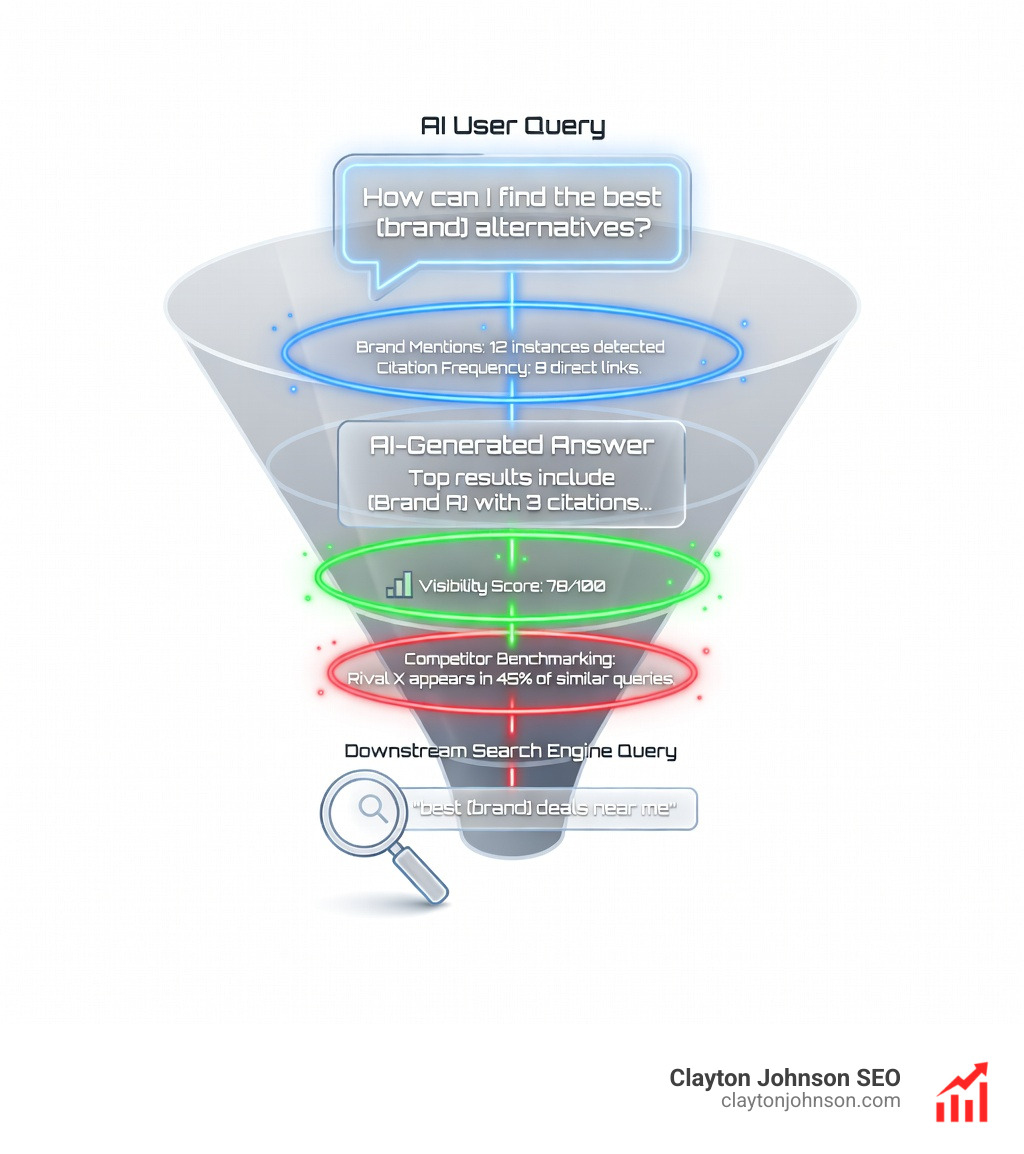
More than 90% of AI-generated questions still turn into search engine queries. That means AI mentions drive real downstream traffic. But you can’t optimize what you can’t see.
That’s the gap an AI SEO performance tracker closes.
I’m Clayton Johnson — an SEO strategist who builds scalable traffic systems and AI-augmented marketing workflows, and I’ve used ai seo performance trackers to help founders and growth teams move from reactive SEO to structured, measurable visibility. In the sections below, I’ll break down the top tools, the metrics that matter, and how to pick the right tracker for your goals.
Why an AI SEO Performance Tracker is Essential for Modern Visibility
The era of “set it and forget it” SEO is officially over. Today, the search landscape is evolving from a library of links into a room full of consultants. When users ask an AI engine for a recommendation, they aren’t looking for ten options; they are looking for the best answer.
Statistics show that many organizations now use AI in their marketing operations. This isn’t just a trend; it’s a fundamental shift in how we discover information. If your business relies on organic traffic, you need to stop guessing and start measuring your AI visibility today.
In traditional SEO, we track keyword rankings. In AI search, we track entity-rich content and citations. Traditional tools might tell you that you rank #1 for “best Minneapolis SEO,” but they won’t tell you if ChatGPT is recommending your competitor instead because their content is better structured for Large Language Models (LLMs).
Conversational search is dynamic. It uses “query fan-out,” where an AI takes a single user question and breaks it into sub-questions to find the most comprehensive answer. An ai seo performance tracker monitors this process, helping us understand which parts of our content are being “read” and cited by these engines. Without this data, we are flying blind in a landscape where many AI-generated questions eventually lead back to traditional search queries.
Top Tools to Use as Your AI SEO Performance Tracker
Choosing the right ai seo performance tracker depends on your scale, budget, and specific goals. Some tools are built for massive enterprises, while others are designed for agile agencies managing multiple brands.
| Tool | Best For | Key Feature |
|---|---|---|
| Scrunch AI | Agencies & SMBs | Multi-brand management & versatility |
| Profound | Enterprises | Deepest dataset & AEO focus |
| Rankscale | Performance SEO | Citation monitoring & brand surfacing |
| Semrush | All-in-one Teams | Visibility Score & prompt research |
| SE Ranking | Growth Teams | ChatGPT & AI Mode tracking |
Scrunch AI
If you’re managing multiple brands or juggling several sites, Scrunch AI is quickly becoming one of the most versatile and agency-friendly platforms in the space. It’s one of the latest AI SEO tools we’ve tested, and it excels at providing a birds-eye view of brand presence across different search environments. It’s particularly useful for teams that need to report on visibility shifts across a diverse portfolio of clients.
Profound
For large organizations, Profound is a powerhouse. It is designed specifically for teams that need deep, enterprise-grade insights. Profound offers what is arguably the deepest dataset available for tracking search results across multiple AI search engines. If you are developing an SEO Strategy for Enterprises, this tool provides the granular data needed to satisfy stakeholders who demand high-level attribution. Pricing starts at roughly $99/month for starters, but enterprise tiers can reach $3,000/month.
Rankscale
Rankscale is one of the first purpose-built tools designed to monitor visibility specifically in AI search engines. Rather than just tracking rankings on traditional SERPs, this SEO tool evaluates how often your brand or content is cited or surfaced within AI-generated responses. This is an increasingly important metric as “Answer Engine Optimization” (AEO) becomes a core part of the marketing mix.
Semrush AI Visibility Toolkit
Semrush has added an AI analytics tool to its already expansive suite. This toolkit helps you benchmark your brand’s overall visibility in AI-generated answers against your industry’s median. It treats prompts like keywords, offering data on search volume and intent. You can even boost your rankings with these free SEO AI tools to get a head start on your AI visibility strategy.
SE Ranking
SE Ranking is a full-stack solution that offers real-time AI visibility and rank monitoring. It includes specific trackers for ChatGPT and Google’s “AI Mode.” For those who want to automate their reporting, it’s a great fit—check out The Lazy Marketer Guide to Automated SEO Reporting to see how this integrates into a broader workflow.
Key Metrics and Data Points for AI Search
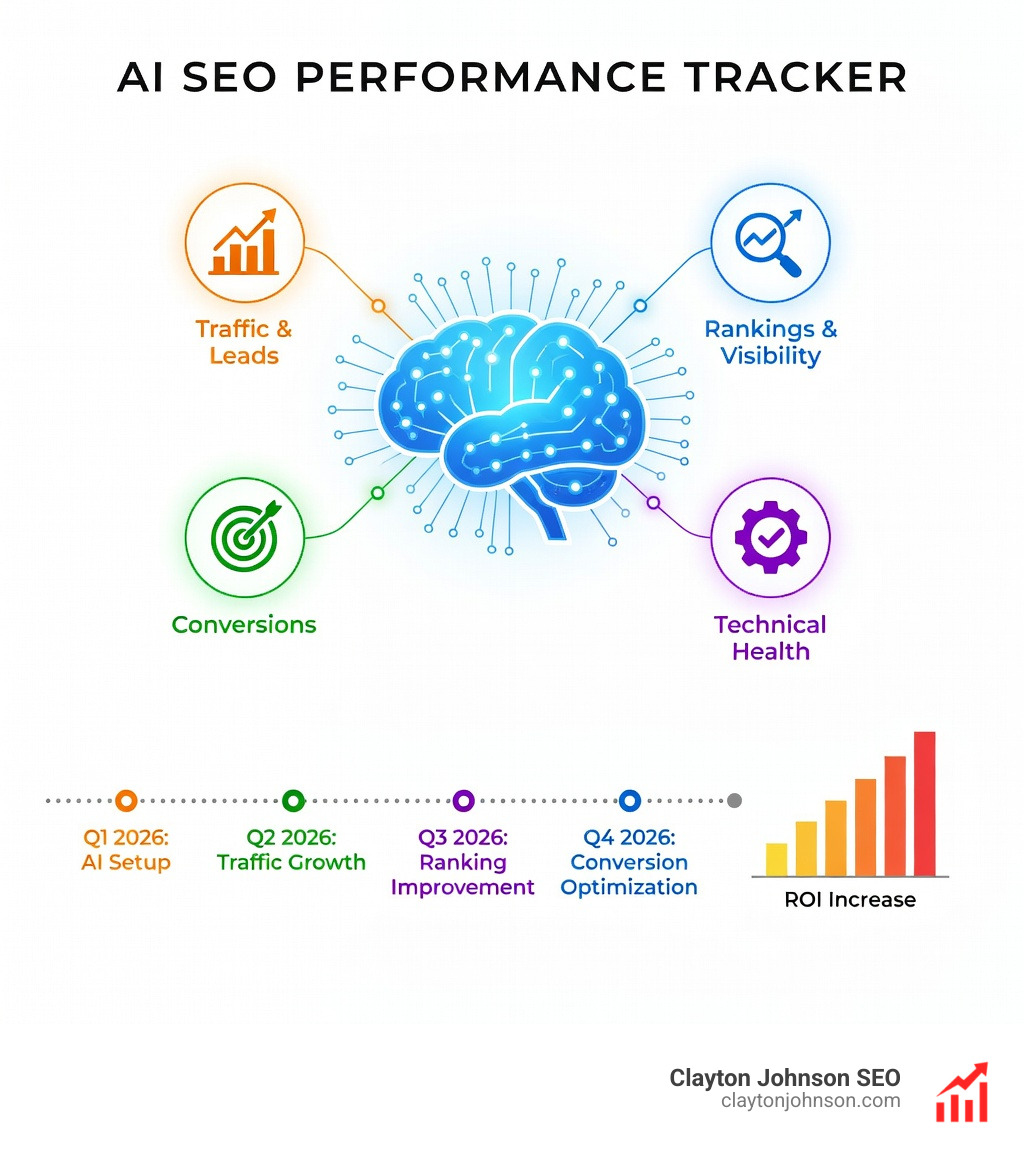
To win in the age of AI, we have to look past simple “blue link” clicks. An ai seo performance tracker provides a new set of KPIs that reflect how LLMs perceive your brand.
Understanding the AI SEO Performance Tracker Visibility Score
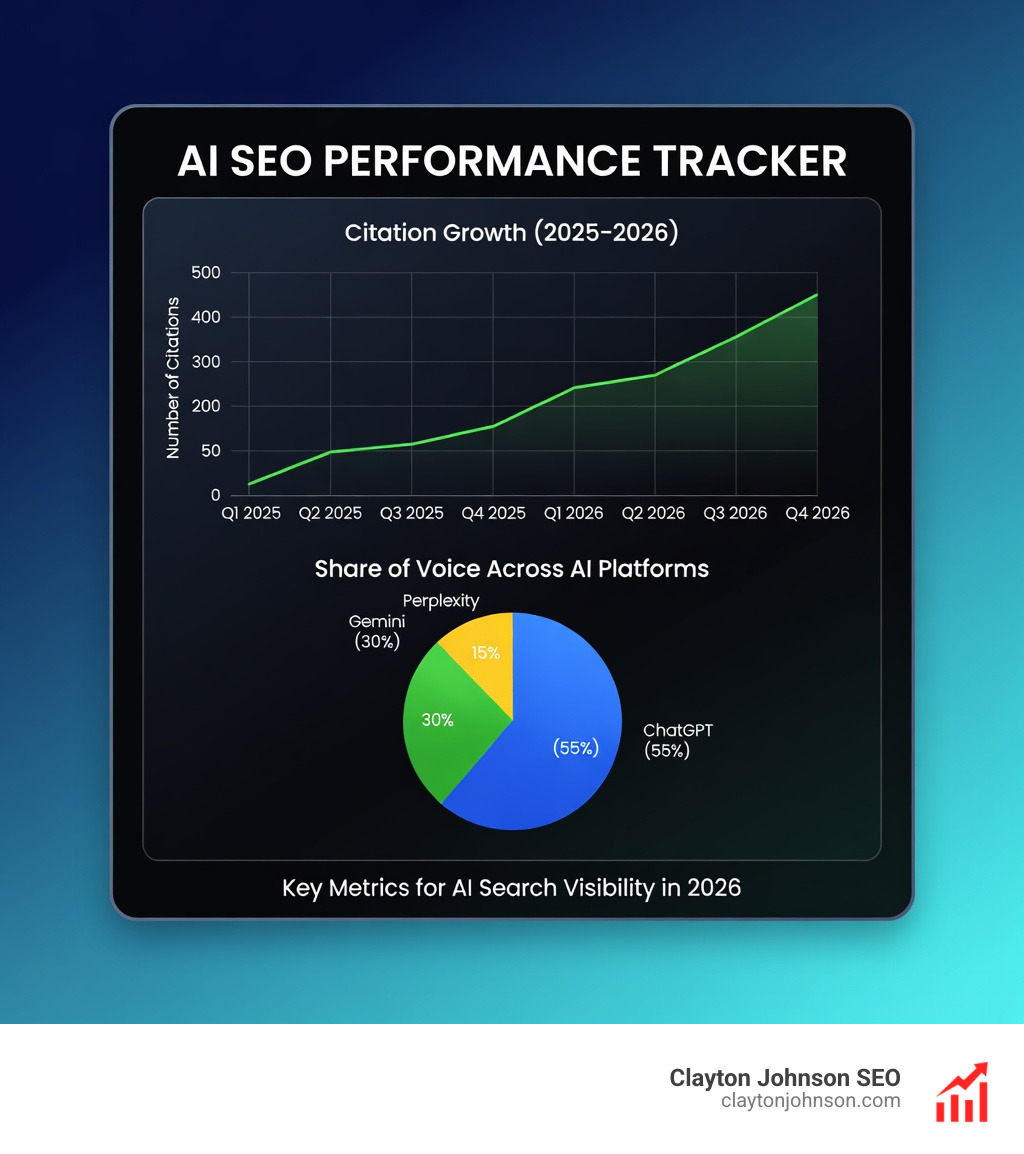
The AI Visibility Score is a benchmark that shows how often your brand is mentioned compared to the median of your top competitors. Think of it as your “Share of Voice” for the AI era. If your score is low, it means AI engines are pulling information from other sources, even if you rank well on Google.
Tracking this score allows you to see trends over time. Is your visibility growing as you publish more structured content? The future of search with AI-powered keyword research relies on identifying the specific prompts that trigger these mentions.
Tracking Citations and Mentions
Citations are the new backlinks. When Google’s AI Overviews or Perplexity provide an answer, they often include links to their sources.
- Direct Links: These drive immediate traffic to your site.
- Entity Associations: This is when the AI mentions your brand as an authority on a topic without necessarily linking to you. This builds your “brand authority” in the eyes of the LLM.
One actionable tip: filling content gaps with Surfer SEO’s ‘Facts’ can increase AI citations by up to 25%. AI engines love factual, structured data because it’s easier for them to parse and verify.
Strategic Implementation and Accuracy Factors
Just because a tool gives you a number doesn’t mean that number is 100% accurate. AI search results are highly dynamic—they change based on the user’s previous questions, their location, and the specific version of the LLM being used.
Evaluating Your AI SEO Performance Tracker Options
When choosing a tool, we recommend starting with a goal assessment. Are you trying to protect your brand’s reputation, or are you trying to steal market share from a competitor?
- Budget: Enterprise tools like Profound offer massive datasets but come with a higher price tag.
- Scalability: If you’re a growing company, you need a tool that can handle more prompts as your content library expands.
- Ease of Use: Does the tool integrate with your current stack (like Google Search Console)?
If you’re feeling overwhelmed, consulting with an SEO Consultant can help you map out which tools actually move the needle for your specific business model. You can also look for the best ways to get a free AI SEO audit today to test the waters before committing to a paid subscription.
Factors Impacting Data Accuracy
Accuracy in an ai seo performance tracker is driven by three main factors:
- Update Frequency: AI engines update their “knowledge” frequently. A tracker that only updates once a month is useless. You want daily or real-time updates.
- Citation Recognition: Can the tool tell the difference between a mention of your brand and a mention of a similar-sounding competitor?
- Context Parsing: Does the tool understand the sentiment? Being mentioned in an AI result is bad if the AI is using you as an example of “what not to do.”
We’ve seen how SEOs hit aggressive performance goals by focusing on “LLM readability”—ensuring that code is clean and schema markup is perfect so that trackers (and the AI engines themselves) can accurately identify the brand.
Frequently Asked Questions about AI SEO Performance Trackers
How do AI SEO trackers differ from traditional SEO tools?
Traditional tools focus on “Rankings” (where you sit on a list of 10 links) and “Keywords.” An ai seo performance tracker focuses on “Visibility” (whether you are part of the generated answer) and “Prompts.” Traditional SEO is about being found; AI SEO is about being recommended. For a refresher on the basics, see our guide on SEO 101.
Can these tools track visibility in ChatGPT and Perplexity?
Yes. Leading tools like SE Ranking and Profound specifically monitor ChatGPT search, Perplexity, and Microsoft Copilot. Because these engines don’t use a traditional ranking system, trackers use “simulated prompts” to see which brands the AI chooses to cite in its conversational responses.
What is a good AI Visibility Score?
A “good” score is relative to your industry. In highly competitive spaces (like SaaS or Finance), a visibility score of 20-30% might be leading the market. The goal isn’t to hit 100%; it’s to consistently stay above the “Competitor Median.” You can use AI-driven SEO audits to see how your current score compares to your closest rivals.
Conclusion: Building a Structured Growth Architecture
At the end of the day, an ai seo performance tracker is just a tool. To see real results, you need a system that turns that data into action.
At Clayton Johnson SEO, we are building Demandflow.ai — a software platform designed to provide a structured strategy and growth operating system for founders and marketing leaders. We believe that most companies don’t lack tactics; they lack structured growth architecture.
Our approach combines:
- Actionable Strategic Frameworks: Moving beyond “more content” to “better structure.”
- Taxonomy-Driven SEO Systems: Organizing your site so AI engines can easily understand your authority.
- AI-Augmented Marketing Workflows: Using tools to automate the tedious parts of tracking so you can focus on strategy.
Clarity leads to structure, which leads to leverage, and ultimately, compounding growth. Whether you are an enterprise in Minneapolis or a global SaaS brand, the goal is to move from guessing to knowing. If you’re ready to master the new era of search, you can find more info about AI tools and how they fit into a modern growth engine on our site.
Stop chasing the algorithm and start building an authority-building ecosystem that AI engines can’t ignore.