Steal These Business Models (Legally)

Why Every Strategist Needs a Business Model Canvas Example
A Business model canvas example shows you exactly how successful companies structure their strategy in one visual page. Here are the top real-world examples that illustrate how the framework works:
| Company | Key Innovation | Primary Revenue Model |
|---|---|---|
| Netflix | 2,000 taste clusters for personalization | Subscription streaming |
| Patagonia | Sustainability as core value proposition | Premium pricing + repairs |
| Airbnb | Two-sided marketplace platform | Commission from hosts and guests |
| Uber | On-demand ride matching | Transaction fees + surge pricing |
| Apple | Vertical integration + ecosystem lock-in | Hardware sales + services |
| Amazon | Multi-model ecosystem (retail + AWS + Prime) | E-commerce + cloud + subscriptions |
| Tesla | Direct-to-consumer EV sales | Vehicle sales + software subscriptions |
| Udemy | User-generated course content | Revenue share with instructors |
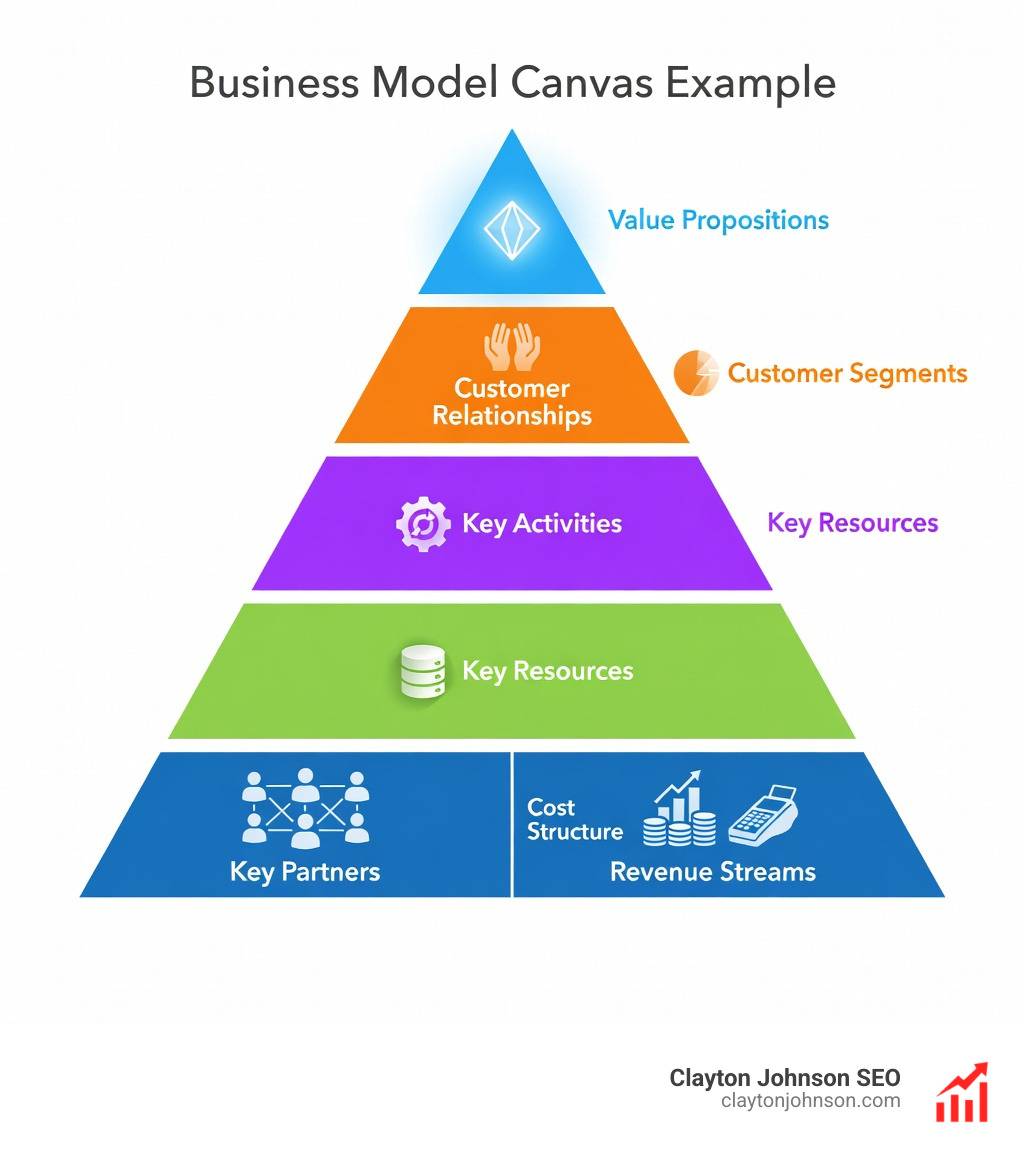
The Business Model Canvas isn’t just another planning template—it’s the strategic framework used by leading organizations and startups worldwide to visualize how they create, deliver, and capture value. Created by Alexander Osterwalder and Yves Pigneur in their bestselling book Business Model Generation, this single-page tool breaks down any business into nine interconnected building blocks that tell a complete story.
Why does this matter? Most businesses fail not because they build bad products, but because they never clearly understand how they make money. The canvas forces you to answer the hard questions: Who pays you? Why? What does it cost to deliver? What makes you different?
Instead of writing a 40-page business plan nobody reads, you can map your entire strategy on one page using sticky notes. This makes it easy to spot gaps, test assumptions, and pivot quickly when market connections change.
The framework works whether you’re launching a startup, analyzing competitors, or innovating within an established company. Netflix uses it to manage their content strategy. Patagonia built their sustainability model with it. Tech giants like Apple and Amazon apply these principles across multiple business units.
I’m Clayton Johnson, and I’ve used business model canvas examples to help dozens of companies clarify their growth strategy and identify revenue opportunities they were missing. Throughout this guide, I’ll show you exactly how top companies structure their canvases and how to build your own.
Business model canvas example vocabulary:
What is the Business Model Canvas?
At its heart, the Business Model Canvas (BMC) is a strategic management tool that provides a holistic view of a company’s operations. It was developed by Alexander Osterwalder, a Swiss entrepreneur and co-founder of Strategyzer, alongside Yves Pigneur. They wanted to create a “shared language” for strategy—something that a CEO, a developer, and a marketing manager could all look at and understand instantly.
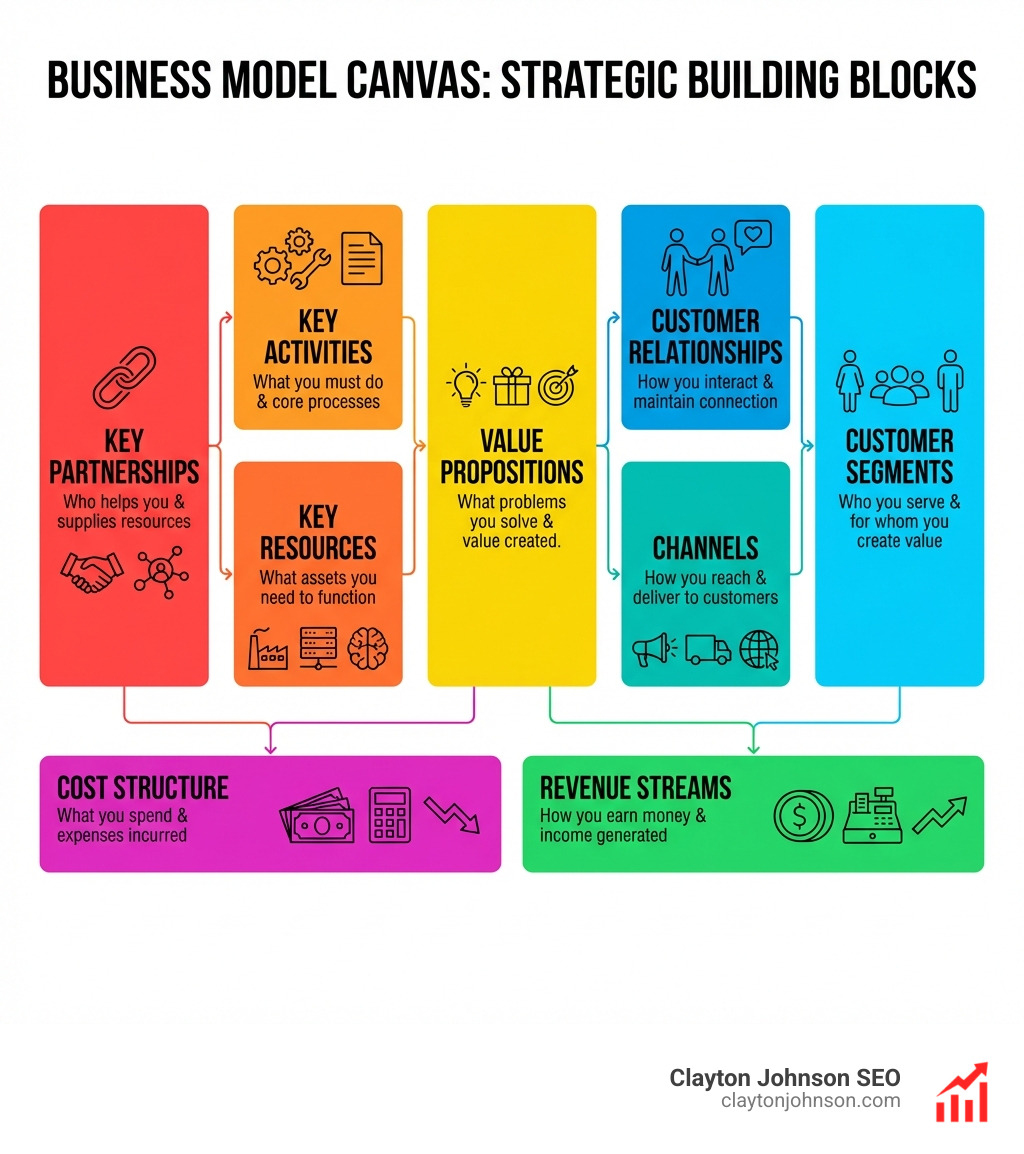
The canvas is designed to help us describe, design, challenge, and pivot a business model. It moves us away from “blah blah blah” and toward visual clarity. Instead of guessing how a business works, we map out the nine building blocks:
- Customer Segments: Who are we helping?
- Value Propositions: Why do they care?
- Channels: How do we reach them?
- Customer Relationships: How do we keep them?
- Revenue Streams: How do we get paid?
- Key Resources: What do we need to own?
- Key Activities: What do we need to do?
- Key Partners: Who helps us?
- Cost Structure: What are our big expenses?
By laying these out on a single page, we can see if the “front stage” (what the customer sees) aligns with the “back stage” (how we run the business). If you want to dive deeper into the official source, you can Download the official Business Model Canvas PDF or check out our guide on digital innovation via the Business Model Canvas.
8 Real-World Business Model Canvas Example Breakdowns
Understanding the theory is one thing, but seeing it in action is where the magic happens. We’ve analyzed some of the world’s most successful companies to see how they “stole” market share by innovating their business models.

Netflix Business Model Canvas Example
Netflix is the ultimate story of a business model pivot. They started as a DVD-by-mail service and transformed into a global content creator.
- Customer Segments: Netflix divides its 125 million global viewers into 2,000 “taste clusters.” They don’t just care about your age or location; they care about your movie and TV show preferences to provide personalized recommendations.
- Value Proposition: On-demand streaming, original content (like Stranger Things), and a “no ads” experience.
- Key Resources: Their vast content library and their recommendation algorithm are their “secret sauce.”
- Revenue Streams: A simple subscription-based model. Recently, they’ve even experimented with ad-supported tiers to capture more price-sensitive segments.
For a deeper look at how they found their audience, see our guide on BMC customer discovery.
Patagonia Business Model Canvas Example
Patagonia is a Business model canvas example that proves you can be profitable while being ethical. Their model is built on “anti-consumption.”
- Value Proposition: High-quality, durable outdoor gear with an environmental mission. They even tell customers “Don’t Buy This Jacket” if they don’t need it.
- Customer Relationships: Built on activism and trust. They offer repairs and trade-ins to extend product life.
- Key Activities: Environmental activism, sustainable sourcing (switching to 100% organic cotton back in 1994), and supply chain transparency.
- Cost Structure: They accept higher costs for sustainable materials because it justifies their premium pricing.
You can read more Scientific research on Patagonia’s business model to see how they’ve scaled sustainability.
Airbnb and Uber: The Platform Model
Both Airbnb and Uber use a “Multi-Sided Platform” model. They don’t own the assets (houses or cars); they own the connection between the provider and the user.
- Key Partners: For Airbnb, it’s the hosts. For Uber, it’s the drivers. Without these partners, the business doesn’t exist.
- Value Proposition: For users, it’s convenience and lower prices. For providers, it’s income generation.
- Revenue Streams: They take a small cut from every transaction. Airbnb takes a bit from the host and a little more from the guest.
- Key Resources: Their technology infrastructure and brand trust.
Mastering these connections is vital, as we discuss in mastering BMC channels and relationships.
Apple and Tesla: Direct-to-Consumer Innovation
Apple and Tesla both use vertical integration to control the customer experience from start to finish.
- Channels: Unlike traditional car companies or electronics brands that rely on third-party dealers, Apple and Tesla sell directly to consumers through their own stores and websites.
- Value Proposition: High-end design, cutting-edge technology, and an ecosystem that “just works.”
- Revenue Streams: While hardware sales (iPhones, Model 3s) are the big hitters, both are leaning heavily into software subscriptions (Apple Music, Tesla Full Self-Driving).
Startups can learn a lot from this definitive BMC tech startup template for scalable growth.
Amazon: The Ecosystem Giant
Amazon is a “Frankenstein” of business models in the best way possible. They are a retailer, a cloud provider, and a logistics company all in one.
- Customer Segments: Everyone from individual shoppers to massive enterprises (AWS).
- Value Proposition: “The Everything Store,” fast shipping via Prime, and reliable cloud infrastructure.
- Key Activities: Logistics, warehouse management, and continuous software development.
- Revenue Streams: Retail sales, third-party seller fees, Prime subscriptions, and AWS cloud fees.
To see how Amazon stays ahead, check out our BMC SWOT integration guide.
Udemy and AliExpress: User-Generated and Global Sourcing
These companies scale by letting others do the heavy lifting of content and product creation.
- Udemy: They don’t hire teachers; they enable instructors to offer courses on virtually any topic. This user-generated content model allows them to scale infinitely without massive upfront costs.
- AliExpress: Owned by Alibaba, it connects global consumers with sellers primarily from China. By partnering with low-cost manufacturers, they offer competitive pricing that is hard to beat.
How to Fill Out Your Canvas Step-by-Step
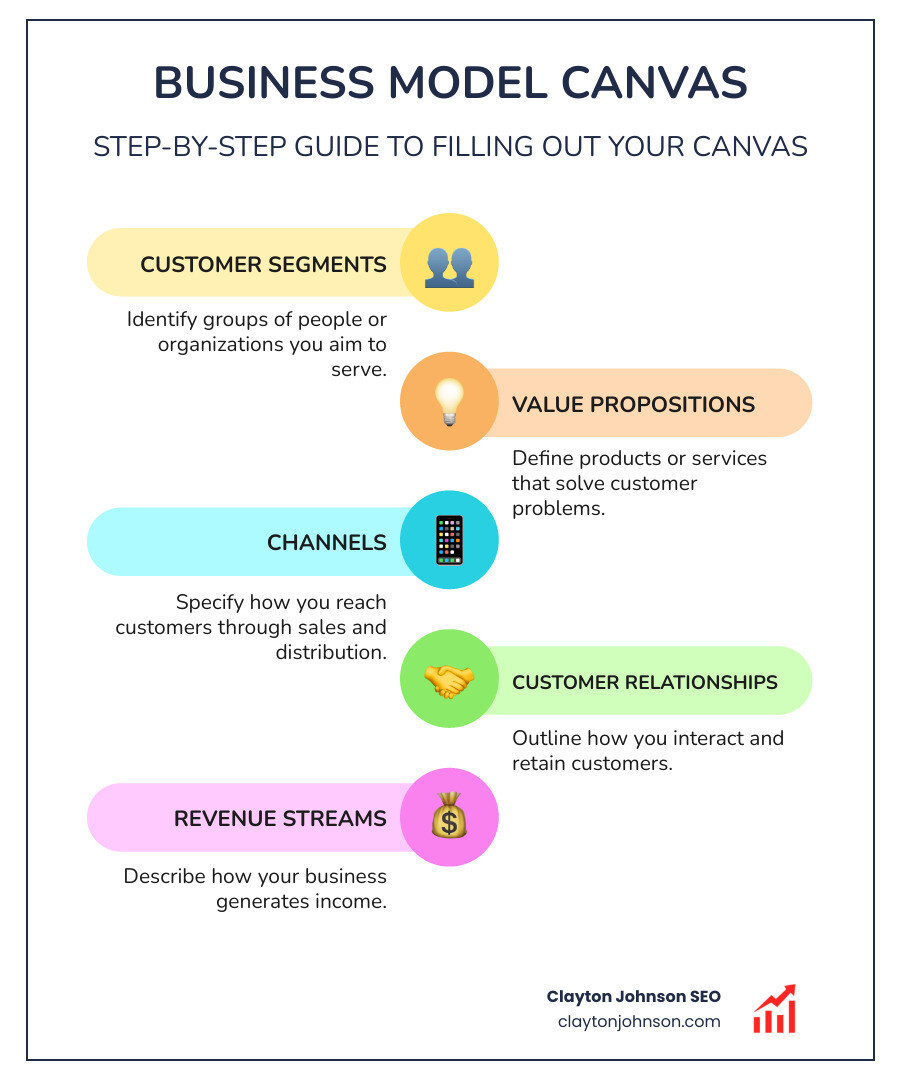
Don’t just stare at a blank page. Grab a stack of sticky notes and your team. We recommend filling out the canvas in a specific order to ensure the logic flows correctly.
Step 1: Customer Segments
Start with the “Who.” Who are you creating value for? Be specific. Instead of “Small Businesses,” try “Boutique Law Firms in Minneapolis with 5–10 employees.”
Step 2: Value Propositions
What problem are you solving? Why would someone choose you over a competitor? Avoid vague terms like “high quality.” Instead, use “Reducing inventory overhead by 20% through automated restocking.”
Step 3: Channels
How do you reach your customers? This includes your website, social media, and physical stores. Think about the entire customer journey, from awareness to post-purchase support.
Step 4: Customer Relationships
What kind of relationship do you have? Is it a personal concierge service (high cost) or a self-service automated platform (low cost)?
Step 5: Revenue Streams
How does the money come in? Is it an asset sale, a subscription fee, or a licensing deal?
Step 6: Key Resources
What do you need to make the business work? This could be physical assets (trucks), intellectual property (patents), or human capital (expert developers).
Step 7: Key Activities
What are the most important things you do every day? For a bakery, it’s baking. For Netflix, it’s content production and algorithm tuning.
Step 8: Key Partners
Who are your suppliers and partners? Why do you need them? Usually, it’s to reduce risk or acquire resources you don’t want to build yourself.
Step 9: Cost Structure
What are your biggest expenses? Are you “Cost-Driven” (like Southwest Airlines) or “Value-Driven” (like Rolex)? For more on managing these, see our deep dive into BMC cost structure.
BMC vs. Lean Canvas: Choosing Your Framework
While the Business Model Canvas is the gold standard for established businesses, many startups prefer the Lean Canvas, created by Ash Maurya.
| Feature | Business Model Canvas | Lean Canvas |
|---|---|---|
| Focus | Holistic Business Strategy | Product-Market Fit |
| Best For | Established Businesses / Innovation | Early-Stage Startups |
| Key Blocks Removed | Key Partners, Activities, Resources | Problem, Solution, Key Metrics |
| New Blocks Added | Customer Relationships | Unfair Advantage |
The Lean Canvas is built on the idea that most startups fail because they build the wrong product, not because they have the wrong partners. It forces you to focus on the “Problem” and “Solution” first. We often suggest blending Lean Startup and BMC for the best results.
Pro-Level Strategy: Avoiding Common BMC Pitfalls
Even experts make mistakes. Here are the most common “fail modes” we see when teams use the Business model canvas example approach:
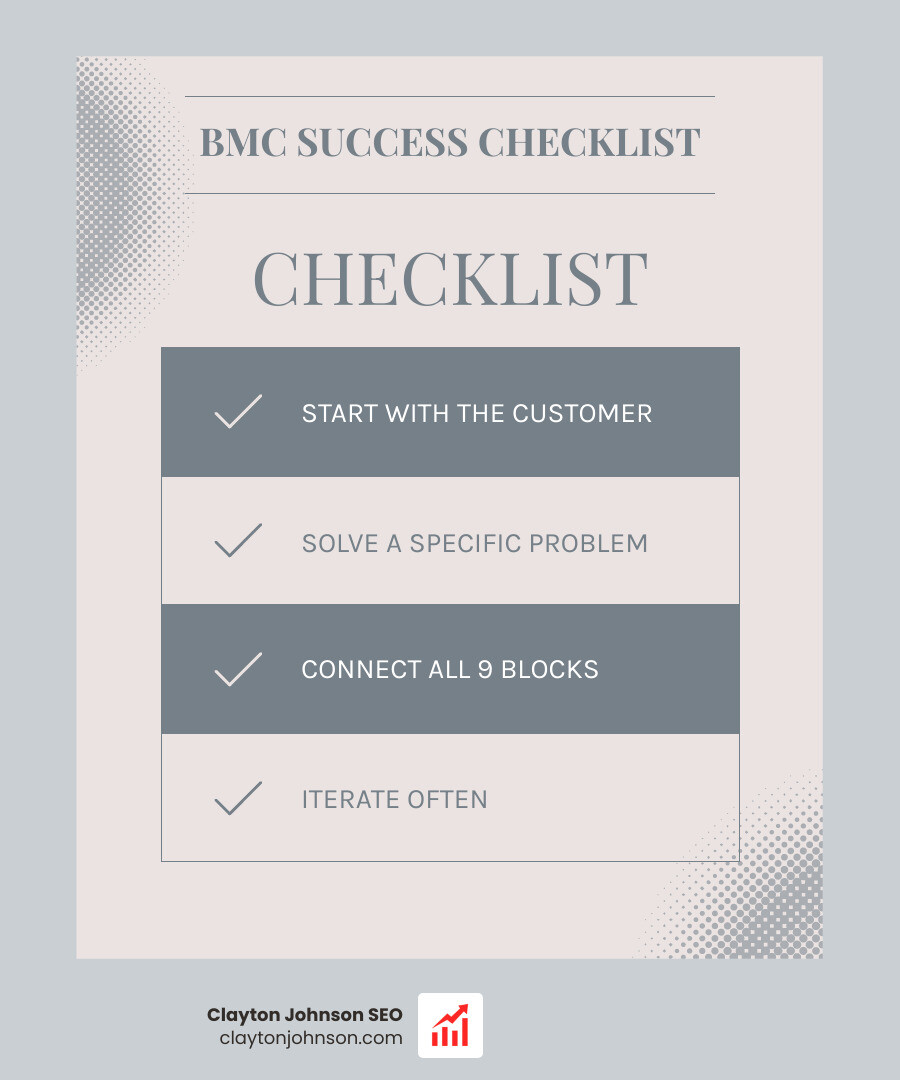
- Treating it as a “List” rather than a “System”: Every block should connect to another. If you have a “Premium” value proposition but a “Low Cost” cost structure, your model might be broken.
- The “Vague Value” Trap: Don’t use marketing fluff. If your value proposition is “Great Service,” you haven’t said anything. Be specific about the pain you solve.
- Mixing “The Present” with “The Future”: If you are mapping your current business but adding features you hope to build next year, you’ll get confused. Use different colored sticky notes to separate “Now” from “Future.”
- Designing for “Everyone”: If your customer segment is “everyone,” your value proposition will be weak. Niche down to win.
For those looking to automate their strategy workflows, we’ve even put together a complete Claude skill pack for modern developers to help you use AI in your business modeling.
Frequently Asked Questions about Business Models
How often should I update my Business Model Canvas?
The BMC is a living document, not a “one and done” task. We recommend reviewing it quarterly or whenever there is a major shift in the market. If a new competitor enters or your customer acquisition cost spikes, it’s time to pull out the sticky notes.
What is the role of the Value Proposition Canvas?
Think of the Value Proposition Canvas as a “plug-in” for the BMC. It zooms in on two specific blocks: Customer Segments and Value Propositions. It helps you map out customer “Pains,” “Gains,” and “Jobs-to-be-done” to ensure your product actually solves a real problem.
Can established businesses use the BMC for innovation?
Absolutely. In fact, companies like Amazon and GE use it to manage their “Portfolio.” They use the canvas to “Exploit” their current successful models while simultaneously using it to “Explore” new, disruptive models in separate business units.
Conclusion
The Business model canvas example isn’t just a diagram; it’s a way of thinking. It forces us to stop focusing on features and start focusing on value. Whether you’re looking at the sustainability of Patagonia or the ecosystem dominance of Amazon, the lesson is the same: clarity is power.
At Clayton Johnson SEO, we’re obsessed with growth strategy and building content systems that actually move the needle. We help founders and marketing leaders in Minneapolis and beyond diagnose their growth problems and execute with measurable results.
If you’re ready to stop guessing and start growing, check out our actionable frameworks or learn more about our social media marketing services to see how we can help you build a business model that wins.