The Two-Way Street of Foundational AI SEO

Why AI Is Redefining SEO Fundamentals ⚙️
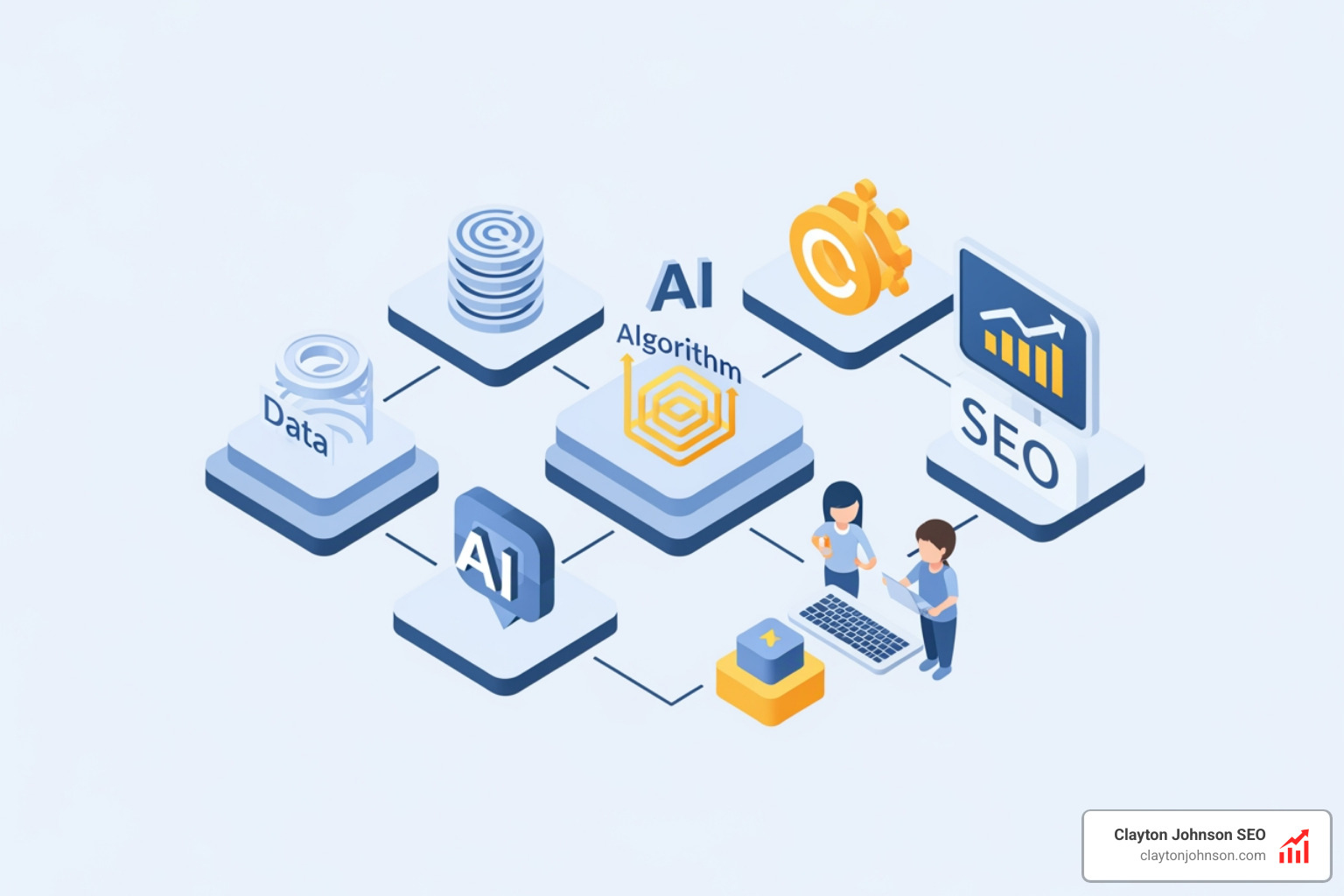
What elements are foundational for seo with ai comes down to a core truth: AI hasn’t replaced the principles of good SEO—it’s amplified them. The fundamentals still matter, but how search engines understand, rank, and surface content has fundamentally changed.
Quick Answer:
- High-quality, human-reviewed content with original insights and information gain
- Search intent optimization for conversational and long-tail queries
- E-E-A-T signals (Experience, Expertise, Authoritativeness, Trustworthiness)
- Technical infrastructure: site speed, mobile optimization, Core Web Vitals, schema markup
- Content architecture: topic clusters, pillar pages, strategic internal linking
- Structured data and entity clarity for machine-readable context
- Generative Engine Optimization (GEO) for AI Overviews and answer engines
- Passage-level extractability and multimodal content formats
The search landscape is splintering. Google still commands 93.57% of traditional search, but AI platforms like ChatGPT now handle approximately 37.5 million searches per day—with about 30% of prompts carrying search intent. Gen Z uses AI chatbots for 31% of their searches, compared to 58% for manual search engines. Meanwhile, Google’s AI Overviews now appear in 13.14% of queries, and less than 50% of those overviews link to the first organic result.
This isn’t a future trend. It’s happening now.
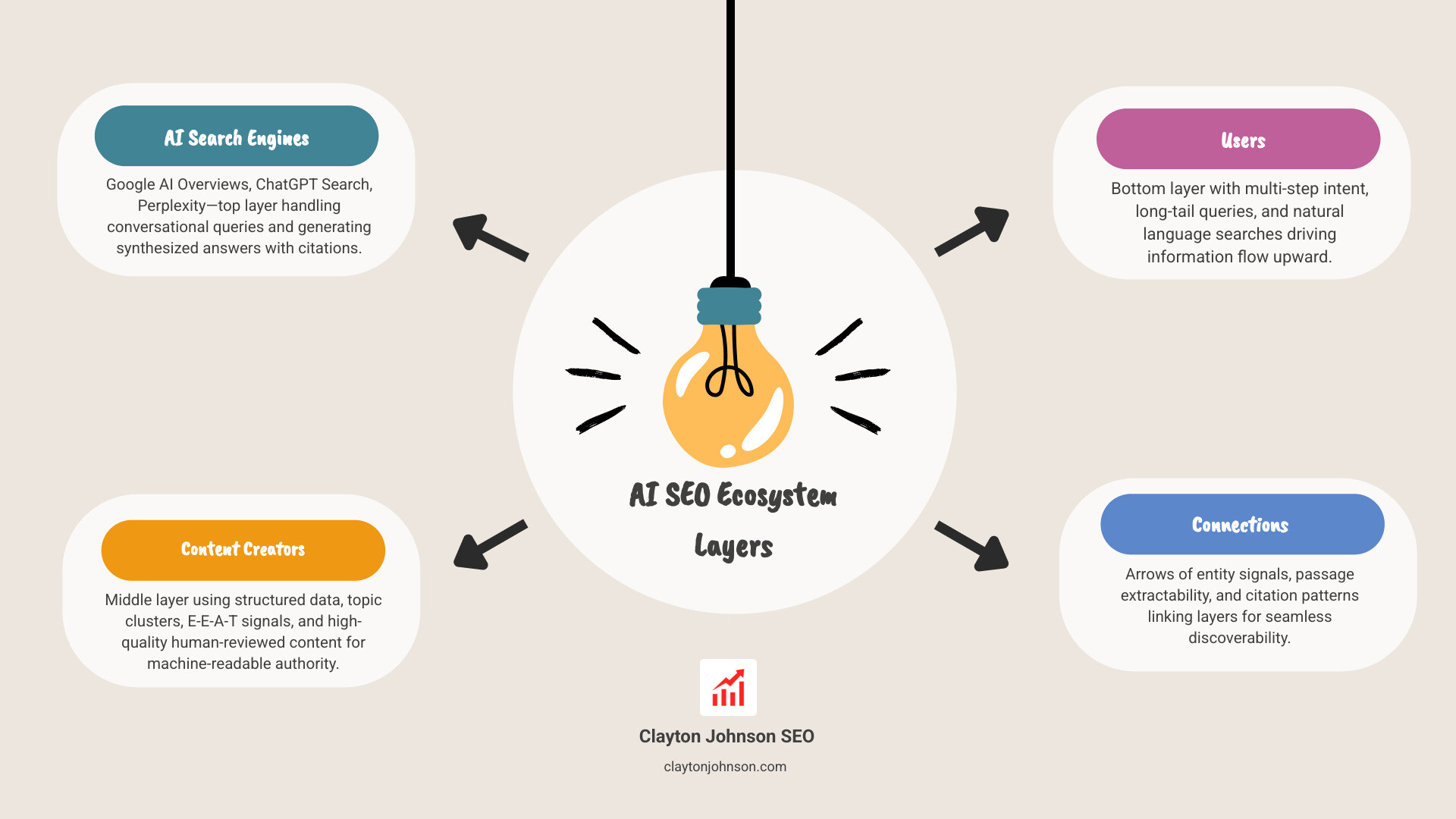
Search engines are using natural language processing models like BERT, MUM, and RankBrain to interpret queries with unprecedented semantic depth. AI-powered search doesn’t just match keywords—it understands intent, anticipates follow-up questions, and synthesizes multi-source answers. Traditional ranking factors still apply, but they’re now filtered through AI systems that prioritize clarity, structure, authority, and extractability.
The organizations winning in this environment aren’t chasing algorithmic hacks. They’re building foundational infrastructure: content that machines can interpret, structured data that provides entity clarity, topic architectures that demonstrate depth, and technical foundations that enable both human users and AI crawlers to navigate efficiently.
I’m Clayton Johnson, and I’ve spent years engineering scalable SEO systems that bridge traditional search fundamentals with AI-driven discoverability—helping businesses understand what elements are foundational for seo with ai and how to implement them systematically. This guide breaks down exactly what’s changed, what’s endured, and how to build a strategy that works across both traditional SERPs and AI-generated answers.
What elements are foundational for seo with ai vocab to learn:
- AI SEO strategy framework
- AI driven SEO checklists
- AI SEO positioning guide
Understanding the Shift: What is AI SEO?
At its simplest, AI SEO is the practice of optimizing your digital presence to be discovered, understood, and cited by artificial intelligence systems. We often think of SEO as “pleasing the algorithm,” but in the AI era, the algorithm has evolved into a sophisticated reasoning engine.
This shift began years ago with RankBrain, Google’s first foray into machine learning, which helped interpret queries it had never seen before. It accelerated with BERT (Bidirectional Encoder Representations from Transformers), which allowed Google to understand the context of words in a sentence rather than just looking at the words individually. Today, we have MUM (Multitask Unified Model), which is 1,000 times more powerful than BERT and can process information across text, images, and video simultaneously.
Why does this matter for your strategy? Because of a concept called Retrieval-Augmented Generation (RAG). When a user asks an AI a question, the system doesn’t just “guess.” It searches its index (retrieval), finds the most relevant passages, and then synthesizes an answer (generation).
According to a Gartner report on search volume trends, search volumes on traditional engines are expected to drop by 25% by 2026 as more users turn to AI-driven chatbots. This doesn’t mean SEO is dying; it means the “query fan-out” effect—where a single search leads to multiple AI-generated sub-queries—requires a much more robust AI SEO approach.
What Elements Are Foundational for SEO with AI?
In the early days of AI, many marketers thought they could just hit “generate” and flood the internet with content. We now know that’s a recipe for disaster. Search engines are getting better at identifying “AI fluff”—content that is grammatically correct but offers zero new value.
To win, we must focus on Information Gain. This is the unique value your content provides that isn’t already found on the first page of Google. If AI models see your site as just a rehash of Wikipedia, they won’t cite you.
The Pillars of AI-Friendly Content:
- Human-Reviewed Precision: Every piece of content should pass through a human expert to ensure factual accuracy and brand voice.
- Original Research: Proprietary data, case studies, and unique experiments are gold for AI citations.
- Fact-Checking: AI models are prone to hallucinations; your role is to be the “source of truth.”
- Direct Answers: Structure your content to provide clear, extractable answers to common questions early in the text.
Understanding The Truth About AI SEO means realizing that machines are looking for signals of quality that only humans can consistently provide.

Optimizing Search Intent for what elements are foundational for seo with ai
In the past, we optimized for keywords like “best running shoes.” Today, we optimize for conversational queries like “What are the best running shoes for someone with high arches training for a marathon in Minneapolis?”
This is a shift from keyword matching to intent mapping. AI search engines are predictive; they anticipate the next three questions a user might ask. By using Keyword Strategy tools that focus on semantic depth, we can map out entire user journeys.
Long-tail keywords are no longer just “low volume” targets; they are the primary way users interact with voice search and AI chat. We need to look at semantic depth—covering a topic so thoroughly that the AI sees our page as the “definitive” source for that specific intent.
Why E-E-A-T is a foundational element for seo with ai
Google’s E-E-A-T guidelines (Experience, Expertise, Authoritativeness, Trustworthiness) are more critical than ever. Why? Because AI models need to know who to trust.
When an AI engine like ChatGPT or Google AI Overview selects a source to cite, it looks for:
- Experience: Does the author have first-hand experience with the topic?
- Expertise: Are there verifiable credentials or a history of high-quality publishing?
- Authoritativeness: Does the domain have a strong reputation in this specific niche?
- Trustworthiness: Is the information accurate, transparent, and backed by first-party data?
We recommend including robust author bios, citing reputable external sources, and showcasing case studies to build this foundational trust.
Technical Infrastructure and Schema: The Machine-Readable Layer
If content is the “soul” of your SEO, technical infrastructure is the “body.” If the body is broken, the soul can’t move. AI crawlers are faster and more demanding than traditional bots.
Site speed and mobile optimization are no longer optional. Google has confirmed that Core Web Vitals act as a tiebreaker ranking signal. If two pages have equally good content, the faster, more accessible page will win the citation.
The Power of Structured Data
To help machines “read” your site, you must use Schema.org markup. This is like providing a map to the AI.
- JSON-LD: This is the preferred format for Google and AI models.
- Article Schema: Tells the AI who wrote the piece and when it was published.
- FAQ & How-To Schema: Makes your content highly extractable for “Position Zero” and AI Overviews.
- Organization & Person Schema: Links your brand and authors to the broader Knowledge Graph.

Always validate your code using the Rich Results Test to ensure crawlers can actually see your hard work.
Content Architecture: Topic Clusters and Authority
AI doesn’t just rank pages; it ranks entities. To be seen as an authority, you can’t just write one-off blog posts. You need a Topic Cluster strategy.
This involves creating a “Pillar Page” (a comprehensive guide on a broad topic) and linking it to several “Cluster Pages” (specific articles on sub-topics). This architecture builds Core SEO by showing search engines that you have “topical depth.”
| Feature | Single-Page Optimization | Topic Cluster Strategy |
|---|---|---|
| Focus | Ranking for one keyword | Dominating a whole topic |
| Internal Linking | Random or sparse | Strategic “hub and spoke” |
| AI Preference | Low (seen as thin) | High (seen as authoritative) |
| User Journey | Ends after one page | Encourages deeper exploration |
By building these relationships, you are essentially creating your own mini-knowledge graph. This makes it much easier for AI models to understand the context of your site. Our Anthropic Claude SEO Strategy often focuses on this exact type of semantic relationship building.
Generative Engine Optimization (GEO) and the Future of Visibility
We are entering the era of Generative Engine Optimization (GEO). This is the specific practice of optimizing for AI-generated responses like ChatGPT Search and Google AI Overviews.
GEO differs from traditional SEO because the goal isn’t just to be “number one” on a list of links—it’s to be the cited source within the AI’s answer.
How to Win in GEO:
- Passage-Level Extractability: Use clear headings and bullet points. AI models love content they can “snip” and use directly.
- Source Attribution: Use authoritative language and cite your data. AI systems are more likely to link to you if you look like a primary source.
- Multimodal Formats: Don’t just write text. Include videos, infographics, and tables. Google’s MUM model is looking for the “best” format to answer a user’s query.
- Voice Search Optimization: Use natural language. People talk to AI differently than they type into a search bar.
For a deeper dive, see The Ultimate Guide to Generative Engine Optimization.

Frequently Asked Questions about AI SEO
What is the difference between traditional SEO and GEO?
Traditional SEO focuses on ranking your website in the “10 blue links” on a search results page. GEO (Generative Engine Optimization) focuses on getting your content included and cited within the AI-generated summaries at the top of the page. While the foundations are the same, GEO requires more focus on structured data and “snappable” content passages.
Do keywords still matter in an AI-driven search landscape?
Yes, but their role has changed. Keywords are now “intent signals.” Instead of stuffing a page with a specific phrase, we use keywords to help AI understand the topic and context. Semantic variations and natural language are now more important than exact-match keyword density.
How can I track my visibility in AI Overviews?
Tracking is more complex because AI results are often personalized. We recommend using tools that specifically monitor “Share of Voice” in AI Overviews and tracking “Brand Mentions” across LLMs. Looking at your Search Console for “impressions” on queries that trigger AI Overviews is also a great starting point.
Conclusion
The “Two-Way Street” of AI SEO means that while search engines are using AI to understand us better, we are using AI to build better, more structured websites.
At Clayton Johnson SEO, we believe that success in this new era requires more than just content—it requires structured growth architecture. Through our platform, Demandflow.ai, we help founders and marketing leaders implement taxonomy-driven SEO systems and strategic frameworks that turn search visibility into compounding growth.
Whether you are in Minneapolis or operating globally, the goal remains the same: Clarity, Structure, and Leverage. Don’t just chase the next update; build the foundational infrastructure that makes your brand the obvious choice for both humans and machines.
Ready to future-proof your strategy? Explore our AI Search solutions today.