Why AI Authority Building is the New SEO Gold Rush


The Search Rules Have Changed — and Most Brands Are Already Behind
How AI builds authority is no longer a theoretical question — it’s the core challenge determining who gets recommended, cited, and trusted in AI-generated search results.
Here’s the short answer:
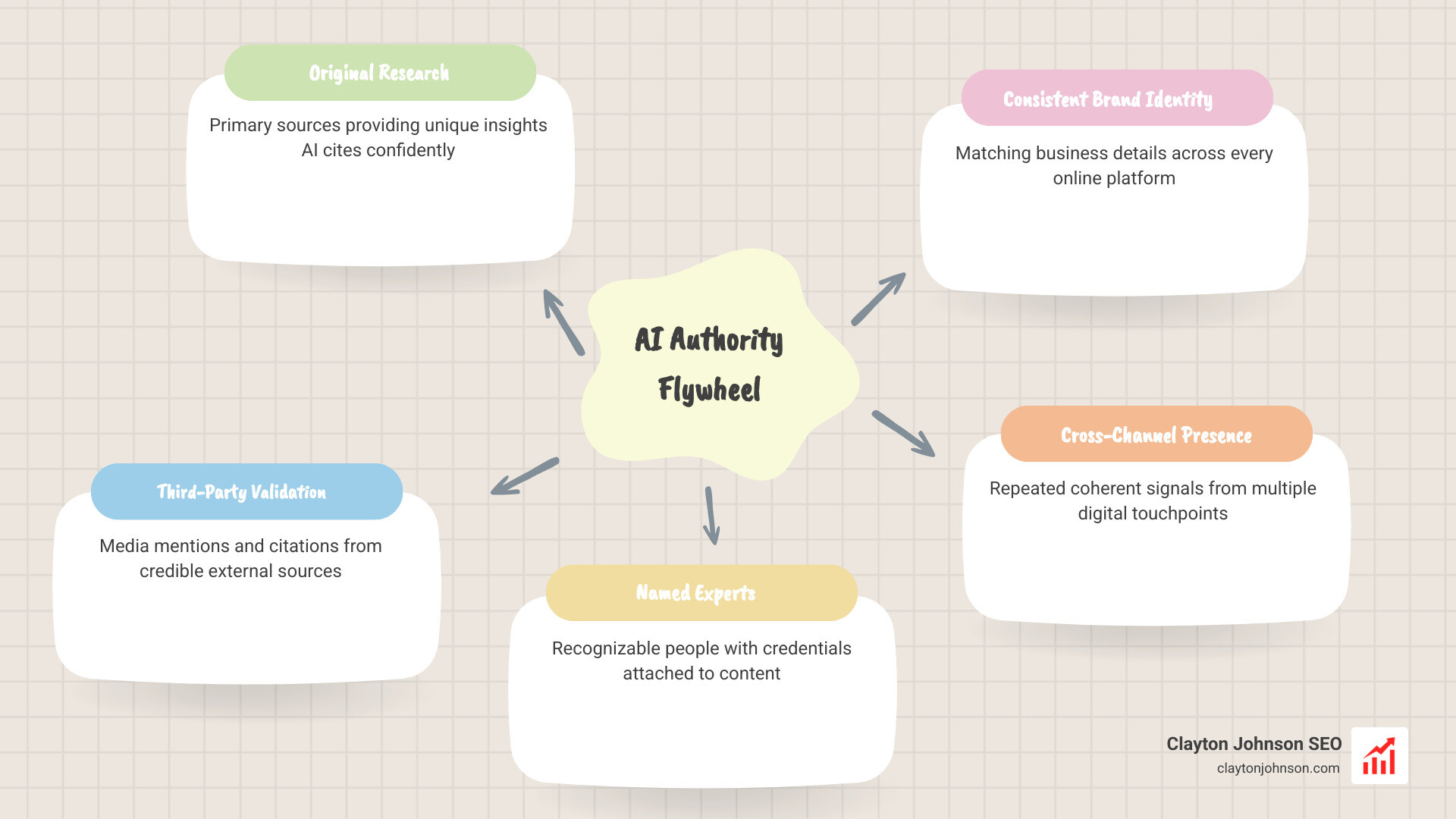
AI builds authority by triangulating verifiable trust signals across the web, including:
- Original research and unique insights — primary sources AI can cite with confidence
- Third-party validation — media mentions, reviews, and citations from credible external sources
- Recognizable named experts — real people with credentials attached to content
- Consistent brand identity — matching business details across every platform
- Cross-channel presence — repeated, coherent signals from multiple digital touchpoints
Think of AI as a digital bouncer. It only lets in brands it can verify. Keywords and backlinks got you in the old door. Today, the door requires proof.
The stakes are real. Prominent media mentions account for 27% of citations used by large language models. Branded web mentions show the strongest correlation with inclusion in AI Overviews. And 50% of B2B buyers currently use AI as their primary research tool — meaning the shortlist is often set before a buyer ever visits your site.
Traditional SEO rewarded optimization. AI rewards legitimacy.
I’m Clayton Johnson, an SEO strategist and growth architect who has spent years building scalable authority systems — and studying exactly how AI builds authority through structured data, entity recognition, and verifiable trust signals. In the sections below, I’ll walk you through the complete framework for going from invisible to inescapable in AI-driven search.
How ai builds authority basics:
Understanding How AI Builds Authority Through Trust Signals
In the traditional SEO world, we spent decades chasing the algorithm. We focused on keyword density, H1 tags, and the sheer volume of backlinks. But as we move into the era of Generative Search, the algorithm has been replaced by a “reasoning engine.”
AI engines like ChatGPT, Claude, and Perplexity don’t just look for matches; they look for trust signals. These signals are verifiable markers that AI uses to decide if your brand is worth citing. According to research on building trust in AI, nearly 90% of people want content clearly labeled when AI is involved, and 75% are concerned with misinformation. AI models are programmed to mirror this caution by favoring sources that demonstrate E-E-A-T (Experience, Expertise, Authoritativeness, and Trustworthiness).
Entity Recognition and Knowledge Graphs
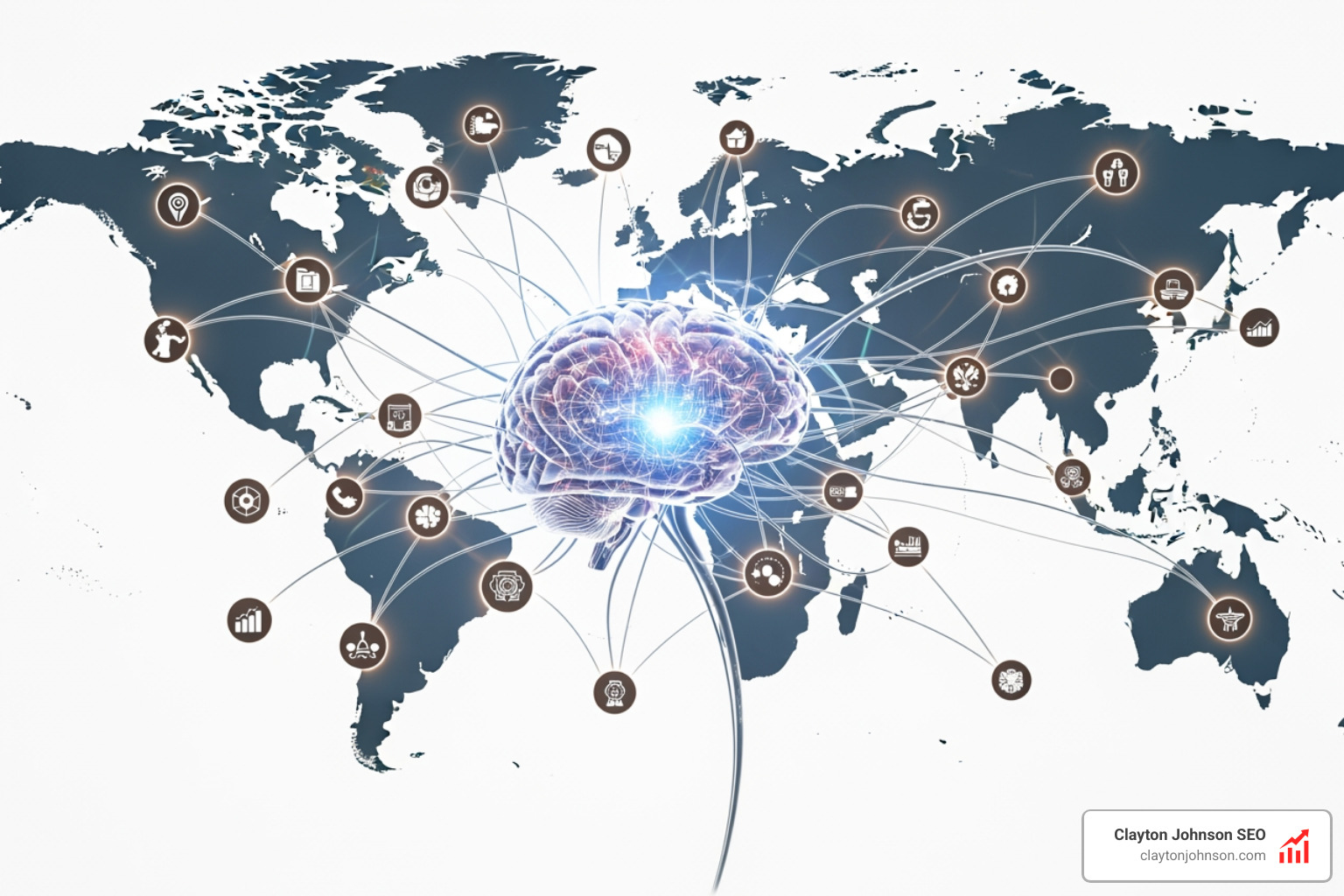
One of the most critical ways how AI builds authority is through entity recognition. AI doesn’t see your website as a collection of URLs; it sees your brand as an “entity”—a unique node in a massive Knowledge Graph.
When your brand is mentioned on Reddit, cited in a Forbes article, and has a consistent Google Business Profile in Minneapolis, the AI connects those dots. If your business details are mismatched—say, a different phone number on LinkedIn than on your site—the “digital bouncer” gets suspicious. Consistency across these nodes is what transforms you from a “brand nobody” into a recognized authority. For a deeper dive into this, check out The authoritative guide to not being a brand nobody.
Citation Patterns: The New Backlink
In the AI era, being referenced is the new backlink. AI models use citation patterns to verify claims. If multiple authoritative sources—like academic journals or major trade publications—all point to your original research, the AI views that as a “consensus.” This creates a citation reinforcement loop: the more you are cited, the more the AI trusts you, leading to even more citations in AI-generated answers.
| Feature | Traditional PageRank | AI Entity Recognition |
|---|---|---|
| Primary Metric | Link Quantity & Authority | Verifiable Trust Signals |
| Search Focus | Keywords & Strings | Entities & Relationships |
| Validation | Domain Rating | Cross-Platform Consistency |
| Goal | Ranking #1 | Being the Cited Source |
The Shift from Keywords to AI-Verifiable Proof
We used to game PageRank by repeating keywords. That doesn’t work anymore because AI understands semantic depth. It knows the difference between a shallow listicle and a deep exploration of a topic.
Princeton research on generative engine optimization found that adding citations and statistics to content can improve AI visibility by up to 40%. AI models are trained to prefer sourced claims over generic fluff. This is why we emphasize “primary source authority.” When we publish original data or unique frameworks, we aren’t just creating content; we are creating the raw material that AI models use to build their responses.
To stay ahead, you need a strategy that accounts for how different models—like Anthropic’s Claude—process information. You can explore this further in our guide on Anthropic Claude SEO strategy.
The 5 Core Pillars of AI-Recognized Brand Identity
Building a brand that AI trusts requires a shift from “marketing” to “infrastructure.” At Demandflow, we view this through five core pillars.
1. Original Research and Proprietary Data
AI models are hungry for new information. If you are just summarizing what everyone else has said, you are a secondary source. To be a primary source, you must produce original research. This could be a survey of your customers in the Minneapolis area, a case study with specific metrics, or a proprietary framework for solving a problem. When others cite your data, the AI notes that you are the “originator” of that truth.
2. Third-Party Validation
You can’t just say you’re an expert; someone else has to say it for you. How generative engines define rank shows that prominent media mentions account for a significant portion of AI citations. This includes podcast interviews, webinars, and guest posts on reputable sites. These act like digital “votes of confidence” that the AI uses to verify your identity.
3. Recognizable Expert Authorship
AI models prioritize content bylined to named authors with verifiable credentials. Anonymous “Admin” posts are a trust killer. By building out robust author profiles—complete with bios, social links, and links to other published works—you help the AI build a “Person” entity in its Knowledge Graph. This is a foundational part of building a robust AI content strategy.
4. Structured Identity (Schema)
Schema markup is the “behind-the-scenes” code that tells AI exactly who you are. It defines your Organization, your People, and your Services in a language the AI understands perfectly. Without proper Schema, the AI has to guess. With it, you are providing a clear, structured roadmap of your brand’s authority.
5. Cross-Channel Consistency
If your brand voice is professional on your website but chaotic on X (formerly Twitter), the AI perceives a lack of coherence. How AI builds authority is heavily dependent on seeing the same “entity” across the entire digital landscape. This consistency compounds credibility over time.
Establishing Expertise with Human-in-the-Loop Workflows: How AI Builds Authority
One of the biggest mistakes we see is brands letting AI generate 100% of their content. This leads to “algorithmic noise”—generic, uninspired text that lacks the nuance of human experience.
The secret to scaling while maintaining authority is the Human-in-the-Loop workflow. We use AI to handle the mechanical work—drafting outlines, transcribing Subject Matter Expert (SME) interviews, and clustering keywords. But the “soul” of the content—the contrarian opinions, the personal anecdotes, and the “why”—must come from a human.
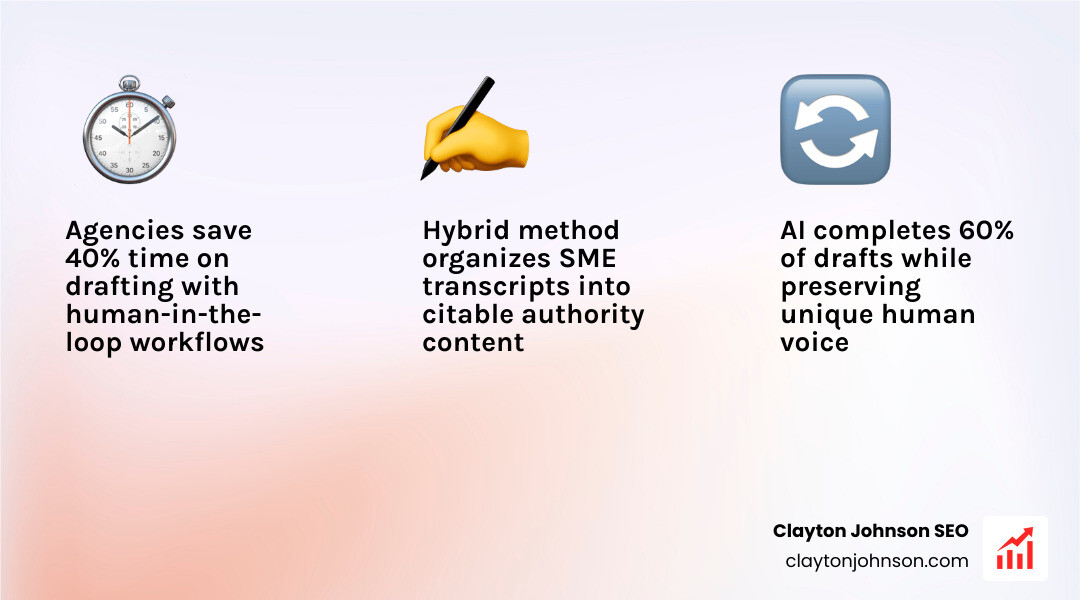
According to StoryChief, agencies using this hybrid method report 40% time savings in drafting while maintaining the distinctive voice that differentiates their work. The key is treating AI as a “structure generator,” not a knowledge source. You feed the AI your expert transcripts, and it helps you organize them into a citable format. This is how you how to build an authority site that stands out in a sea of AI-generated fluff.
Mapping the Messy Middle: How AI Builds Authority Across the Journey
Authority isn’t just about being “the best”; it’s about being “the most relevant” when it matters. This brings us to Google’s messy middle concept—the phase between a user’s initial trigger and their final purchase.
During this stage, users loop between exploration (searching for options) and evaluation (comparing those options). AI search engines are now the primary tool for navigating this loop. To build authority here, you need to show up where your customers are asking questions. This means:
- Answering “How-to” questions on your blog.
- Participating in discussions on Reddit or niche forums.
- Ensuring your brand is mentioned in “Best of” lists and comparison articles.
By mapping the customer journey, you can create off-site campaigns that place your brand in the path of the AI’s data retrieval. For businesses in specific regions, our local guide to building digital authority explains how to dominate these local “messy middle” conversations.
Practical Steps to Earn AI Citations and Media Mentions
If “being referenced is the new backlink,” then Digital PR is the new link building. But we aren’t talking about spammy press releases. We are talking about earning legitimate mentions in the places AI models look for “truth.”
The Citation Reinforcement Loop
AI models are trained on massive datasets, including Wikipedia, major news outlets, and academic journals. When you earn a mention in a top-tier publication, you aren’t just getting traffic; you are getting “embedded” into the AI’s training data.
To earn these citations:
- Pitch Original Data: Journalists love statistics. If you have unique data about the Minneapolis market, share it.
- Be a Podcast Guest: AI models now transcribe and “listen” to audio. A mention of your brand on a high-authority podcast is a powerful trust signal.
- Create Comparison Content: If you don’t create the comparison, your competitors will. Be the source that explains the pros and cons of different solutions in your industry.
This is all part of the ultimate guide to AI-driven SEO strategy. You want to create a footprint so large and so consistent that the AI cannot ignore you.
Implementing Technical Excellence with Schema and Structured Data
While content is the “what,” technical SEO is the “how.” To ensure the AI can parse your authority, you must implement technical excellence.
According to the MonsterInsights AI SEO guide, Schema markup is the most important tool in your technical arsenal. At a minimum, you should have:
- Organization Schema: Defines your brand, logo, and social profiles.
- Person Schema: Establishes the credentials of your authors.
- Article/FAQ Schema: Helps AI extract answers directly for search snippets and AI Overviews.
Furthermore, you need to ensure your robots.txt file allows AI crawlers (like GPTBot) to access your high-value content. If the “bouncer” can’t see your credentials, they can’t let you in. For a structured approach to this, see The guide to automated SEO positioning.
Measuring Success in the Age of Generative Search
Traditional SEO metrics like “Keyword Rankings” are becoming less relevant. If an AI summary answers a user’s question and cites your brand, you might get a “zero-click” result—no traffic to your site, but a massive win for brand authority.
So, how do we measure success? We look at:
- Citation Frequency: How often is your brand cited in responses from ChatGPT, Claude, and Perplexity?
- Branded Search Volume: Are more people searching for your brand by name? This is the strongest correlation with AI authority.
- Sentiment Analysis: When AI mentions your brand, is the context positive or negative?
- Share of Model: What percentage of AI responses in your category mention your brand vs. your competitors?
Tracking these requires moving from basic analytics to AI-driven SEO systems. It’s about monitoring the entire ecosystem, not just your own website. Ahrefs research on top mentioned sources shows that 86% of top-cited sources are NOT shared across different AI platforms, meaning you need to track your visibility across multiple models.
Frequently Asked Questions about AI Authority
What is the difference between traditional SEO and AI authority?
Traditional SEO is about optimizing for a search engine’s ranking factors (links, keywords). AI authority is about optimizing for a reasoning engine’s trust factors (verifiable proof, entity consistency, expert authorship). SEO gets you found; AI authority gets you recommended.
How long does it take to see results from AI authority building?
Technical signals like Schema can have an impact relatively quickly. However, building “entity authority” through media mentions and original research typically takes 90 to 180 days to fully reflect in AI responses. It is a discipline, not a one-time campaign.
Can small businesses compete with large brands in AI search?
Yes! In fact, small businesses often have an advantage in niche markets. By owning a specific “topic cluster” and providing more depth and “lived experience” than a large, generic competitor, a small brand can become the go-to authority for the AI. It’s about being the big fish in a specific pond.
Conclusion: Building Your Structured Growth Architecture
The AI SEO Gold Rush is here, but the winners won’t be the ones who generate the most content. The winners will be the ones who build the best infrastructure.
At Clayton Johnson SEO, we are building Demandflow.ai to solve this exact problem. Most companies don’t lack tactics; they lack a structured growth architecture. We combine actionable strategic frameworks with taxonomy-driven SEO and AI-augmented workflows to turn your brand into an inescapable authority.
Whether you are based here in Minneapolis or operating globally, the goal remains the same: Clarity → Structure → Leverage → Compounding Growth.
Ready to stop chasing algorithms and start building authority? Explore our SEO content marketing services and let’s build your growth engine together.