AI Driven SEO Systems: From Strategy to Execution

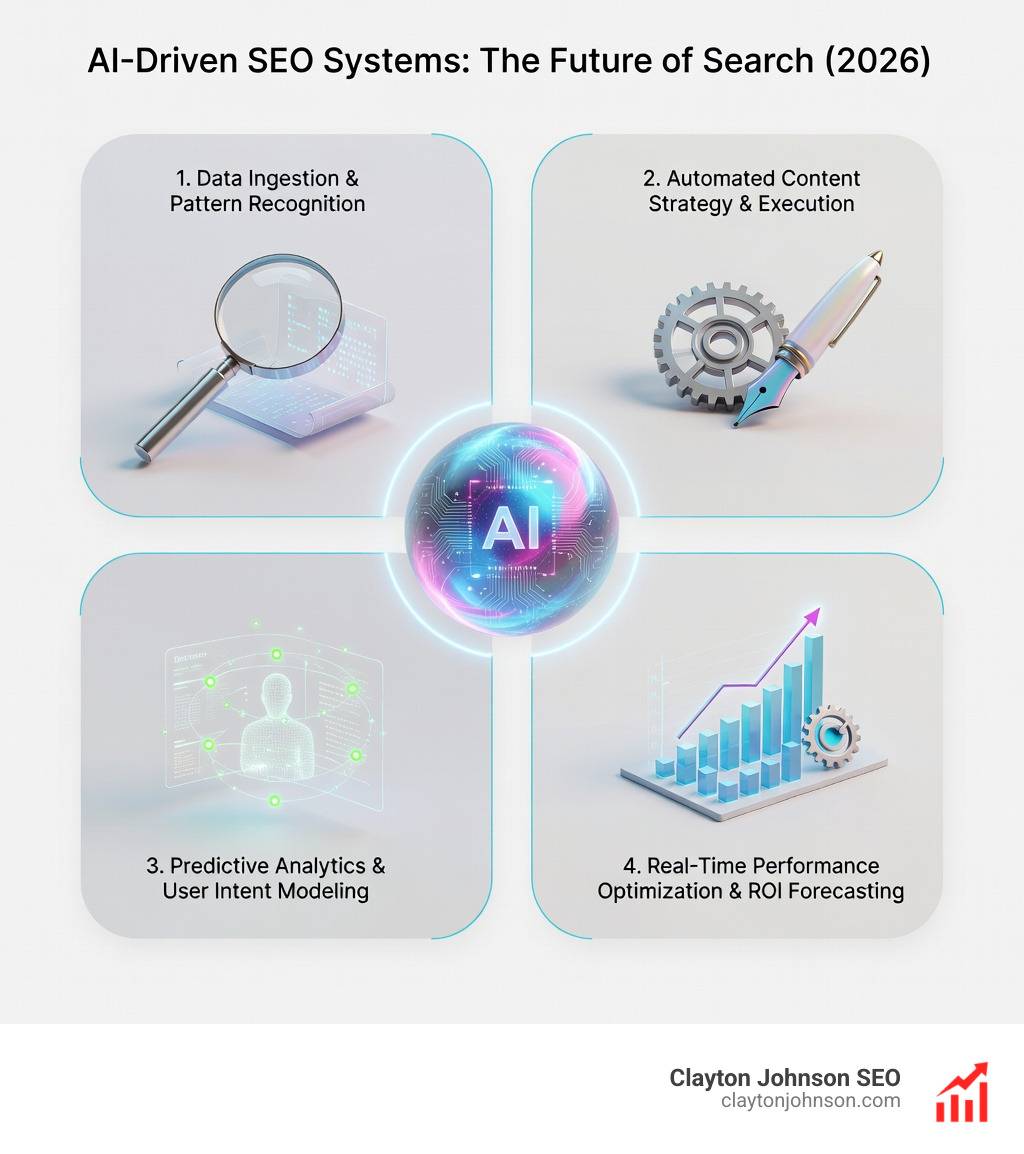
AI driven SEO systems are software platforms and workflows that use artificial intelligence to automate, analyze, and optimize every layer of search visibility — from keyword research and content structuring to technical audits and AI answer tracking.
Here is a quick breakdown of what they do and why they matter:
| Capability | What It Does |
|---|---|
| Keyword & intent analysis | Identifies search demand and user context at scale |
| Content optimization | Structures content for both Google and generative AI |
| Technical SEO automation | Audits and fixes site infrastructure continuously |
| GEO / AEO tracking | Measures brand visibility inside AI-generated answers |
| Workflow orchestration | Chains research, briefs, drafts, and publishing into automated pipelines |
Search is not what it used to be.
Google now delivers AI Overviews. ChatGPT, Perplexity, and Gemini answer questions directly — often without sending users to your site at all. About 60% of marketers are already piloting or scaling AI in their workflows, up 18% from just a few years ago.
If your content is not structured for AI extraction, you are not just losing rankings. You are losing citations, answers, and decisions.
Traditional SEO tools were built for a world of ten blue links. That world is gone. Today’s search environment rewards content that AI systems can parse, trust, and reuse — not just content that earns backlinks and keyword density scores.
The businesses winning in search are not just optimizing pages. They are building systems.
I’m Clayton Johnson — an SEO strategist focused on engineering scalable, AI-augmented traffic systems and structured content architectures that compound over time. I have built and deployed AI driven SEO systems across dozens of business models, bridging technical SEO depth with strategic positioning and workflow automation. Let’s break down exactly how these systems work and how to build one that drives measurable, durable growth.
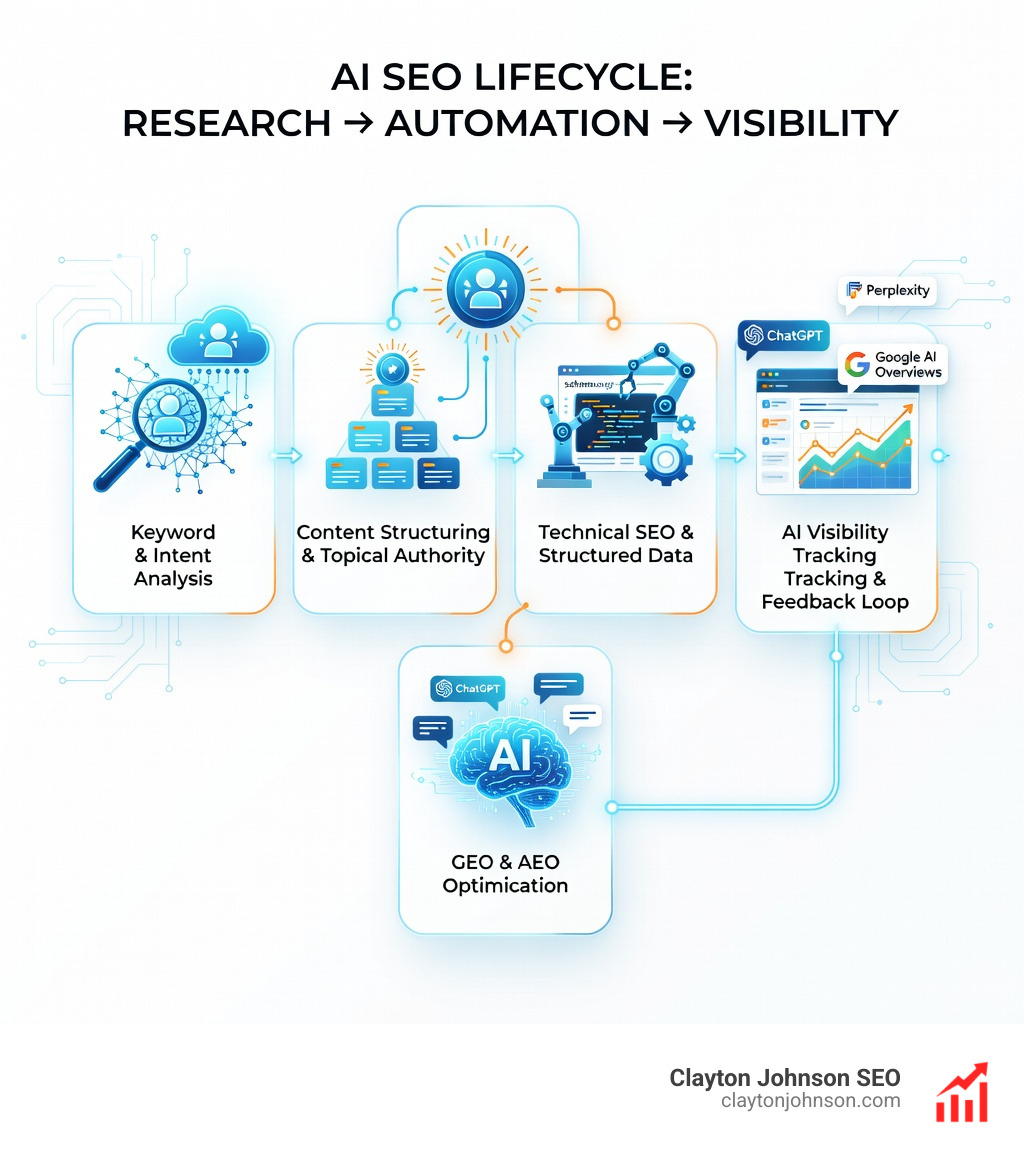
Ai driven seo systems definitions:
- AI SEO strategy framework
- AI driven SEO tactics
- SEO AI workflow automation
Defining AI Driven SEO Systems and the Shift to Context
In the past, SEO was often a game of “match the keyword.” If a user searched for “best coffee maker,” you made sure that exact phrase appeared in your title, headers, and meta description. Today, AI driven SEO systems have shifted the focus from literal keyword matching to deep contextual relevance.
Modern search engines and Large Language Models (LLMs) don’t just look for words; they look for meaning. They use semantic search to understand the relationships between different concepts. For example, an AI knows that if you are talking about “espresso extraction,” “burr grinders,” and “water temperature,” you are an authority on high-end coffee brewing, even if you never use the keyword “best coffee maker.”
This shift is why 60% of marketers are moving toward AI-mediated workflows. These systems allow us to perform intent analysis at a scale that was previously impossible, ensuring that every piece of content serves a specific stage of the buyer’s journey.
Moving Beyond Keywords to Topical Authority
Topical authority is the new gold standard. Instead of ranking for a single term, your goal is to own an entire subject area. AI driven SEO systems help us build this authority by mapping out entity relationships and knowledge graphs.
By creating content clusters—groups of related articles that link back to a central “pillar” page—we signal to both Google and AI agents that our site is a comprehensive resource. This isn’t just about traffic; it’s about becoming a “machine-readable source of truth” that LLMs can cite with confidence. You can explore more about AI search strategy to see how these clusters form the backbone of modern visibility.
How AI Driven SEO Systems Differ from Traditional Tools
Traditional SEO tools are reactive. They tell you what happened last month or where you rank today. In contrast, AI driven SEO systems are proactive and predictive.
- Real-time processing: While traditional tools might update data weekly, AI systems can monitor SERP shifts and AI Overviews in real-time.
- Predictive analytics: These systems can forecast traffic based on emerging trends and competitive gaps before they become obvious.
- Pattern recognition: AI can scan thousands of pages to identify why a competitor is winning, spotting subtle signals like passage-level clarity or schema depth that a human might miss.
- Automated execution: Perhaps the biggest difference is the ability to take action. Some systems can automatically deploy on-page changes, update internal links, or generate content briefs based on live data.
The Rise of Generative Engine Optimization (GEO)
As search moves away from “ten blue links” toward conversational answers, a new discipline has emerged: Generative Engine Optimization (GEO). This is the process of making your brand visible in the answers provided by ChatGPT, Perplexity, Claude, and Google’s AI Overviews.

In this “search-everywhere” era, being #1 on Google is no longer enough. You also need to be the source that the AI cites when a user asks a question. This is often called Answer Engine Optimization (AEO). The goal is to ensure your brand is not just found, but chosen as the authoritative response.
Tracking Visibility in AI-Generated Answers
How do you know if you’re winning in an AI world? Traditional rank tracking doesn’t work when every answer is hyper-personalized. AI driven SEO systems now include citation tracking and sentiment analysis. These tools monitor whether your brand is mentioned, how often it appears compared to competitors, and whether the AI is speaking about you in a positive or neutral tone.
We focus heavily on source attribution—ensuring the AI points back to your site as the expert. For businesses in Minneapolis or those looking for national reach, our AI SEO services provide the infrastructure needed to track these fragmented search surfaces.
Optimizing Content for LLM Extraction
To be cited by an AI, your content must be “digestible” for a machine. This requires a few specific tactical shifts:
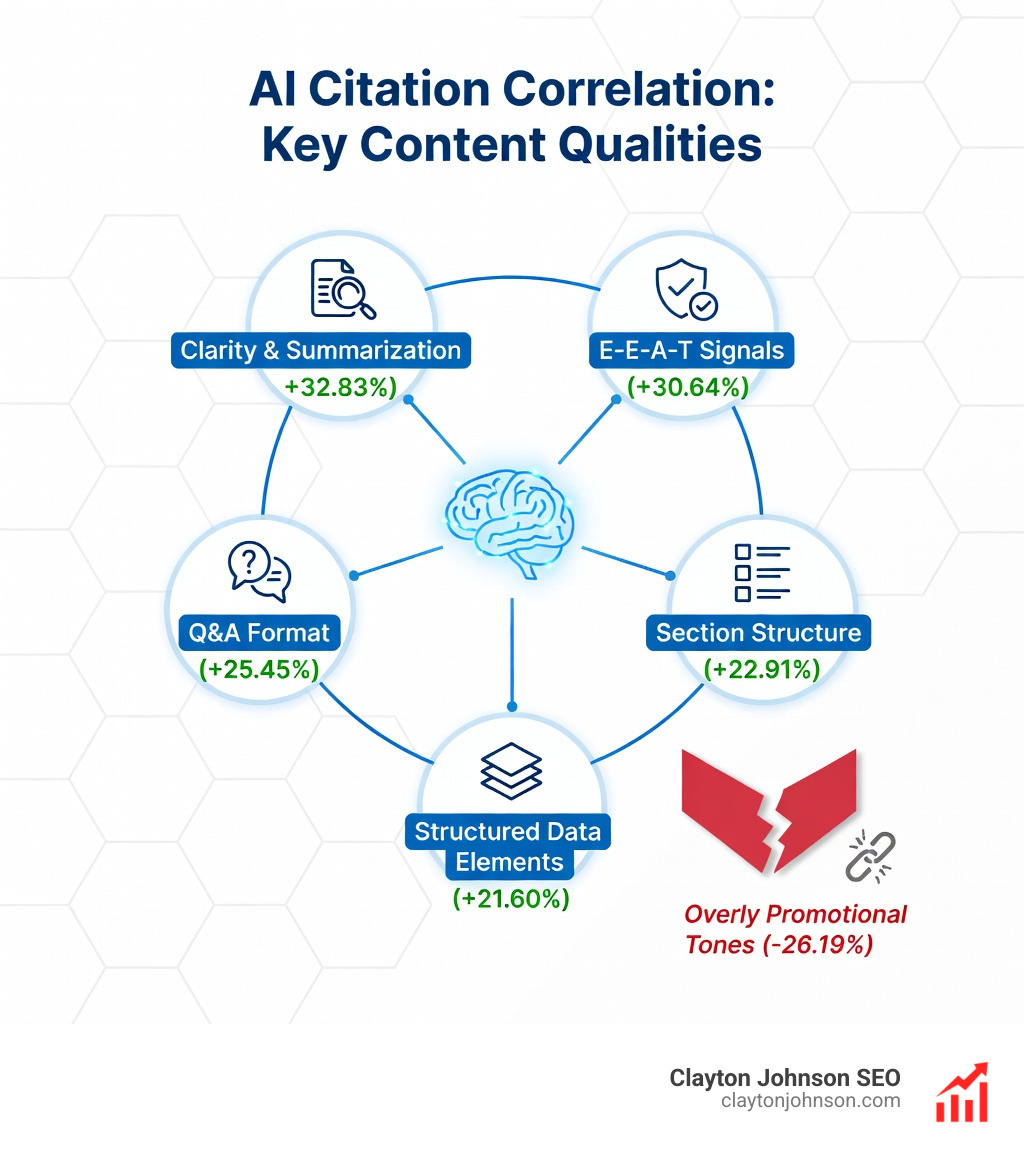
- Structured Data: Using Schema.org and JSON-LD to tell the AI exactly what your data means.
- Clear Summaries: Leading with a “bottom line up front” (BLUF) approach. Research shows that clarity and summarization can improve AI citation probability by over 32%.
- Q&A Formatting: Directly answering common user questions in a concise format.
- Information Density: Providing high-value facts without the “fluff” that generic AI writers often produce.
Core Components of AI Driven SEO Systems
A truly effective AI SEO system isn’t just a single tool; it’s a multi-dimensional architecture. It combines technical SEO, content intelligence, and link building into a unified growth engine.

At Clayton Johnson SEO, we believe that most companies don’t lack tactics—they lack structured growth architecture. Our platform, Demandflow.ai, is designed to solve this by providing a “growth operating system.” This involves moving away from sporadic projects and toward a continuous, data-driven cycle. You can learn more about how we integrate these elements in our SEO content marketing guide.
Automating Workflows with AI Driven SEO Systems
The real power of AI lies in its ability to handle the “grunt work” of SEO, freeing up human experts to focus on strategy and creativity.
- Keyword Research: AI agents can browse the web, analyze autocomplete data, and identify low-competition “easy-to-rank” keywords in minutes rather than hours.
- Content Briefs: Instead of manually checking the top 10 results, AI can summarize the common themes, required headers, and target word counts needed to compete.
- Internal Linking: Systems can automatically suggest the best pages to link to within your own site to spread “link juice” and improve crawlability.
- Automated Audits: Continuous monitoring for broken links, slow page speeds, or indexing issues ensures your technical foundation never crumbles.
Measuring Success within AI Driven SEO Systems
Success in the AI era is measured by more than just clicks. We look at AI Visibility Scores, which analyze dozens of factors to determine how likely your content is to be cited by an LLM. We also use traffic forecasting to model how different SEO investments will pay off over time. By tying these metrics to conversion optimization, we ensure that traffic actually turns into revenue. For a deeper dive into these metrics, visit our page on analytics and data.
Leveraging Technology for AI SEO Execution
When building your stack, it is important to distinguish between “AI-powered” hype and actual technological capability. Effective AI driven SEO systems generally fall into two categories: comprehensive platforms and specialized solutions.
Comprehensive AI SEO Platforms
These are the “all-in-one” systems that handle the entire SEO lifecycle. They provide a “single source of truth” for your data. Key features to look for include:
- Advanced Keyword Research: Engines that use billions of data points and years of historical context.
- Technical SEO Auditing: Automated systems that find and prioritize fixes without requiring manual developer sprints.
- Competitive Intelligence: AI that reverse-engineers competitor strategies by analyzing their content gaps and backlink profiles.
- Performance Tracking: Unified dashboards that blend data from Google Search Console, analytics, and AI visibility trackers.
Specialized AI Solutions for Content and Visibility
Sometimes, you need a “best-in-breed” tool for a specific task.
- Content Generation & Optimization: Tools that use Natural Language Processing (NLP) to guide how content should be structured to rank. The best versions of these don’t just write for you; they help you optimize human-written content for semantic relevance.
- LLM Readability: Specialized tools that “translate” your website into machine-readable formats like
llms.txt, making it easier for AI crawlers to parse your site. - Citation Tracking: Platforms that specifically monitor your brand’s presence inside conversational search engines like Perplexity or ChatGPT.
Future-Proofing Your Strategy: E-E-A-T and Emerging Trends
As AI content floods the internet, search engines are doubling down on E-E-A-T (Experience, Expertise, Authoritativeness, and Trustworthiness). Google wants to know that there is a real human with real experience behind the information.
The Role of Human Expertise in an AI World
AI is a teammate, not a replacement. While an AI can draft a 2,000-word article in seconds, it cannot provide original research, unique brand voice, or the “human touch” that builds genuine trust. As Angeley Mullins from the Forbes Business Development Council says, the most successful marketers will be those who integrate AI while maintaining creative storytelling and critical thinking.
We use AI to handle the scale, but our strategists provide the oversight. This includes setting ethical guardrails to prevent “hallucinations” (when AI makes up facts) and ensuring that all content aligns with your brand’s unique positioning. Our approach to AI governance ensures that your data and brand reputation remain protected.
Avoiding Overhyped AI Products
Not every tool that slaps an “AI” label on its homepage is worth your budget. To avoid “glorified content spinners,” evaluate tools based on:
- Data Quality: Is the AI powered by real-time search data or an outdated dataset?
- Stability: Does the tool integrate seamlessly into your existing workflows, or is it a clunky standalone product?
- Workflow Fit: Does it actually save time, or does it require so much editing and “babysitting” that it’s faster to do it manually?
Frequently Asked Questions about AI SEO
Will AI replace SEO experts?
No. AI will replace SEO experts who don’t use AI. As Christina Inge from Harvard Professional Development puts it: “Your job will not be taken by AI. It will be taken by a person who knows how to use AI.” The role is shifting from manual execution to strategic orchestration.
What is the difference between SEO and GEO?
SEO (Search Engine Optimization) focuses on ranking your website in traditional search results (the “blue links”). GEO (Generative Engine Optimization) focuses on making your brand the preferred answer and cited source within AI-generated responses like ChatGPT or Google AI Overviews.
How do I track my brand in ChatGPT or Perplexity?
You need specialized AI driven SEO systems that use AI agents to “query” these engines and report back on whether your brand is mentioned, the sentiment of the mention, and which of your pages are being used as sources.
Conclusion
The transition to AI driven SEO systems is not just a trend; it is a structural shift in how the internet works. When AI mediates how users discover information, staying visible requires more than just keywords—it requires a structured growth architecture.
At Clayton Johnson SEO, we help founders and marketing leaders build these systems through Demandflow.ai. We move beyond simple content marketing to create taxonomy-driven SEO and competitive positioning models that compound over time.
Clarity leads to structure. Structure leads to leverage. Leverage leads to compounding growth.
If you are ready to stop chasing tactics and start building a growth engine that wins in both traditional and AI search, it’s time to build your growth system with us. Our scalable authority retainers are designed to provide the link velocity, content depth, and AI readiness signals needed to dominate your market. Whether you’re starting with our Foundation Authority or scaling to become a Market Leader, we ensure your domain remains competitive in the search-everywhere era.