Long tail keyword tools help you discover specific, low-competition search phrases that drive targeted traffic and higher conversions. The best options include:
- LowFruits – Automated Google Autocomplete mining with SERP difficulty scoring
- Semrush Keyword Magic Tool – 1.25 billion keyword database with advanced filtering
- Moz Keyword Explorer – AI-powered search intent analysis across 170 Google engines
- Google Autocomplete – Free manual method for discovering actual user queries
- KeywordsPeopleUse – Visual mind-map generator serving 15,000+ users in 150 countries
Most marketers chase high-volume keywords that look impressive in spreadsheets. The problem? Those terms bring visitors who aren’t ready to convert.
Long-tail keywords—phrases with three or more words—solve this by capturing specific search intent. Someone searching “phone cases” is browsing. Someone searching “black thin silicon case for iphone xs” is ready to buy.
The data backs this up. While short-tail terms generate more total searches, long-tail keywords drive higher conversion rates because they target users further down the funnel. They’re also easier to rank for since competition decreases as specificity increases.
Here’s what makes this challenging: Finding these opportunities manually is time-consuming and incomplete. Google Keyword Planner hides many long-tail variations to simplify advertiser bidding. Standard tools group distinct searches together, missing the raw, unfiltered queries your audience actually types.
The gap between generic keyword research and discovering high-intent long-tail opportunities costs you traffic, rankings, and revenue. Customers now consult an average of 10 sources before converting, and 90% switch between devices and platforms to complete tasks online. You need visibility across this entire journey—not just at the top of the funnel.
I’m Clayton Johnson, and I’ve built SEO strategies for companies ranging from startups to enterprise clients by focusing on systematic discovery using long tail keyword tools to uncover low-competition opportunities that competitors miss. This guide breaks down exactly which tools deliver results and how to use them strategically.
Why Long Tail Keywords Outperform Short-Tail Terms
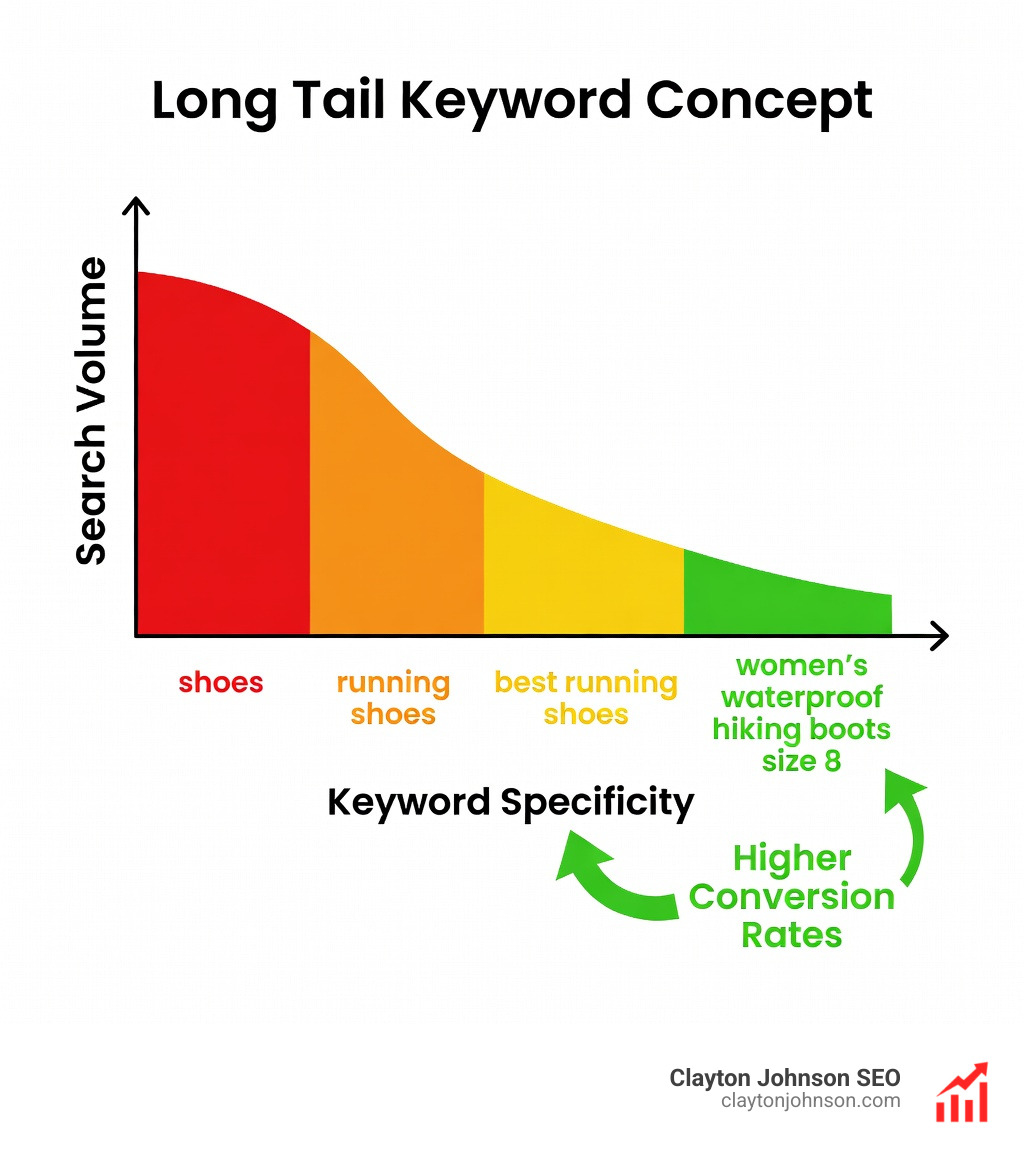
In search, bigger isn’t always better. Short-tail keywords (one or two words) like “running shoes” boast massive search volumes, but they are often a trap. The competition for these terms is fierce, usually dominated by massive brands with bottomless budgets. More importantly, the intent is vague. Is the searcher looking for history, images, or a store?
Long-tail keywords, by contrast, are the foundation of a successful SEO content marketing strategy. They typically consist of three or more words and represent the “long tail” of the search demand curve. While each individual phrase has lower monthly searches, collectively, they make up the majority of all searches performed on Google.
The Power of Specific Intent
When we use long tail keyword tools, we aren’t just looking for words; we’re looking for problems that need solving. A user searching for “best organic fertilizer for indoor tomato plants” is much closer to a purchase than someone just searching “plants.” This specificity is why long-tail terms lead to significantly higher conversion potential.
The Alphabet Soup Method
One of the most effective ways to find these gems is the Alphabet Soup Method. By taking a seed keyword and adding every letter of the alphabet to the end in a search bar, you trigger Google’s autocomplete to show you exactly what people are typing. It’s a raw look into the customer journey.
Research shows that the modern buyer’s path is non-linear. Customers consult an average of 10 sources before making a decision. Because 90% of users switch between devices to complete a task, capturing them with specific long-tail content ensures you are there at every touchpoint of their journey, whether they are on a phone in Minneapolis or a laptop at the office.
Top Paid Solutions for Professional Keyword Discovery
For those building niche sites or scaling a business, manual research isn’t enough. Professional long tail keyword tools automate the discovery process, providing metrics like keyword difficulty and SERP analysis that free methods lack.
| Tool | Key Advantage | Best For |
|---|---|---|
| LowFruits | Finds “weak spots” in SERPs | Niche site builders & beginners |
| Semrush | 1.25 billion keyword database | Advanced SEO & Competitor analysis |
| Moz | AI-powered Search Intent | Content strategy & CTR optimization |
| Mangools | Intuitive UX and SERP difficulty | Small businesses & Freelancers |
KWFinder by Mangools
KWFinder by Mangools is widely considered one of the most user-friendly long tail keyword tools on the market. It was designed specifically to help users find high-volume, low-difficulty keywords. It provides a clear “Keyword Difficulty” score that helps us decide instantly if a term is worth our time.
Semrush Keyword Magic Tool
If you need raw power, the Semrush Keyword Magic Tool is the gold standard. It allows you to take a single seed keyword and generate thousands of variations. By using their advanced filters to set a minimum word count of three, you can instantly strip away the high-competition short-tail fluff and focus on the “magic” of the long tail.
Moz Keyword Explorer
The Moz Keyword Explorer offers a unique “Organic CTR” metric, which tells us how many clicks are actually going to organic results versus ads or SERP features. With over 1.25 billion suggestions, it uses AI to categorize keywords by search intent, helping you align your content with what the user actually wants to find.
KeywordsPeopleUse
This tool is a favorite for content planners. It powers over 15,000 users globally and provides visual mind-maps of search queries. Instead of just a list, you see how questions and phrases branch off from one another. It’s excellent for bulk processing and setting up search alerts to stay ahead of emerging trends in your industry.
Best Free Long Tail Keyword Tools for Budget-Friendly Research
You don’t always need a big budget to find high-intent keywords. Some of the most valuable data comes directly from the source: the search engines themselves.
Google Autocomplete and Trends
Google Autocomplete is the ultimate “unfiltered” look at what users type. Unlike advertiser-focused tools, Autocomplete shows real-time queries. To use it effectively for research, simply start typing your seed keyword and note the suggestions.
Google Trends is another powerhouse. It allows you to see the “Interest Over Time” for a keyword on a scale of 0 to 100. This is vital for avoiding “dying” niches and focusing on topics that are gaining traction.
WordStream Free Keyword Tool
The WordStream Free Keyword Tool is an excellent alternative to Google Keyword Planner. It provides search volume and competition data across 24 business verticals. One of its unique advantages is the ability to filter by industry and location, making it highly relevant for businesses in specific areas like Minneapolis.
Keyword Tool and Suggest APIs
Tools like KeywordTool.net use suggest APIs from Google, YouTube, and Bing to generate tens of thousands of long-tail phrases. They work by automatically appending letters and numbers to your search term, effectively doing the “Alphabet Soup” work for you. This reveals high-intent searches that standard tools often group together or hide.
Strategic Implementation and Evaluation Metrics
Finding a keyword is only half the battle. The other half is knowing which ones to prioritize. When evaluating keywords within your long tail keyword tools, we look at several key metrics:
- Search Volume: While long-tail terms have lower volume, we still want to ensure people are actually searching for them.
- Keyword Difficulty (KD): This tells us how hard it will be to outrank the current top 10 results.
- SERP Features: Are there videos, snippets, or ads taking up space? Sometimes a high-volume keyword isn’t worth it if the SERP is too crowded.
- Weak Spots: Tools like LowFruits identify “weak spots” where low-authority sites (like forums or small blogs) are ranking. These are your best opportunities to strike.
- Organic CTR: How many people actually click the organic links?
- Search Intent Alignment: Does the keyword match the type of content you are creating (Informational, Transactional, or Navigational)?
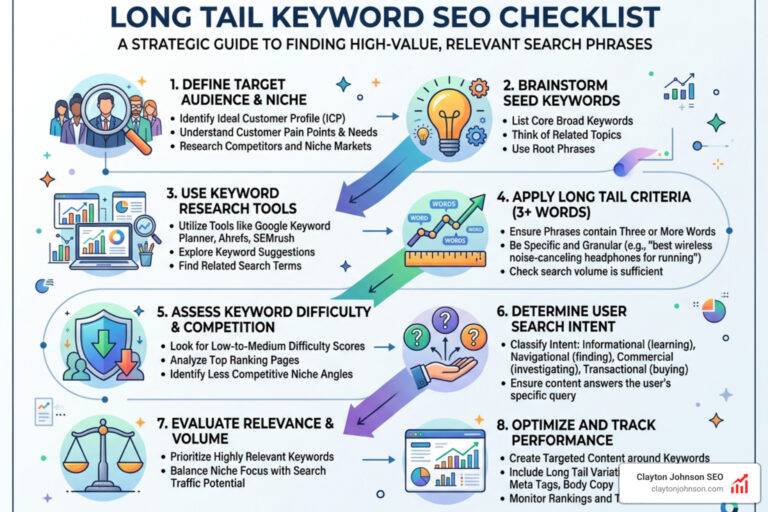
How to Perform Research with Long Tail Keyword Tools
- Start with a Seed: Enter a broad term like “SEO.”
- Apply Filters: Set a minimum word count of 3 or 4 to isolate long-tail terms.
- Automate Discovery: Use the Alphabet Soup Method automation features in your tool to generate thousands of ideas.
- Analyze the SERP: Look for keywords where the top results have low Domain Authority or are irrelevant to the specific query.
- Export and Map: Export your CSVs and map these keywords to your content architecture.
For WordPress users, the All in One SEO (AIOSEO) plugin is a game-changer. It integrates with tools like Semrush to give you long-tail suggestions directly inside your WordPress editor, making on-page optimization seamless.

Are free long tail keyword tools enough for beginners?
Free tools are a fantastic starting point. They provide raw data and real user queries. However, they have limitations. Free tools often lack competition metrics, bulk export capabilities, and historical data. As your site grows, upgrading to a paid tool like Mangools KWFinder or Semrush becomes necessary to scale your research and ensure your time is spent on keywords you can actually rank for.
Frequently Asked Questions about Long Tail Keywords
What is the difference between long-tail and short-tail keywords?
Short-tail keywords are broad, one or two-word phrases (e.g., “coffee”). They have high volume but high competition and vague intent. Long-tail keywords are three or more words (e.g., “best organic fair trade coffee beans for espresso”). They have lower volume but higher conversion rates and much lower competition.
Why do long-tail keywords have higher conversion rates?
Long-tail keywords are more specific. When someone searches for a specific phrase, they are usually further along in the buying cycle. They know exactly what they want, which makes them much more likely to convert once they find a page that answers their specific query.
How do I find low-competition keywords for a new niche site?
The best way is to use long tail keyword tools to find “weak spots” in the SERPs. Look for keywords where forums like Reddit or Quora are ranking in the top three positions. This indicates that Google hasn’t found a high-quality, dedicated article on the topic yet, leaving a gap for you to fill.
Conclusion
Success in SEO isn’t about shouting the loudest; it’s about being the most relevant. By leveraging long tail keyword tools, you move away from the “spray and pray” method of content creation and toward a structured, high-leverage growth strategy.
At Clayton Johnson SEO and through our platform, Demandflow, we believe that clarity and structure are the keys to compounding growth. We don’t just provide tactics; we provide the growth infrastructure your business needs to dominate its niche. Whether you are looking for a SEO Consultant to guide your strategy or the tools to execute it yourself, focusing on the long tail is the fastest path to measurable results.
Ready to stop guessing and start growing? Focus on the phrases your customers are actually typing, use the right tools to find them, and build the authority your brand deserves.