Your Competitor Just Got Recommended by ChatGPT. Here’s How to Fix That.
AI authority building is the practice of making your brand the source that AI systems like ChatGPT, Claude, and Perplexity trust, cite, and recommend when users ask questions in your category.
Here’s the quick version of how to do it:
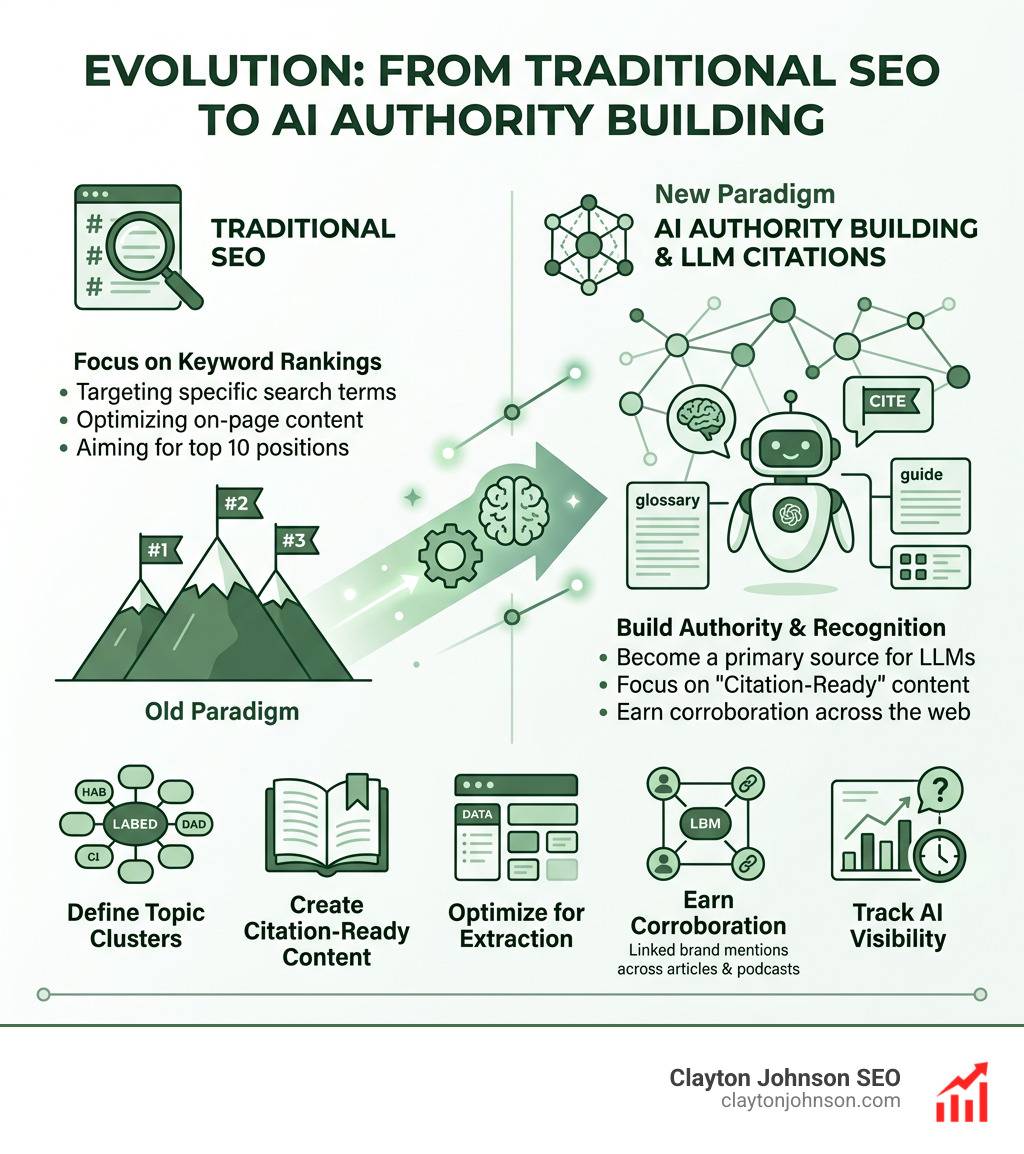
- Define your topic clusters – Pick 3-5 core subjects where you want to be the go-to expert
- Create citation-ready content – Build glossaries, how-tos, comparisons, and proof pages AI models can extract from
- Earn corroboration – Get your brand mentioned across trusted sources like industry publications, podcasts, and communities
- Optimize for extraction – Use clear headings, structured data, and consistent entity naming so AI can quote you safely
- Track your AI visibility – Test your target queries weekly in ChatGPT, Claude, and Perplexity to monitor mentions and sentiment
Imagine a potential client opens ChatGPT and types: “Who’s the best SEO consultant for wealth management firms?” Your competitor’s name comes up. Not yours.
That scenario is already happening to businesses right now. And it’s not a fluke. It’s the result of a fundamental shift in how people find and evaluate expertise.
Traditional SEO got you ranked on Google. AI authority building gets you recommended by AI.
The difference matters more than most business owners realize. AI models don’t rank pages. They synthesize answers from sources they trust. If your brand isn’t in that trusted pool, you’re invisible at the exact moment a prospect is ready to make a decision.
The good news? Most of your competitors haven’t figured this out yet. The window to get ahead is open — but it won’t stay that way for long.
This guide walks you through exactly how to build AI-recognized authority, step by step, even if you’re starting from scratch.
What is AI Authority Building and Why Does It Matter in 2025?
In the old days of SEO (which, let’s be honest, feels like last Tuesday), we obsessed over blue links and ranking #1. But in 2025, the landscape has shifted. Users aren’t just scrolling through pages; they are having conversations with Large Language Models (LLMs).
AI authority building is the strategic process of ensuring these LLMs recognize your brand as a credible, definitive expert. When an AI model like Claude or Perplexity generates an answer, it looks for “citation-ready” information. If your content is structured correctly and corroborated across the web, the AI “feels safe” recommending you.

As Google’s official blog on AI history notes, machine learning has been part of the search ecosystem since 2001. However, we have moved far beyond simple spell-checks. Today, AI models evaluate authority through interconnected content depth and citation patterns rather than just raw backlink counts.
This is why we believe why-ai-authority-building-is-the-new-seo-gold-rush/ is the most accurate way to describe the current era. If you aren’t building authority that AI can parse, you are essentially invisible to the millions of users starting their purchase journeys inside a chat interface.
| Feature | Traditional SEO | AI Authority Building |
|---|---|---|
| Primary Goal | Rank #1 for specific keywords | Become the “recommended” source in AI answers |
| Success Metric | Click-through rate (CTR) and traffic | Mention frequency and sentiment in LLMs |
| Content Focus | Keyword density and length | Semantic relevance and “extractability” |
| Algorithm | PageRank and backlinks | Neural networks and citation patterns |
The Shift from Keywords to AI Authority Building
The technical engine behind this shift is Google’s MUM (Multitask Unified Model), which is reportedly 1,000x stronger than its predecessor, BERT. According to Scientific research on the T5 text-to-text framework, modern NLP frameworks use text strings for both inputs and outputs, allowing models to understand context over exact keyword matches.
This means “keyword stuffing” is officially dead. AI models prioritize the meaning behind your content. They look for how well you cover long-tail queries and whether your information provides a comprehensive answer to a user’s underlying intent.
Why Brands Must Prioritize AI Visibility Now
If you are a business owner, you need to understand “recommendation moments.” These are the seconds when a user asks an AI assistant for a suggestion. If Perplexity cites your competitor’s white paper to answer a question about “wealth management SEO,” that competitor just earned a high-trust lead without the user ever visiting a search engine.
Establishing this presence is the core of how-to-build-an-authority-site-that-dominates-the-serps/. In 2025-2026, building a moat around your brand requires being the source that AI models turn to when their training data or real-time retrieval needs a “safe” and accurate answer.
The Three Pillars of AI-Recognized Expertise
Building authority isn’t a guessing game. We use a three-pillar framework to ensure your brand is recognized by both humans and machines. This “Authority Triangle” balances the depth of your site, the strength of your market presence, and your visibility within AI ecosystems.
For a deeper dive into how these systems work together, check out the-guide-to-automated-seo-positioning-and-brand-authority/.
Mapping Strategic Topic Clusters for AI Authority Building
AI models don’t just look at individual pages; they look at your “body of work.” To prove you are an expert, you must cover a topic from first principles to advanced edge cases.
We recommend using tools like Ahrefs or Semrush to identify the core pillars of your industry. Once you have your pillars, use Keyword Insights to group related questions into clusters.
A successful cluster typically includes:
- One Pillar Page: A 2,000+ word comprehensive guide.
- 7-11 Supporting Articles: Deep dives into specific sub-topics or “how-to” guides.
- Internal Linking: Connecting these pages so AI crawlers can see the breadth of your expertise.
Establishing Market Authority Through Citations
Market authority is about what others say about you. AI models use “citation patterns” to verify if you are a real-world leader. This is where Perplexity’s transparency and citation features become vital. Perplexity explicitly uses citations to show users where its information comes from.
If your brand is mentioned in industry publications, Reddit threads, and high-authority podcasts, AI models cross-reference these mentions to build a “trust score” for your entity. This is the secret to the-authoritative-guide-to-not-being-a-brand-nobody/. You want to be the “boring, repeatable” choice that AI feels confident citing.
Engineering Your Content for LLM Extraction and Citations
“AI Authority Engineering” is the repeatable work of making your content easy for an AI to steal (in a good way). You want to create “citation lanes”—sections of content that are so clear and well-supported that an AI can’t help but quote them.
Using tools like Clearscope or Surfer helps ensure you are using the semantic terms that AI models expect to see in a high-quality article. Furthermore, Link Whisper can help automate the internal linking process, ensuring no piece of “authority” content is left isolated.
Navigating the Messy Middle of the Customer Journey
Building authority isn’t just about the final sale; it’s about being present during the “exploration” and “evaluation” phases. This is what Google calls the “messy middle”.
During this stage, users are looping between searching for information and comparing options. If your content answers their specific “how-to” questions or provides unbiased “comparison” data, you become a fixture in their journey. We discuss how to build systems for this in stop-shouting-and-start-building-authority-with-these-content-systems/.
Technical Optimization for AI Authority Building
To be “extractable,” your site needs more than just good writing. It needs a technical foundation that speaks the language of AI.
- Semantic Density: Ensure your content uses related terms (e.g., if writing about “wealth management,” include “fiduciary,” “portfolio rebalancing,” and “estate planning”).
- FAQ Schema: Use SEO Scout to implement structured data that tells AI exactly what questions your page answers.
- Entity Consistency: Use the same brand name, author names, and contact details across all platforms. AI models are sensitive to “entity ambiguity.”
- Topic Gaps: Use Frase.io to find questions your competitors aren’t answering and fill those gaps.
Scaling Authority Across Multi-Channel Ecosystems
Your authority shouldn’t live only on your website. AI models are trained on the entire internet, including social media, forums, and video platforms. To build true ai authority building momentum, you need a multi-channel content flywheel.
Learning how to build authority in social media is essential because platforms like Reddit and LinkedIn are high-signal sources for AI models. When people discuss your brand on Reddit or share your insights on LinkedIn, it provides “social proof” that AI models use to validate your expertise. This is part of a-local-guide-to-building-digital-authority-without-losing-your-mind/.
Implementing the Authority Ladder for Agentic AI
As we move toward “Agentic AI”—where AI agents make decisions or execute tasks—managing risk becomes paramount. We use a framework called the “Authority Ladder” to delegate tasks to AI safely.
According to research on Agentic AI in Marketing and the authority ladder, autonomy must be earned. You shouldn’t just let an AI write and publish your entire authority strategy. Instead, use a phased approach:
- Drafting: Use tools like Jasper or Copy.AI to create initial outlines or summaries.
- Review: A human subject matter expert (SME) checks for factual accuracy and “brand voice.”
- Governance: Ensure all AI-generated content meets ethical and quality standards before it goes live.
Turning AI Visibility into Business Outcomes
Visibility is great, but ROI is better. When you establish AI authority, you aren’t just getting “clicks”; you are getting increased sales through social media authority.
High-quality thought leadership makes 73% of executives trust a brand more than traditional marketing. By being the “safe” recommendation in ChatGPT or Perplexity, you reduce sales friction. Prospects arrive at your door already convinced of your expertise because an AI they trust told them you were the best.
Frequently Asked Questions about AI Authority
How do I measure my brand’s visibility in ChatGPT or Claude?
Measuring AI visibility is different from tracking Google rankings. We recommend “manual baselining.” Every week, test 20-30 queries related to your business across ChatGPT, Claude, and Perplexity.
- Does your brand appear in the answer?
- Is the sentiment positive?
- Are you cited as a source?
Document these results in a spreadsheet to track your “Share of Model” over time.
Can I use AI tools to build authority without getting penalized?
Yes, but you must keep a “human-in-the-loop.” Purely AI-generated content often lacks the unique insights and proprietary data that earn citations. Use AI for research and structuring, but use a human for the final 20% of the work. Tools like Grammarly can help ensure your AI-assisted content remains polished and professional.
What are the biggest mistakes to avoid in AI SEO?
- Over-reliance on AI: Don’t publish raw AI output. It lacks the “Expertise” part of E-E-A-T.
- Generic Content: AI models love original research. If you just summarize what’s already on the web, you won’t get cited.
- Ignoring Human Oversight: Always fact-check. AI models can hallucinate, and being associated with misinformation is an authority killer.
- Outdated Data: AI models have “knowledge cutoffs.” Ensure you are feeding them fresh, real-time data through your website’s knowledge sources.
Conclusion
The era of “tricking” search engines with keywords is over. In its place is a more sophisticated, more rewarding challenge: ai authority building.
By focusing on topic clusters, earning real-world citations, and engineering your content for extraction, you can ensure that when the next “recommendation moment” happens, it’s your brand that gets the nod.
At Clayton Johnson SEO, we specialize in these forward-looking strategies. Whether you are looking for SEO Services or need a specialized approach for a wealth management firm, we help you build the digital authority that AI can’t ignore.
Don’t let your competitors own the conversation. Start building your AI authority today.