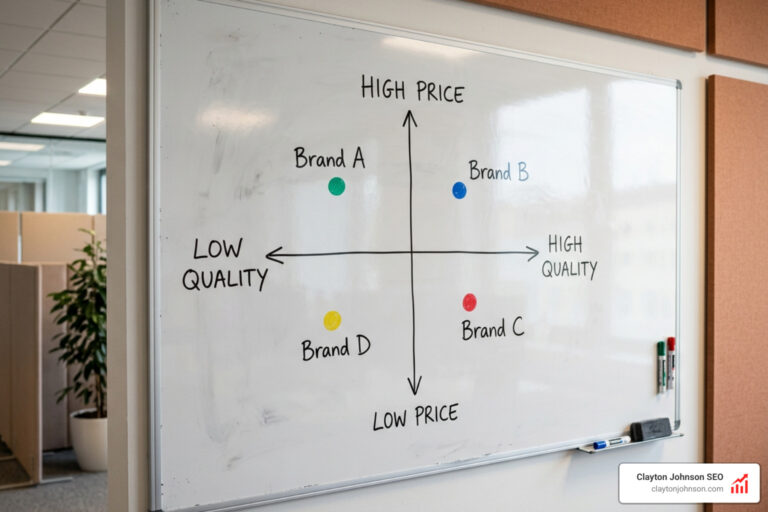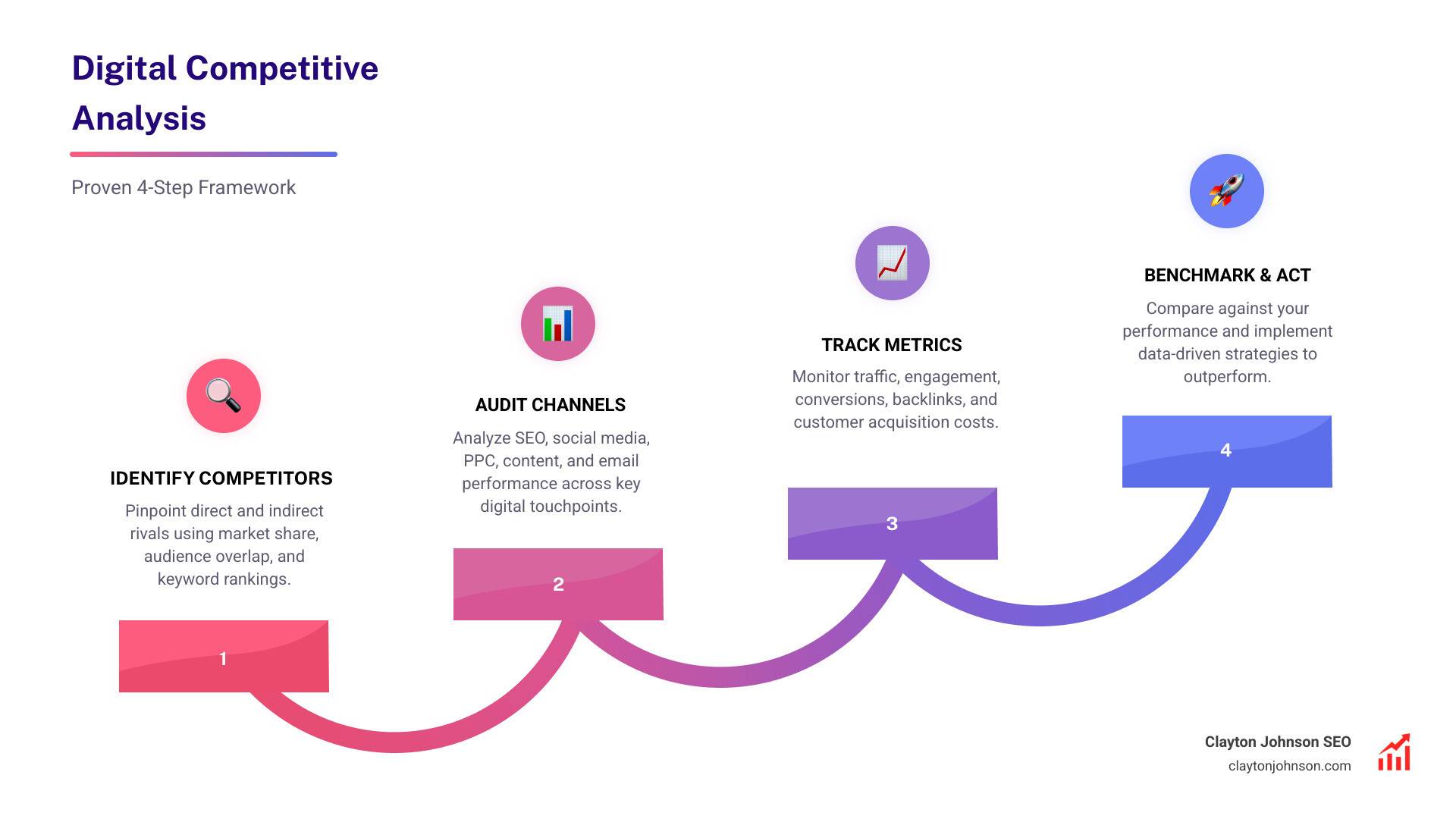
Why Digital Competitive Analysis Is Essential for Modern Marketing
Digital competitive analysis is the process of researching your competitors’ online strategies—SEO, PPC, content, social media, and traffic sources—to uncover gaps, validate your positioning, and make smarter marketing decisions. Unlike traditional competitor research, digital analysis offers real-time data, measurable metrics, and the ability to pivot instantly based on what’s working in your market.
Quick Overview: What Digital Competitive Analysis Includes
- Identifying competitors (direct, indirect, and brand competitors)
- Tracking key metrics (traffic, engagement, conversions, keyword rankings)
- Analyzing channels (SEO, PPC, social media, email, content)
- Performing SWOT analysis (strengths, weaknesses, opportunities, threats)
- Benchmarking performance and setting realistic goals
- Using tools and AI (Semrush, Ahrefs, Rival IQ, ChatGPT)
- Applying insights to improve your own strategy
Most companies conduct competitive analysis before they start planning and strategizing. But here’s the problem: 73% of marketers believe their social media efforts are “somewhat effective” or “very effective,” yet many struggle to prove ROI or understand why competitors are winning.
Digital markets evolve fast. A competitor can launch a new campaign, shift their SEO strategy, or partner with an influencer—and you won’t know unless you’re tracking them. That’s why ongoing competitor tracking matters. It helps you review benchmarks, catch trends, learn from mistakes, and refine your goals.
Consider this: Discover.com saw a 32% growth in traffic over the past year, pushing them into the “Game Changers” category in their industry. By targeting a rival’s audience, they identified a potential reach of 57.7 million people. That’s the power of data-driven competitive intelligence.
But competitive analysis isn’t just about collecting data. It’s about turning insights into action. As one strategist put it: “Raw data is just noise. The most common failure in competitive analysis isn’t a lack of information, but a lack of interpretation.”
This guide walks you through a five-step framework for digital competitive analysis, the metrics and channels to track, the tools and AI features that save time, and how to apply insights to outsmart your rivals.
I’m Clayton Johnson, an SEO and growth strategist who has built scalable traffic systems and competitive intelligence frameworks for multiple companies across industries. Digital competitive analysis is at the core of my approach to structured strategy and measurable growth.
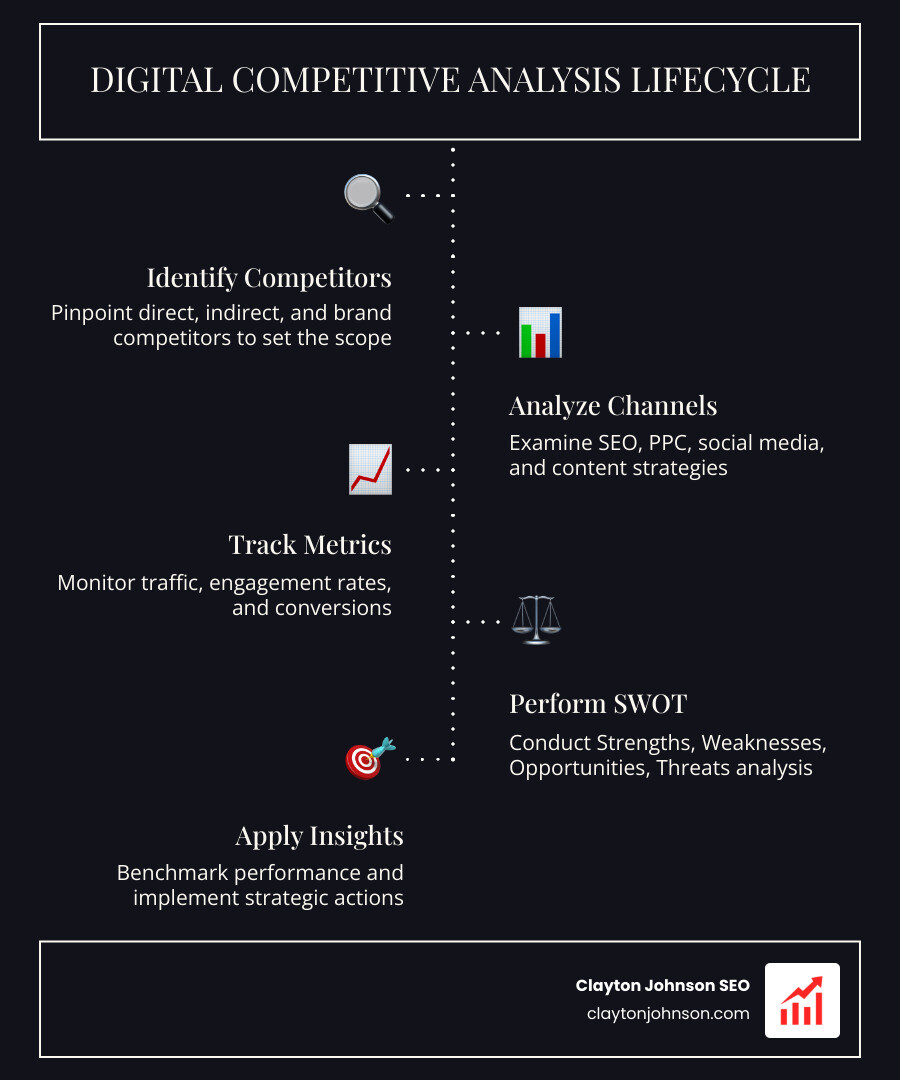
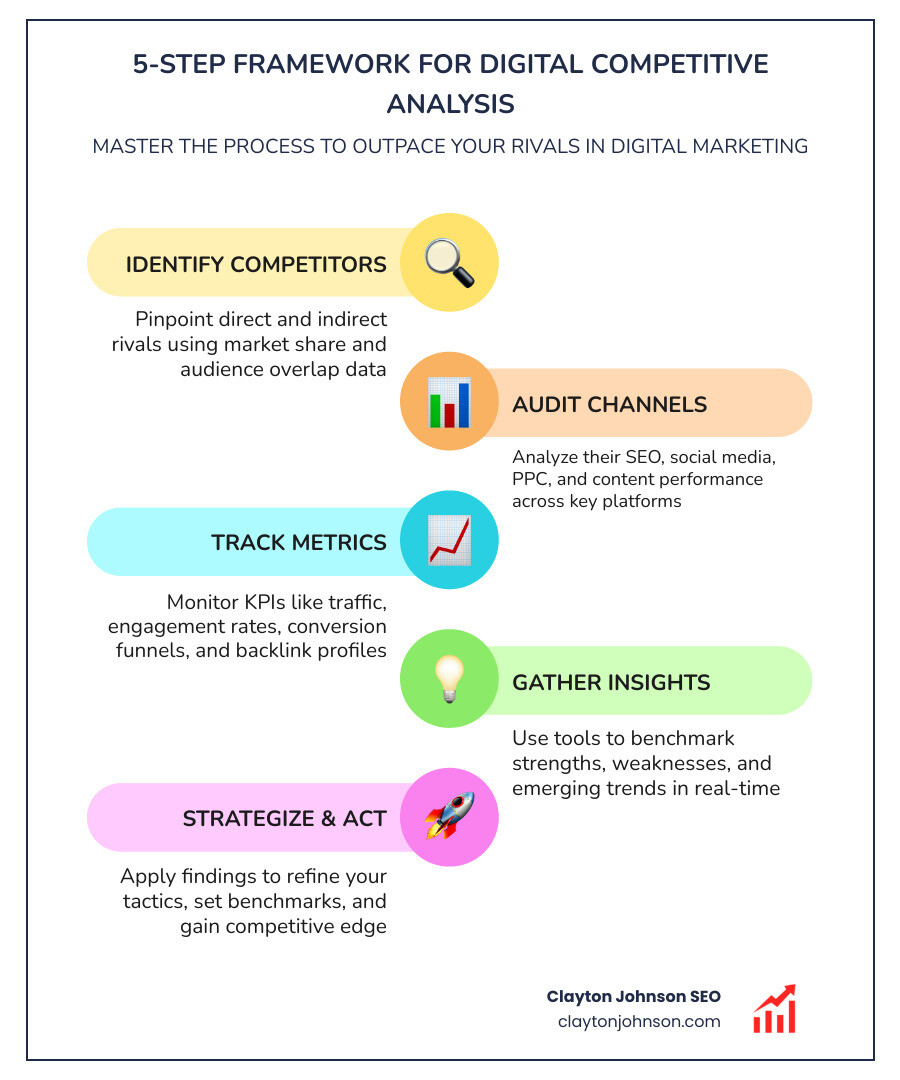
The 5-Step Framework for Digital Competitive Analysis
To avoid drowning in data, we need a structured approach. Think of this framework as your “strategic north star.” It moves you from “What are they doing?” to “How do we beat them?”
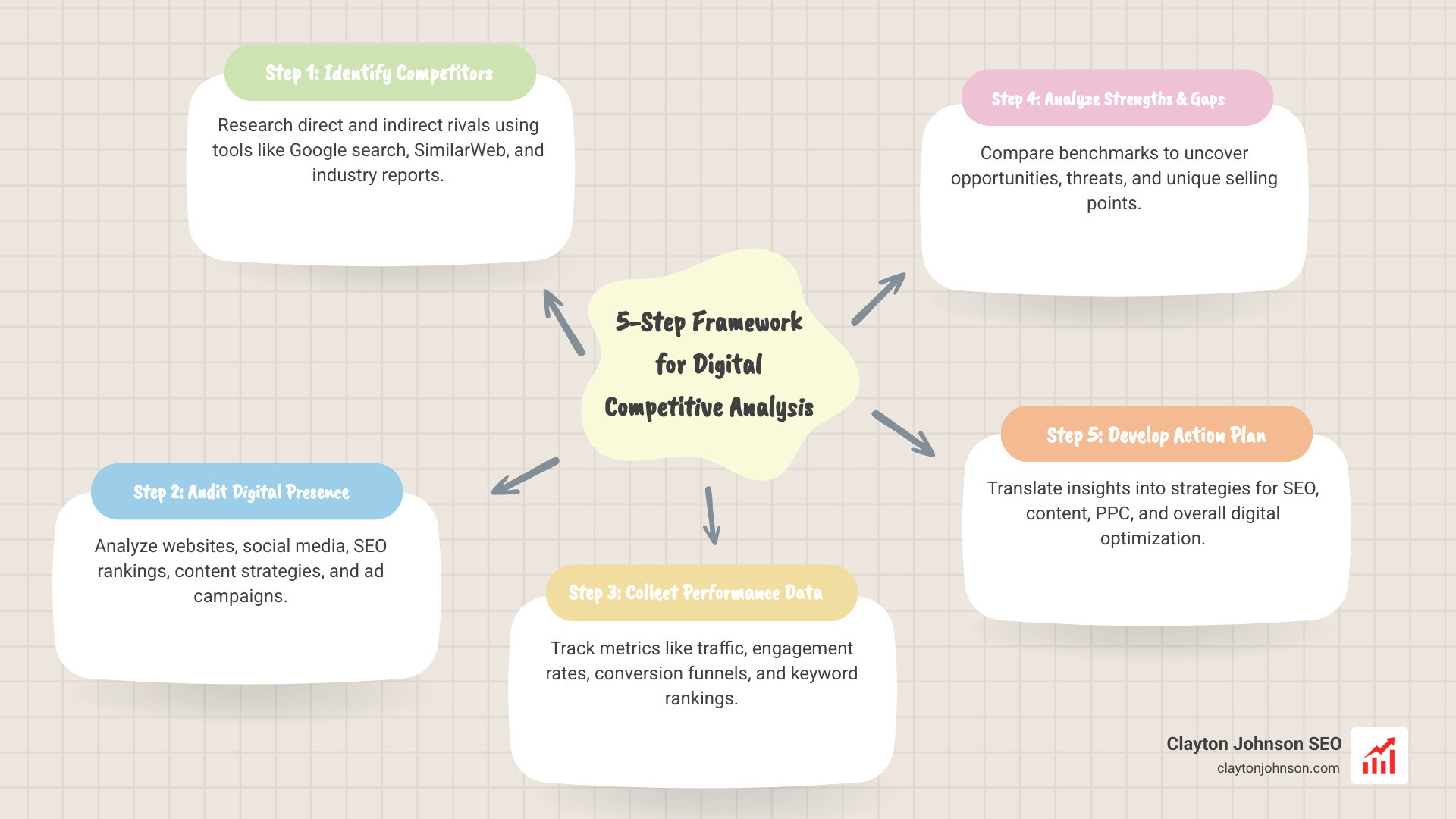
A successful digital competitive analysis starts with broad Market Analysis to understand the economic currents and ends with granular tactical adjustments. We recommend using Porter’s Five Forces to evaluate industry structure—analyzing buyer power, supplier power, and the threat of new entrants or substitutes—before diving into the digital specifics.
Identifying Competitors in Digital Competitive Analysis
In the digital world, your competitors aren’t just the shops down the street. We categorize them into three buckets:
- Direct Competitors: They offer the same product or service to the same audience (e.g., two Minneapolis law firms specializing in personal injury).
- Indirect Competitors: They solve the same customer problem but with a different approach (e.g., a DIY legal template site vs. a full-service law firm).
- Brand Competitors: These are companies that compete for the same “mind share” or audience attention, even if their products differ.
We use tools like SimilarWeb to find “audience overlap.” If you’re a local retailer, you might find your audience spends significant time on specific lifestyle blogs. That overlap is a goldmine for partnership opportunities.
Performing a Digital SWOT Analysis
Once you’ve identified the players, it’s time for a SWOT Analysis. This isn’t just a boring quadrant; it’s a diagnostic tool.
- Strengths: Does the competitor have a high Domain Authority? A massive email list?
- Weaknesses: Are their customers complaining about slow shipping in reviews? Is their mobile site experience clunky?
- Opportunities: Is there a keyword they aren’t ranking for? A social platform (like TikTok) they are ignoring?
- Threats: Are they moving into your specific niche or geographic territory?
The goal here is to refine your unique value proposition. If every competitor is focusing on “price,” your opportunity might be focusing on “premium service” or “local Minneapolis expertise.”
Audience Analysis and Demographics
Who is actually visiting your competitors’ sites? Understanding demographics—age, wealth, and interests—is vital. For instance, in the credit card industry, data shows a dominance of males aged 25–34, yet some brands skew much younger.
By analyzing where your rivals’ audiences live and what they care about, you can find massive untapped markets. As we mentioned earlier, Find identified a 57.7M potential audience simply by analyzing Chase’s reach. We also keep an eye on privacy and compliance tools like iubenda to see how competitors are handling data—this can often reveal which markets (like the EU) they are prioritizing.
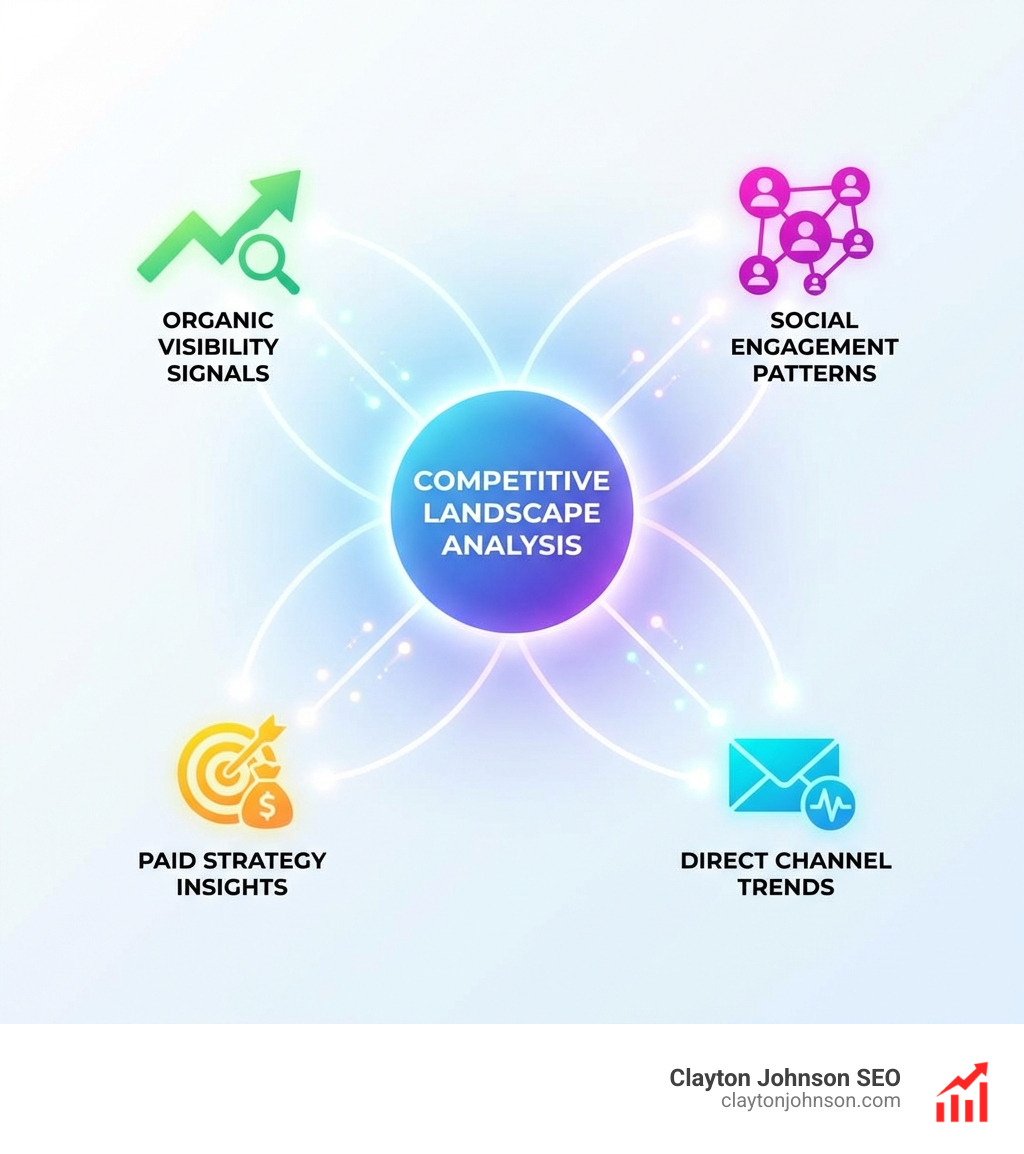
Key Metrics and Channels to Track
Data without context is just noise. To win, we track specific metrics across the most influential digital channels.
When we look at How to Think About Competitive Pressure, we focus on three main pillars: Traffic, Engagement, and Conversions.
| Metric Category | SEO Focus | PPC Focus | Social Media Focus |
|---|---|---|---|
| Visibility | Organic Rankings | Ad Impressions | Follower Growth |
| Acquisition | Backlink Profile | Cost Per Click (CPC) | Share of Voice |
| Engagement | Time on Page | Click-Through Rate | Engagement Rate |
| Action | Lead Gen from Content | Landing Page Conv. | Click-to-Site |
Common Types of Digital Analysis
- SEO Analysis: We use Ahrefs to deconstruct a competitor’s backlink profile and keyword strategy. If they have a high-traffic page that hasn’t been updated since 2022, that’s a content gap we can exploit.
- PPC Analysis: What are they bidding on? Analyzing their ad copy reveals their most profitable “hooks.”
- Social Media Analysis: With roughly 42% of the population on social media, this is a massive focus. 73% of marketers find social media effective, but only if they are tracking “share of voice” against rivals.
- Content Strategy: Are they winning with long-form blogs, video unboxings, or whitepapers?
Benchmarking Performance and Setting Goals
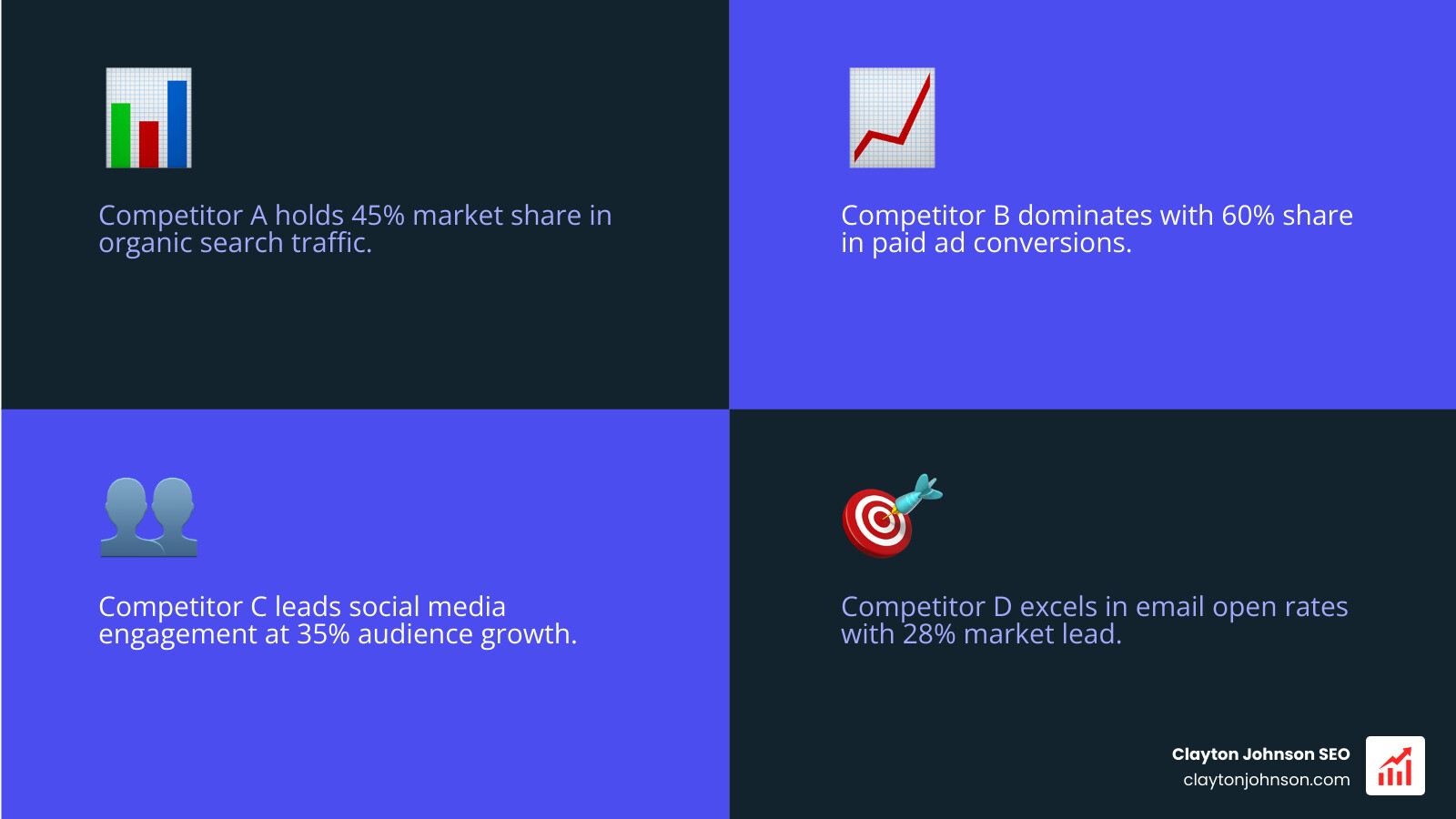
You can’t know you’re winning if you don’t keep score. We use platforms like G2 and Capterra to see how users rank competitor products. If a rival has a 32% growth in traffic, we don’t just panic—we benchmark our own growth against theirs to set realistic, data-backed KPIs.
Leveraging AI and Top Tools for Competitive Intelligence
The days of manual spreadsheets are over. Modern digital competitive analysis is powered by automation and machine learning.
The Role of AI in Digital Competitive Analysis
AI is changing the game by identifying “unknown-unknowns.” Tools like ChatGPT or Gemini can summarize hundreds of competitor reviews in seconds, highlighting recurring customer pain points. AI features in major SEO suites can now predict market shifts before they happen, allowing us to be proactive rather than reactive.
We also track “AI Traffic”—visits coming from AI search engines like Perplexity. If your competitors are appearing in ChatGPT’s recommendations and you aren’t, you’re losing the next generation of search.
Essential Tools for Modern Marketers
To build a “living radar system,” we rely on a stack of professional tools:
- Semrush: The gold standard for traffic strategies and market overview.
- Moz: Excellent for tracking local search competition and domain authority.
- Rival IQ: Perfect for “no-data-scientist-required” social media benchmarking.
- BuzzSumo: Identifies which of your competitors’ content pieces are getting the most shares.
- SpyFu: Uncovers the exact keywords competitors buy on Google Ads.
- Statista: Provides the macro-level industry data and consumer trends needed to ground your research.
Turning Insights into Action: Strategy and Benchmarking
The most common mistake is treating the analysis as a final report. Instead, it should be a catalyst for your go-to-market strategy.
Effective Market, Industry, and Competitive Analysis should lead to immediate changes. If you find a competitor is winning through “educational video content,” your next move should be a YouTube strategy, not just another blog post.
Real-World Examples of Success
Take the credit card industry. By using audience overlap tools, one brand finded their users were heavily interested in gaming. They pivoted their LinkedIn and social strategy to include partnerships with gaming influencers, resulting in a massive spike in new applications.
Similarly, Discover.com’s 32% growth wasn’t an accident—it was the result of identifying “Game Changer” keywords that their direct rivals were neglecting. They didn’t just copy; they out-maneuvered.
Common Mistakes to Avoid
- Static Snapshots: Markets move. A one-time analysis is a dead map. You need a live GPS.
- Data Drowning: Don’t track everything. Focus on the metrics that drive revenue.
- Confirmation Bias: Don’t just look for data that proves you’re the best. Look for where you are losing.
- Ignoring the “42%”: With such a high percentage of the population on social media, ignoring a rival’s social engagement is a recipe for irrelevance.
- Relying solely on Google: While search is huge, don’t forget email, dark social, and direct traffic.
Frequently Asked Questions about Digital Competitive Analysis
What is the difference between digital and traditional competitor analysis?
Traditional analysis often focuses on “offline” factors like TV ads, print, and physical location. Digital competitive analysis focuses on the “digital footprint”—SEO, social engagement, and online conversion funnels. Digital analysis is also much faster; you can see a competitor’s new ad the moment it goes live.
How often should I update my competitive research?
We recommend a deep dive every quarter, but “pulse monitoring” should be ongoing. Set up alerts for competitor brand mentions and keyword shifts so you can react in real-time.
Can I perform competitive analysis for free?
Yes, you can use free versions of tools like Moz, Ubersuggest, or even just manual Google searches and social media audits. However, to get the deep “AI-assisted” insights and historical data needed for a serious growth strategy, professional tools are usually worth the investment.
Conclusion
At the end of the day, digital competitive analysis isn’t about being a copycat. It’s about finding the “white space” in the market where your rivals are weak and your strengths can shine. Whether you are a founder in Minneapolis or a marketing leader for a global brand, understanding the digital landscape is the only way to ensure your growth is sustainable.
At Clayton Johnson, we help founders and marketing leaders diagnose growth problems and choose the right strategy. We specialize in building AI-assisted workflows and SEO systems that turn competitive intelligence into measurable results.
Ready to stop guessing and start outsmarting your rivals? Outsmart your rivals with expert SEO services and let’s build a strategy that wins.