Why the Best AI Content Tools Matter for Modern Marketers
Best AI content tools are reshaping how marketing teams create, optimize, and scale content without sacrificing quality. According to recent data, 90% of marketers now use AI for faster decision-making, while 65% report better SEO results when implementing AI in their workflows. The shift isn’t about replacing human creativity—it’s about removing bottlenecks, standardizing quality, and freeing strategists to focus on positioning and insight rather than repetitive drafting.
Quick Answer: Top AI Content Tools by Use Case
| Use Case | Best Tools |
|---|---|
| Long-form writing | ChatGPT, Claude, Jasper |
| SEO optimization | Surfer SEO, Clearscope, ContentShake AI |
| Social media copy | Copy.ai, Rytr, Jasper |
| Visual content | Canva, Midjourney, Pictory |
| Video editing | Descript, Runway |
| Grammar & editing | Grammarly, Hemingway App |
| Workflow automation | Zapier, Notion AI |
The challenge isn’t finding AI tools—it’s choosing the right stack for your workflow. Generic listicles push affiliate products; real practitioners need tools that integrate with existing systems, maintain brand voice, and deliver measurable results. The best approach combines chat-first assistants like ChatGPT or Claude for drafting with specialized optimization layers like Surfer SEO for ranking, editing tools like Grammarly for polish, and automation platforms like Zapier to connect everything.
Most importantly: AI should scale human expertise, not replace it. Tools handle research, structure, and repetitive tasks. Humans bring strategy, judgment, and the proprietary insights that differentiate content. Testing shows fully AI-generated content underperforms human-edited work by 15-30% on engagement—the sweet spot is a hybrid workflow where AI removes friction and humans add strategic value.
I’m Clayton Johnson, and I’ve spent years building SEO-driven content systems and AI-augmented marketing workflows for growth-focused teams. Throughout this guide, I’ll walk you through the Best AI content tools across every function—writing, SEO, visuals, video, and automation—so you can build a stack that fits your actual workflow, not just the hype cycle.
The Best AI Content Tools for Every Workflow
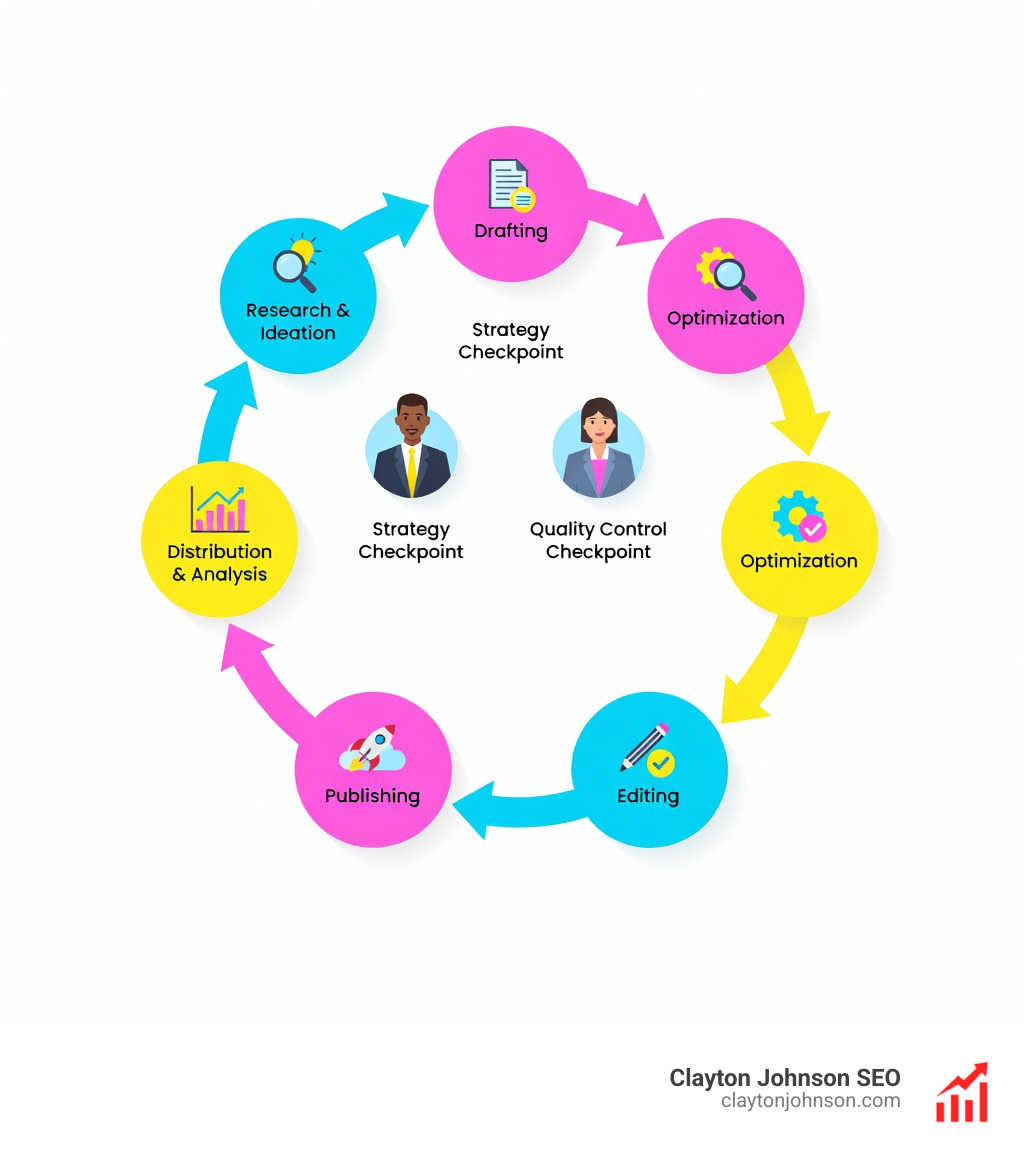
To build a high-performing content engine, we need to look at the entire lifecycle. Content isn’t just a block of text; it’s a process that starts with research and ends with distribution. When we talk about the Best AI content tools, we aren’t just looking for a “write button.” We are looking for efficiency and scalability.
Research shows that while 90% of marketers use AI for faster decision-making, the real winners are those who use AI to handle the “heavy lifting”—like summarizing 50 search results or generating 20 social media hooks—so they can spend more time on high-level strategy. For a deeper dive into the broader landscape, check out The Ultimate Guide to Digital Marketing AI.
Best AI Content Tools for Writing and Copywriting
The writing phase is where most people start their journey. Depending on whether you’re writing a 3,000-word whitepaper or a snappy LinkedIn post, your tool choice will change.
- ChatGPT (OpenAI): The “Swiss Army Knife” of AI. It is incredibly versatile for brainstorming, outlining, and drafting. With the latest models, it can even suggest SEO optimizations proactively. It’s often the starting point for most solopreneurs and freelancers.
- Claude (Anthropic): We find that Claude often produces more natural, human-like prose than ChatGPT. It has a massive “context window,” meaning you can feed it an entire ebook or a dozen research papers, and it will retain that information to help you write. For those building technical content, Mastering the Claude AI Code Generator shows how it can even handle complex technical documentation.
- Gemini (Google): If you live in Google Workspace, Gemini is a no-brainer. It integrates directly with Docs and Gmail, making it easy to pull research from the web in real-time.
- Jasper: Built specifically for marketing teams, Jasper includes “Brand Voice” features that allow you to train the AI on your specific style guides and past content. This ensures that the output sounds like us, not a robot.
- Copy.ai: Excellent for high-volume marketing and sales copy. It offers over 90 templates for everything from “Webinar Follow-up Emails” to “Instagram Captions.”
- Rytr: A budget-friendly option that is great for short-form content. It allows you to select from 20+ tones (enthusiastic, convincing, etc.) to get the right “vibe” for your copy.

Best AI Content Tools for SEO and Search Intent
Generating text is easy; generating text that ranks on the first page of Google is hard. This is where specialized SEO tools come in. Statistics show that 65% of companies have noted better SEO results when using AI.
- Surfer SEO: This tool analyzes the current top-ranking pages for your keyword and gives you a “Content Score.” It tells you exactly which terms to include and how long your article should be. We use this to ensure our content isn’t just good, but competitive.
- Clearscope: Often considered the gold standard for enterprise teams, Clearscope focuses heavily on search intent. It helps us understand exactly what a user is looking for so we can provide the most relevant answer.
- Outranking: This tool excels at the planning stage. It looks at what is already ranking and helps you build a structure that covers all the necessary topic gaps.
- ContentShake AI: A newer tool from the Semrush ecosystem that combines AI writing with real-time SEO data, making it a powerful “all-in-one” for small teams.
By Using AI Competitive Insights to Outsmart Your Rivals, we can move beyond guessing and start publishing content backed by data.
Comparing Top AI Software: Features, Pricing, and Ease of Use
Choosing the Best AI content tools requires balancing functionality with your budget. Some tools are free, while others are significant monthly investments.

| Tool | Primary Feature | Pricing (Approx.) | Skill Level |
|---|---|---|---|
| Grammarly | Editing & Tone | Free to $30/mo | Beginner |
| Canva | Graphic Design | Free to $120/yr | Beginner |
| Jasper | Enterprise Writing | Starts at $49/mo | Intermediate |
| Descript | Video/Audio Editing | Free to $30/mo | Intermediate |
| Surfer SEO | SEO Optimization | Starts at $89/mo | Advanced |
| Pictory | Video Generation | Starts at $19/mo | Beginner |
- Grammarly: More than just a spellchecker, it now includes generative AI features to help you rewrite sentences for better clarity. It’s essential for daily writing.
- Canva: Their “Magic Studio” has brought AI to the masses. You can generate images from text, remove backgrounds with one click, and even transform a document into a presentation instantly.
- Descript: This tool changed the game for video and podcasting. It transcribes your audio, and then you edit the video by editing the text. If you delete a word in the transcript, it deletes it in the video.
- Pictory: Perfect for repurposing. You can paste a blog post URL, and Pictory will automatically extract the highlights and create a short-form video for social media.
Understanding these trade-offs is why Why Your Brand Needs an AI Growth Strategy is so critical for long-term success.
How to Choose the Best AI Content Tools for Your Needs
Don’t fall for the “shiny object syndrome.” Before adding a new tool to your stack, evaluate it against these criteria:
- Ease of Use: If it takes three weeks to learn, your team won’t use it.
- Integration: Does it talk to the tools you already use? (e.g., WordPress, Slack, Google Docs).
- Output Quality: Does it require a 90% rewrite, or is it 70% of the way there?
- Scalability: Can it handle one blog post a week? What about fifty?
- Data Security: Especially for enterprises, knowing how your data is used to train future models is vital.

Developing these 8 Essential AI Skills Every Marketer Needs will help you make better decisions as the technology evolves.
Integrating AI into Your Content Creation Workflow
The real magic happens when you stop using these tools in isolation. By connecting them, we create a “content factory.”
- Zapier: This is the glue. You can set up a “Zap” where a new blog post in WordPress automatically triggers an AI tool to generate a LinkedIn post, a tweet, and an email summary.
- Notion AI: By keeping your research, outlines, and drafts in one place, Notion AI allows you to summarize meeting notes or expand on ideas without switching tabs.
- Workflow Automation: We recommend a “Human-in-the-Loop” system. AI generates the first draft, but a human expert always performs the final “sanity check” and adds proprietary data.
For developers or advanced users, learning How to Extend Claude with Custom Agent Skills allows for even deeper customization of these workflows.
Frequently Asked Questions about AI Content Software
Can AI tools replace human writers?
No. While AI is great at pattern recognition and summarizing, it lacks human empathy, relatability, and cultural nuance. AI doesn’t have “lived experience.” It can’t tell a story about a specific client meeting in Minneapolis or explain the subtle “vibe” of a local brand. Furthermore, AI is prone to “hallucinations” (making things up), so fact-checking remains a strictly human job.
What are the best free AI content tools?
You can get a lot done without spending a dime. ChatGPT Free and Claude Free are excellent for drafting. Grammarly Free handles basic polish, and the Hemingway App is a fantastic (and free) way to check the readability of your writing. Canva Free also offers limited but powerful AI design features.
How do AI tools help with SEO?
AI speeds up the most tedious parts of SEO:
- Keyword Research: Clustering thousands of keywords into topics.
- Search Intent: Analyzing the SERPs to see if Google wants a “how-to” guide or a product page.
- Content Grading: Providing real-time feedback on keyword density and readability.
- Meta Descriptions: Generating dozens of variations for A/B testing in seconds.
Conclusion
The era of manual, “from-scratch” content creation is ending. By embracing the Best AI content tools, we can produce more work, rank higher in search, and reach our audience more effectively. However, the tool is only as good as the strategist using it.
At Clayton Johnson SEO, we focus on building growth frameworks that combine the analytical power of AI with the strategic depth of human experts. Whether you are looking for an SEO strategy that actually moves the needle or a content system that scales, we are here to help founders and marketing leaders in Minneapolis and beyond achieve measurable results.
Ready to level up? Start by picking one tool from this list, master it, and then build your stack one step at a time.