Why AI Optimization for SEO is Reshaping Search Visibility
AI optimization for SEO is the practice of structuring your content so AI-powered search engines—ChatGPT, Perplexity, Google’s AI Overviews, and Gemini—can extract, cite, and recommend your brand as a trusted source. Unlike traditional SEO, which focuses on ranking webpages, AI optimization centers on being selected by language models that synthesize information and present direct answers to user queries.
How to Implement AI Optimization for SEO:
- Structure content for machine readability – Use clear headings, Q&A formats, and bulleted lists
- Add semantic clarity – Include definitions, data points, and concise summaries
- Implement schema markup – Help AI systems verify and cite your content
- Build E-E-A-T signals – Demonstrate experience, expertise, authoritativeness, and trustworthiness
- Target discovery queries – Optimize for how people ask questions to AI assistants
- Keep content fresh – Update regularly, as AI models prioritize recent information
- Track AI citations – Monitor brand mentions across generative search platforms
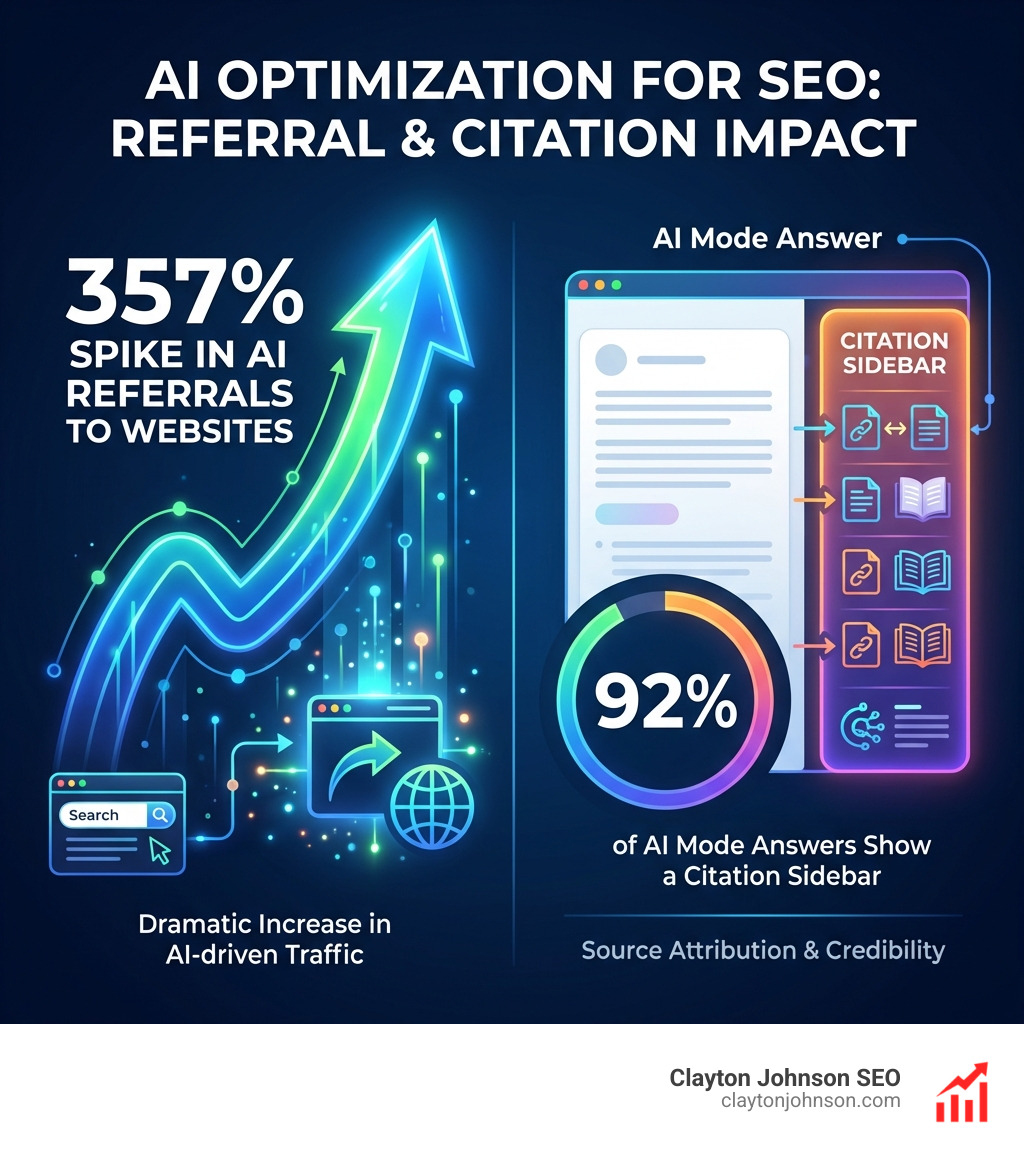
The stakes are high. AI Overviews now appear on 16% of searches, and in June 2025 alone, AI referrals to top websites spiked 357% year-over-year, reaching 1.13 billion visits. Meanwhile, over 65% of searches end without a click—users get their answers directly from AI-generated summaries. Every minute, 5.9 million searches are processed on Google, adding up to 3 trillion searches annually. Yet traditional search behavior is rapidly shifting as millions now turn to ChatGPT, Perplexity, and other AI platforms for quick answers and recommendations.
This isn’t a future trend. It’s happening now.
Search has fundamentally changed from keyword matching to semantic intent understanding. AI systems don’t just link to your page—they filter, synthesize, and quote your content. If you’re not part of the AI output, you’re not part of the conversation. Visibility is no longer defined by ranking position alone; it’s about which content pieces earn a place in the final AI answer.
The good news: AI search represents a largely untapped channel with less competition than traditional SERPs. Early movers gain a durable, compounding edge in visibility and authority. One agency reported 4162% traffic growth from AI-driven SEO workflows. And according to Semrush’s research, AI search visitors convert 4.4 times better than traditional organic visitors.
But success requires a shift in mindset. Instead of chasing rankings, you’re optimizing for citations. Instead of driving clicks, you’re building brand authority. Instead of stuffing keywords, you’re creating promptable content fragments—modular, machine-readable units that AI models can extract and verify.
Traditional SEO fundamentals still matter. Crawlability, metadata, internal linking, backlinks, and E-E-A-T signals remain essential for content discoverability. But now you must also ensure your content is structured for AI parsing. That means concise answers, Q&A headings, schema markup, factual data points, and author credentials. It means writing for both humans and algorithms that don’t read top to bottom but evaluate modular pieces of content.
The shift from traditional search to AI-driven answers also changes what gets cited. Research from Semrush analyzing thousands of AI citations found that clarity and summarization (+32.83%), E-E-A-T signals (+30.64%), Q&A format (+25.45%), section structure (+22.91%), and structured data elements (+21.60%) all strongly correlate with AI citation behavior. Interestingly, a non-promotional tone showed a negative correlation (-26.19%)—likely because professional, well-optimized articles often use a commercial or persuasive tone.
AI models prioritize fresh content over perfect content. As Metehan Yeşilyurt noted, “ChatGPT prioritizes RECENT over PERFECT. That amazing guide from 2022? It’s losing to mediocre content published yesterday.” Content updated within the last 30 days earns 3.2x more citations. Proper schema markup increases AI citations by 28%. Pages with original data tables earn 4.1x more AI citations. Opening paragraphs that answer the query upfront get cited 67% more often.
The future is AI-first. But as Andrew Holland pointed out, “The future of SEO isn’t GEO, it’s Organic Revenue Growth. Your brand search is going to become critically important.” AI optimization for SEO isn’t just about tactics—it’s about building trust, establishing authority, and ensuring your brand is recommended when it matters most.
I’m Clayton Johnson, an SEO strategist who builds scalable traffic systems and AI-augmented marketing workflows designed to turn fragmented efforts into coherent growth engines. My work on AI optimization for SEO focuses on structured content systems, citation tracking, and measurable outcomes that align with long-term brand authority. This guide will walk you through the exact strategies, tools, and frameworks you need to implement AI optimization for SEO—whether you’re a small business on a budget or a growth team ready to scale.
Easy AI optimization for SEO glossary:
Understanding AI SEO: How Search is Changing
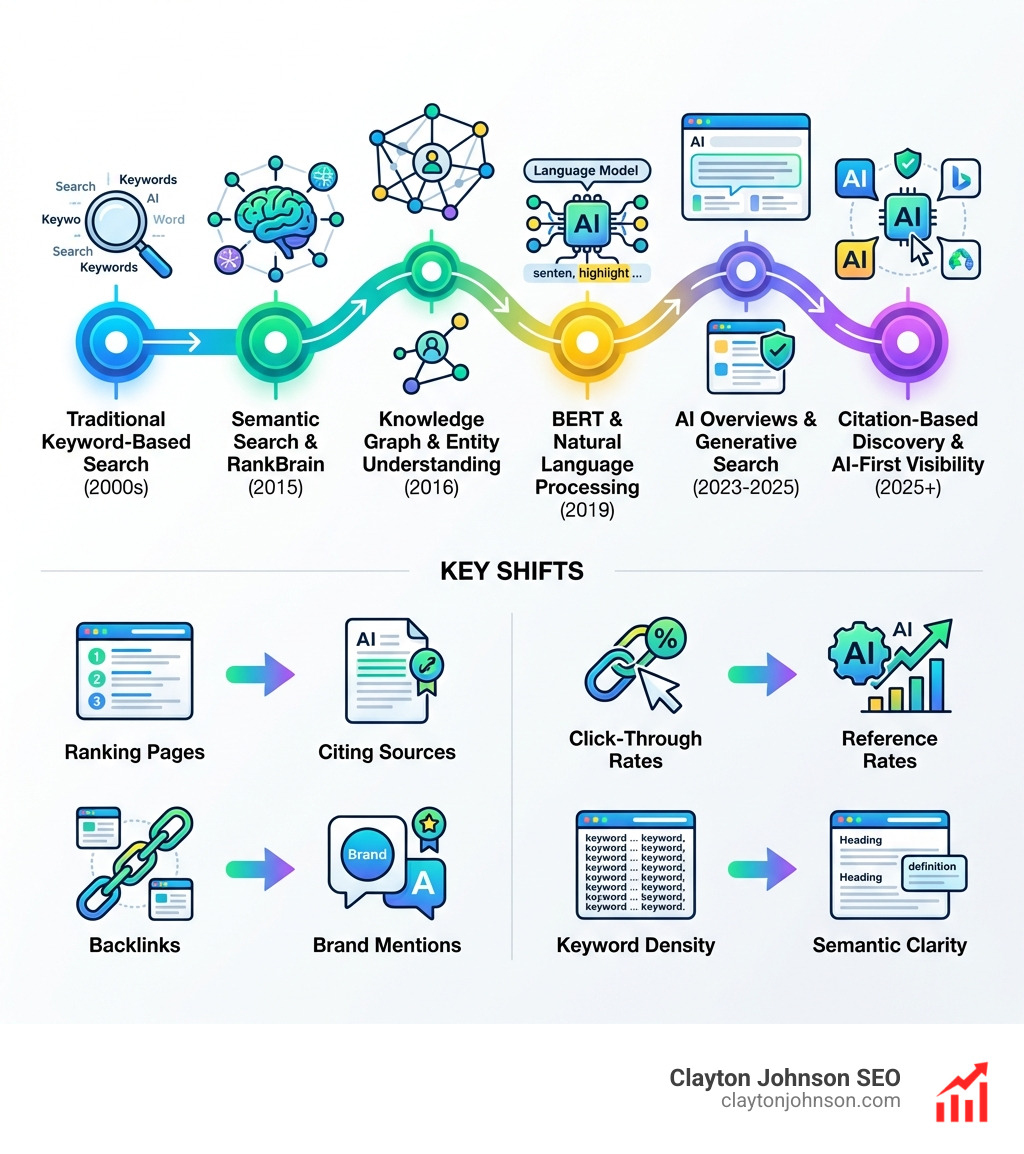
To truly master AI optimization for SEO, we must first recognize that the “10 blue links” era is fading. Traditional SEO was a game of matching keywords and building backlink volume. Today, search is dominated by Large Language Models (LLMs) like those powering Perplexity, ChatGPT, and Gemini. These systems don’t just find information; they synthesize it.
This evolution is often referred to as GEO (Generative Engine Optimization) or AEO (Answer Engine Optimization). In this new landscape, semantic clarity is king. AI models use vector similarity and embeddings to understand the relationship between concepts. For example, if someone asks for the “best quiet dishwasher,” the AI looks for content that understands the context (open-concept kitchens, decibel levels) rather than just the phrase.
Another major shift is the reliance on freshness and authority. Perplexity.ai, for instance, matches Google’s top 10 domains in over 91% of cases, but it prioritizes the most recent data to ensure factual accuracy. We are seeing a move from ranking pages to being a “quoted source.” If you want to dive deeper into the technical shifts, the Generative Engine Optimization guidance provides an excellent academic foundation for these changes.

Key Signals in AI Optimization for SEO
How does an AI “decide” to cite you? We’ve identified four primary signals that move the needle:
- Machine Scannability: AI crawlers are efficient but literal. Content must be broken into discrete, semantically rich units. Use clear H2s and H3s that pose questions and follow them with direct answers.
- Entity Authority: AI models resolve mentions into “entities.” They want to know who you are and if you are a canonical source for a topic. Linking your brand to established knowledge graphs is essential.
- Contextual Relevance: It’s no longer enough to be “about” a topic. You must answer the intent. Are you helping a user explore, buy, or navigate?
- Citation Optimization: This is the new “link building.” We optimize for being the source that an LLM extracts. This involves using “promptable fragments”—sentences that stand alone as verifiable truths.
Implementing AI Optimization for SEO: A Step-by-Step Strategy
Transitioning your strategy requires moving away from static keyword lists toward a dynamic, intent-driven workflow. We recommend starting with a rigorous content audit to see how well your existing assets serve machine learning models.
Step 1: Content Auditing for AI Fit
We begin by unifying crawl data and analytics into an audit graph. We look for “visibility gaps”—topics where you rank on Google but are absent from AI Overviews. Tools like MarketMuse can help benchmark topical depth and semantic gaps at scale.
Step 2: Intent Mapping
AI search intent falls into five buckets: informational, transactional, navigational, conversational, and exploratory. We map these intents to technical actions. For instance, a return policy page targets transactional intent and should have a concise canonical answer at the very top.
Step 3: Optimizing for Zero-Click Searches and AI Overviews
With over 65% of searches ending without a click, your goal is to win the “zero-click” real estate. AI Overviews (AIO) can cut website clicks by 30% but increase impressions significantly. To win here, we focus on content chunking—breaking long-form guides into modular pieces that AI can easily pull into a snippet.
If you need a professional team to handle this transition, our SEO Services are designed to modernize your architecture for the generative era.
| Feature | Traditional SEO Workflow | AI SEO Workflow |
|---|---|---|
| Primary Goal | Rank #1 on SERP | Earn citations in AI answers |
| Metric | Click-Through Rate (CTR) | Reference/Citation Rate |
| Content Unit | The entire webpage | Modular “Content Fragments” |
| Authority | Backlink Profile | Entity Authority & E-E-A-T |
| Targeting | Specific Keywords | Semantic Intent & Entities |
Optimizing Content Structure for AI Search Visibility
The way we format content is the “secret sauce” of AI optimization for SEO. AI systems evaluate modular pieces of content rather than reading top-to-bottom.
- Schema Markup & JSON-LD: This is no longer optional. Using Schema.org tags (like FAQPage, HowTo, and Organization) transforms ambiguous text into explicit facts that LLMs can verify. It’s like providing a map for the AI crawler.
- Q&A Formats: Research shows Q&A formats perform best for GEO because they mirror how users interact with AI assistants.
- H2/H3 Hierarchy: Use descriptive headings. Instead of “Conclusion,” use “Why [Product] is the Best Choice for [User].”
- The “Lead” Paragraph: Open every section with a 40-60 word definition or direct answer. This increases your chances of being pulled into an AI Overview by 67%.
For tailored advice on your site structure, our SEO Expert services can help you implement these technical layers correctly.
Technical Tactics for AI Optimization for SEO
Technical SEO for AI isn’t just about speed; it’s about accessibility for non-human readers.
- Robots.txt & AI Crawlers: Ensure you aren’t accidentally blocking bots like GPTBot or CCBot. Use a robots.txt checker to verify your settings.
- JavaScript Rendering: Unlike Googlebot, many LLM crawlers struggle with client-side JavaScript. If your content is hidden behind JS, the AI won’t see it. Always prefer server-side rendering for critical content.
- Citation Tracking: Start tracking brand mentions across LLMs. We look for unlinked mentions and sentiment. If an AI is recommending your competitor, we analyze their “semantic gap”—what facts do they have that we don’t?
- Semantic Gaps: Use AI tools to compare your content against the top cited sources. Are you missing key data points or statistics? Pages with original data earn 4.1x more citations.
The Role of E-E-A-T and AI-Generated Content Rankings
A common question we hear is: “Can AI-generated content rank?” The answer is a resounding yes, but with a massive caveat. Google’s guidance on AI-generated content makes it clear: the source of the content matters less than the quality and helpfulness of the information.
However, for YMYL (Your Money, Your Life) topics like health and finance, Google prioritizes content written by real-world experts. This is where E-E-A-T (Experience, Expertise, Authoritativeness, and Trustworthiness) becomes your competitive moat. AI can generate a list of tips, but it cannot replicate personal experience or original research.
Aligning AI Content with E-E-A-T
To survive the AI era, we must “humanize” our content. AI models look for signals of real-world expertise to avoid hallucinations.
- Detailed Author Bios: Include credentials, social links, and awards. Use Schema Markup to link authors to their professional profiles.
- Original Research: Publish surveys, benchmarks, and case studies. AI search models love citing original data because it provides “provenance”—a clear origin for a fact.
- Human Oversight: Always have a subject matter expert (SME) review AI-assisted drafts. This ensures technical accuracy and adds the “Experience” element that LLMs lack.
- Fact-Checking: AI citations are volatile. If you publish a factual error, and an LLM cites it, your brand reputation takes a hit. Enforce a rigorous governance framework for all claims.
Essential AI SEO Tools for Every Budget
You don’t need a million-dollar budget to start with AI optimization for SEO. There are tools available for every stage of growth.
- Ubersuggest: An excellent, affordable entry point for small businesses. It offers AI Search Visibility tracking and AI Keyword Overviews that show how your brand appears in LLMs separately from traditional search.
- Semrush: The gold standard for enterprise-level AI visibility. Their “AI Search Optimizer” helps you rewrite content specifically for LLM parsing.
- MarketMuse: Best for building topical authority. It uses AI to identify semantic gaps in your content clusters.
- Frase & Jasper AI: Powerful for scaling content creation while maintaining SEO alignment. Frase is particularly good at creating briefings based on SERP analysis.
Affordable AI Optimization for SEO for Small Businesses
If you’re a startup or small business in Minneapolis, you can still compete with the giants by being smarter with your workflows.
- Master Prompt Engineering: Use tools like ChatGPT to generate FAQ sections for your blog posts. Instead of a generic prompt, ask: “Based on the top 10 search results for [Topic], what are the 5 most common questions users ask, and what are the concise, factual answers?”
- Use Free AI Writing Tools: Ahrefs offers a suite of free tools for generating metadata, alt text, and transcripts.
- Ubersuggest Lifetime Plan: For a one-time fee, you can get lifetime access to keyword rankings and AI suggestions, which is much more affordable than monthly subscriptions to larger platforms.
- Community Visibility: AI models like Reddit. In fact, Reddit appears in over 40% of results across AI Overviews and ChatGPT. Engaging in niche communities can indirectly boost your AI visibility.
Measuring Success and the Future of Search
Tracking success in the AI era requires new KPIs. We no longer just look at “Position 1.” We look at:
- Citation Frequency: How often is your brand cited as a source in ChatGPT or Perplexity?
- Share of Voice in AIO: What percentage of AI Overviews for your target keywords include your content?
- Brand Sentiment: When AI models talk about you, is the tone positive and authoritative?
- Organic Search CTR: Monitoring the delta between impressions and clicks to see how AI Overviews are impacting your traffic.
The 5-10 year outlook suggests that search will become even more conversational and personalized. Google’s Search Generative Experience (SGE) is just the beginning. We anticipate a shift toward “agentic search,” where AI assistants perform tasks for users rather than just providing links. For those interested in the deep learning side, the latest research on ML predicting user intent shows how these models are becoming eerily accurate at anticipating what a user needs before they even finish typing.
Frequently Asked Questions about AI SEO
Can AI-generated content rank well in Google?
Yes. Google’s primary concern is the helpfulness and accuracy of the content, not whether a human or a machine wrote it. However, purely automated, low-quality content designed to manipulate rankings will be flagged as spam. The key is to use AI as a collaborator, adding human expertise and original data to ensure the content meets E-E-A-T standards.
How do I optimize for zero-click searches and AI Overviews?
To win in zero-click environments, you must provide “snackable” information. Use the “Inverted Pyramid” style of writing: provide the direct answer or definition in the first 50 words, followed by structured data (lists, tables), and then the detailed explanation. Implementing FAQ and How-to schema is also critical for appearing in these featured modules.
Will SEO still exist in 10 years with the rise of AI?
SEO will absolutely exist, but it will look very different. It will evolve into GEO (Generative Engine Optimization). As long as people need to find information, businesses will need to optimize their visibility. The focus will shift from “Googling” to “Discovery.” Your job will be to ensure that wherever a user asks a question—be it a search bar, a voice assistant, or an AI agent—your brand is the answer they receive.
Conclusion
The transition to AI optimization for SEO is the most significant shift in digital marketing since the invention of the search engine itself. It requires a move from keyword-centric tactics to an entity-first, authority-driven growth strategy. By focusing on semantic clarity, structured data, and E-E-A-T, you can ensure your brand remains visible in a world where AI synthesizes the answers.
At Clayton Johnson SEO, we specialize in building these future-proof content systems. Whether you need a comprehensive audit or a scalable AI-assisted workflow, we provide the actionable frameworks to help you win. Ready to adapt? Let’s talk about your next move as an SEO Consultant.