Google Gen AI is the Smartest Thing Since Sliced Bread


Demystifying Google Gen AI
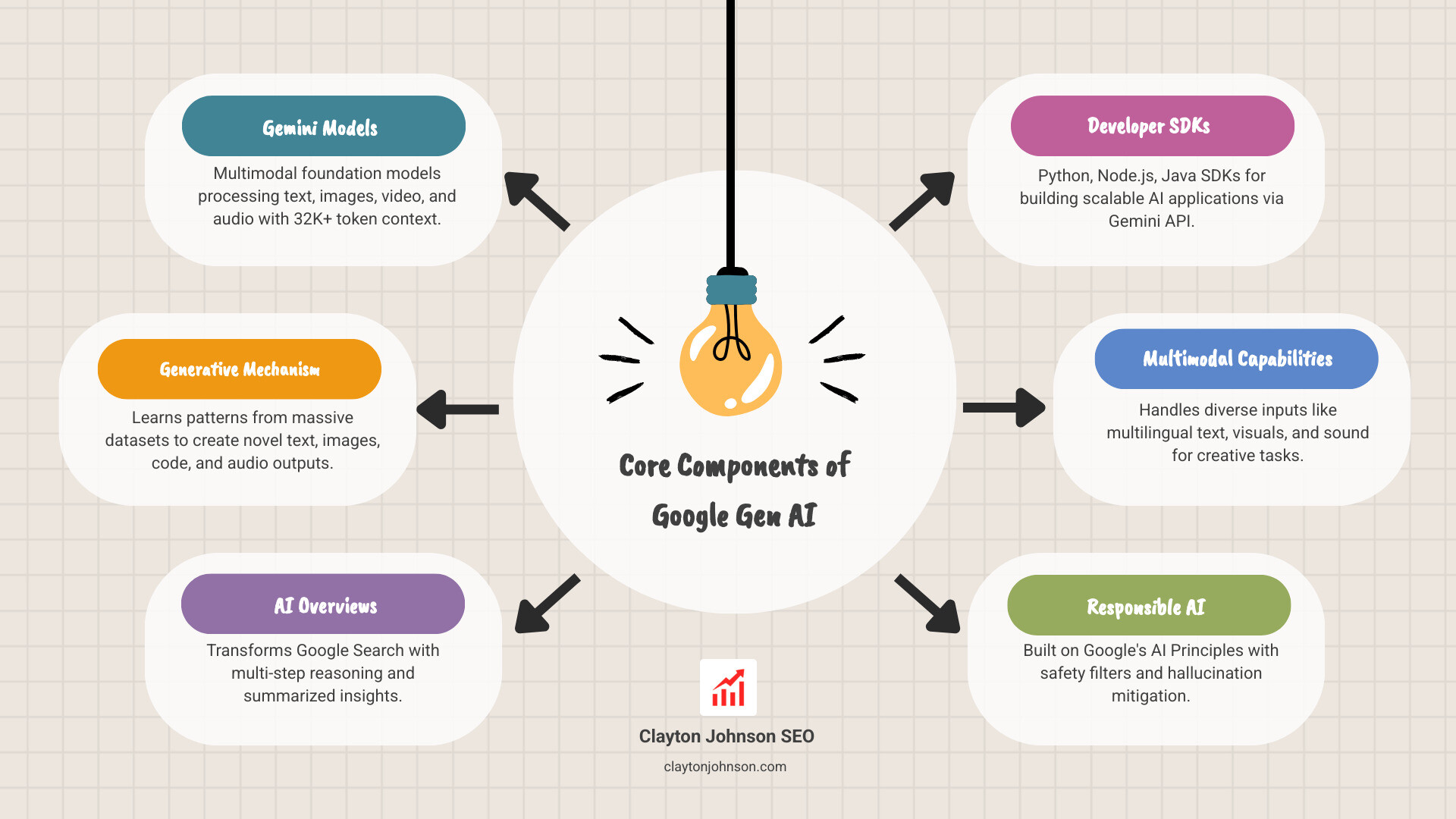
Google Gen AI (Generative Artificial Intelligence) is Google’s advanced AI that creates new, original content rather than just analyzing existing data.
- Purpose: To generate diverse new outputs like text, images, code, and audio.
- Mechanism: It learns from massive datasets to understand patterns and then generates novel data with similar characteristics.
- Key Distinction: Unlike traditional AI that predicts or categorizes, Google Gen AI creates.
- Google’s Products: Includes models like Gemini, AI Overviews in Google Search, and developer SDKs.
Over the past 25 years, Google has consistently reimagined what technology can do. Now, Google Gen AI stands at the forefront of this evolution, transforming everything from how we search for information to how developers build applications. It’s a powerful shift from AI that simply understands to AI that creates. This guide will explore Google’s groundbreaking generative AI offerings and how they are reshaping our digital world.
As Clayton Johnson, I’ve seen how Google Gen AI is transforming how businesses operate, from content creation to strategic market analysis. My work focuses on integrating these powerful AI systems into scalable growth architectures for founders and marketing leaders.
Understanding the Power of Google Gen AI

To truly appreciate Google Gen AI, we first need to understand how it differs from the “traditional” AI we’ve lived with for years. Traditional AI is essentially a world-class librarian; it can find a book, categorize it, and tell you if a picture contains a cat or a dog based on patterns it has seen before. Google Gen AI, however, is the author, the illustrator, and the coder all rolled into one.
At its core, Google Gen AI is powered by Large Language Models (LLMs) and foundation models. These models don’t just “know” facts; they understand the statistical relationships between bits of data. When you ask it to brainstorm a movie prequel or suggest a title for a story, it isn’t just searching a database. It is predicting the most creative and relevant next steps based on billions of patterns it learned during training.
Google develops these tools under a strict set of Google’s AI Principles, ensuring that the technology is socially beneficial, avoids creating or reinforcing unfair bias, and is built and tested for safety. This framework is essential because, while the AI can be incredibly creative, it needs a “moral compass” to navigate the vast amounts of information it processes.
Multimodal Processing in Google Gen AI
One of the most impressive feats of the Gemini era is “multimodality.” In the past, you had one AI for text and another for images. Google Gen AI models, particularly the Gemini family, are natively multimodal. This means they are trained to understand and operate across different types of information simultaneously—text, images, video, audio, and even code.
Key technical highlights include:
- Long-Context Understanding: Some models offer a context window of up to 32,000 tokens, allowing them to “remember” and process massive amounts of information in a single session (like a long document or a complex codebase).
- Multilingual Support: These models are fluent in more than 100 languages, making them a global tool for communication and creation.
- Versatile Model Selection: Through the Gemini API Model Overview, developers can choose the right model for their specific needs, whether it’s the speed of Flash or the reasoning power of Pro.
Transforming Search with Google Gen AI
Perhaps the most visible change for the average user is the integration of Google Gen AI into Search through AI Overviews. For over two decades, Google Search focused on “ten blue links.” Today, it uses a customized Gemini model to provide quick, comprehensive answers to complex questions.
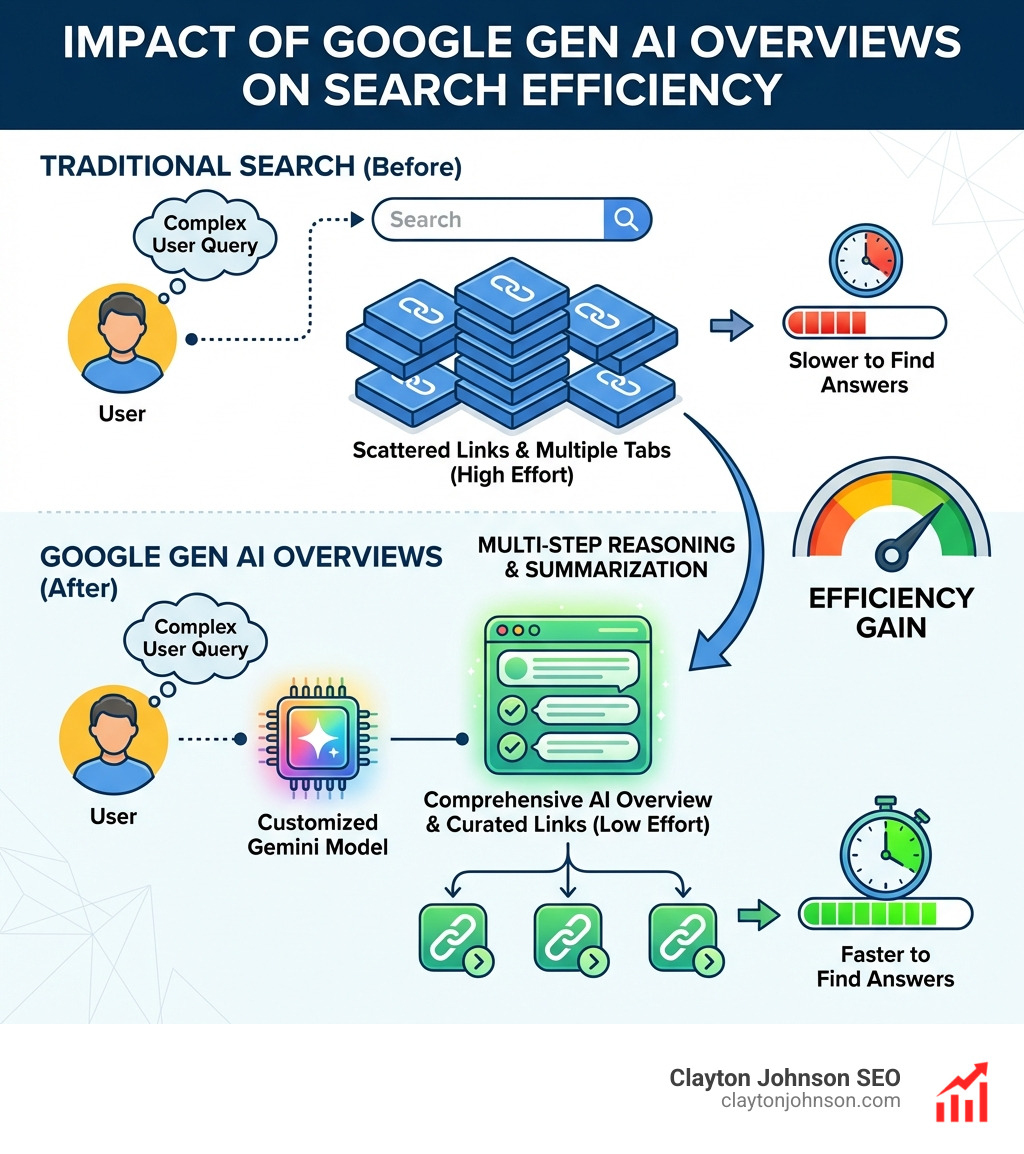
Through experiments in Search Labs, Google found that AI Overviews have been used billions of times. Users are increasingly satisfied because they can get a high-level summary of a topic while still having access to links to dive deeper. Whether you are planning a multi-stop vacation or researching the best way to remove a grass stain, AI Overviews use multi-step reasoning to do the heavy lifting for you. You can learn about AI Overviews in Search to see how Google maintains its 25-year legacy of information quality while embracing this new generative frontier.
The Gemini Ecosystem: From Nano to Ultra
Google’s approach to Google Gen AI isn’t “one size fits all.” The Gemini ecosystem is tiered to provide the right amount of intelligence for the right task:
- Gemini 1.5 Pro: The flagship model for complex reasoning and large-scale tasks.
- Gemini Flash: Optimized for speed and efficiency, perfect for high-volume applications.
- Nano Banana Pro (Gemini 3 Pro Image): A specialized model for creating high-fidelity visuals. It can use up to 14 images as reference points to generate stunning, high-quality graphics.
- Genie: A “foundation world model” with 11 billion parameters that can generate interactive, action-controllable virtual environments from a single image or sketch.

Beyond consumer apps, Google DeepMind is using these models to push the boundaries of science. Projects like AlphaFold have already revolutionized biology by predicting protein structures, a feat that is accelerating the search for cures to diseases. This isn’t just about writing emails; it’s about solving some of the world’s most complex scientific puzzles.
Building with the Google Gen AI SDK and Vertex AI
For the developers and builders among us, Google Gen AI provides a robust playground. The Google Gen AI SDK offers a unified interface that allows you to start prototyping with the Gemini Developer API and then seamlessly migrate to Vertex AI on Google Cloud for enterprise-grade scaling.

The SDK is available across all major programming languages:
- Python: The Python Gen AI SDK on GitHub is the most popular starting point.
- Other Languages: Support is also available for Node.js, Go, Java, and C#.
Gemini Code Assist
To make the building process even faster, Gemini Code Assist integrates directly into popular editors like VS Code and JetBrains. It helps developers write code with higher velocity and security, acting as a pair programmer that understands your entire repository.
| Feature | Gemini Developer API | Vertex AI (Google Cloud) |
|---|---|---|
| Primary Use | Fast prototyping & hobbyists | Enterprise-scale production |
| Security | Standard API security | Enterprise-grade privacy & compliance |
| Customization | Basic prompting | Advanced tuning & RAG |
| Integration | Simple API calls | Deep Google Cloud ecosystem integration |
Responsible Innovation and Handling Limitations
We have to be honest: as smart as Google Gen AI is, it’s not perfect. One of the most discussed limitations is “hallucination”—the tendency for an AI to confidently state something that isn’t true. Because LLMs predict the next likely word rather than checking a factual database, they can sometimes get their wires crossed.
To combat this, Google employs several strategies:
- Safety Filters: These block harmful content, hate speech, and harassment.
- Grounding and RAG: By connecting the AI to reliable external data sources (Retrieval-Augmented Generation), Google ensures responses are based on facts.
- Citation Checks: Vertex AI includes features to attribute sources, allowing users to verify where the information came from.
- Prohibited Use Policy: Google maintains a clear Generative AI Prohibited Use Policy to prevent the technology from being used for deceptive or harmful purposes.
We always recommend that users critically evaluate AI responses. Think of Google Gen AI as a brilliant intern—it’s incredibly helpful and fast, but you should still double-check its work before sending it to the CEO.
Frequently Asked Questions about Google Gen AI
What is the difference between Google Gen AI and traditional AI?
Traditional AI is designed to recognize patterns, classify data, and make predictions (like your email’s spam filter). Google Gen AI goes a step further by using those patterns to create entirely new content, such as a poem, a piece of code, or an image of a “banana-shaped spaceship.”
How do I access Google Gemini and AI Overviews?
You can access Gemini through the dedicated web interface at gemini.google.com. AI Overviews are currently rolling out to users globally within standard Google Search results, starting in the U.S.
Can developers use Google Gen AI for coding?
Yes! Developers can use the Gemini API to build their own apps or use Gemini Code Assist to help them write, debug, and optimize their own code. Google also offers Gemma, a family of open-source models for developers who want more control over their AI environment.
Conclusion
Google Gen AI is more than just a flashy new tool; it is a fundamental shift in how we interact with technology. From the way we search for answers to the way we build the future of software, these models are providing the “creative spark” that traditional computing lacked.
At Clayton Johnson, we believe that the real power of AI is unlocked when it is integrated into a structured growth architecture. We don’t just use AI for the sake of it; we use it to build AI-enhanced execution systems that drive measurable growth. Whether you are a founder in Minneapolis or a marketing leader looking for a competitive edge, understanding these tools is the first step toward leverage and compounding growth.
If you’re ready to move beyond tactics and start building structured growth infrastructure, we’re here to help. Explore our SEO content marketing services to see how we combine taxonomy-driven SEO with the latest in generative technology to put your business on the map.