How AI Based Analytics Makes Sense of Your Messy Data

What AI Based Analytics Actually Does With Your Data 📊
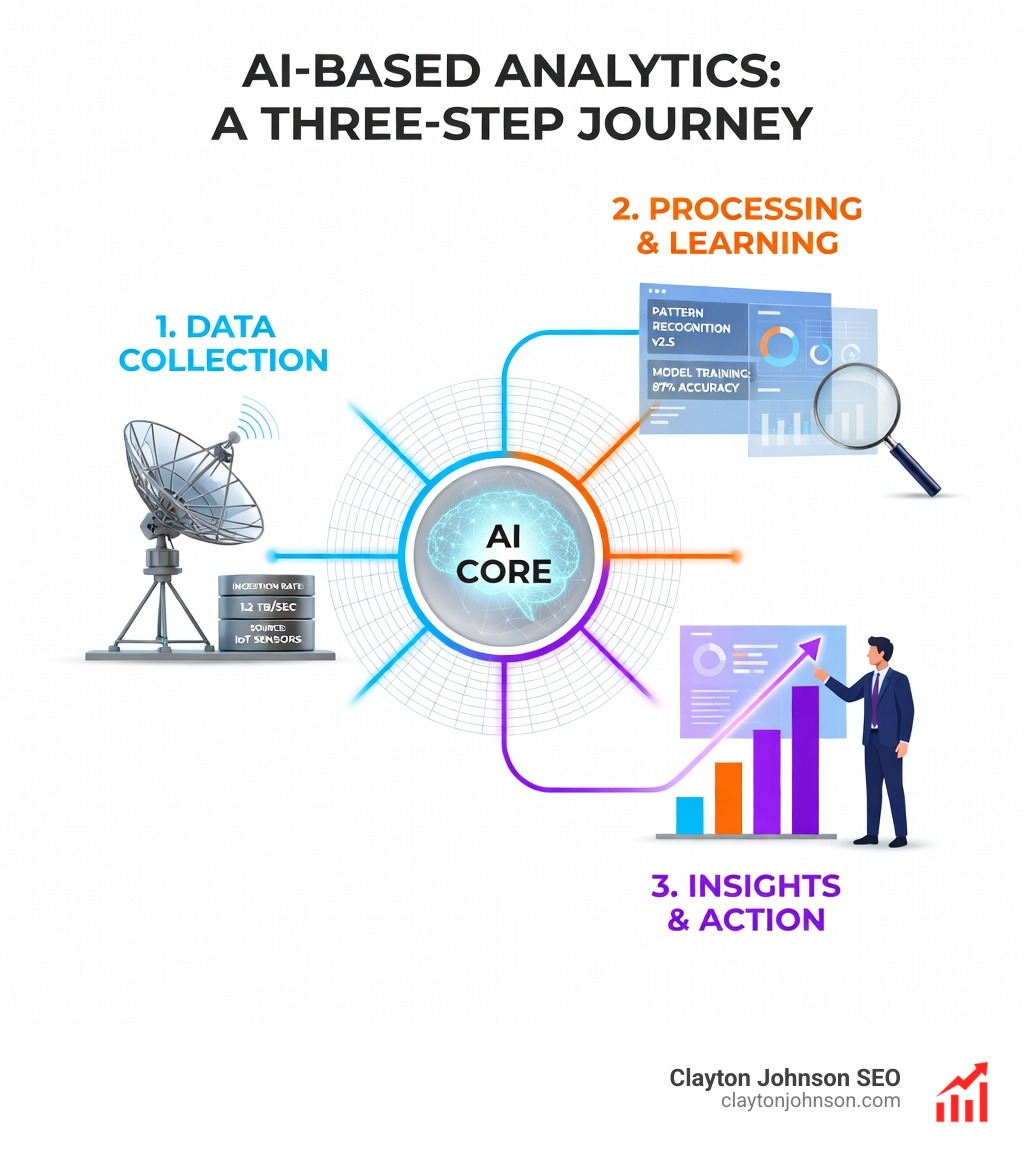
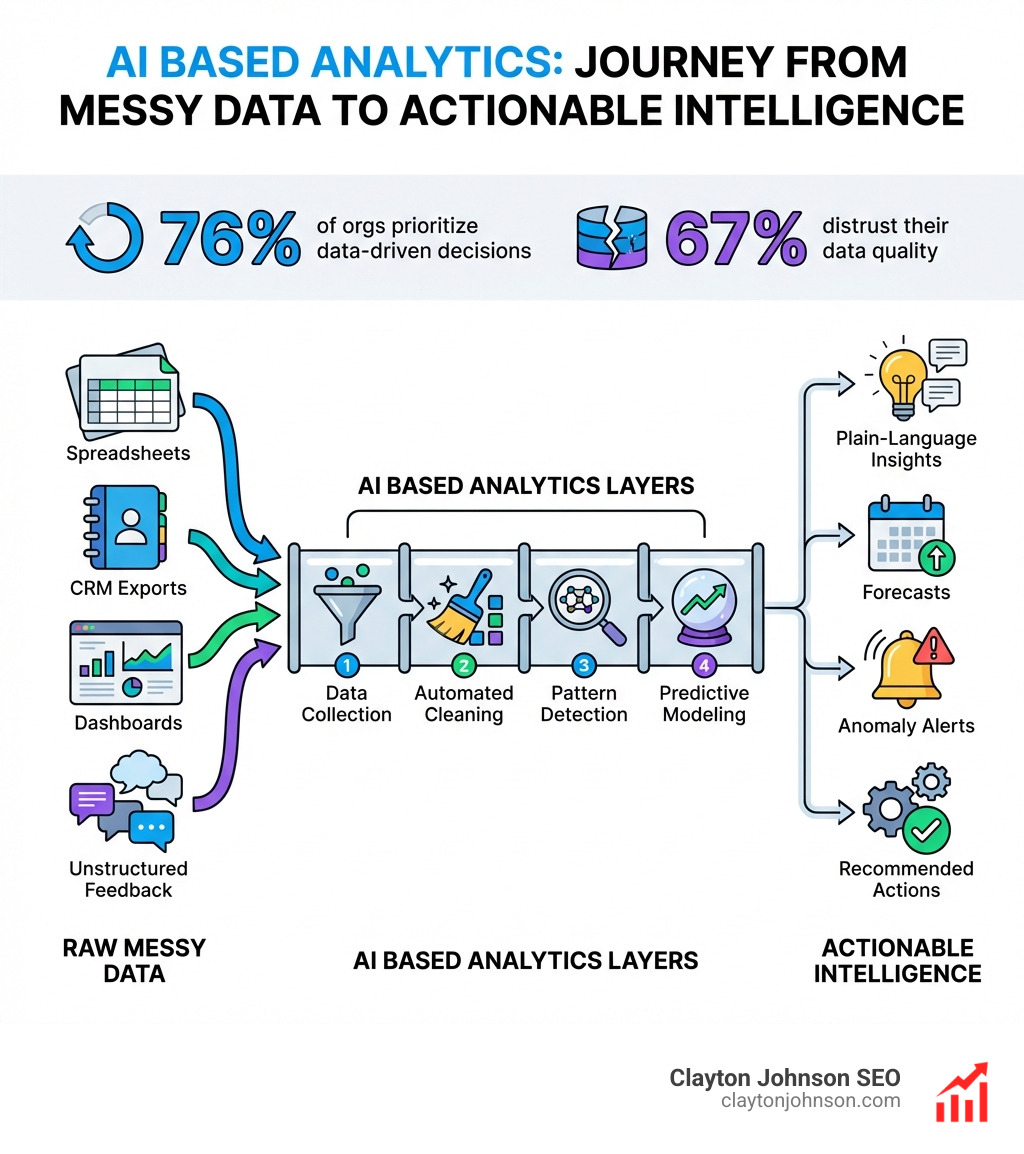
AI based analytics is the practice of using artificial intelligence — including machine learning, natural language processing, and deep learning — to automatically collect, clean, analyze, and surface insights from large or complex datasets, faster and more accurately than traditional methods.
Here’s what it does at a glance:
- Finds patterns humans would miss in large datasets
- Automates tedious data cleaning and preparation
- Predicts future outcomes based on historical trends
- Explains the why behind changes in your metrics
- Recommends actions — not just reports
- Answers questions in plain English, no SQL required
Data is everywhere. Clarity is not.
Most founders and marketing leaders aren’t short on data. They’re short on signal. You have dashboards, spreadsheets, CRM exports, and product analytics — but the picture they paint is fragmented, delayed, and hard to act on.
Traditional BI tools show you what happened. By the time the report is ready, the moment to act has passed.
That’s the core problem AI based analytics solves. It shifts you from reactive reporting to proactive intelligence — catching anomalies in real time, forecasting what’s coming, and telling you why a metric moved before you even think to ask.
The scale of this shift is significant. According to research, 76% of organizations cite data-driven decision-making as a priority — yet 67% don’t trust the quality of their own data. AI analytics addresses both sides of that gap: improving data integrity while making insights accessible to everyone on your team, not just analysts.
I’m Clayton Johnson, an SEO strategist and growth operator who works at the intersection of AI-assisted workflows, structured content systems, and measurable business outcomes — including how AI based analytics powers smarter marketing and operational decisions. The frameworks below are built from hands-on system design, not theory.
Ai based analytics terms explained:
Defining AI Analytics vs. Traditional Methods
To understand why ai based analytics is such a game-changer, we have to look at what we’ve been dealing with for the last two decades. Traditional Business Intelligence (BI) is like looking in a rearview mirror. It’s great for seeing where you’ve been, but it doesn’t help you steer around the pothole ten feet in front of you.
Traditional analytics relies on manual processing, static dashboards, and basic statistical methods like regression or hypothesis testing. If you want a new insight, you usually have to wait for an analyst to build a new report. This creates a “reactive” culture where decisions are made on data that is already days or weeks old.
In contrast, ai based analytics flips the script. It uses machine learning to proactively scan your data for “aha!” moments. Instead of you hunting for the insight, the insight finds you.
| Feature | Traditional BI | AI Based Analytics |
|---|---|---|
| Primary Goal | Reporting (What happened?) | Intelligence (Why & What’s next?) |
| User Effort | High (Manual queries/filters) | Low (Natural language/Automation) |
| Speed | Delayed (Batched processing) | Real-time (Streaming analysis) |
| Nature | Reactive & Static | Proactive & Dynamic |
| Data Types | Structured (Tables/SQL) | Multimodal (Text, Images, Audio, SQL) |
The urgency for this shift is backed by hard numbers. A Deloitte study found that 82 percent of surveyed companies expect a portion of their jobs to be fully automated within a few years due to AI. This isn’t just about replacing tasks; it’s about making data-driven decisions a core competency rather than a bottleneck.
The Core Pillars and Types of AI Based Analytics
If ai based analytics is the engine, these are the parts that make it run. Understanding these helps you see past the marketing hype and into the actual utility of the tools you’re using.
The Core Pillars of AI Based Analytics
There are five key technologies that power modern AI analytics:
- Natural Language Processing (NLP): This allows you to talk to your data. Instead of writing code, you ask, “Why did revenue dip in Minneapolis last Tuesday?” NLP interprets the intent and pulls the answer.
- Machine Learning (ML): These are the algorithms that learn from patterns. They get better at predicting outcomes—like customer churn or seasonal demand—the more data they digest.
- Neural Networks: Modeled after the human brain, these help recognize complex, non-linear patterns that traditional math might miss.
- Deep Learning: A subset of neural networks that uses layered algorithms to find patterns in abstract data, such as identifying a “frustrated” tone in customer support transcripts.
- Large Language Models (LLMs): These provide the “reasoning” layer. They can summarize thousands of customer reviews into three bullet points or turn a plain-English request into a complex SQL query.
From Descriptive to Agentic Analytics
Not all ai based analytics is created equal. We view the maturity of analytics across a spectrum:
- Descriptive Analytics: Tells you what happened (e.g., “Sales are up 10%”).
- Diagnostic Analytics: Tells you why it happened (e.g., “Sales are up because of a viral post in the Minneapolis market”).
- Predictive Insights: Tells you what might happen (e.g., “Based on current trends, you will stock out of this SKU in 14 days”).
- Prescriptive Actions: Tells you what you should do (e.g., “Reorder 500 units now to avoid a stockout”).
- Conversational Analytics: Making data human. You can ask questions in plain language and get instant, visual answers.
- Agentic Analytics: The future. This is where AI “agents” don’t just find the insight; they execute the fix. For example, an agent might notice an ad campaign is underperforming and automatically reallocate the budget to a higher-performing cluster.
Transforming Workflows and Industry Applications
The real magic happens when ai based analytics is woven into your daily marketing workflows. It transforms the entire data lifecycle.
- Collection & Preparation: AI can automate the “janitor work” of data. It identifies anomalies, fixes missing values, and standardizes labels across different platforms.
- Analysis: It performs “multi-step investigations.” If a metric changes, the AI automatically probes related variables (like price, weather, or competitor activity) to find the root cause.
- Visualization: Tools like ThoughtSpot SpotIQ automatically generate the right chart for the right data, so you don’t have to spend hours fiddling with axes and colors.
However, the foundation must be solid. As research from Drexel University points out, 67 percent of organizations lack trust in their data quality. This is why we focus so heavily on analytics and data services to ensure the “messy data” is cleaned before the AI tries to make sense of it.
Real-World Industry Use Cases
We see ai based analytics solving massive problems across various sectors:
- Healthcare: Predicting patient therapy abandonment or helping doctors prescribe more accurately based on historical patient data.
- Retail: SKU-level optimization. One major retailer achieved double-digit revenue growth by using AI to spot demand spikes at the individual product level.
- Finance: Real-time fraud detection. AI scans millions of transactions per second to flag unusual patterns that a human would never see.
- Manufacturing: Predictive maintenance. Sensors on equipment use AI to predict a failure before it happens, saving thousands of hours in downtime.
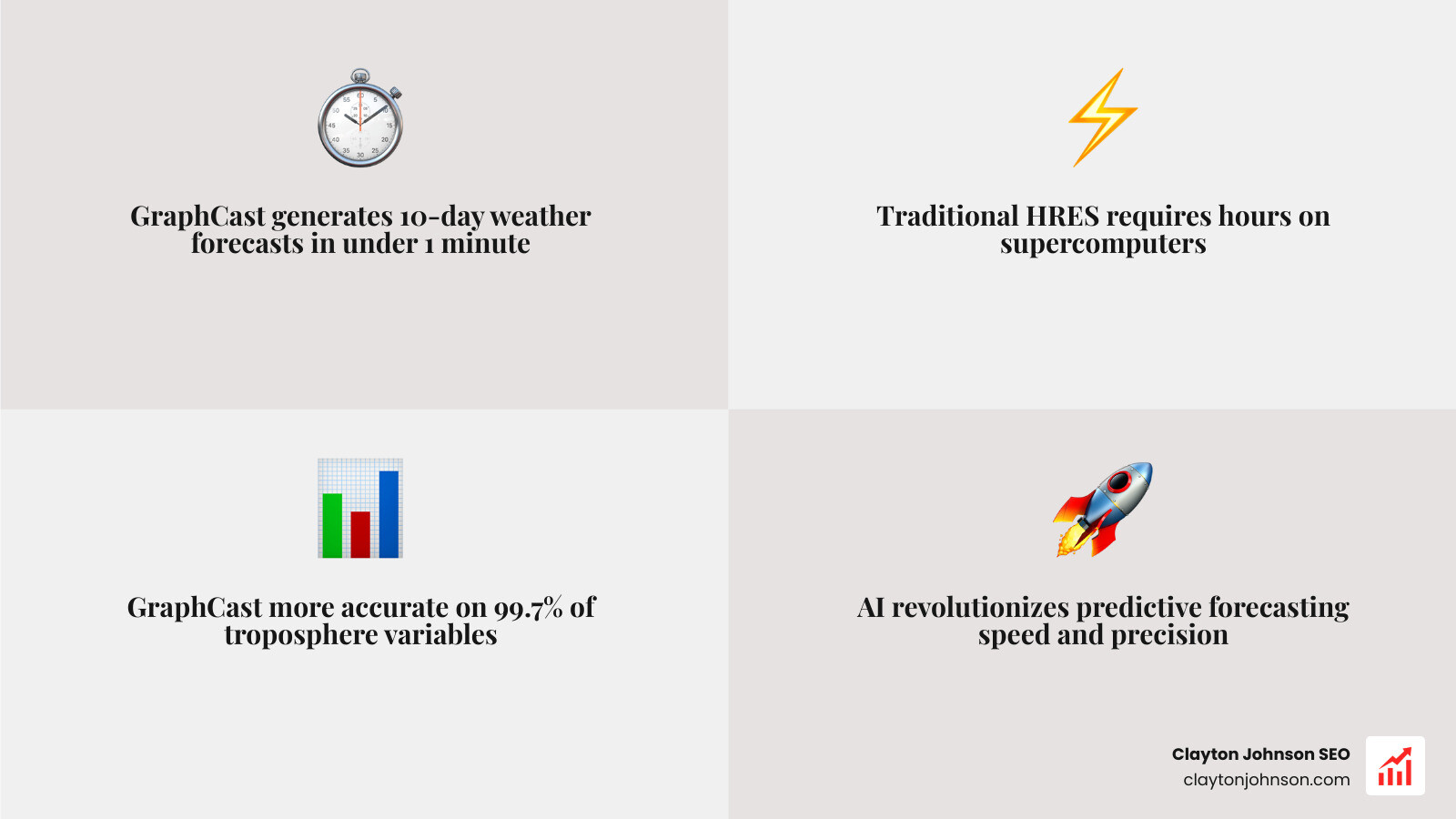
- Weather Forecasting: DeepMind’s GraphCast can produce a 10-day weather forecast in less than a minute on a single Google TPU. Compared to traditional methods that can require hours on specialized hardware, GraphCast has been reported to be more accurate on 99.7% of variables in the troposphere.
Implementing AI Based Analytics: Tools and Strategies
If you’re ready to move beyond spreadsheets, you need a stack that supports AI-augmented marketing.
Leading Platforms in the Space
- Snowflake Cortex AI: This allows you to run industry-leading LLMs (like Claude or Llama) directly “next to your data.” This is huge for security—your data never leaves the Snowflake perimeter. Companies have reported 334% faster processing for trillions of data points using Snowflake Cortex.
- Databricks AI/BI: A unified suite that combines predictive modeling with generative AI. It treats AI as an integrated capability of the data lake, not a bolt-on accessory.
- ThoughtSpot: Known for “Search & AI-Driven Analytics,” it allows non-technical users to query data as easily as using Google. Their Spotter agents can even write code or build visualizations on the fly.
Overcoming Challenges in AI Based Analytics Adoption
It’s not all sunshine and automated insights. Implementing ai based analytics comes with hurdles:
- Data Quality: Garbage in, garbage out. You need a unified data foundation first.
- Integration Silos: Your CRM needs to talk to your ERP and your marketing stack.
- Skill Gaps: Your team needs basic “AI fluency”—understanding how to validate AI results and ask the right questions.
- Governance: Ensuring that sensitive data is handled ethically and securely.
We recommend starting small. Pilot a high-value use case—like predicting customer churn or automating SEO reporting—to prove the ROI before scaling across the entire organization.
Frequently Asked Questions about AI Analytics
What is the difference between AI analytics and traditional BI?
Traditional BI is retrospective and manual; it tells you what happened in the past through static reports. AI based analytics is prospective and automated; it uses machine learning to predict future trends, explain the “why” behind metrics, and recommend specific actions in real-time.
Can AI analytics work with my existing data tools?
Yes. Most modern platforms like Snowflake or MindsDB are designed to sit on top of your existing data warehouses, CRMs, and ERPs. They act as an intelligence layer rather than requiring you to rip and replace your current infrastructure.
How does AI improve predictive accuracy in business?
AI uses algorithms like neural networks to process thousands of variables simultaneously. While a human might only look at “Price vs. Sales,” AI can look at “Price + Competitor Stock + Local Weather + Social Media Sentiment + Historical Seasonality” to provide a much more accurate forecast. For example, some companies have saved 4,000 hours of effort by using Gen AI to automate these complex correlations.
Conclusion
The transition to ai based analytics is no longer optional for companies that want to scale. When data volume is exploding, the human brain simply can’t keep up with the “messy” reality of modern business.
At Clayton Johnson, we believe that clarity leads to structure, and structure leads to leverage. This is the heart of Demandflow.ai—our growth operating system designed for founders who are tired of “tactic soup” and want a structured growth architecture.
By moving from reactive dashboards to proactive, AI-driven systems, you stop guessing and start compounding. Whether you are looking for AI-driven SEO audits or a complete overhaul of your AI infrastructure, the goal remains the same: transforming messy data into a competitive advantage.
Ready to see how AI can clean up your data mess? Let’s build your structured growth system today.