Why the Right AI Consulting Company Can Make or Break Your AI Investment
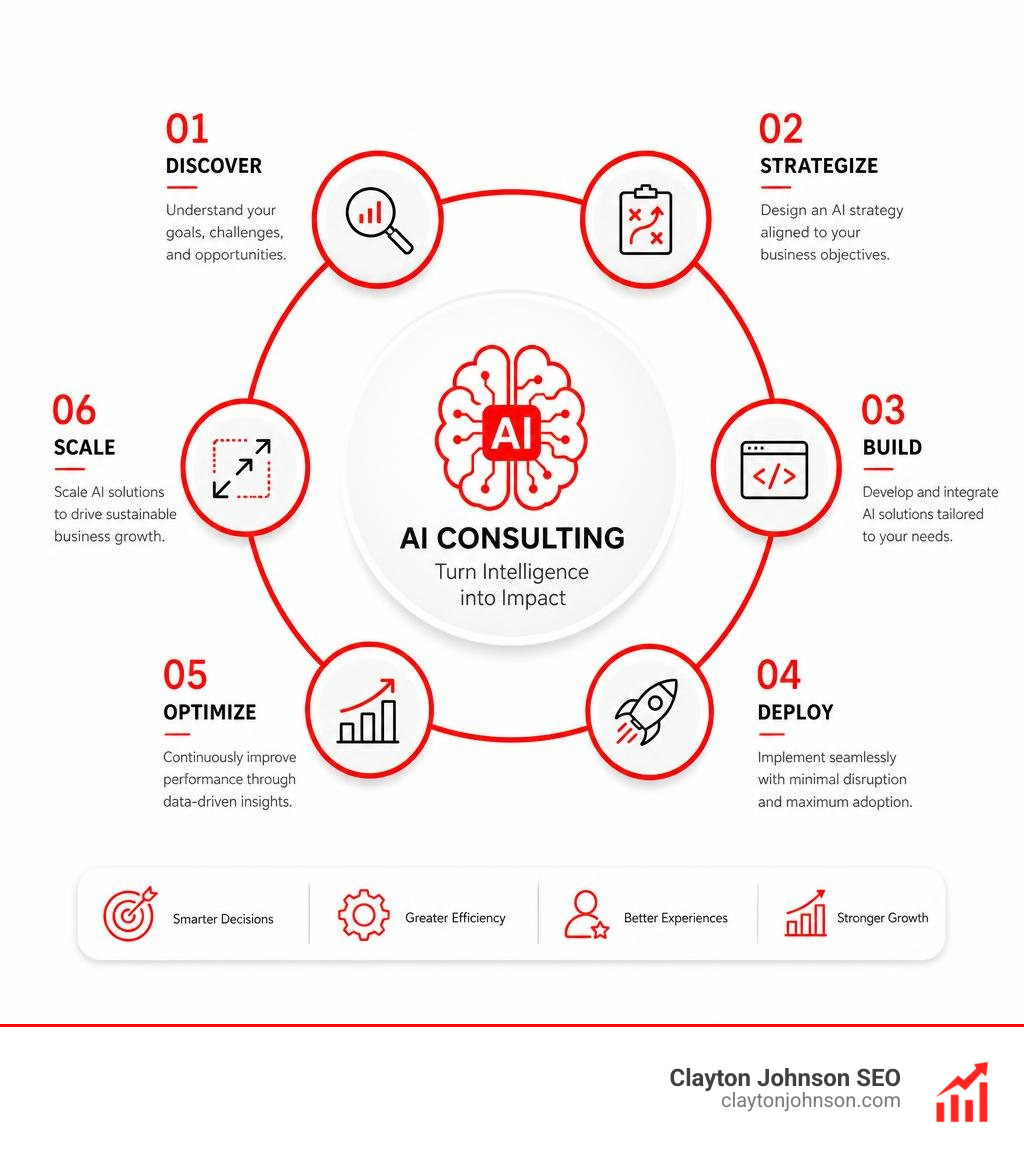
An ai consulting company helps businesses plan, build, and scale artificial intelligence solutions that deliver real results — not just flashy demos. If you’re trying to figure out what these firms do and whether you need one, here’s the short version:
What an AI consulting company does:
- Assesses your data, systems, and goals to find high-value AI opportunities
- Builds a roadmap from first pilot to full production deployment
- Implements custom AI solutions and integrates them with your existing tools
- Sets up governance, compliance, and security frameworks
- Trains your team and builds internal AI capabilities
AI is moving fast. According to research projections, AI could add $15 trillion to the global economy by 2030. Nearly every organization is already using AI in some form — but most are still struggling to move from small experiments to real, company-wide impact.
That gap between ambition and execution is exactly where AI consulting firms come in.
The challenge isn’t just technical. It’s strategic, organizational, and operational all at once. A good AI consulting partner helps you cut through the noise and focus on what actually moves the needle for your business.
I’m Clayton Johnson, founder of Clayton Johnson SEO, and I’ve spent years helping businesses navigate the intersection of technology, strategy, and search — including how ai consulting company decisions fit into broader digital growth plans. That perspective shapes everything in this guide.
What is an AI Consulting Company and How Does It Differ from Traditional IT?
To understand what an ai consulting company does, we have to look at how it differs from traditional IT or digital transformation consulting.
Traditional IT consulting is deterministic. It is built around predictable rules, structured databases, and fixed logic. You write a piece of software, tell it exactly what to do, and it executes that command the same way every single time. It is about building stable infrastructure, migrating databases to the cloud, and executing legacy modernization projects.
AI consulting, on the other hand, is probabilistic. It deals with systems that learn, adapt, and make predictions based on data. Because these systems are non-deterministic, they introduce unique forms of uncertainty. An AI consultant doesn’t just write code; they design systems that can reason, analyze unstructured data, and continuously optimize themselves.

This shift requires a concept called hybrid intelligence—the practice of combining advanced AI technology with human creativity, domain expertise, and strategic decision-making. Leading frameworks, such as those pioneered by McKinsey’s AI Consulting | Artificial Intelligence (QuantumBlack) | McKinsey & Company , emphasize that technology alone is never enough. True transformation happens when you modernize your legacy systems while simultaneously building the human workflows to support them.
If you want to dive deeper into how this looks in practice, check out The Non-Robotic Guide to Implementing AI in Business to understand the human-centric side of AI integration.
Core Services Offered by Enterprise AI Consultants
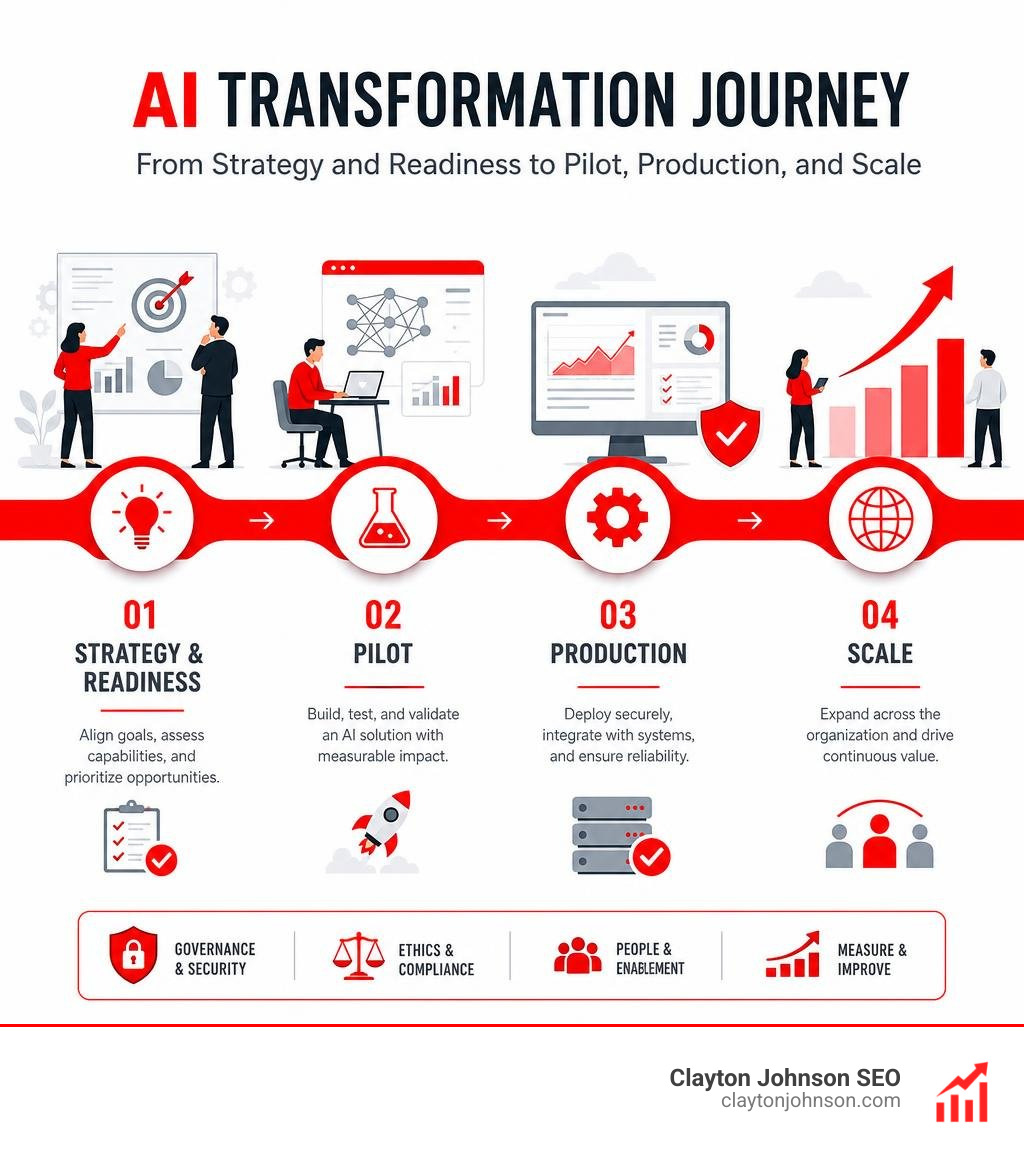
Enterprise AI consultancies offer end-to-end services designed to take organizations from initial curiosity to scaled, high-ROI operations. These services generally fall into four core pillars.
AI Strategy and Roadmapping
Before writing a single line of code, we must determine if your business is actually ready for AI. Consultants perform AI readiness assessments and opportunity mapping to identify where AI can deliver the highest return on investment.
We look at your data infrastructure, team skills, and operational bottlenecks. This step keeps you from spending money on technology that doesn’t solve a real business problem. As we often tell our clients, planning is everything—read more about this in AI Strategy 101: Don’t Just Buy It, Plan It and our comprehensive Enterprise AI Strategy 101.
Custom Implementation and Scaling to Production
Many businesses get stuck in “pilot purgatory”—they build a neat Proof of Concept (PoC) but struggle to deploy it across the entire enterprise. A specialized ai consulting company designs the custom solution architecture, selects the right models (whether open-source or private LLMs), and integrates them into your existing software stack.
They build the data pipelines, set up MLOps (Machine Learning Operations) for continuous monitoring, and ensure the system scales smoothly. To avoid common pitfalls during this phase, check out AI Implementation Best Practices: Don’t Let Your Bot Go Rogue and our strategic guide on Scaling AI: A Strategic Framework for Modern Organizations.
Data Governance and Responsible AI
AI is only as good as the data feeding it. AI consultants help establish robust data governance frameworks to ensure your data is clean, secure, and legally compliant. This includes setting up mechanisms for data privacy, bias detection, and explainability so you can defend your AI’s decisions.
Whether you must comply with GDPR, HIPAA, SOC 2, or the EU AI Act, specialized partners like AI Solutions & Consulting Services | Merceros – Custom AI Development help design compliant architectures that protect your intellectual property and keep your data secure.
Key Criteria for Choosing the Right AI Consulting Partner
With so many agencies claiming to be AI experts overnight, choosing the right partner can feel overwhelming. If you are wondering why you might need external help in the first place, our article on Why Your Business Needs an AI Workflow Consultant Right Now breaks down the operational benefits.
When you are ready to evaluate potential partners, keep these three areas in mind.
Key Criteria for Choosing the Right AI Consulting Company
Look for a partner who prioritizes co-creation and knowledge transfer. You do not want a consultant who builds a black-box system and leaves you dependent on them for every minor update.
The best firms, such as VEGAA AI — AI Consulting & Implementation | Charlotte, NC , focus on upskilling your internal team and building an AI Center of Excellence (CoE) so you can run and maintain the systems yourself. Evaluate them on their delivery speed, team expertise (look for senior ML engineers, not just generalist IT staff), and their structured approach to change management.
Evaluating the Track Record of an AI Consulting Company
Avoid firms that only talk about strategy without showing production-ready work. Ask for concrete case studies that demonstrate a high production deployment rate.
For example, London-based Atchai | AI Strategy & Engineering Consultancy, London uses a de-risked, sprint-based engineering methodology to quickly validate ideas and deploy secure, high-throughput document workflows. A proven track record of moving projects from pilot to production in weeks—not years—is the hallmark of a top-tier consultancy.
Assessing Technical Depth and Cloud Partnerships
Enterprise AI requires massive computing power and secure infrastructure. Your consulting partner should have deep expertise in major cloud platforms (AWS, Google Cloud, Microsoft Azure) and modern AI orchestrators. Look for firms with recognized cloud competencies.
These partnerships ensure they can design cost-effective data pipelines, leverage pre-built cloud AI services, and deploy your models securely within your existing virtual private cloud (VPC).
High-Value AI Use Cases Across Key Industries
AI is transforming business operations across every sector. To help visualize the impact, let’s look at some of the most common high-value use cases.
| Industry | High-Value AI Use Case | Primary Business Outcome |
|---|---|---|
| Financial Services | Fraud detection, AML/KYC automation, RM assistants | Reduced risk, faster compliance, doubled team capacity |
| Healthcare | Clinical trials optimization, patient intake automation | 10x lower trial costs, 68% reduction in onboarding times |
| Manufacturing | Predictive maintenance, supply chain S&OP | Minimized machine downtime, highly accurate forecasting |
| Retail | Dynamic pricing, real-time transaction analytics | Increased profit margins, hyper-personalized customer experiences |
Financial Services and Banking
In highly regulated financial environments, AI is being used to automate complex compliance checks, model credit risk, and detect fraud in real-time.
For instance, specialized AI consultancies have helped major global institutions like HSBC, Visa, and AXA integrate advanced machine learning models. In one notable deployment, a leading Asian bank implemented an AI assistant for relationship managers, which effectively doubled the team’s capacity by automating document retrieval and client reporting.
Healthcare and Life Sciences
In healthcare, speed and accuracy save lives. AI consulting firms help organizations optimize clinical trials by using predictive models to identify the best patient cohorts.
Organizations like Protas have successfully used AI technology to reduce clinical trial costs tenfold. Furthermore, automating clinical intake processes has helped multi-site health systems reduce patient onboarding times by up to 68%.
Retail and Manufacturing
For retail and manufacturing brands, the focus is on supply chain efficiency and real-time decision-making. Manufacturers use predictive maintenance models to analyze sensor data from machinery, predicting failures before they cause costly downtime.
In retail, giants like Toshiba Tec have partnered with AI consultants to turn massive amounts of transaction data into real-time inventory and pricing decisions using GPU-accelerated computing. Meanwhile, companies like Siemens have activated AI tools for over 30,000 software developers to supercharge internal productivity.
Emerging Trends Shaping AI Consulting in 2026
The landscape of artificial intelligence is shifting rapidly. In 2026, we are moving past simple chatbots and static search tools toward highly autonomous, adaptive systems.
Agentic AI and Multi-Agent Systems
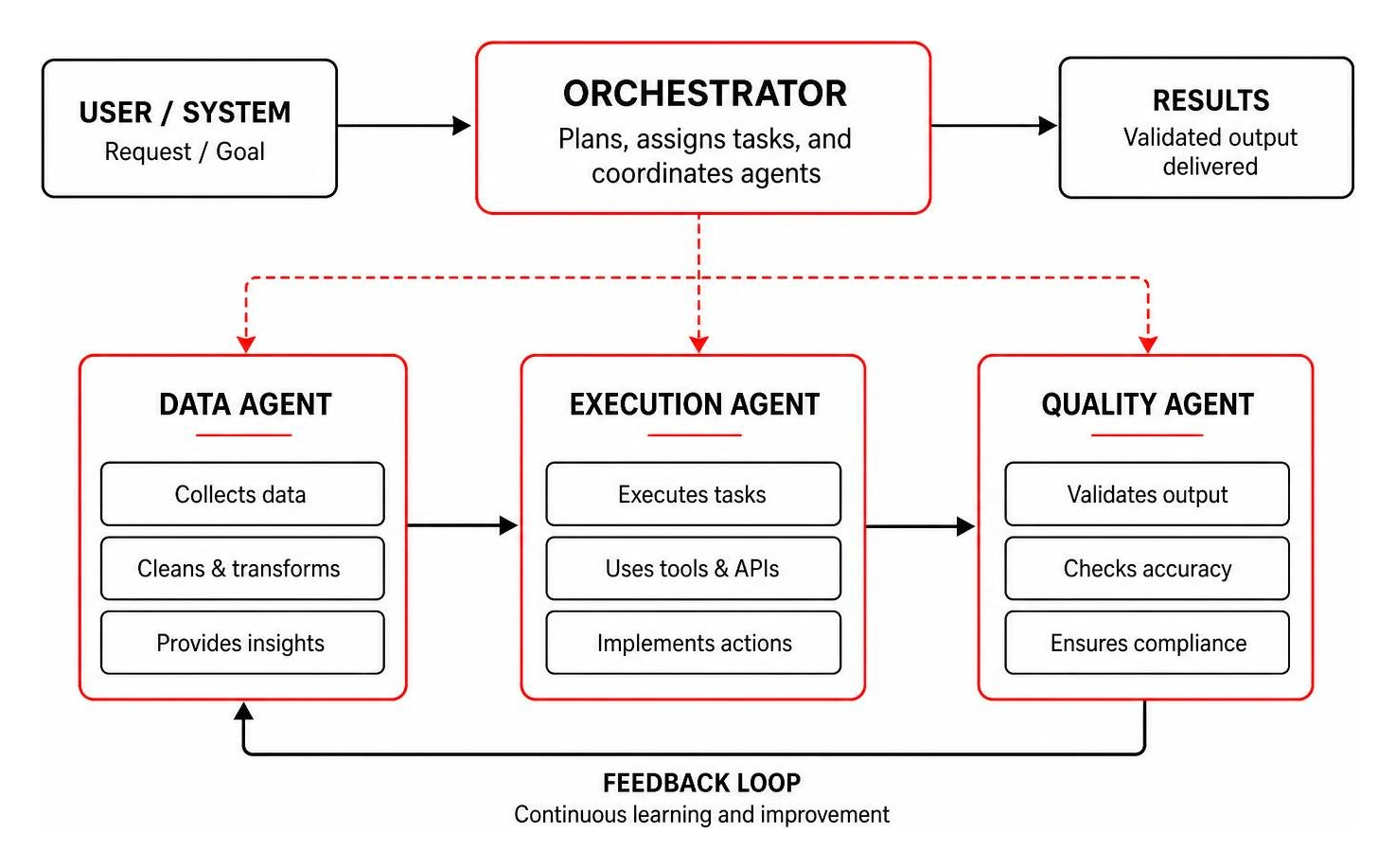
The biggest trend defining 2026 is the rise of agentic AI and multi-agent systems. Unlike traditional automation tools that follow rigid, step-by-step paths, AI agents can autonomously plan, use tools, and collaborate with other agents to execute complex, multi-step workflows.
Pioneering firms like floWolf | First AI-Native Company | It’s flowtime! are building next-generation IT architectures using “disposable fluid apps” and prompt-based interactions. If you want to see how these autonomous workflows can slash operational overhead, take a look at The Lazy Manager’s Guide to AI Workflow Automation Services.
AI-Native Operating Models
To fully capture the value of these advanced systems, organizations must transition to AI-native operating models. This means designing your business processes around what AI can do, rather than simply trying to plug AI into old, inefficient workflows.
It involves composable architectures, API-first integrations, and zero-UI design patterns. Leading advisory firms, such as Andrew Ng’s AI Aspire | AI Advisory by Andrew Ng & Kirsty Tan , help enterprises restructure their people, processes, and platforms to thrive in this new era. To explore why companies are making this shift, read our deep dive on The AI Business Revolution: Who Is Using It and Why.
Frequently Asked Questions about AI Consulting
What is the difference between AI consulting and traditional software development?
Traditional software development relies on deterministic logic—if you press button A, the software executes command B. AI consulting focuses on probabilistic systems. These systems analyze vast amounts of data to make predictions, recognize patterns, and learn over time. This requires specialized expertise in data engineering, model tuning, MLOps, and continuous optimization that traditional software developers typically do not possess.
How long does it take to deploy an enterprise AI solution?
While massive enterprise transformations can take many months, agile AI consultancies can often deploy a working, high-value Minimum Viable Product (MVP) to production in 8 to 12 weeks. This is achieved by using a phased roadmap: starting with a rapid 5-day design sprint, building and validating a prototype, and then scaling it with robust integration patterns.
How do AI consulting firms address data security and compliance?
Top-tier AI consulting firms implement “security-by-design.” They use end-to-end encryption, strict access controls, and data minimization techniques. They ensure that your proprietary business data is never used to train public models. Furthermore, they build compliance architectures that align with major frameworks like SOC 2, HIPAA, GDPR, and the EU AI Act.
Conclusion: Partnering for Long-Term AI Success
Investing in artificial intelligence is no longer about keeping up with a trend—it is about securing your company’s competitive advantage. But navigating model selection, data readiness, and responsible governance is incredibly complex. Partnering with a dedicated ai consulting company gives you the technical depth, industry experience, and strategic roadmap you need to turn your ambitious goals into measurable business outcomes.
At Clayton Johnson SEO, we help businesses map their target audiences, align their digital strategies, and build high-quality content that drives real organic growth. If you are ready to explore how custom AI solutions can streamline your operations and scale your business, read our complete guide on AI Services and Consulting From Sci-Fi Dreams to Scalable Realities to start planning your next move.