Essential Foundations of Python Programming Artificial Intelligence
Building intelligent software requires a firm understanding of core computer science primitives and data abstractions. Python programming artificial intelligence relies on standard language fundamentals combined with mathematical operations to transform raw data into predictive intelligence.
Core Syntax for Python Programming Artificial Intelligence
Before training neural networks or deploying agents, developers must master foundational Python elements. The basic primitives include variables, conditional branching (if-else), iterative loops (for, while), and modular functions. Exception handling using try-except blocks ensures scripts handle malformed data without crashing production pipelines.
Data structures serve as the building blocks for machine learning models:
- Lists and Tuples: Ordered collections used to store sequences of inputs or feature vectors.
- Dictionaries: Key-value pairs essential for handling unstructured data, JSON responses, and hyperparameter configurations.
- Sets: Unordered collections of unique elements used for deduplication and token filtering.
Object-Oriented Programming (OOP) allows developers to encapsulate model architectures, preprocessing pipelines, and custom agent states into clean classes. For a complete starting point, check out our guide on Python AI for Beginners.
Essential Python Libraries and AI Frameworks
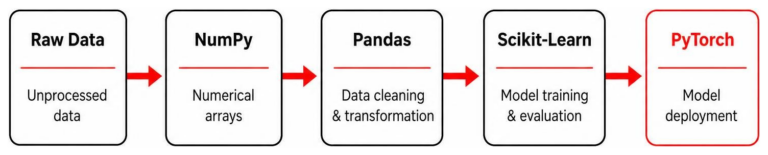
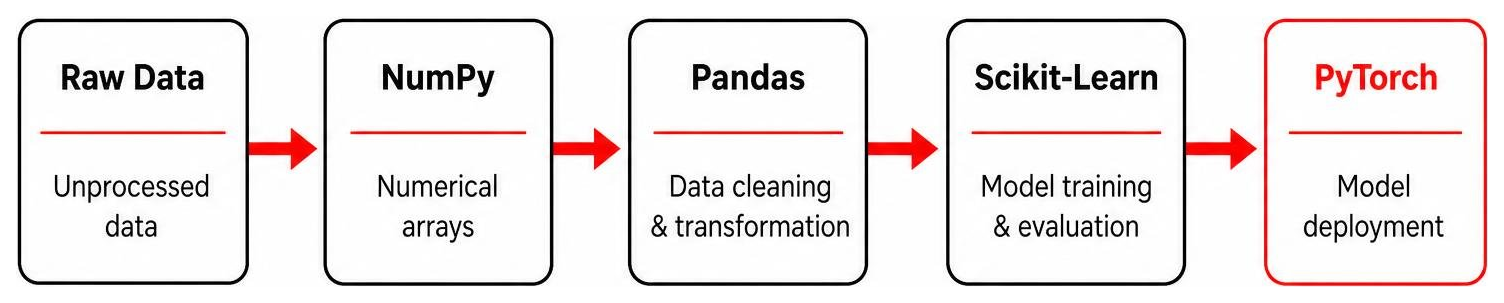
Python’s real superpower lies in its extensive ecosystem of specialized computational libraries. Standard Python collections lack the speed needed for matrix algebra, which is why optimized C-backed libraries form the foundation of AI development.
- NumPy: Provides multi-dimensional
ndarrayobjects for high-performance numerical operations. - Pandas: Introduced
SeriesandDataFramesfor structured tabular data manipulation, cleaning, and transformation. - Matplotlib & Seaborn: Standard visualization tools used to plot loss curves, feature distributions, and confusion matrices.
- Scikit-Learn: The go-to toolkit for classical machine learning, covering regression, classification, clustering, and feature selection.
- SciPy: Adds advanced scientific computing tools like optimization, signal processing, and numerical integration.
To learn more about selecting the right tool stack, read The Essential AI ML Tools Handbook.
| Framework / Library | Primary Purpose | Best Used For | Learning Curve |
|---|---|---|---|
| Scikit-Learn | Classical ML Algorithms | Regression, Random Forests, K-Means Clustering | Beginner-Friendly |
| PyTorch | Dynamic Deep Learning | Research, NLP, Computer Vision, Generative Models | Intermediate |
| TensorFlow | Production Deep Learning | Enterprise Deployment, Mobile AI, Embedded Systems | Intermediate / Advanced |
Integrating PyTorch, TensorFlow, and Keras
Deep learning architectures rely on tensor mathematical graphs executed across specialized hardware. Frameworks like PyTorch and TensorFlow streamline complex calculus, calculating gradients automatically through reverse-mode automatic differentiation.
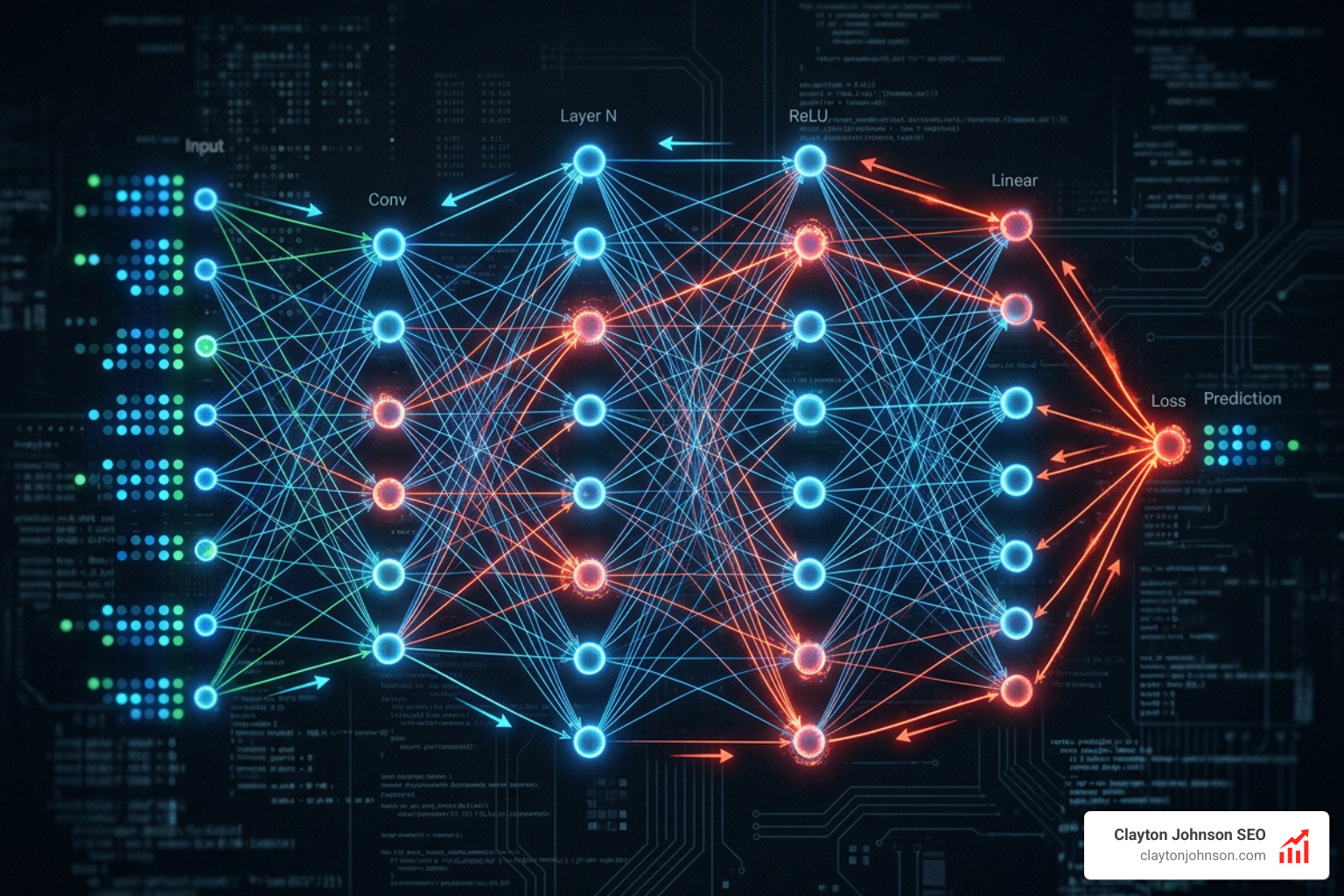
During model training, algorithms perform forward passes to evaluate inputs against loss functions, followed by backpropagation to calculate optimization gradients. These computational tasks require hardware acceleration, utilizing CUDA-enabled GPUs or Apple Silicon Neural Engines to achieve massive parallel speedups. Keras acts as a high-level abstraction API, simplifying neural network design on top of TensorFlow or PyTorch backends.
Learning Python for AI: Roadmap, Best Practices, and Resources
Mastering AI programming requires balancing theoretical mathematical understanding with practical coding practice.
Recommended Learning Resources and Pathways
Beginners benefit from structured pathways that emphasize hands-on coding over passive reading. Standard tools like interactive Jupyter Notebooks and package management platforms like Anaconda eliminate setup hurdles, allowing developers to execute code directly in their browser.
Top learning resources include:
- DeepLearning.AI: Hands-on courses taught by Andrew Ng covering AI fundamentals, prompt engineering, and deep learning architectures.
- Udacity Nanodegrees: Project-centered learning paths focusing on practical PyTorch applications and data analysis pipelines.
- AIPython Textbook Code: Clean, educational open-source scripts provided by the AIPython Textbook Code project, matching pseudocode algorithms step-by-step.
For step-by-step guidance, follow Your Roadmap to Learning Artificial Intelligence.
Writing Efficient and Maintainable Python Code for AI
Messy code leads to silent data bugs and high compute costs. Adopting production software engineering standards is critical for scalable AI projects:
- Leverage Type Hints: Use Python’s
typingmodule to define explicit parameter inputs and return types, catching bugs prior to execution. - Modularize Code into Reusable Functions: Refactor monolithic scripts into isolated functions and custom local modules.
- Use Vectorized Operations: Avoid slow standard
forloops by using native vectorization in NumPy and Pandas. - Implement Design Patterns: Separate data loading pipelines from model architecture and training loops.
For handy reference guides, see our Cheat Sheet to Artificial Intelligence Python Code Examples.
Real-World Applications and AI Model Deployment
Python AI applications bridge raw enterprise datasets with intelligent automation.
Data Analysis, NLP, and Computer Vision Applications
Python excels at processing unstructured input channels like free-form text, images, video streams, and web content.
- Data Manipulation & Scraping: Tools like BeautifulSoup and Requests fetch web data, while Pandas structures raw HTML into clean training tables.
- Natural Language Processing (NLP): Transformer architectures process text sequences to perform sentiment analysis, summarization, and named entity extraction.
- Computer Vision (CV): Convolutional neural networks and vision transformers analyze visual frames for object recognition and automated quality inspections.
To understand how models ingest data, read The Secret Sauce of How AI Analyzes Complex Data Sets.
Deploying Python AI Models in Real-World Production
Building a accurate model is only half the battle; serving predictions reliably at scale requires modern web infrastructure.

Modern deployment strategies rely on asynchronous web frameworks like FastAPI to expose model inference endpoints. Packaging applications inside Docker containers guarantees environment consistency across local development and cloud infrastructure like AWS, Google Cloud Vertex AI, or Azure ML. Continuous observability stacks track data drift, token usage, and inference latency in production environments.
Advanced Agentic and Neuro-Symbolic AI Frameworks in Python
As AI shifts from passive text generation to active automation, Python developers leverage framework abstractions to build autonomous systems.
Structured Agents with Pydantic AI, ADK, and DSPy
Traditional prompt engineering can be brittle. Modern workflows replace raw prompt strings with programmatic typed structures and compiled agent pipelines.

- pydantic/pydantic-ai: Brings standard Pydantic validation and dependency injection to GenAI, providing type-safe tool calling and structured output guarantees.
- DSPy Framework: Stanford’s open-source library that replaces manual prompts with declarative Signatures, compiling and optimizing prompt modules against specific quality evaluation metrics.
- Google Agent Development Kit: A code-first framework designed for building multi-agent graph workflows, multi-turn task execution, and local debugging.
Neuro-Symbolic AI with SymbolicAI
Generative models rely on probabilities, which can occasionally lead to output hallucinations. Neuro-symbolic frameworks combine non-deterministic language models with traditional deterministic logic.
The SymbolicAI Repository uses Python’s native operator overloading (+, ==, &) to execute syntactic code and conceptual semantic operations seamlessly. By applying Design by Contract paradigms (@contract), SymbolicAI enforces output validation, retries, and automatic error resolution before returning data to the application core.
Overcoming Common Challenges in Python AI Development
| Challenge | Cause | Resolution Strategy |
|---|---|---|
| GPU Out-of-Memory (OOM) | Large model weight sizes and large context window batches | Apply gradient accumulation, mixed-precision training (FP16), or quantization (INT8/INT4). |
| Model Hallucinations | Unbounded probabilistic decoding | Enforce structured output validation using Pydantic schemas and neuro-symbolic contracts. |
| Dependency Conflicts | Fast ecosystem updates and breaking package changes | Use strict constraint files and environment isolation tools like uv or Conda. |
| High Inference Latency | Sequential unoptimized API calls and slow loops | Implement asynchronous call batches, compile prompts via DSPy, and host models on optimized vLLM runtimes. |
Future Trends in Python Programming Artificial Intelligence
The Python AI landscape continues to evolve rapidly. Developer workflows are shifting away from manual prompt crafting toward compiled prompts, automated zero-shot reasoning loops, and multimodal native agent systems. These optimizations allow autonomous Python agents to perform complex, continuous reasoning tasks while keeping execution costs low.
Frequently Asked Questions About Python Programming Artificial Intelligence
Who is this Python AI guide designed for?
This guide is designed for complete beginners, non-technical professionals, data analysts, and experienced software engineers who want to learn python programming artificial intelligence. Prior programming knowledge helps, but beginner-friendly resources make starting accessible for anyone.
Which Python libraries are required to build AI applications?
Core requirements depend on your project scope:
- Data Science & ML: NumPy, Pandas, Scikit-Learn.
- Deep Learning: PyTorch or TensorFlow.
- Generative AI & Agents: Pydantic AI, DSPy, or SymbolicAI.
How do modern AI agent frameworks enhance Python development?
Modern frameworks replace raw text prompts with type-safe Python code. They bring developer tools like static type checking, automated prompt compilation, structured output validation, and native tool orchestration to generative AI applications.
Conclusion
Python remains the world’s most versatile language for artificial intelligence. By combining readable language syntax with dynamic libraries, modern agent frameworks, and neuro-symbolic validation logic, Python enables developers to turn ambitious AI ideas into stable production software.
Whether you are automating simple workflows or engineering autonomous multi-agent networks, mastering python programming artificial intelligence is a high-value skill set for the future.
Ready to scale your technical presence and reach target developer audiences online? Discover how our search strategies can elevate your organization by visiting our AI Coding Pillar Page.