Buyer Persona vs. Target Audience vs. Ideal Customer Profile: What’s the Difference?
In customer strategy, terms like “Buyer Persona,” “Target Audience,” and “Ideal Customer Profile (ICP)” are often tossed around interchangeably. This confusion is more than just a semantic headache—it can actively derail your campaigns. When teams don’t share a unified definition of who they are trying to reach, execution fragments, budgets bleed, and messaging becomes a generic soup that appeals to no one.
To get everyone on the same page, we need to understand that these three concepts are not competing frameworks. Instead, they represent a nested, three-step strategic workflow.
Think of it this way:
- Your ICP determines which accounts or businesses are the right fit.
- Your Target Audience determines the reach of your campaigns.
- Your Buyer Persona determines the actual resonance of your messaging.
Here is a quick breakdown of how these terms compare across key strategic parameters:
| Feature | Ideal Customer Profile (ICP) | Target Audience | Buyer Persona / Target Audience Persona |
|---|---|---|---|
| Focus Level | Account / Company Level | Market Segment Level | Individual / Human Level |
| Primary Criteria | Firmographics (revenue, size, industry, tech stack) | Broad demographics & general intent | Psychographics, daily challenges, personal motivations |
| Core Question | Which companies will get the highest ROI from us? | Which group of people should we show our ads to? | What specific problem keeps this individual up at night? |
| Primary Use Case | Sales prospecting, account-based marketing (ABM) | Media buying, channel selection, broad ad campaigns | Content creation, copywriting, product design, SEO mapping |
Understanding these distinctions is the first step toward building a highly targeted customer strategy. If you want to dive deeper into how to map your market segments and find your sweet spot, check out our comprehensive guide on how to determine your target market and audience.
What is a Target Audience Persona?
A target audience persona (often referred to interchangeably with a buyer persona) is a highly detailed, qualitative representation of an individual within your target market. While a target market segment might tell you that your audience consists of “B2B marketing managers aged 30–45 in North America,” a persona zooms in on “Marketing Manager Mike.”
A true persona goes far beyond basic demographic data to capture the psychological and behavioral realities of your customers. It maps out their daily workflows, their career ambitions, their deepest professional fears, and the specific triggers that prompt them to seek out a solution.
By humanizing your data, you stop writing copy for search engine bots or faceless corporations, and you start writing for real people. Designing marketing assets without this qualitative foundation is like building a product with zero user research—you might ship something, but you won’t know if it actually solves a real-world problem. For a deeper look at why this qualitative shift is so critical, read our guide on Why Your Business Needs Better Personas and How to Build Them.
The Role of ICPs and Personas in B2B and B2C Strategy
The way you balance your ICPs and personas depends heavily on your business model.
In B2B marketing, the buyer of your product and the actual end user are frequently two entirely different people. For example, if you sell enterprise project management software, the person signing the check might be a Chief Technology Officer (CTO) or a VP of Finance (the buyers). However, the people using the tool every single day will be project managers and software engineers (the end users).
If you only market to the buyer, your end users will hate the software, leading to poor adoption and high churn. If you only market to the end user, you’ll never get past the procurement department. This is why B2B companies must map out both buyer personas and user personas. The buyer persona guides your sales pitches, ROI calculators, and business value messaging, while the user persona guides your product design, onboarding flows, and help center documentation.
In B2C marketing, the buyer and the user are usually the same person, meaning the customer journey is more direct. Here, personas focus heavily on lifestyle, personal values, subcultures, and emotional triggers.
Whether you are B2B or B2C, ignoring the distinction between who purchases and who uses your product is a recipe for friction. To learn more about tailoring experiences for the actual people interacting with your digital assets, explore our resource on Yes, You Need a UX Persona. Here’s Why & How to Create One.
Why a Target Audience Persona is Critical for Marketing and Content Strategy

If you try to speak to everyone, you end up speaking to no one. In digital marketing, casting too wide of a net is the primary driver of unqualified leads, wasted ad spend, and high bounce rates.
When you build and operationalize a clear target audience persona, your entire marketing engine becomes dramatically more efficient. The statistics speak for themselves:
- Users who engage with tailored, personalized digital experiences read 3.9 times more pages than those navigating generic, non-personalized sites.
- Fast-growing companies generate 40% more revenue from personalized marketing efforts than their slower-moving competitors.
- A small, highly focused set of three to four personas typically accounts for over 90% of a company’s sales. You don’t need to target every minor niche—you just need to super-serve your core segments.
Furthermore, building deep personas is becoming a critical competitive advantage for Generative Engine Optimization (GEO) and AI-driven search. As AI search agents and LLMs increasingly synthesize answers for users, they build those answers around the specific identity and context provided in the user’s prompt. When your content is meticulously optimized to address the highly specific, contextual pain points of a defined persona, AI tools are far more likely to pull your content as the definitive source.
If you want to write content that stands out in the age of AI and search disruption, you must learn to move beyond flat, demographic-only profiles. Discover our proven framework in How I Build Audience Personas That Make Content Impossible to Ignore.
Aligning Search Intent with Your Target Audience Persona
One of the biggest mistakes in search engine optimization is treating keyword research and persona development as two separate tasks. Keywords are often linked broadly to your target audience, but the actual content you create to target those keywords must be tailored to a specific persona’s search intent.
Every search query represents a question. To answer it effectively, you must understand who is asking and why. For instance, a search for “local SEO tips” could be typed by:
- A freelance web designer looking to upsell their clients.
- A busy local business owner trying to get more calls from Google on a tight budget.
The search term is identical, but the ideal content for each searcher is completely different. The freelance designer wants technical checklists and white-label reporting tools. The local business owner wants simple, jargon-free steps they can complete in 15 minutes between customer appointments.
By mapping your keyword strategy directly to your target personas, you can target high-intent, long-tail keywords that attract qualified buyers rather than empty traffic. To master this alignment, check out The Ultimate Guide to Mastering Search Intent Targeting.
Improving Messaging and Campaign Targeting
A completed persona shouldn’t sit in an unopened PDF document. Its primary purpose is to help you build a highly functional message hierarchy.
A message hierarchy takes your persona’s core challenges and maps them directly to your brand’s value propositions, supporting proof points, and specific calls to action. This ensures that your brand voice remains consistent across all touchpoints, from social media ads to sales enablement decks.
Once your messaging is aligned with your personas, you can run highly effective A/B tests to validate your assumptions. Rather than testing random button colors, you can test entirely different value propositions to see which pain points resonate most deeply with your target segments. To learn more about using segmentation to drive real product and marketing insights, read our analysis on Customer Strategy Customer Segmentation Product Insight.
Key Components of a High-Performing Persona

A high-performing target audience persona needs to feel like a real human being. If your persona profile is just a list of dry statistics, your team won’t use it. To make your personas actionable, we recommend structuring them in a layered framework, starting with surface-level demographics and moving deeper into psychology and behavior.
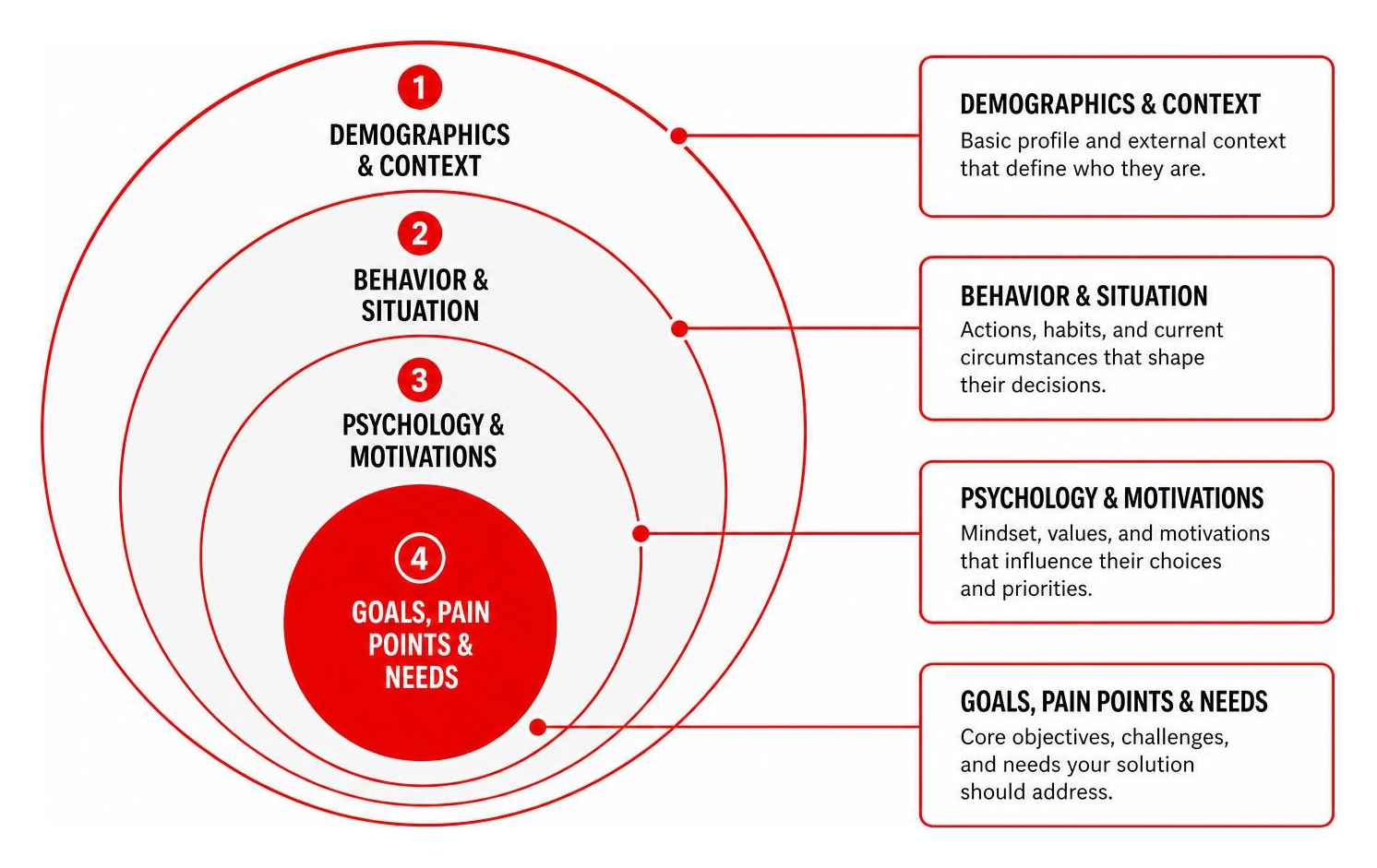
Demographics and Context
This is the outer layer of your persona. It provides the basic demographic outline that helps you set up targeting parameters in ad networks and CRM tools:
- Age and Gender: Helps set the tone and cultural references of your copy.
- Geographic Location: Critical for local businesses or companies with region-specific pricing and logistics.
- Job Title and Industry: Helps determine their professional context and daily responsibilities.
- Income or Budget Range: Ensures your offer is financially realistic for them.
Psychographics, Goals, and Challenges
This is the inner layer, and it is by far the most valuable part of your persona. Psychographics explain why your customers make decisions:
- Core Goals: What does success look like for them? Are they motivated by career advancement, saving time, reducing business risk, or achieving social status?
- Primary Pain Points: What is their single biggest frustration? What is keeping them from achieving their goals?
- Key Objections: Why would they say “no” to your offer? Is it price, lack of time, onboarding friction, or trust issues?
- Buying Triggers: What is the specific event that forces them to look for a solution right now? (e.g., a bad audit, a lost client, or a broken tool).
Uncovering these deep psychological drivers is the secret to creating copy that resonates on an emotional level. To understand how to identify and resolve these friction points throughout your marketing funnel, explore our guide on Customer Journey Pain Points.
For a complete, downloadable template that walks you through mapping these key components step-by-step, check out the Audience Personas – Guide & Template | Mutomorro.
How to Research and Build Your Personas: A Step-by-Step Process

The biggest risk in persona development is building “imaginary” personas based on internal guesswork and assumptions. An assumption-based persona is actually worse than having no persona at all, because it gives your team false confidence while steering your marketing strategy toward a customer that does not exist.
To build accurate, high-performing personas, you must ground your profiles in real evidence and actual customer data. If you are a startup or small business looking to map your audience systematically without getting overwhelmed, read our step-by-step guide on How to Map Your Startup Audience Without Losing Your Mind.
Here is our proven four-step process for building research-backed personas.
Step 1: Gather Quantitative and Qualitative Data
Begin by collecting data from both quantitative and qualitative sources to get a holistic view of your audience:
- Quantitative Data: Analyze your website traffic in Google Analytics, study demographic trends in your CRM, and run broad customer surveys to find statistical patterns.
- Qualitative Data: Conduct one-on-one interviews with 5 to 10 actual customers. Ask them about their daily routines, their biggest frustrations, and how they discovered your business. Focus on their past buying actions rather than hypothetical future scenarios.
To audit your current audience data and find gaps in your research, use our structured template: Audit Your Audience Like a Pro With This Template.
Step 2: Identify Patterns and Segment Your Audience
Once you have gathered your research, look for recurring trends. Group your customers based on shared behaviors, goals, and pain points rather than just demographics.
For example, you might find that you serve two distinct groups: one that values speed and convenience above all else, and another that is highly price-sensitive and willing to invest more time. To help organize this data, you can leverage our 10 Free Sales Customer Segmentation Templates for Every Industry.
Step 3: Determine the Number of Personas to Create
Most small-to-mid-sized businesses only need two to four distinct personas to cover the vast majority of their customer base.
Trying to target five or more personas risks diluting your marketing efforts and overcomplicating your strategy. Identify your primary persona (the customer segment that generates the highest revenue and is the easiest to serve) and focus 80% of your energy there. Use secondary personas to guide minor campaigns or product variations.
Step 4: Draft the Persona Narrative
Now, bring your data to life by writing a one-page narrative for each persona.
- Give them a realistic, fictional name (e.g., “Startup Founder Sam”).
- Add a representative stock photo so your team can visualize a real person.
- Include verbatim quotes from your customer interviews to capture their exact voice and terminology.
- Clearly define their goals, pain points, preferred channels, and buying triggers.
For a detailed walkthrough of this narrative process, see Target Audience Personas: What They Are and How to Create Them.
Practical Examples of Well-Developed Personas
To see how these concepts translate into real-world marketing assets, let’s look at two practical examples of well-developed personas.
For a complete library of real-world profiles, you can explore our detailed Buyer Persona Example Marketing Manager Mike template.
B2B Persona Example: Startup Founder Sam
- Fictional Profile: Sam is 34, lives in Austin, TX, and recently raised a seed round for his B2B SaaS platform.
- Daily Context: Sam wears five different hats. He is managing product development, hiring his first sales rep, and trying to figure out marketing. He is overwhelmed and has very little free time.
- Core Goals: Scale monthly recurring revenue (MRR) to hit Series A funding milestones; automate lead generation so he can focus on product strategy.
- Primary Pain Points: Knowledge workers spend three hours on admin and meetings for every hour of strategic work—and Sam is living this statistic. He is bogged down in manual outreach and has no predictable channel for organic traffic.
- Key Objections: “SEO takes too long to show results, and we need leads today.” Or, “I don’t have the budget to hire a full-time, in-house SEO specialist.”
- Our Strategic Angle: We speak directly to Sam’s need for efficiency by offering done-for-you, predictable SEO blueprints that require minimal oversight from him.
To read Sam’s full, comprehensive profile, check out Buyer Persona Example Startup Founder Sam.
B2C Persona Example: Local Business Owner Laura
- Fictional Profile: Laura is 48, owns an upscale local boutique and home decor shop, and is highly active in her local business alliance.
- Daily Context: Laura loves curation and customer service, but she dreads the digital side of her business. She knows she needs to rank on Google, but she finds search engine optimization confusing and full of technical jargon.
- Core Goals: Increase foot traffic to her physical storefront; build a loyal community of local shoppers who choose her boutique over big-box online retailers.
- Primary Pain Points: Laura feels frustrated by irrelevant, high-budget digital marketing tactics that don’t apply to a local shop. She wants simple, actionable local SEO strategies that actually drive neighborhood foot traffic.
- Key Objections: “I’ve been burned by digital agencies in the past who promised the world but didn’t understand our local community.”
- Our Strategic Angle: We use warm, jargon-free communication and focus entirely on local visibility, showing Laura how simple Google Map optimizations can directly increase weekend foot traffic to her shop.
To see how we tailor our local search strategies for Laura’s specific needs, explore Buyer Persona Example Local Business Owner Laura.
Common Mistakes and Risks in Persona Development
Even with the best intentions, many businesses make critical errors when building and using personas. Here are the most common pitfalls to watch out for:
- Building “Imaginary” Personas: Relying on internal brainstorms rather than real customer conversations. If you don’t speak directly to your audience, your persona is just creative writing.
- Stopping at Basic Demographics: Knowing your customer is a “35-year-old male in Chicago” doesn’t help you write compelling copy. You must dig into their psychographics, fears, and buying triggers.
- Letting Personas Gather Dust: A persona that sits in an unopened strategy slide deck is useless. You must actively integrate your personas into your daily marketing workflows, creative briefs, and content calendars.
- Ignoring Persona Drift: Human behavior and market dynamics change. A persona built in 2024 may no longer be accurate in July 2026. If you don’t review your profiles regularly, your messaging will slowly lose relevance.
To learn how to predict your customers’ changing behaviors and keep your strategies aligned with real-world shifts, read our deep dive on Why Your Customers Do What They Do and How to Predict It.
Frequently Asked Questions about Target Audience Personas
How often should you update your target audience personas?
We recommend reviewing your personas every 90 days (quarterly) to check for “persona drift” against fresh customer feedback, support tickets, and sales data. You should conduct a formal, data-driven update at least once a year to ensure your profiles reflect current market trends and product evolutions.
What is the difference between a target audience and a target persona?
A target audience is a broad, quantitative segment of your market (e.g., “mid-sized B2B agencies searching for collaboration tools”). A target persona is a highly specific, qualitative representation of a single individual within that audience, complete with a name, photo, psychographics, and exact quotes (e.g., “Efficient Emily, a project manager struggling with status meetings”).
What is a negative or inverted persona?
A negative (or inverted) persona is a semi-fictional profile of a customer segment you actively want to avoid targeting. Defining who is a bad fit for your brand—such as low-budget tire-kickers, customers with high churn rates, or users who require excessive support—is often the fastest way to bring your actual target audience into sharp focus, saving you thousands of dollars in wasted ad spend.
Conclusion
At the end of the day, marketing isn’t about search engine algorithms, faceless corporations, or demographic buckets. It’s about human connection.
Building a highly accurate, research-backed target audience persona is the single most powerful step you can take to move past marketing guesswork and start building real relationships that drive revenue. When you know exactly who you are selling to, your messaging clarifies, your campaigns convert, and your budget goes further.
At Clayton Johnson SEO, we specialize in helping businesses map their target audiences, align their search intent, and build content strategies that turn qualified search traffic into loyal customers. If you are ready to align your sales, marketing, and product teams around a shared, data-driven understanding of your ideal customer, explore our comprehensive Customer Strategy Buyer Personas resources today. Let’s stop guessing and start growing together.