Why Most Businesses Get SEO Wrong Before They Even Start
An audience mapping SEO strategy is one of the most important things you can do to grow organic traffic — yet most small businesses skip it entirely.
Here is what it means and why it matters:
| What | Why It Matters |
|---|---|
| Audience mapping | Identifies who is searching, what they need, and how they phrase it |
| vs. keyword research alone | Keywords tell you what people type — audience maps tell you why |
| vs. demographic personas | Demographics describe people; audience maps describe search behavior |
| The SEO payoff | Content aligned to real audience behavior ranks better and converts more |
Most SEO problems are not technical. They are audience problems.
Think about it this way: over 90% of startups fail — and the most common reason is not a bad product. It is building the right product for the wrong people. The same is true for SEO content. You can publish perfectly optimized pages and still get zero results if you are targeting the wrong audience with the wrong message.
According to industry data, organic search drives 53% of all website traffic. But that traffic is only valuable when it brings the right people to your site — people who actually need what you offer.
That is exactly what an audience mapping SEO strategy solves.
I’m Clayton Johnson SEO, and I have spent over a decade helping businesses build search visibility systems grounded in deep audience intelligence — applying audience mapping SEO strategy to connect the right content with the right people at the right stage of their journey. In the sections below, I’ll walk you through the exact process I use with clients.
Why Traditional Personas Fail and the Rise of the Audience Mapping SEO Strategy
For years, marketing departments have relied on traditional buyer personas. You know the drill: you sit in a conference room and invent “Marketing Manager Mike,” a 34-year-old who loves craft beer, owns a golden retriever, and reads tech blogs on the weekend.
While these exercises might make you feel warm and fuzzy, they are practically useless for organic search. Fictional hobbies do not tell you what someone types into a search bar when their software crashes at 2:00 AM.
To see why demographic personas fall flat, look at this classic comparison:
| Metric | Persona A | Persona B |
|---|---|---|
| Year of Birth | 1948 | 1948 |
| Gender | Male | Male |
| Location | United Kingdom | United Kingdom |
| Financial Status | Extremely Wealthy | Extremely Wealthy |
| Marital Status | Married Twice | Married Twice |
| Interests | Dogs, luxury travel, family | Dogs, luxury travel, family |
| Identity | Prince Charles (King Charles III) | Ozzy Osbourne |
On a traditional demographic persona sheet, these two individuals look completely identical. Yet, if you try to sell them the same product using the same search terms and messaging, you will fail spectacularly. Their online behavior, language, vocabulary, and search habits exist in completely different universes.
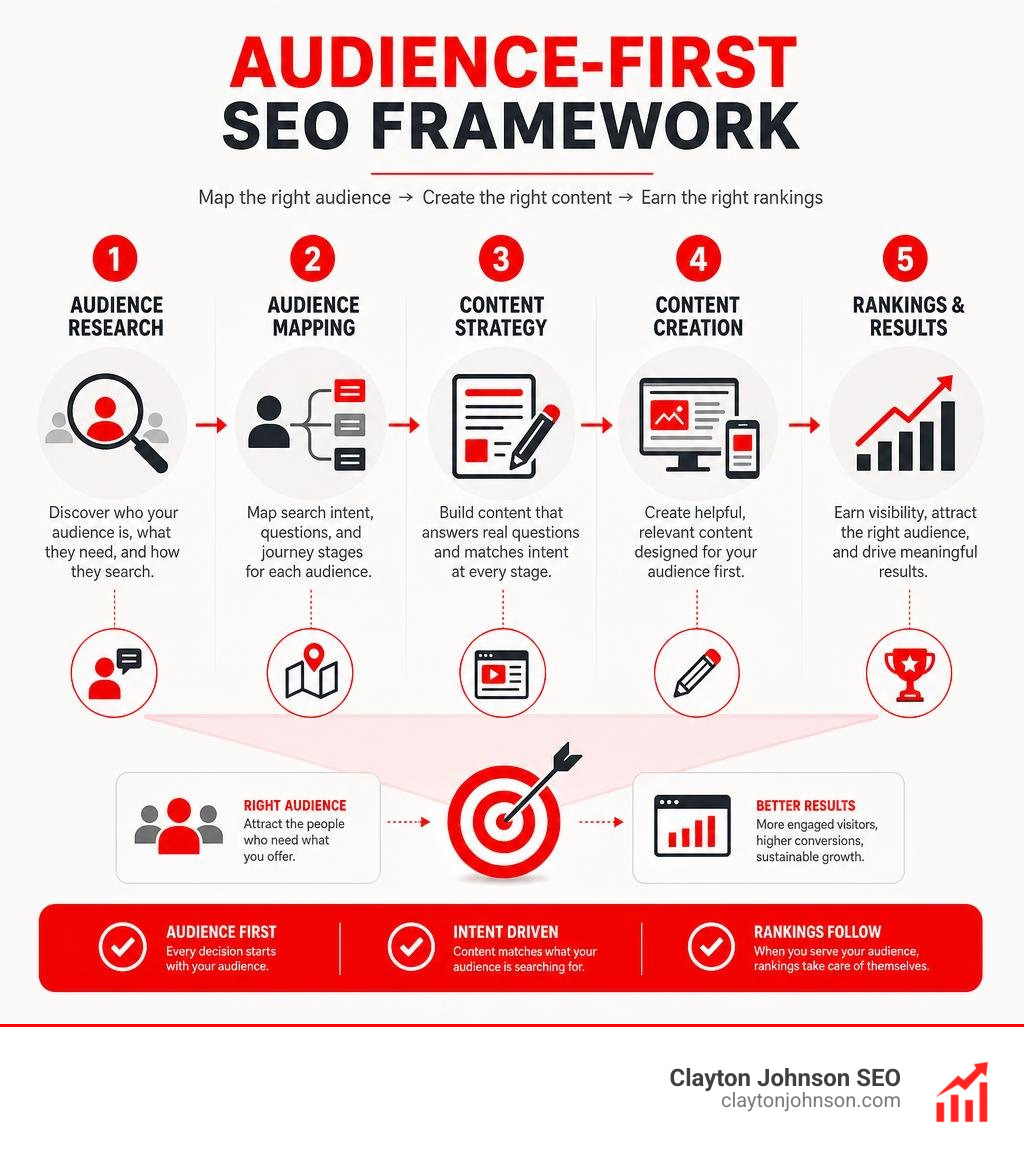
This is why we must shift from demographics to an audience mapping SEO strategy. An audience map records real-world search behavior, immediate pain points, and intent. Instead of guessing what a demographic segment wants, we look at the actual breadcrumbs they leave across the internet.
This shift is even more critical in 2026 because of the rapid rise of AI search engines. Platforms like ChatGPT, Claude, and Google’s Gemini do not just match keywords; they evaluate user history, context, and personalized conversational data. AI search engines are designed to remember previous searches for logged-in users and synthesize highly personalized recommendations.
If your content is generic and built for a broad demographic, AI engines will ignore it. But when you build highly targeted content that signals exactly who you serve and how you solve their specific problems, you build an information moat that AI search tools will pull from.
To build a strategy that actually moves the needle, you need to move beyond outdated profiles. Take a look at our guide on Why Your Business Needs Better Personas and How to Build Them to see how to start shifting your perspective, and explore our foundational framework on Customer Strategy to ground your search tactics in real business goals.
How to Build a Multi-Platform Audience Behavior Map
Building a behavior map requires looking beyond a single search tool. Your audience does not live exclusively on Google. Depending on their age, industry, and immediate needs, they are searching across TikTok, Reddit, Amazon, Discord, and AI engines.

An effective audience behavior map crosses both quantitative and qualitative data sources:
- Quantitative Data: Google Search Console queries, Google Analytics 4 (GA4) In-Market Segments, conversion data, and search volume tools.
- Qualitative Data: Customer support tickets, sales call recordings, social media threads, and direct customer interviews.
By combining these signals, you can pinpoint exactly where your ideal customers hang out and what triggers their search journey. If you are a startup founder trying to figure this out without burning through your budget, check out our guide on How to Map Your Startup Audience Without Losing Your Mind. Once you are ready to organize this data, you can streamline the process and Audit Your Audience Like a Pro with This Template.
Mining Real-World Search Data for Your Audience Mapping SEO Strategy
To turn raw data into a functional search map, start with your existing search queries. Google Search Console (GSC) is a goldmine for this. Filter your queries by impressions and click-through rates to find what terms are already driving people to your site.
Often, you will find that your audience uses highly specific, conversational, long-tail keywords rather than the high-volume, generic terms you might expect. For example, instead of searching for “accounting software,” a startup founder might search for “best accounting software for sole proprietor with inventory under $50.”
This is where you can find valuable “intent gaps.” If you are ranking for a high-volume query but your click-through rate is low or your bounce rate is incredibly high, you likely have a content mismatch. You are giving them a generic overview when they actually need a highly specific, actionable solution.
Understanding these nuances is what separates basic keyword research from true positioning. For a deeper dive into decoding these search behaviors, read The Mind Reader’s Guide to SEO Buyer Intent Profiling.
Leveraging Social Listening and AI Search Signals
Sometimes the most valuable search data does not show up in traditional keyword tools. This is because keyword tools show you search patterns after they have already crystallized into search volume. To find the problems your audience is experiencing before they search Google, you need to go where they talk openly: Reddit, Discord, and Quora.
Let’s look at a quick manual social listening protocol you can use today:
- Go to Google and search:
site:reddit.com "shoes for nurses"(or use your specific industry topic). - Filter the results by “Past Year” or “Past Month.”
- Look for threads with high engagement and read the comments.
- Pay close attention to the exact vocabulary, fears, and frustrations users express.
For instance, if you run a shoe company targeting healthcare workers, you might find Reddit threads where nurses complain about lower back pain after 12-hour shifts. They are not just searching for “durable shoes”; they are asking, “What shoes stop lower back pain for nurses on concrete floors?”
This conversational phrasing is the foundation of Audience DNA. When users interact with AI search engines like ChatGPT or Gemini, they do not type disjointed keywords. They ask complete, contextual questions:
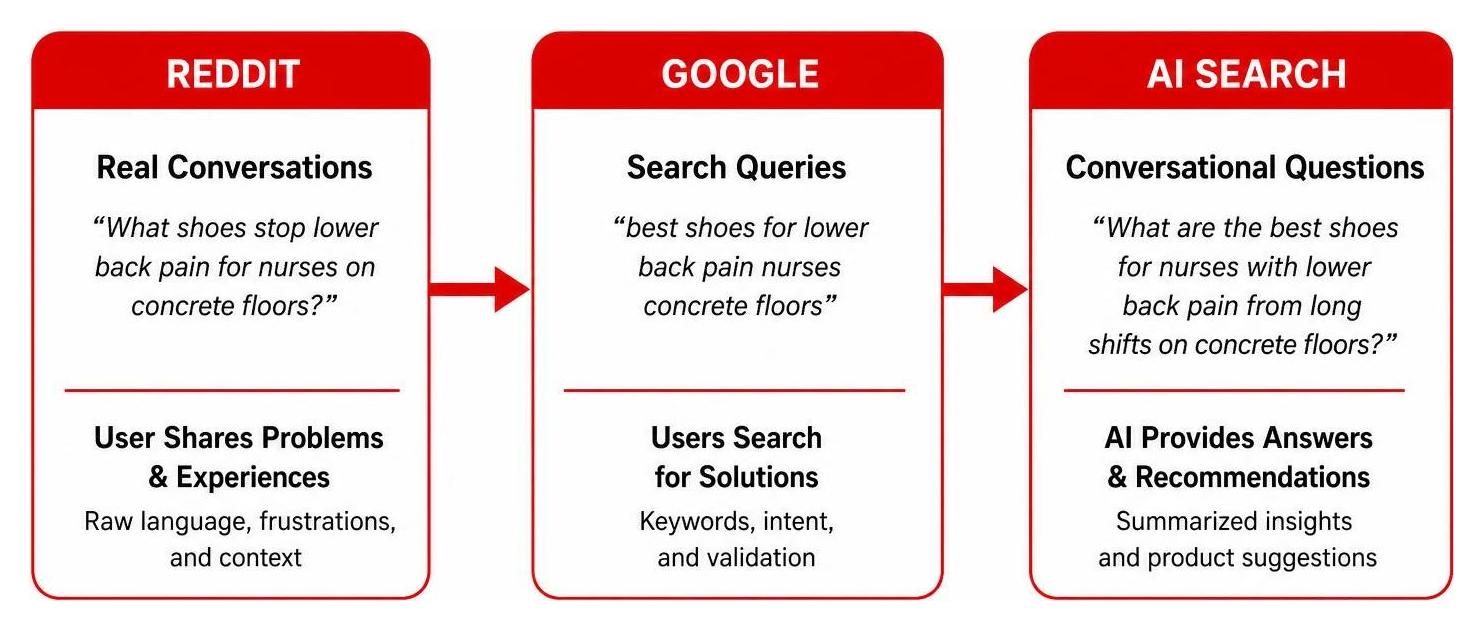
By mapping these questions, you can optimize your content for zero-click search features and conversational AI recommendations. To learn more about structuring these behavioral insights, take a look at our breakdown of Buyer Personas.
Structuring Your Content Architecture Around Multiple Audiences
Most businesses make the mistake of creating a single, generic buyer’s journey on their website. They write one set of blog posts, one product page, and hope it appeals to everyone.
In reality, your business likely serves multiple distinct audiences. A B2B SaaS tool might target both the startup founder (who cares about cost, quick setup, and ROI) and the IT director (who cares about enterprise security, compliance, and API integrations).
If you try to write a single page that satisfies both, you will satisfy neither. Your content architecture must segment these audiences at the top of the funnel, even if their paths eventually converge at the final checkout or demo booking stage.
To help you organize these distinct pathways, we have compiled 10 Free Sales Customer Segmentation Templates for Every Industry to make structuring your campaigns simple.
Mapping Search Intent to the Customer Journey
To keep your content organized, you must map user intent to specific stages of the customer journey. We break this journey down into four primary phases:
- Trigger Event (Informational Intent): The user experiences a sudden problem. Example: “Why is my website traffic dropping after a core update?”
- Research (Informational/Navigational Intent): The user looks for potential methods or solutions. Example: “How to fix a Google helpful content update drop.”
- Evaluation (Commercial Intent): The user compares different service providers or tools. Example: “Clayton Johnson SEO vs. DIY SEO audit.”
- Decision (Transactional Intent): The user is ready to buy or hire and looks for reassurance. Example: “Clayton Johnson SEO pricing and reviews.”
When you align your content to these specific steps, you ensure you are not serving a “how-to” guide to someone who is ready to buy, or a sales pitch to someone who is just trying to understand their problem. For a complete blueprint on executing this, see The Ultimate Guide to Mastering Search Intent Targeting.
Building Topic Clusters and Internal Linking Webs
Once you have mapped your queries to the customer journey, you can organize them into topic clusters (also known as SEO silos).
A topic cluster consists of:
- A Pillar Page: A comprehensive, high-level guide covering a broad topic (typically 3,000 to 5,000 words).
- Cluster Pages: Shorter, hyper-focused subtopic pages (1,200 to 2,000 words) that answer specific questions.
- Internal Linking: Bi-directional links connecting the cluster pages to the pillar page, passing authority and relevance throughout the site.
This structure builds massive topical authority. It signals to search engines (and AI models) that your site is an expert resource on the subject, rather than just a collection of random, disconnected articles. To see how topic clusters directly impact your product positioning and user experience, explore our insights on Customer Segmentation Product Insight.
Executing and Measuring Your Strategy
An audience mapping SEO strategy is not a set-it-and-forget-it project. It is an ongoing cycle of research, execution, measurement, and refinement.

To execute this successfully, you must bridge the gap between quantitative SEO data and qualitative human expertise. This is where Subject Matter Experts (SMEs) become your secret weapon. AI can summarize existing web pages, but it cannot replicate first-hand, lived experience.
By interviewing your internal experts and integrating their unique insights into your topic maps, you satisfy Google’s E-E-A-T (Experience, Expertise, Authoritativeness, Trustworthiness) framework. This makes your content incredibly difficult for competitors — or AI bots — to copy.
To prioritize your content pipeline, we recommend using an execution triage matrix. Score your target topics based on two simple metrics:
- Business Value: How likely is this topic to drive high-intent leads or conversions?
- Execution Ease: Do we already have the expert knowledge and resources to write this quickly?
Focus on high-value, high-ease topics first to secure quick wins before tackling larger, more competitive themes. For a deeper look at aligning your operational workflows with high-level design, review our approach to Strategic Design.
How to Avoid Common Pitfalls in Your Audience Mapping SEO Strategy
Even with the best intentions, it is easy to stumble. Here are the most common pitfalls we see brands make when executing an audience-first SEO strategy:
- Keyword Stuffing and Over-Optimization: Writing for algorithms instead of humans. If your content sounds like a robot wrote it to rank for “best audience mapping SEO strategy tools,” your human readers will bounce immediately.
- Content Decay: Publishing content and letting it sit for years. Search behavior, user intent, and market dynamics change. If you do not audit and update your pages regularly, your rankings will slip.
- Siloed Data: Keeping your SEO team separate from your sales and customer service teams. Your sales reps talk to customers every day; if they are not sharing customer objections with your SEO content writers, you are missing out on your best transactional keyword ideas.
- Keyword Blurring (Cannibalization): Creating multiple pages that target the same competitive keyword. Remember the golden rule of keyword mapping: only one page on your site should be optimized for a specific competitive search intent. Having multiple pages compete for the same term confuses search engines and dilutes your organic authority.
Measuring Success Beyond Rankings and Traffic
If you are only measuring your SEO success by keyword rankings and raw organic traffic, you are missing the point. You can rank number one for a high-volume keyword, but if that traffic does not convert into pipeline growth, your organic strategy is failing.
Instead, focus on these revenue-centric metrics:
- Conversion Rates by Audience Segment: Are your targeted cluster pages actually driving newsletter sign-ups, demo requests, or product purchases?
- Pipeline Growth and Assisted Conversions: How often does an organic blog post serve as the first or middle touchpoint in a customer’s multi-channel journey before they finally buy?
- Engagement Metrics: Look at scroll depth, average session duration, and internal click-through rates. If users spend several minutes reading your content, it proves your audience map correctly predicted their search intent.
- Core Web Vitals and Page Speed: Technical performance is a critical part of the user experience. A delay of just one second in page load time can reduce conversions by up to 20%. Ensure your site is fast, responsive, and easy to navigate on mobile devices.
Frequently Asked Questions
What is the difference between an ICP and an audience map?
An Ideal Customer Profile (ICP) focuses heavily on firmographic data (such as company size, annual revenue, industry, and geographic location) to define the perfect account for your sales team. An audience map, on the other hand, focuses on real-time behavioral data, search habits, questions, and immediate pain points. While your ICP tells you who to target, your audience map tells you how to talk to them when they search online.
How often should we update our audience maps?
We recommend conducting a deep audience audit every quarter. Search behaviors shift, new competitors enter the market, and AI search engines continuously update their algorithms. Regular quarterly reviews ensure your content calendar remains aligned with how people actually search.
Do we need expensive enterprise tools to start audience mapping?
No! While advanced tools can speed up the process, you can build a highly effective, low-cost audience map using Google Sheets, Google Analytics 4, Google Search Console, and manual social listening on Reddit and Quora. Start with the free tools you already have, and invest in enterprise platforms only when you need to scale your operations.
Conclusion
At its core, SEO is not about tricking an algorithm. It is about understanding human behavior and providing the absolute best answer to a user’s question at the exact moment they need it.
By aligning your positioning strategy with an audience mapping SEO strategy, you stop chasing vanity traffic and start building a predictable, high-converting inbound pipeline. You ensure that every piece of content you publish serves a clear business purpose, establishes your topical authority, and speaks directly to the needs of your ideal customers.
Ready to align your brand positioning with a search strategy that actually wins customers? Check out our guide on how to use a competitive positioning map to define your unfair advantage, or contact us today to build an audience-first SEO system that drives sustainable, long-term growth.