Why Small Business SEO Tips Matter More Than Ever in 2026
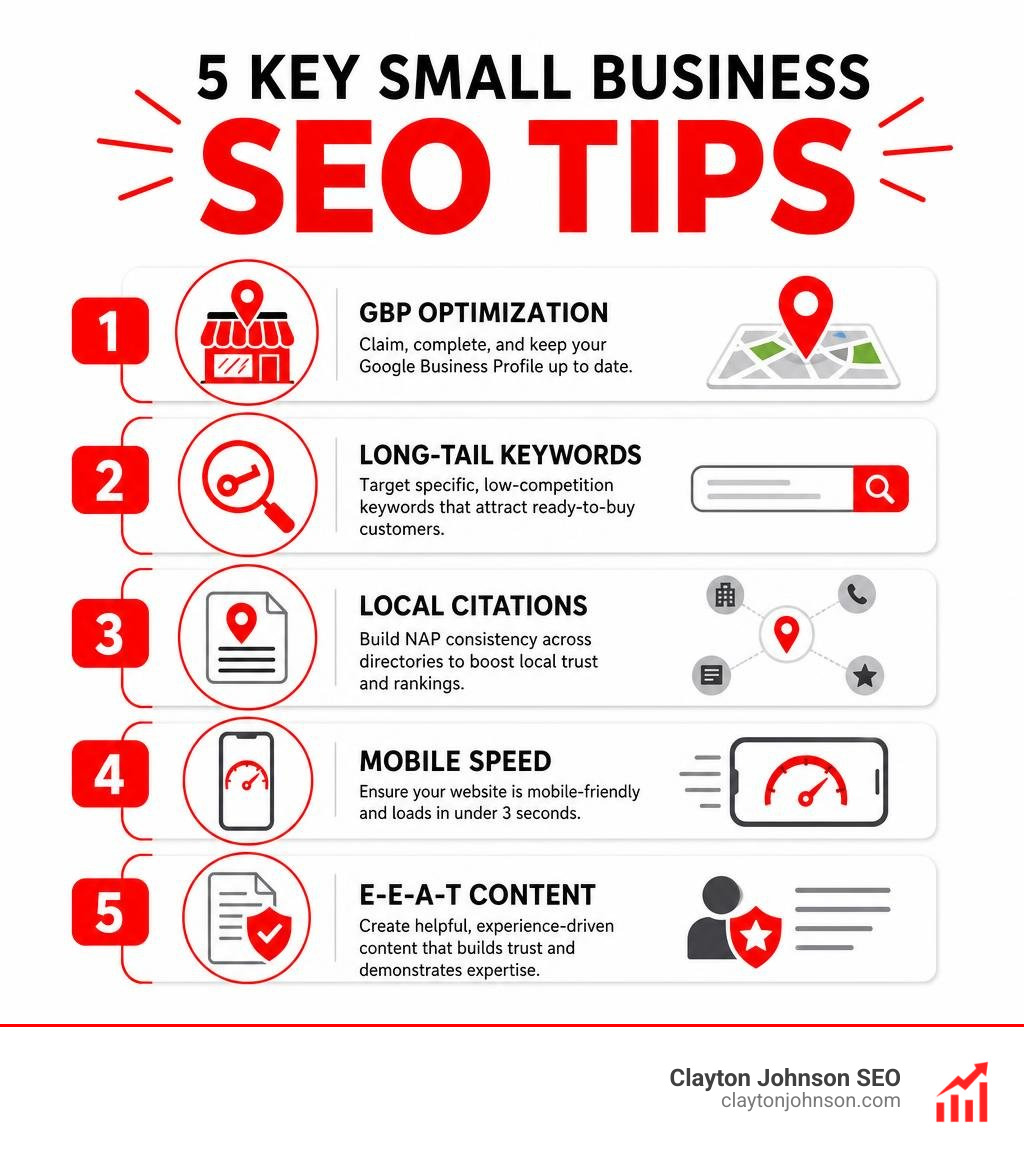
If you’re looking for small business SEO tips that actually move the needle, here’s a quick-start list before we dive deep:
- Claim and optimize your Google Business Profile — it’s free and drives local results fast
- Target long-tail, low-competition keywords instead of broad terms your biggest rivals already own
- Fix your service pages first — they convert; blog posts come second
- Ensure your site is mobile-friendly and loads in under 3 seconds
- Build NAP consistency (Name, Address, Phone) across every directory
- Earn backlinks through local partnerships — never buy them
- Structure content for AI search using short direct answers, clear headings, and FAQ sections
- Track results in Google Search Console — it’s free and essential
Organic search is not a nice-to-have. It drives 53% of all online traffic and contributes to 44% of revenue across digital channels. And here’s the sobering part: only 0.63% of Google users ever click anything on page two.
That means page one isn’t just better — it’s basically the only page that exists.
Yet most small business owners either ignore SEO entirely or try tactics that were outdated five years ago. In 2026, search has shifted dramatically. Google AI Overviews now appear on roughly 16% of queries. Platforms like ChatGPT and Perplexity are sending real traffic. The rules have changed — but the opportunity for small businesses has never been bigger.
Why? Because large brands chase broad, high-volume keywords. That leaves an enormous gap of specific, local, and niche queries where a focused small business can win — often without a massive budget.
I’m Clayton Johnson, founder of SmallBizSEO — a dedicated small business SEO resource built to help local owners turn search visibility into real leads. I’ve spent more than a decade building search systems specifically for small and locally operated businesses, and the practical framework behind SmallBizSEO sits at the heart of every small business SEO tip in this guide. Everything here is drawn from real-world execution, not theory.
Essential Small Business SEO Tips to Outrank Competitors
When you run a small business, every marketing dollar must justify itself. Many business owners default to paid search advertising (like Google Ads) because it offers instant gratification. You pay, you get a click, and you hope for a sale.
But the moment you stop paying, your traffic drops to zero.
Organic SEO works differently. It is a compounding asset. The work you do today continues to drive traffic, leads, and sales months—and even years—down the road without a recurring cost-per-click. Over time, the cost per lead for organic search is typically 60% to 70% lower than paid advertising.
| Feature | Paid Search Advertising (PPC) | Organic Search Engine Optimization (SEO) |
|---|---|---|
| Upfront Cost | Low (Pay per click immediately) | Medium to High (Time or agency fees) |
| Traffic Sustainability | Stops the second your budget runs out | Continues to compound and drive free traffic |
| Long-term ROI | Linear (More traffic always costs more) | Exponential (Cost per lead drops over time) |
| Trust & Credibility | Users often skip sponsored ads | High trust; organic rankings signal authority |
To win this compounding game, you must understand where the traffic is. Over 90.55% of global traffic originates from Google Search, Google Images, and Google Maps combined. If your business isn’t visible on these platforms, you are effectively invisible to the vast majority of your target market.
To start ranking, you must master keyword research. This is the process of finding the exact words and phrases your customers type into search engines.
Many small businesses make the mistake of chasing broad, high-volume keywords. For example, a local bakery might try to rank for “best bakery.” But they will find themselves competing with national brands, Wikipedia, and massive recipe sites. Instead, the secret is targeting “long-tail keywords” and “money queries” that have lower search volume but incredibly high buyer intent.
Instead of “best bakery,” a smart business targets “gluten-free wedding cakes in [City Name]” or “organic sourdough bread delivery nearby.” These queries have a lower keyword difficulty (meaning they are easier to rank for), and the people searching for them are ready to buy.
If you are new to this world, don’t worry. You don’t need a marketing degree to get started. We suggest reading our comprehensive guide on SEO 101 to get a firm handle on the vocabulary. Once you understand the basics, you can check out our step-by-step roadmap on How to Master SEO Basics Without a Degree to begin your optimization journey.
The Core Pillars of On-Page and Technical Optimization
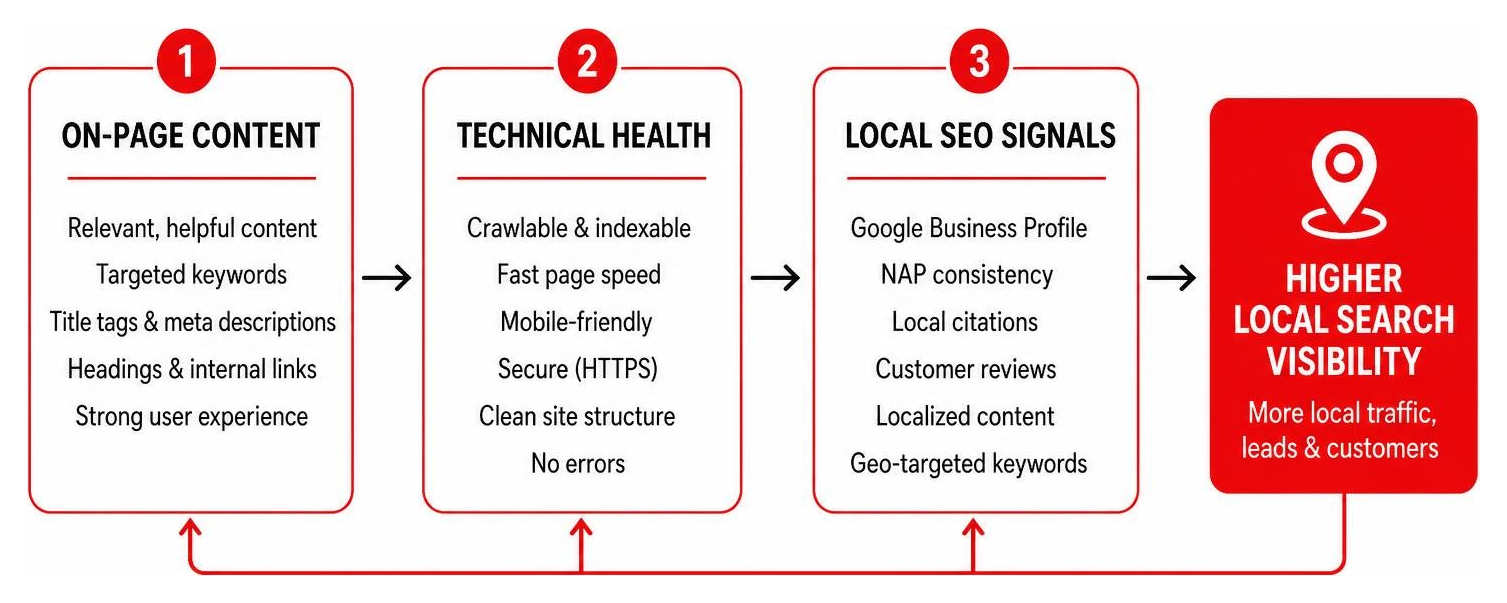
To rank on Google, your website must satisfy two primary audiences: human searchers and search engine crawlers. We break this down into two main disciplines: on-page SEO (the content and structure your users see) and technical SEO (the backend code and performance that search engines crawl and index).
On-Page Small Business SEO Tips for High Rankings
On-page SEO is all about relevance and user experience. Google’s algorithms have evolved to prioritize helpful, deeply informative content over keyword-stuffed pages. Here is your checklist for optimizing every page on your site:
- Title Tags: Keep your title tags under 60 characters and place your primary keyword near the beginning. For example: Emergency Plumber in Austin, TX | 24/7 Rapid Response.
- Meta Descriptions: Keep these under 155 characters. While they don’t directly impact rankings, they act as your organic ad copy. Write a compelling description that encourages users to click.
- Header Tags (H1, H2, H3): Use a logical heading structure. Your page should have only one H1 tag (the main title). Use H2 tags for major sections and H3 tags for sub-sections. This helps both users and search engines read your page.
- Keyword Mapping & Content Depth: Dedicate one primary page to each major service you offer. Do not bundle all your services onto a single page. If you are a landscaping company, create separate pages for “Lawn Mowing,” “Patio Installation,” and “Tree Trimming.” Ensure these pages are comprehensive and answer every question a buyer might have.
- Image Alt Text: Search engines cannot “see” images the way humans do. Add descriptive alt text (ideally between 50 and 60 characters) to your images so crawlers understand what they represent.
- Internal Linking: Link your pages together naturally. When you write a blog post about lawn care tips, link back to your commercial lawn mowing service page. This passes authority through your site and helps crawlers index your pages.
Technical SEO Essentials for Small Websites
No matter how great your content is, it won’t rank if search engines can’t crawl your site, or if users leave because your pages load too slowly. Technical SEO is the foundation of your search strategy.
First, prioritize site speed. A website that takes more than 3 seconds to load on a mobile device loses a massive percentage of its visitors before they even see the homepage. You can easily speed up a WordPress site by compressing heavy images (convert them to WebP format and keep them under 200KB) and using lightweight caching plugins.
Second, ensure your site is fully optimized for mobile-first indexing. Google primarily uses the mobile version of your content for indexing and ranking. If your site looks beautiful on a desktop but is hard to navigate on a phone, your rankings will suffer.
Third, secure your site with an HTTPS protocol. An SSL certificate is a direct ranking signal and protects your user’s data.
Finally, run a free technical crawl of your site. You can use a tool like Screaming Frog (which is completely free for up to 500 URLs) to identify broken links (404 errors), redirect loops, and duplicate content. To ensure your site meets Google’s modern performance metrics, consult Google’s Core Web Vitals guidelines to optimize your page load experience and visual stability.
Mastering Local Search and Map Pack Visibility
For local businesses, standard organic rankings are only half the battle. The real prize is the “Local Map Pack”—the three local business listings that appear at the very top of Google search results alongside a map.
Local Small Business SEO Tips to Dominate Your Neighborhood
Almost half (46%) of all searches on Google have local intent. What’s more, 72% of consumers who perform a local search visit a store within five miles of their current location. The local search funnel is incredibly fast: 76% of people who search on their smartphones for something nearby visit a business within 24 hours, and 28% of those searches result in an immediate purchase.
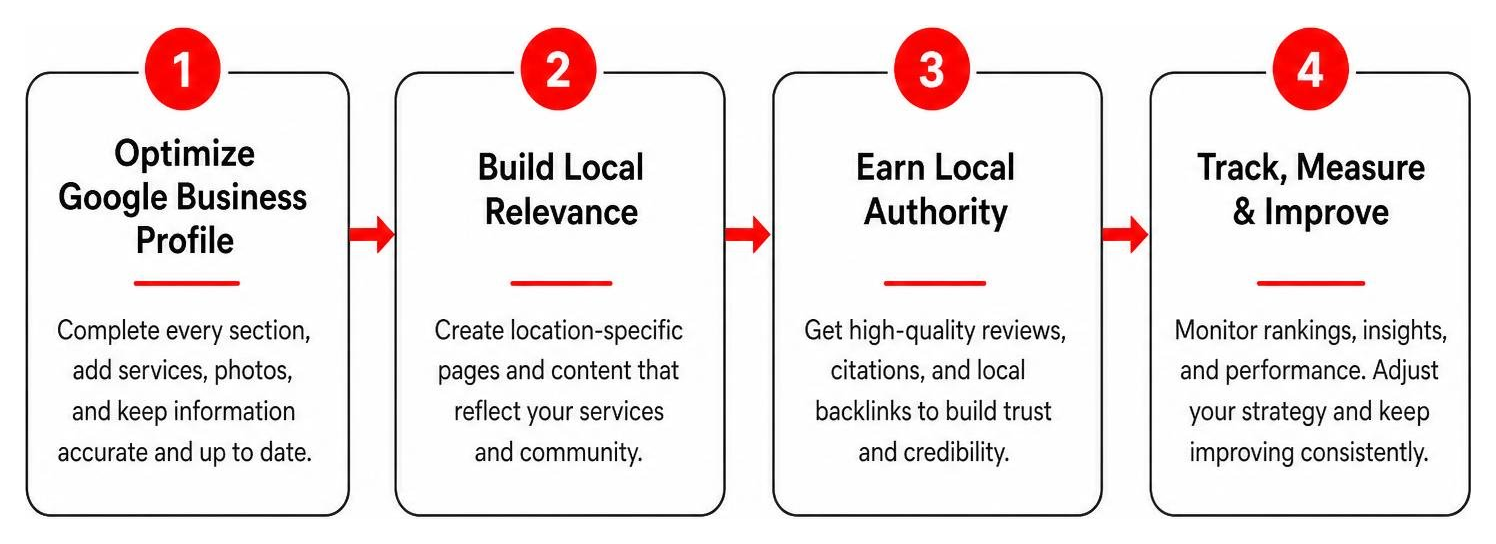
To capture this high-intent traffic, you must dominate local search. Here is how to do it:
- Optimize Your Google Business Profile (GBP): This is the single most important tool in your local SEO toolkit. Claim your profile, fill out every single field, select the correct business categories, upload at least 10 high-quality photos, and list your products and services individually.
- Maintain Strict NAP Consistency: Your Name, Address, and Phone number (NAP) must be identical across your website, your GBP, and all local directories (like Yelp, YellowPages, and Apple Maps). Inconsistent NAP data quietly confuses search engine algorithms and damages your rankings.
- Build a Review Engine: Google trusts what customers say about you more than what you say about yourself. Don’t just wait for reviews; build a systematic process to ask for them. Send a friendly text message or email with a direct review link immediately after a successful sale or service.
- Create Location-Specific Content: If you serve multiple neighborhoods or cities, build unique location pages on your website. Do not copy-paste the same content and simply swap out the city names—Google penalizes duplicate content. Write unique, helpful, localized copy for each area you serve.
If you want to dive deeper into the advanced strategies that make local businesses rank, read our breakdown of The Secret Sauce for Local SEO Success to start outranking your neighborhood competitors.
Ethical Link Building and Authority Signals
Backlinks—links from other websites pointing to yours—are like votes of confidence in the eyes of search engines. The more high-quality, authoritative websites that link to you, the more Google trusts your site.
But let’s be clear: never buy cheap backlink packages. Buying bulk links from spammy websites violates search guidelines and can trigger severe penalties that wipe your site from search results entirely. Instead, focus on earning links ethically:
- Local Partnerships & Sponsorships: Sponsor a local youth sports team, partner with a complementary local business, or join your Chamber of Commerce. These organizations almost always link back to their partners.
- Supplier & Retailer Directories: If you sell products from major brands, reach out to the manufacturers and ask to be listed on their official “Where to Buy” or dealer directory pages.
- Unlinked Brand Mentions: Set up a Google Alert for your business name. If a local blogger or news outlet mentions your business but doesn’t link to your site, send a polite email asking if they would mind turning that mention into a clickable link.
These authority signals feed directly into Google’s E-E-A-T framework: Experience, Expertise, Authoritativeness, and Trustworthiness. By showing real customer reviews, verified business details, and links from trusted local organizations, you demonstrate to search engines that you are a legitimate, trustworthy business.
Navigating the AI Search Era: GEO, AEO, and AIO
By July 2026, the search landscape has shifted dramatically. Traditional “blue-link” search engines have evolved into AI-synthesized answer engines. Google AI Overviews now appear on roughly 16% of search queries, and platforms like ChatGPT, Perplexity, and Gemini are driving a massive share of direct recommendations.
To survive in this new era, small businesses must optimize for these generative engines.
Optimizing for Google AI Overviews and ChatGPT
This shift has introduced three new concepts to the search marketing world:
- GEO (Generative Engine Optimization): Optimizing your content so AI engines can easily read, summarize, and cite it.
- AEO (Answer Engine Optimization): Formatting your content to directly answer conversational questions.
- AIO (Artificial Intelligence Optimization): The overall system of aligning your brand’s digital footprint with AI training models.
AI search engines do not scrape the web randomly; they rely on structured, highly authoritative, and fast-loading data. To ensure your small business is recommended by ChatGPT and cited in Google AI Overviews, implement these modern optimization techniques:
- Write Conversational, Direct Answers: AI engines look for concise, direct answers to questions. Near the top of your service and blog pages, include a clear 50-to-60-word summary that directly answers the primary search query.
- Implement Schema Markup: Use structured data (schema.org) to tell search engines exactly what your business is, what services you offer, your physical address, and your pricing. This code makes your site highly readable for AI crawlers.
- Focus on Niche Specificity: AI engines summarize broad topics easily, but they struggle with highly specific, localized, or technical questions. By publishing original, deep-dive content on niche topics (e.g., “how local building codes impact water heater installation in [City]”), you become the primary source the AI must cite.
- Build Brand Mentions Across the Web: AI models learn from conversations, reviews, and directory listings across the entire internet. The more active your brand is on local forums, review platforms, and industry directories, the more likely an AI engine is to recommend your business when a user asks for a recommendation.
Frequently Asked Questions About Small Business SEO
How long does it take to see results from SEO?
SEO is a long-term investment, not an overnight switch. Generally, you can expect to see early ranking improvements and local map visibility within 3 to 6 months. Meaningful organic traffic growth and compounding lead generation typically take 6 to 12 months of consistent optimization effort.
What are the most common SEO mistakes small businesses make?
The most common mistake is publishing informational blog posts before making commercial service pages excellent. Service pages are your “money pages”—they convert visitors into paying customers. Other common errors include keyword stuffing (repeating keywords unnaturally), using duplicate content across service pages, buying cheap backlink packages, and failing to track performance in Google Search Console.
When should a small business hire an SEO agency?
You should consider hiring professional help when your foundational DIY setup is complete but your growth has plateaued, or when managing your SEO takes too much time away from running your business. If you’re ready to scale, we recommend reviewing our curated lists of the Top 10 Small Business SEO Companies and the 8 Best SEO Companies for Small Businesses That Actually Deliver Results to find a partner that fits your budget and goals.
Conclusion
Mastering search engine optimization doesn’t require a massive marketing budget or a team of enterprise developers. By focusing on the fundamentals—targeting realistic long-tail keywords, optimizing your Google Business Profile, fixing your technical foundation, and structuring your content for the AI search era—your small business can successfully compete with and outrank much larger competitors.
For business owners who want a focused path forward, SmallBizSEO is built specifically around practical SEO systems for small businesses — from local visibility and content planning to the search foundations that generate qualified leads. At Clayton Johnson SEO, we help small and growing businesses map their target audiences, build high-authority content, and implement search systems that drive actual revenue. If you’re ready to stop guessing and start growing your organic traffic, explore our tailored Clayton Johnson SEO Services to get a customized, high-impact growth plan for your business.