Why Agencies Are Switching to AI SEO Operating Systems Right Now
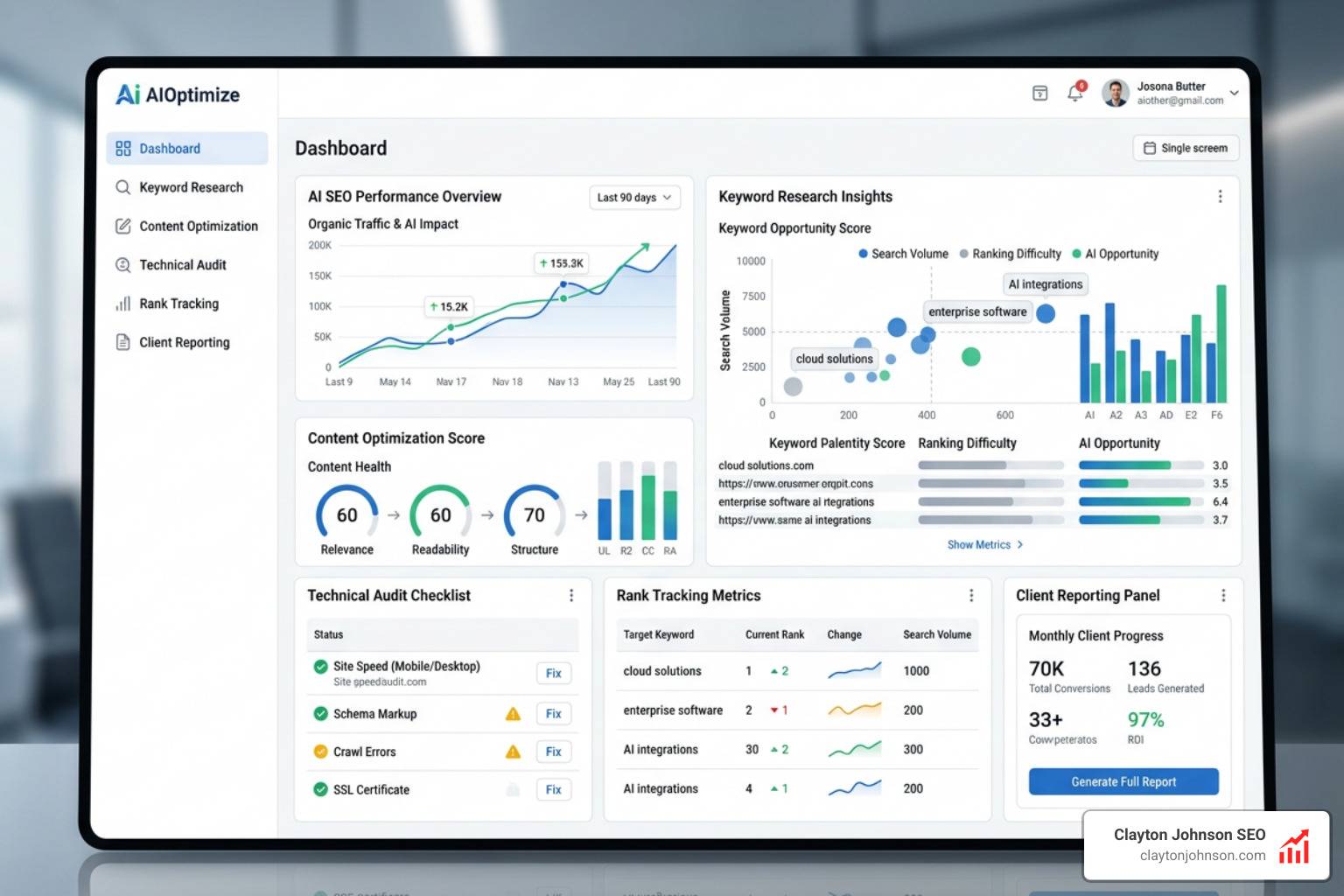
The best all-in-one AI SEO operating systems for clients and agencies combine keyword research, content optimization, technical audits, rank tracking, and client reporting into a single unified workflow.
Top platforms at a glance:
| Platform | Best For | Starting Price |
|---|---|---|
| Search Atlas | Full AI agent automation + LLM visibility | $99/mo |
| Semrush | All-in-one research + agency growth tools | $139.95/mo |
| Surfer SEO | Content optimization + AI search tracking | $175/mo |
| AIOSEO | WordPress multi-site management | $299.60/yr |
| Alli AI | CMS-agnostic bulk deployment | Custom |
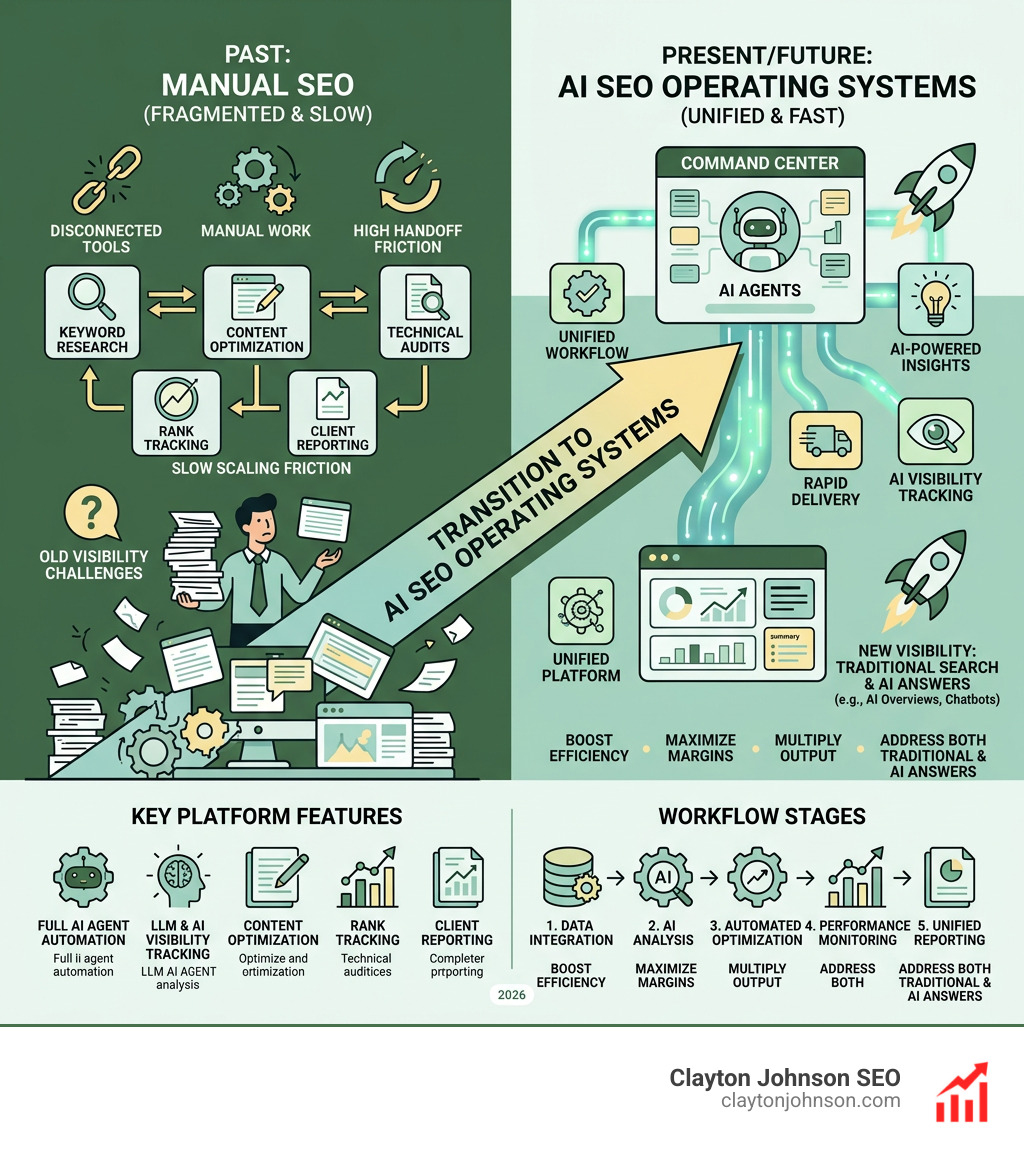
Running an SEO agency used to mean juggling a dozen disconnected tools — one for audits, another for reporting, a third for content, and so on. Each tool added complexity, cost, and handoff friction.
That’s a problem.
Fragmented workflows slow down delivery, eat into margins, and make it hard to scale without adding headcount.
The shift toward AI SEO operating systems changes that equation. Instead of stitching together separate tools, agencies can now manage research, optimization, AI visibility tracking, and client reporting from one platform. A tool that costs $200 per month but saves 20 hours of manual work across a client portfolio isn’t a cost — it’s a multiplier.
There’s also a new visibility challenge worth noting: it’s no longer enough to rank on Google. Clients now ask why their brand doesn’t appear in ChatGPT, Perplexity, or Google AI Overviews. The platforms covered in this guide address both traditional search and AI-generated answers.
I’m Clayton Johnson, an SEO strategist with nearly two decades of experience building scalable search frameworks for competitive markets — and evaluating the best all-in-one AI SEO operating systems for clients and agencies is something I do hands-on for the businesses I work with. This guide cuts through the noise so you can choose the right platform for your specific client portfolio and growth goals.
Evaluating the Best All-in-One AI SEO Operating Systems for Clients and Agencies
When we look for the best all-in-one AI SEO operating systems for clients and agencies, we aren’t just looking for a fancy interface. We are looking for a “command center” that bridges the gap between raw data and executable strategy. For an agency, profitability lives in the minutes saved between keyword discovery and content publishing.
The evaluation criteria for a true “Operating System” (OS) include:
- Workflow Integration: Can your team move from a technical audit to a content brief without exporting five different CSV files?
- Multi-Client Management: Does the platform offer a single dashboard to monitor 50+ accounts, or do you have to log in and out like it’s a social media account in the early 2000s?
- White-Label Reporting: Can you generate professional, branded reports that make you look like a genius to your clients?
- AI Capabilities: Does the “AI” actually do something useful, like clustering thousands of keywords or predicting search trends, or is it just a glorified chatbot?
| Feature | Semrush | Search Atlas | Surfer SEO |
|---|---|---|---|
| Keyword Research | Industry-leading database | Semantic/Entity focused | SERP-based analysis |
| Content Optimization | Real-time assistant | AI Agent (Atlas Brain) | Content Score & NLP |
| Agency Tools | CRM & Lead Gen | White-label dashboards | Collaboration tools |
| AI Search Tracking | AI Visibility Toolkit | LLM Visibility tool | AI Tracker |
For agencies in the prospecting phase, using specialized tools like LowFruits can be a game-changer for finding low-competition keywords that provide immediate value in a proposal. However, to sustain growth, you eventually need to fold those insights into a broader AI marketing workflow.
Semrush and Search Atlas: The Best All-in-One AI SEO Operating Systems for Clients
If you want a platform that feels like it has an entire department of robots working for you, Semrush and Search Atlas are the heavy hitters.
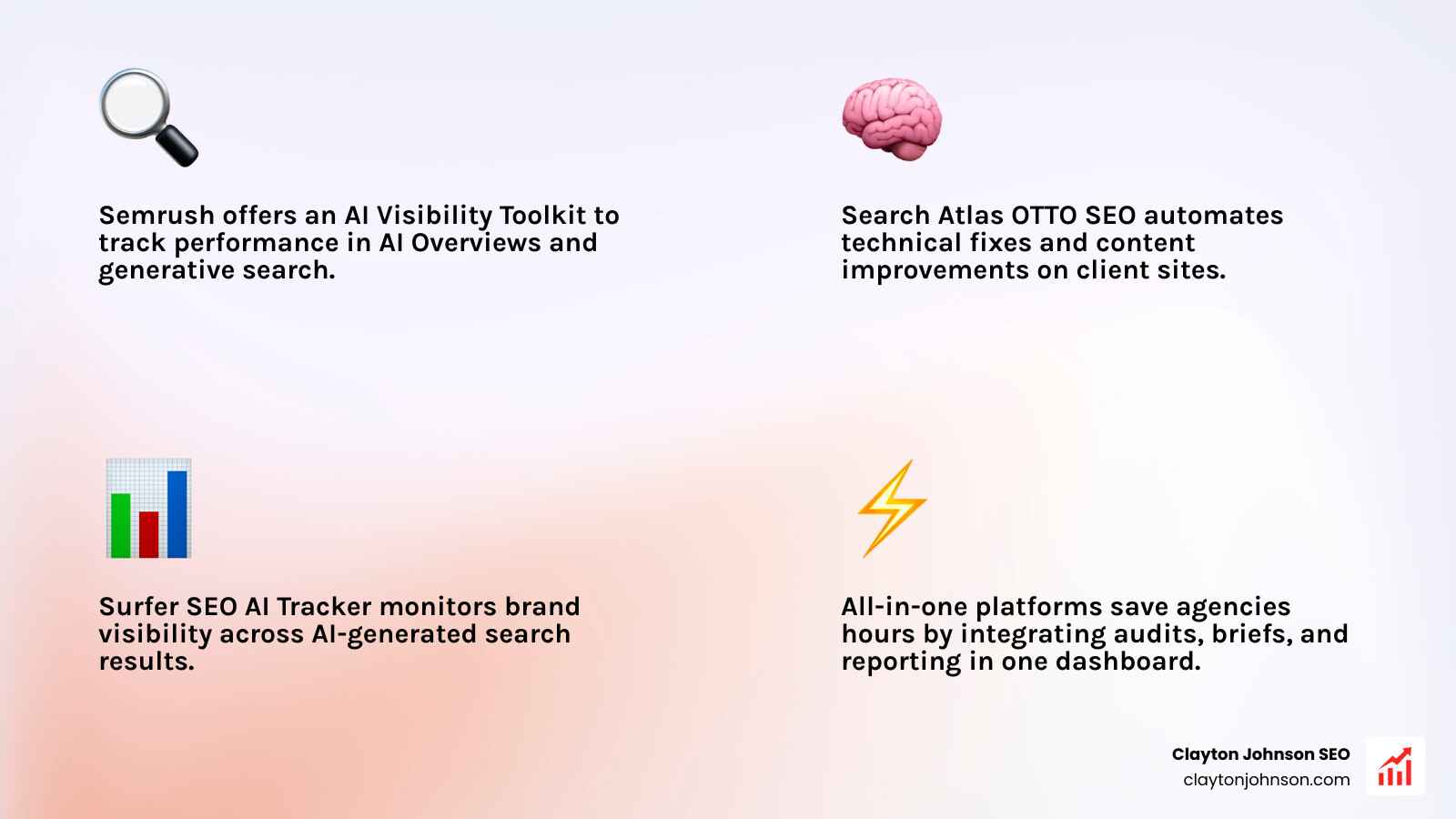
Semrush has long been the gold standard for research, but their “One” platform now bundles classic SEO tools with a dedicated AI Visibility Toolkit. This allows agencies to track performance not just on the blue links, but also within Google AI Overviews and ChatGPT. Their Agency Growth Kit is particularly slick—it provides a dedicated CRM for managing prospects and lead generation widgets you can stick on your own site.
Search Atlas, on the other hand, is pushing the boundaries of what we call “Agentic SEO.” Their standout feature is OTTO SEO, an AI assistant that doesn’t just give you a “to-do” list; it can actually implement technical fixes and content improvements directly on the client’s site. For a busy agency, this is like having a junior developer and an SEO specialist rolled into one.
When it comes to technical health, we often recommend starting with Screaming Frog for that initial deep dive, but a modern OS like Search Atlas allows you to monitor those technical vitals daily. Learning how to use AI audits ensures that you aren’t just fixing broken links, but actually optimizing for how AI crawlers perceive your client’s site architecture.
Surfer SEO and AIOSEO: Scalable AI SEO Operating Systems for Agencies
Not every agency needs a massive enterprise suite. Sometimes, you need a system that excels at one thing—like content production or WordPress management—and scales that to the moon.
Surfer SEO has evolved from a simple correlation tool into a robust content operating system. Their AI Tracker feature is a favorite for agencies because it reports on brand visibility in AI search results. This is a massive “value-add” for clients who are worried about being replaced by a ChatGPT answer. Agencies can use Surfer to build detailed content briefs that are grounded in real-time SERP data, ensuring that every piece of content has a mathematical chance of ranking.
If your agency specializes in WordPress, AIOSEO (All In One SEO) is often the most practical choice. Their Elite plan supports up to 100 websites, allowing you to manage a massive portfolio from a centralized dashboard.
- Multi-site management: No more logging into 50 different WP-admin panels.
- Technical control: Manage robots.txt and schema across your entire network.
- Link Assistant: Use AI to find internal linking opportunities across hundreds of posts in seconds.
To really maximize these tools, we suggest looking beyond content automation. While tools like SEOBoost are “secret weapons” for securing quick ranking boosts through content fine-tuning, the real power comes from having a system that tracks these changes across your entire client list automatically.
Technical SEO Automation and GEO Tracking Features
The new frontier of search is Generative Engine Optimization (GEO). Traditional rank trackers are becoming less relevant as search engines move toward AI-generated answers.
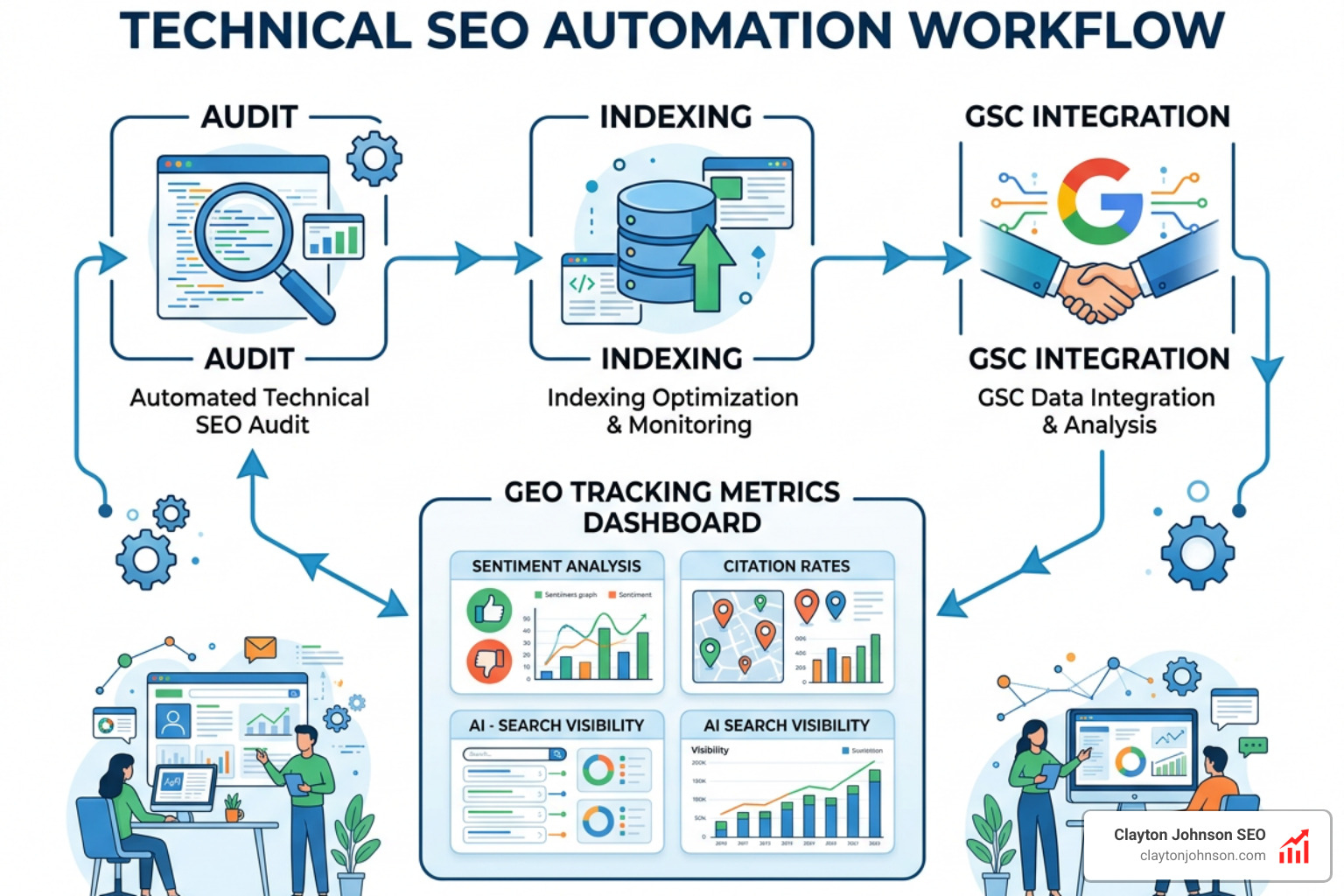
Platforms like Rankscale.ai allow agencies to track whether their clients are being cited in Perplexity or ChatGPT. This isn’t just about a number; it includes sentiment analysis and citation analysis. If a client is mentioned but the sentiment is “expensive and slow,” that’s a PR problem that SEO agencies are now expected to solve.
Other key features in the modern technical stack include:
- Indexing Automation: Tools like Indexly ensure that new content is discovered by search engines immediately, bypassing the weeks of waiting that often frustrate new clients.
- AI-Powered Audits: Moving beyond simple “page speed” checks to analyze how “extractable” your data is for LLMs.
- GSC Integration: A true OS must have a direct line to Google Search Console. This is the non-negotiable data source for monitoring a client’s technical health and organic performance.
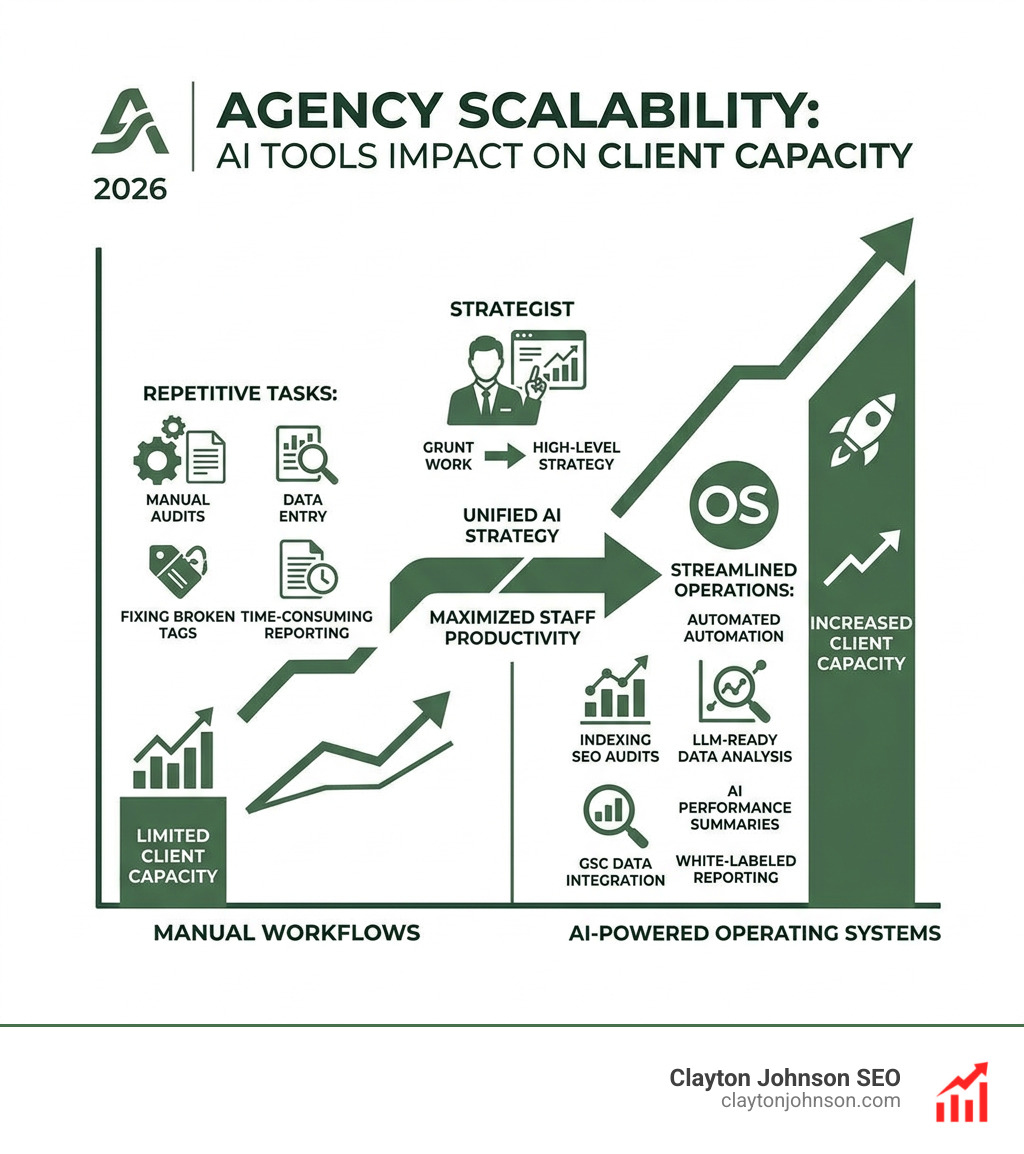
Using the top automated audit tools allows your senior strategists to stop playing “find the broken tag” and start playing “how do we dominate this niche.”
Implementing a Unified AI SEO Strategy for Long-Term Growth
Choosing the best all-in-one AI SEO operating systems for clients and agencies is only half the battle. The other half is implementation. A unified strategy means that your data flows seamlessly from the audit phase to the reporting phase.
One of the biggest drains on agency profitability is reporting. We’ve seen teams spend dozens of hours manually compiling data into slide decks. Platforms like Agency Analytics solve this by integrating with over 75 marketing platforms, allowing for automated, white-labeled reporting schedules.
Even better, tools like Whatagraph use AI to write performance summaries in plain language. Instead of a client seeing a chart and asking “Is this good?”, the AI writes: “Organic traffic increased by 15% this month due to our new content cluster on [Topic].” That saves your account managers hours of explaining the same data points every month.
When you build AI-driven SEO systems, you aren’t just buying software; you are buying back your team’s time. This allows you to focus on high-level strategy and client retention rather than the “grunt work” of data entry.
Choosing the Right System for Your Client Portfolio
How do you pick? It comes down to your specific client mix and your internal workflow.
- For the Content-Heavy Agency: Surfer SEO or Search Atlas are your best bets. They prioritize the “Semantic Web” and help you produce volume without sacrificing quality.
- For the Technical/Enterprise Agency: Semrush or Alli AI. You need the deep data and the ability to deploy code changes at scale across complex sites.
- For the High-Volume Boutique: AIOSEO or Search Atlas. You need ease of use and the ability to manage 50+ clients without a massive overhead.
No matter which you choose, AI is an assistant, not a replacement for E-E-A-T (Experience, Expertise, Authoritativeness, and Trustworthiness). You still need human oversight for strategy. Tools like Majestic are still vital for backlink analysis to ensure your client’s authority signals are genuine and not just “AI noise.”
Using AI competitive analysis tools can help you spot gaps in your rivals’ strategies, but it takes a human to decide which gap is actually worth filling.
The Clayton Johnson Philosophy: Systems Over Tactics
At Clayton Johnson SEO, we don’t believe in “SEO tricks.” We believe in systems.
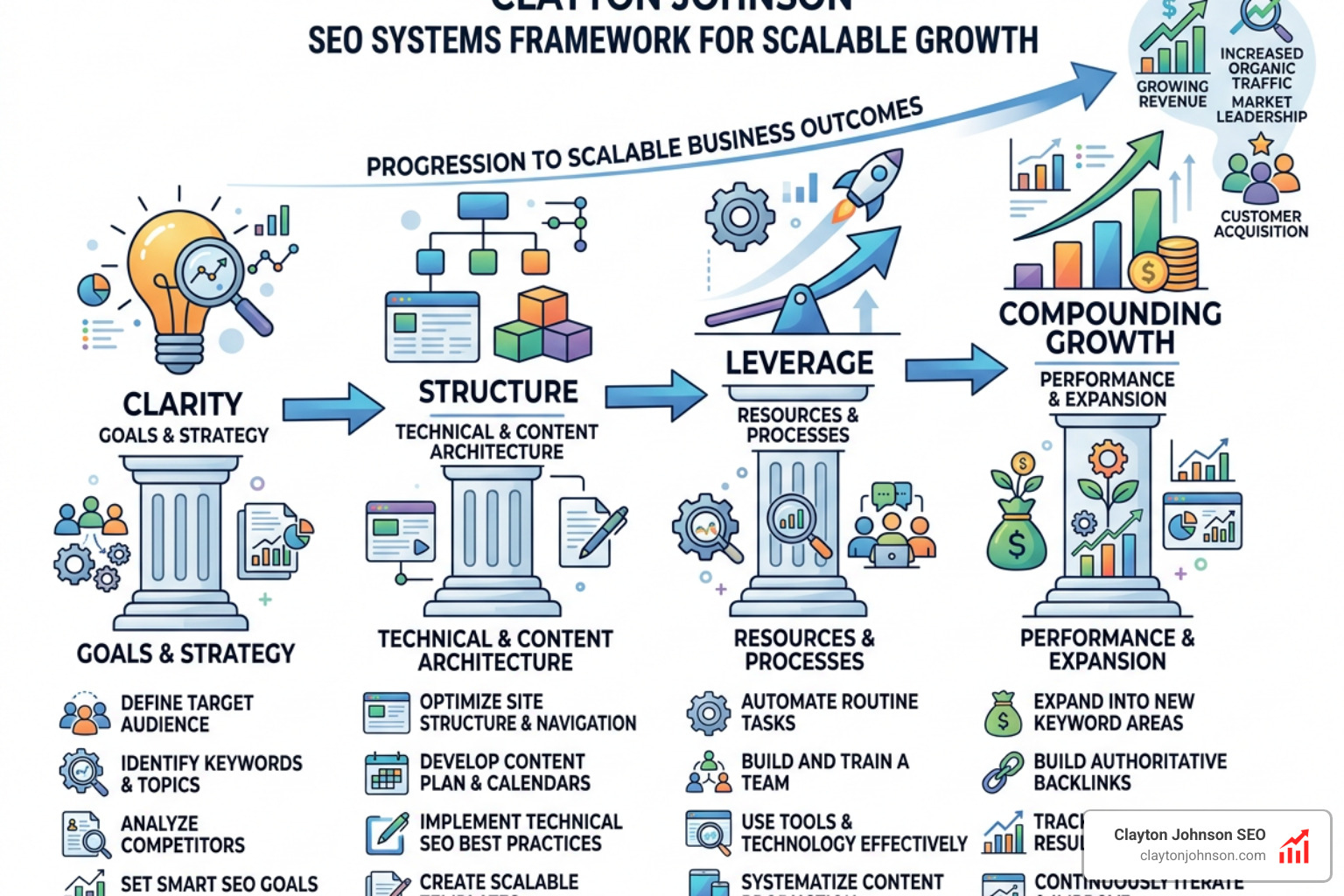
The best all-in-one AI SEO operating systems for clients and agencies are only as good as the frameworks they support. Our philosophy is built on four pillars: Clarity → Structure → Leverage → Compounding Growth.
We use strategic SEO services to build durable ecosystems. This means focusing on:
- Content Architecture: Using taxonomy and internal linking to tell search engines exactly what a site is about.
- Growth Frameworks: Moving beyond “ranking for keywords” to “owning the search intent” of your target audience.
- AI-Enhanced Workflows: Using tools to handle the repetitive 80% of SEO so our humans can focus on the creative 20% that actually moves the needle.
If you are tired of fragmented marketing efforts, it’s time to build a coherent growth engine. Whether you are a founder looking for leverage or an agency owner looking to scale, our ultimate AI SEO guide and strategy frameworks are designed to turn search intent into measurable business outcomes.
SEO is no longer a game of manual labor; it’s a game of strategic leverage. The right AI operating system is the lever. Now, you just have to pull it.