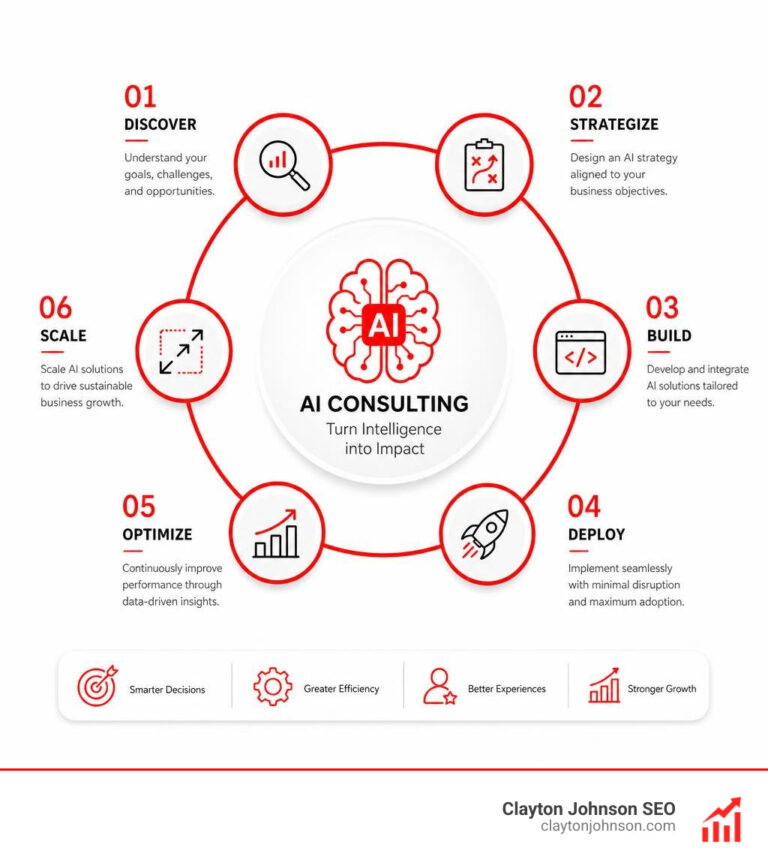
Why Implementing AI in Business Is No Longer Optional in 2026
Implementing AI in business is one of the most important decisions a company can make right now — and most businesses are already moving.
According to McKinsey, 88% of organizations now use AI in at least one business function. Yet only 6% qualify as true AI high performers — companies attributing 5% or more of their EBIT directly to AI. The gap between adopting AI and actually getting value from it is enormous.
Here is a quick overview of how to implement AI in your business:
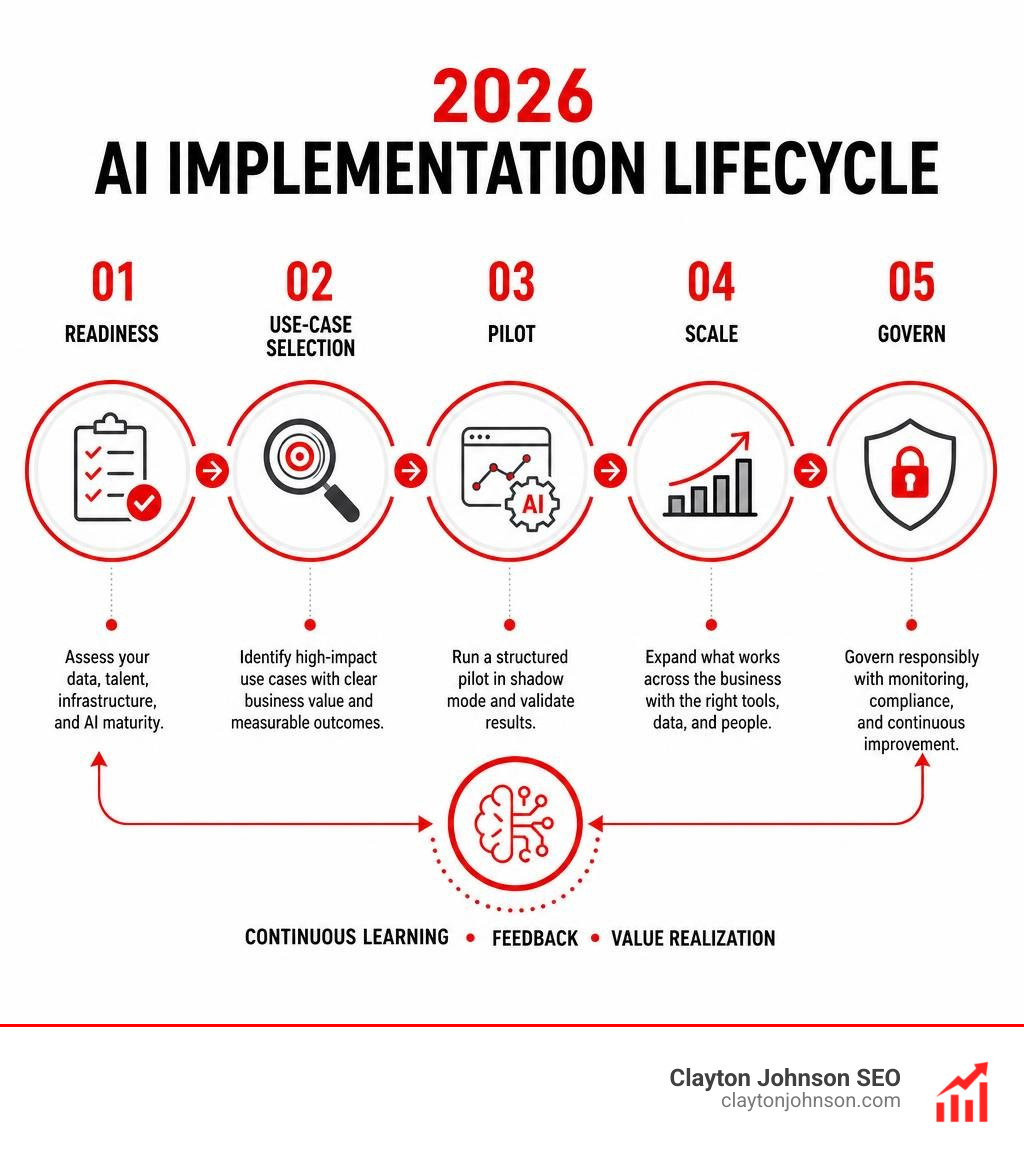
- Assess your AI maturity and readiness — audit your data, talent, and infrastructure before picking tools
- Define a specific, measurable use case — start with high-volume, repetitive tasks that have clear before/after metrics
- Choose the right AI technology — generative AI for content and conversation; machine learning for prediction and structured data
- Form a cross-functional team — include IT, data science, business unit leaders, and an ethics voice
- Run a structured pilot — test in shadow mode with real data before full deployment
- Measure outcomes, not activity — track hours saved, error rates, and cost per task
- Scale what works and govern everything — build monitoring, retraining, and compliance into the process from day one
The payoff is real. Early AI adopters are seeing $3.50 back for every $1 invested. Companies with high AI adoption report a 30% reduction in operational costs. Generative AI alone is delivering a 44% productivity increase across enterprise functions like HR, finance, and procurement.
But the ROI does not come from buying tools. It comes from changing how work gets done.
“Adding AI to an existing workflow without changing it is like adding a faster engine to a car with square wheels.” — a point made repeatedly by AI implementation practitioners in 2026
Most businesses are stuck in what researchers call the “pilot trap” — running small experiments that never scale. Less than 25% of AI pilots make it to full enterprise deployment. The problem is almost never the technology. It is poor planning, weak data foundations, and no clear ownership of outcomes.
This guide walks you through every stage — from assessing where your organization stands today, to choosing the right tools, to building the governance and culture that make AI stick.
At Clayton Johnson SEO, we help businesses cut through the noise and build AI-informed digital strategies that drive measurable growth — and our work at the intersection of search, automation, and implementing AI in business means we understand both the opportunity and the execution gaps firsthand. If you are a small business owner trying to figure out where to start, this guide was written for you.
Assessing Organizational Readiness and AI Maturity
Before buying software or hiring developers, you must understand where your company sits on the AI maturity curve. Rushing into implementation without assessing your current state is like trying to build a skyscraper on quicksand.
According to MIT research, companies in the top two stages of AI maturity—those that actively develop AI-centric ways of working and become AI “future-ready”—consistently achieve financial performance well above their industry averages. Conversely, early-stage firms that try to force advanced AI onto broken legacy processes usually underperform.
To avoid wasting your budget, you must first define your baseline. Learning How to Build a Winning Enterprise AI Strategy in 2026 requires moving beyond the hype cycle and assessing your organization’s structural capability. For a deeper look at aligning your business goals with technology, check out our More info about enterprise AI strategy to see how high performers approach this alignment.
The Four Stages of AI Maturity
To help organizations assess where they stand, MIT researchers developed a four-stage AI maturity model:
- The Foundational Stage: AI usage is ad-hoc, isolated, and highly experimental. Individual employees might use off-the-shelf generative AI tools, but there is no centralized strategy, unified data pipeline, or formal governance.
- The Operational Stage: Organizations target specific, isolated business problems, such as deploying a customer service chatbot. While these projects deliver localized efficiency gains, they remain siloed.
- The Transformational Stage: AI is no longer treated as isolated software upgrades. The organization redesigns entire workflows around AI capabilities, unifies data pipelines, and establishes active leadership ownership.
- The Future-Ready Stage: AI is deeply embedded into the company’s DNA. Automated decision-making, predictive analytics, and agentic workflows run continuously, allowing the business to pivot rapidly and scale operations with minimal friction.
Assessing Your Readiness for Implementing AI in Business
Conducting a practical readiness assessment before moving forward is essential. We recommend focusing on four critical pillars:
- Data Availability and Quality: Is your data clean, structured, and accessible? AI models are only as good as the information you feed them.
- Talent Mapping: Do you have the internal skills to deploy and maintain these systems? Decide early whether to upskill your current team, hire specialists, or work with an external partner.
- Infrastructure Check: Can your current tech stack support AI integration? Legacy systems cause roughly 47% of enterprise AI delays. Verify that your databases and APIs can handle real-time data flows.
- Governance and Security: Establish clear policies regarding data privacy, model bias, and tool usage before writing code to mitigate risks.
If you are wondering how to map out this journey step-by-step, review our guide on More info about building an AI roadmap to ensure you do not skip crucial steps.
Choosing the Right Technology: Generative AI vs. Machine Learning
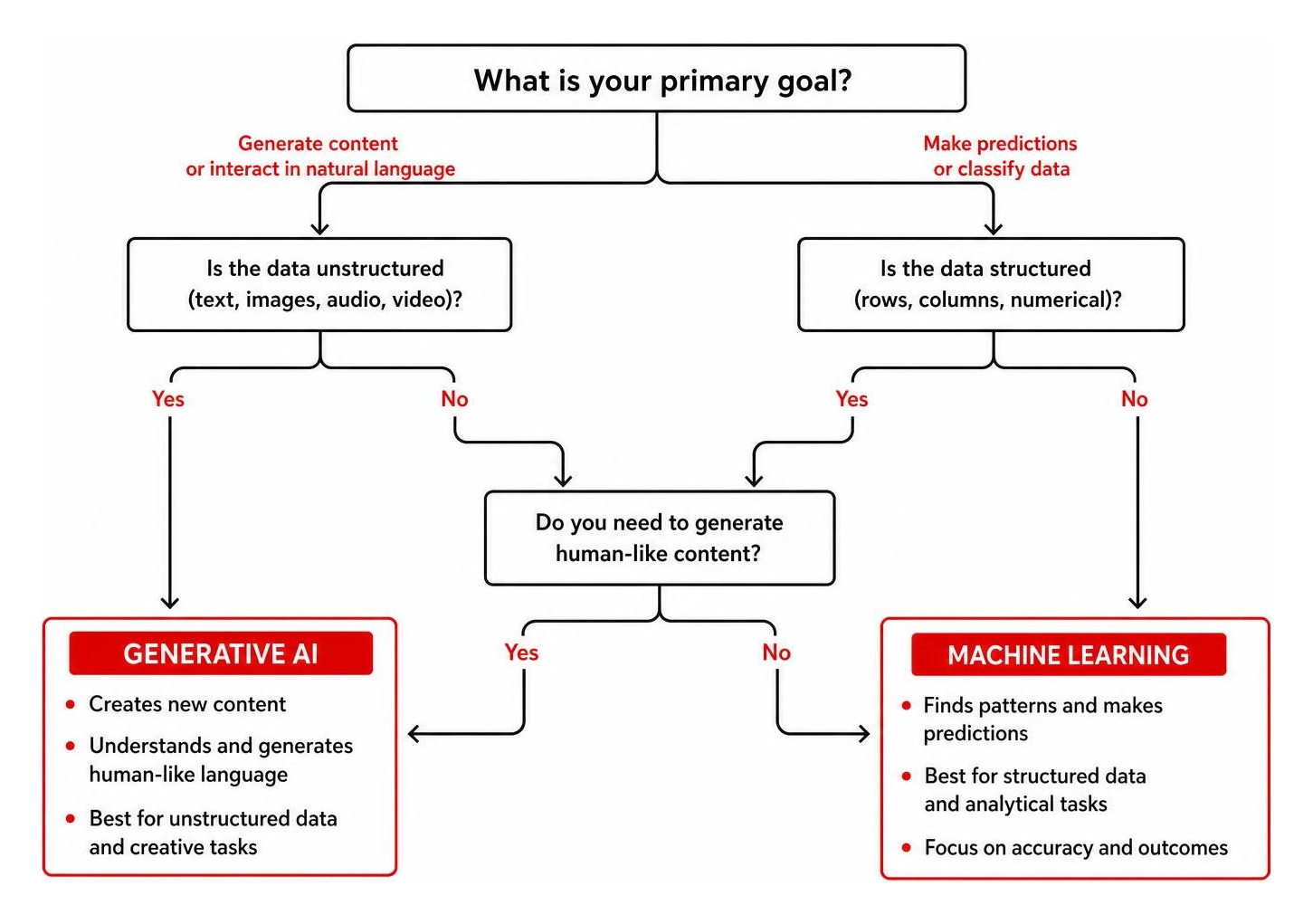
One of the most common mistakes when implementing ai in business is treating all AI as if it were the same. Choosing the wrong type of technology for your specific use case is the fastest way to blow through your budget with nothing to show for it.
To make the right choice, we must distinguish between two primary branches: Generative AI (GenAI) and traditional Machine Learning (ML).
To see how real-world decision-makers navigate this choice, read How to Actually Implement AI in Your Business in 2026.
When to Deploy Generative AI
Generative AI, powered by Large Language Models (LLMs), excels at processing and generating human-like content, unstructured data tasks, and natural language interfaces.
The best use cases for Generative AI include:
- Customer Service and Support: Automating up to 80% of tier-1 inquiries with conversational AI agents that understand context and tone.
- Knowledge Retrieval (RAG Systems): Allowing employees to query millions of internal documents instantly using Retrieval-Augmented Generation (RAG).
- Content and Communication Drafting: Generating personalized marketing copy, drafting client emails, and summarizing long meetings.
- Software Development: Using AI-assisted coding tools to boost developer productivity, which has shown a massive 376% ROI lift over three years for early adopters.
When to Rely on Traditional Machine Learning
Traditional Machine Learning remains the workhorse of enterprise optimization. It is designed for pattern recognition, predictive modeling, and analyzing highly structured, numerical data.
The best use cases for traditional Machine Learning include:
- Demand Forecasting: Analyzing historical sales and economic indicators to predict inventory needs, reducing holding costs by up to 20%.
- Predictive Maintenance: Monitoring industrial equipment and IoT sensors to predict failures before they occur, saving millions in unplanned downtime.
- Fraud and Risk Detection: Scanning millions of financial transactions in real-time to identify anomalies and block fraudulent activity.
- Lead Scoring and Dynamic Pricing: Evaluating customer behavior to score incoming sales leads or adjusting pricing dynamically based on market demand.
| Feature / Capability | Generative AI (GenAI) | Traditional Machine Learning (ML) |
|---|---|---|
| Primary Output | New content (text, code, images, audio) | Predictions, classifications, numerical values |
| Data Requirements | Large volumes of unstructured text/media | Structured, historical, clean numerical datasets |
| Primary Use Case | Customer support, knowledge retrieval, drafting | Forecasting, fraud detection, predictive maintenance |
| Cost Structure | Higher ongoing inference costs (API calls) | Higher upfront training costs, low inference costs |
| Risk Profile | Hallucinations, brand voice consistency, data privacy | Overfitting, algorithmic bias, model degradation |
A Step-by-Step Playbook for Implementing AI in Business
Successful AI implementation is not a software installation; it is an operational transformation. To help you navigate this process without getting lost in “pilot purgatory,” we have synthesized the best practices from top enterprise playbooks into a practical, three-phase execution strategy.
If you want to understand why so many companies get stuck running endless, low-impact tests, read our analysis on More info about escaping pilot purgatory.

Phase 1: Objective Setting and Use-Case Scoring
Every successful project begins with extreme specificity. Define a precise, measurable problem: “We want to use AI to reduce customer support email response times from 12 hours to under 15 minutes while maintaining a 90% satisfaction score.”
Once you have a list of potential projects, use a simple scoring matrix to rank them from 1 to 5 based on:
- Business Impact: How much time or money will this save, or how much revenue will it generate?
- Data Availability: Do we already have the clean, structured data required to feed this model?
- Technical Complexity: Can we build this with out-of-the-box tools, or does it require custom development?
- Organizational Readiness: Are the end-users eager to adopt this tool, or will we face heavy cultural resistance?
For your first project, pick a “quick win”—a use case with high business impact but low-to-medium technical complexity to prove the ROI of implementing ai in business.
Phase 2: Forming Cross-Functional Teams
AI projects fail when they are treated as purely technical endeavors. To succeed, build a cross-functional team that bridges technology and operations:
- Domain Experts: The actual business users who know the daily workflows inside and out. They are critical for defining what the AI needs to do.
- Data and Software Engineers: The builders who connect AI models to your databases, build APIs, and ensure smooth system operations.
- Product Owners / Project Managers: The orchestrators who keep the project on schedule, manage the budget, and align the technical build with business goals.
- Ethical and Compliance Voices: Individuals responsible for reviewing data privacy, ensuring regulatory compliance, and verifying unbiased outputs.
Phase 3: Running Structured Pilots and Shadow Runs
Before rolling out an AI system to your entire company, test it in a controlled environment. A structured pilot should run for 30 to 90 days:
- Build an Eval Set: Gather 50 to 200 real-world historical examples of the task along with the “ground truth” (the perfect human answer) to grade the AI.
- Run in Shadow Mode: Deploy the AI system in the background. Let it process real-time data and draft responses, but have human experts review and grade the outputs without letting them go live.
- Human-in-the-Loop (HITL) Rollout: Once the AI achieves an 80%+ accuracy rate, transition to a limited live pilot with 10 to 25 users. Keep a human in the loop to review and approve every output.
- Gradual Traffic Ramp-Up: Slowly increase the system’s autonomy and user count while monitoring error rates, latency, and user adoption.
Overcoming the Core Challenges of AI Adoption
Implementing AI is not without its hurdles. The path from a great demo to a scaled, revenue-generating production system is paved with operational and technical challenges. In fact, global surveys indicate that between 60% and 80% of AI projects fail to reach production.
To ensure your project succeeds, you must proactively identify and mitigate these common barriers. If you want to study the common pitfalls before they derail your budget, explore our guide on More info about AI project failure causes.

Overcoming the Top Challenges of Implementing AI in Business
The primary barriers to successful AI adoption center on people, processes, and legacy systems:
- The Talent Gap: There is an intense shortage of experienced AI engineers. Consider a hybrid approach: partner with an external AI consultancy for the heavy technical lifting while upskilling your internal team to manage the system long-term.
- Change Management and Cultural Resistance: Employees often fear that AI will replace their jobs. Involve end-users in the design process from day one, positioning AI as an assistant designed to eliminate repetitive tasks.
- Legacy System Integration: Connecting modern AI models to rigid, decades-old database architectures causes delays. Budget time and resources upfront for data engineering to build clean API connections.
- High Implementation and Inference Costs: To keep costs under control, design a multi-model architecture. Use smaller, cheaper models for simple, high-volume tasks, and reserve larger, expensive models only for complex reasoning.
Data Security, Quality, and Governance Strategies
Security is paramount when implementing ai in business. Feeding sensitive customer data or proprietary intellectual property into public AI models can lead to data breaches and regulatory fines.
To safeguard your business, implement a robust data governance framework:
- Adopt a Zero Trust Architecture: Ensure that all data access is strictly controlled, encrypted both in transit and at rest, and audited continuously.
- Opt for Enterprise Tiers: Never allow employees to use free, consumer-facing AI tools for business work. Use enterprise-grade APIs that guarantee zero data retention.
- Establish Data Quality Controls: Implement automated pipelines to clean, deduplicate, and validate your data before it reaches your AI models.
- Design for Regulatory Compliance: Ensure your AI systems comply with local regulations, such as the EU AI Act’s risk-based framework.
For a comprehensive blueprint on setting up these ethical and secure boundaries, read More info about ethical AI implementation.
Infrastructure and System Optimization
To support scalable AI efficiently, optimize your technical infrastructure using two key techniques:
- Prompt Caching: This feature allows AI models to “remember” long, repetitive contexts (like your company’s knowledge base) without reprocessing them on every query, slashing input costs by up to 90%.
- Task-Based Routing: Build a simple classification layer to route simple questions to lightweight, fast models, and reserve premium models for complex reasoning. This typically saves 40% to 60% on monthly inference costs.
Sustaining Long-Term AI Performance and Trust
Deploying your AI system is not the finish line—it is just the beginning of a continuous operational lifecycle. AI models are highly dynamic systems that interact with a constantly changing world. Without ongoing maintenance, monitoring, and ethical oversight, your models will degrade, lose accuracy, and eventually lose trust.
To build a framework that protects your business from these risks over the long term, review More info about building a responsible AI framework.
The EPOCH Framework: Upskilling Human Capabilities
As AI automates routine, rules-based tasks, the value of uniquely human skills increases. To get the most out of your AI investments, actively invest in upskilling your workforce. Researchers use the EPOCH framework to group the five core human capabilities that best complement AI:
- Empathy: The ability to build deep relationships, understand customer emotions, and navigate sensitive interpersonal dynamics.
- Problem-Solving: The cognitive capability to tackle highly complex, novel, and unstructured challenges that lack historical data.
- Originality: Creative thinking, innovation, and the ability to generate entirely new concepts or business models.
- Contextual Judgment: The critical thinking required to evaluate AI-generated outputs, spot subtle biases, and make high-stakes ethical decisions.
- Hands-on Collaboration: The physical and practical coordination required to implement solutions in real-world environments.
By training your team to focus on these skills, you transform your workforce from task-doers into strategic AI orchestrators.
Continuous Monitoring and Model Retraining
In the AI world, “model drift” occurs as real-world customer behaviors and data inputs change, causing models to slowly lose accuracy. To prevent this degradation, establish a rigorous MLOps pipeline:
- Log and Monitor Everything: Track key performance metrics continuously, including latency, cost per task, error rates, and user adoption.
- Implement Regular Human Audits: Task domain experts with reviewing 5 to 10 random AI transactions daily to catch subtle errors or hallucinations.
- Establish Feedback Loops: Build simple mechanisms for users to flag incorrect AI outputs, using these examples to update your eval set and retrain models.
- Schedule Automated Retraining: Regularly retrain your models with fresh, updated historical data to ensure they remain aligned with current real-world conditions.
Practical AI Adoption for Small and Mid-Sized Businesses
If you are running a small or mid-sized business, it is easy to look at enterprise AI budgets and feel like you are being left behind. But here is the good news: in 2026, SMBs actually have a massive competitive advantage when it comes to implementing ai in business.
While large enterprises are bogged down by years of bureaucratic approvals, complex legacy systems, and massive data migration projects, smaller businesses can move incredibly fast. You do not need a multi-million dollar budget or a team of in-house data scientists to start driving real business value with AI.
Here is a highly practical, budget-friendly roadmap for SMB AI adoption:
- Buy First, Build Second: Before you hire a developer to build custom software, look at your existing SaaS tools. Platforms like Shopify, HubSpot, and Microsoft 365 now come with highly advanced, built-in AI features out-of-the-box. Activating and mastering these features is the fastest, lowest-risk way to start.
- Automate Your Most Painful Workflows: Ask your team, “What is the most repetitive, time-consuming task you do every week?” Whether it is sorting customer support emails, extracting data from PDF invoices, or scheduling social media posts, target that specific workflow.
- Use Low-Code Automation Tools: Tools like Make.com and n8n allow you to connect your existing software to advanced AI models using simple, visual interfaces. You can easily build an automated workflow that reads incoming emails, drafts a response using an LLM, and saves the draft in your CRM for human review—all for less than $100 a month.
- Start Small and Test: Never commit to a large, expensive software contract based on a sales demo. Use free or low-cost trials to run a small-scale pilot with one or two employees. Measure the actual hours saved before spending more money.
- Prioritize Data Privacy: Even on a small budget, never feed sensitive customer lists, financial spreadsheets, or proprietary business plans into free, public AI tools. Always ensure you are using paid, enterprise-grade tiers that protect your data.
Frequently Asked Questions about AI Implementation
How long does it take to implement AI in business?
A single, well-scoped AI workflow typically takes 3 to 6 weeks to ship to production. This includes one week of discovery and workflow mapping, 1 to 2 weeks of pilot testing on real data, and 1 to 3 weeks of production rollout and team training.
Building a mature, company-wide AI capability with multiple integrated agents and unified data pipelines generally takes 6 to 12 months.
What are the typical costs associated with AI implementation?
For a custom-built, production-quality first use case, expect to invest between $150,000 and $400,000 if working with an external implementation partner. This covers workflow design, data engineering, model integration, and change management.
Once deployed, your ongoing infrastructure and model inference costs typically range from $1,000 to $15,000 per month, depending on your transaction volume. For smaller businesses using out-of-the-box SaaS tools and low-code integrations, implementation costs can be as low as $15,000 to $50,000.
How do we ensure compliance with AI regulations like the EU AI Act?
Compliance starts with classification. The EU AI Act categorizes AI systems into four risk tiers: Unacceptable risk (prohibited), High risk (requiring full compliance, logging, and third-party audits), Limited risk (requiring clear transparency, such as disclosing that a user is talking to a bot), and Minimal risk (no specific obligations).
To ensure compliance, maintain a living registry of all AI systems used in your business, document their training data sources, establish clear human-in-the-loop oversight, and implement robust data privacy protocols.
Conclusion
Implementing AI in business is not a race to see who can buy the most tools or deploy the largest models. It is a strategic journey of operational redesign, data discipline, and cultural adaptation.
The companies winning in 2026 are not those chasing the latest tech headlines. They are the businesses that identify their most expensive, repetitive bottlenecks, clean their data pipelines, build cross-functional teams, and systematically scale practical solutions.
By taking an audit-first, problem-focused approach, you can avoid the “pilot trap,” protect your data, and join the elite 6% of high performers who are capturing a massive return on their AI investments.
At Clayton Johnson SEO, we specialize in helping businesses cut through the technological noise to build clear, data-driven, and highly effective digital strategies. Whether you are optimizing your workflows for search engines or preparing your business for the age of AI-driven automation, we are here to help you map your audience and scale your operations. Ready to build an AI-informed strategy that drives measurable growth? Explore our More info about AI implementation best practices or contact us today to get started.