How to Find the Best Marketing Agencies in 2026 (And Actually Choose the Right One)
Choosing among the best marketing agencies is one of the highest-stakes decisions a small business owner can make. The right partner can compound your growth. The wrong one can drain your budget for months with little to show for it.
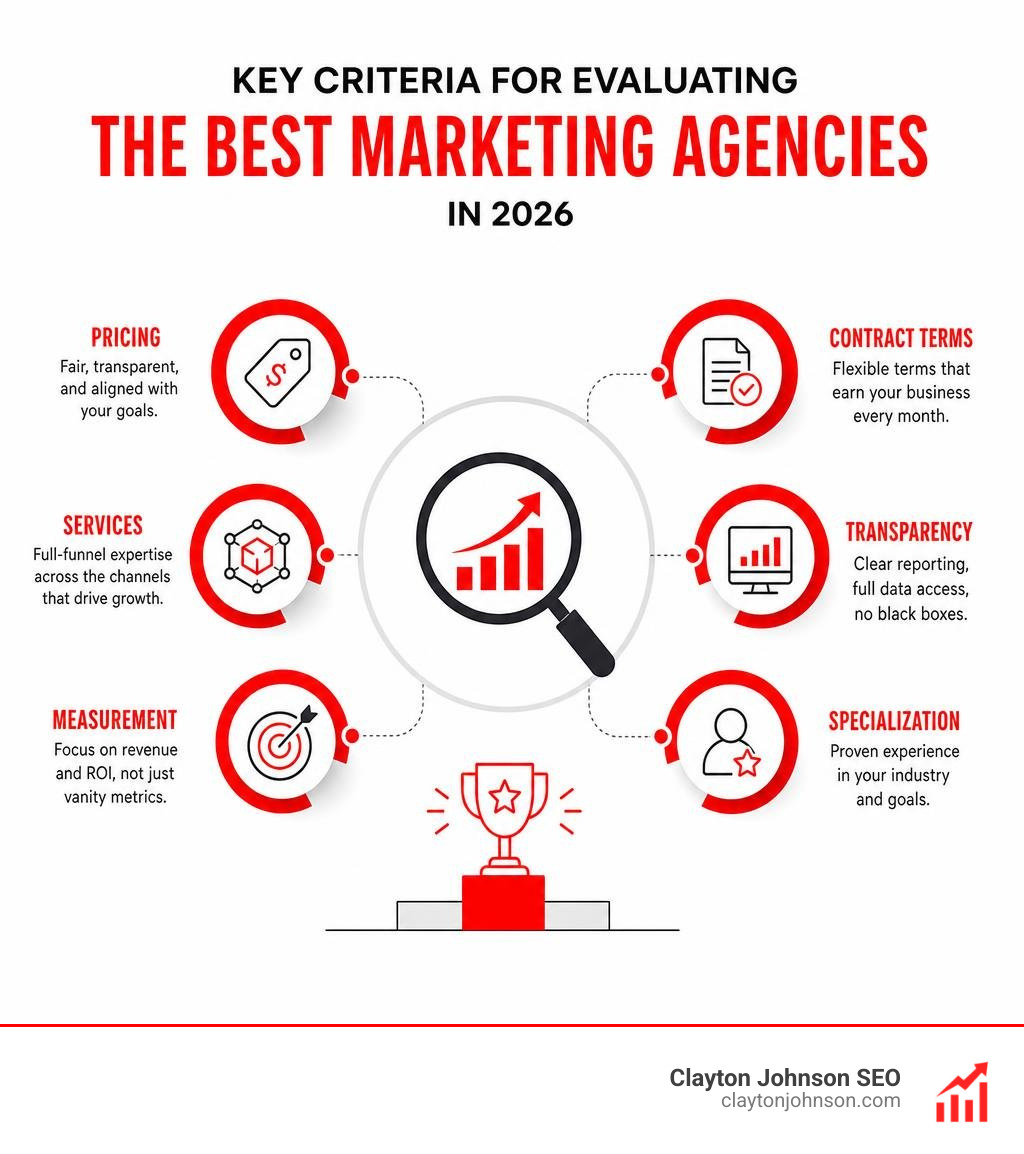
Here is a quick snapshot of what separates top agencies from average ones:
| Factor | What to Look For |
|---|---|
| Pricing | $5,000–$50,000/month retainer or $100–$149/hour |
| Services | SEO, paid search, social media, email, CRM, content |
| Measurement | Revenue and ROI tracking, not just clicks or impressions |
| Contract terms | Month-to-month preferred over rigid 12-month lock-ins |
| Transparency | Full dashboard access and raw data ownership |
| Specialization | Agency expertise matched to your industry and goals |
The marketing agency landscape in 2026 looks very different from even a few years ago. AI-driven search, generative engine optimization, and outcome-based pricing have all changed what a great agency actually does. At the same time, basics still matter — clear communication, trackable results, and a team that treats your budget like their own.
This guide cuts through the noise. It covers agency categories, pricing benchmarks, red flags to avoid, and the right questions to ask before you sign anything.
I’m Clayton Johnson, an SEO strategist and founder of SmallBizSEO, and over the past decade I’ve helped businesses of all sizes evaluate, hire, and get results from the best marketing agencies across both traditional and AI-powered search channels. This guide reflects what I’ve seen work — and what I’ve seen fail — across hundreds of real campaigns.
Best marketing agencies terms to know:
Core Categories Defining the Best Marketing Agencies in 2026

Navigating the landscape of modern marketing providers starts with understanding the different tiers of agencies available today. When you explore our curated top 100 marketing agencies, you will quickly notice that agencies operate across vastly different models, scales, and execution styles.
In 2026, the marketplace has organized itself into three distinct operational categories:
- Enterprise Holding Networks: Massive global organizations managing international ad accounts, multi-channel distribution, and broad brand governance.
- Independent Specialized Studios: Agile, niche-focused firms that concentrate deeply on specialized domains like SEO, performance marketing, or social commerce.
- Performance & AI-First Agencies: Modern teams leveraging automation, predictive data, and AI discovery engines alongside direct-response strategy.
Choosing the right category comes down to matching your company’s operational velocity, internal resources, and target growth objectives with an agency’s core strength.
Global Holding Groups vs Specialized Fandom Studios
At the top end of international commerce stand global holding groups. These historic conglomerates — including networks like HAKUHODO alongside major groups like WPP and Publicis — employ thousands of specialists worldwide. They excel at managing multi-market supply chains, unified creative positioning, and massive media buys across television, digital, and print channels. For enterprise brands requiring multi-national coordination, these conglomerates provide unparalleled global footprint and institutional infrastructure.
However, many growing brands now turn toward specialized fandom and culture-focused agencies like STAN Worldwide. Rather than simply buying commercial reach through broadcast ads, fandom studios focus on turning passive audiences into active superfans and brand advocates. Industry research indicates that up to 80% of consumers discover new products through fandom communities, and user-generated social content generates 6.9 times higher engagement than traditional corporate assets.
While global conglomerates build enterprise scale, specialized studios build cultural participation. Evaluating whether your company requires widespread broadcast reach or deep audience advocacy is a vital first step in agency selection.
Regional Spotlight: Analyzing the Best Marketing Agencies in Phoenix
Regional business dynamics play a major role in shaping how agencies structure their service models. A prime example is the booming market in Phoenix, Arizona.
Downtown Phoenix generated $21 billion in economic activity recently — representing an 11% increase over prior four-year benchmarks — while 73% of small businesses across the Phoenix region reported active growth over the past year. Because Phoenix developed as a market where regional brands carefully watch every dollar, local agencies have built a strong reputation for budget efficiency, disciplined performance execution, and practical ROI.
Marketing agencies operating in regional growth hubs frequently deliver specialized solutions tailored to local market demands:
- Performance Funnels & Local SEO: Maximizing high-intent search capture for fast-growing regional service providers and local retail footprints.
- Recruitment & Employer Branding: Integrating candidate journey mapping with digital marketing, helping fast-scaling companies recruit top talent in competitive regional job markets.
- Structured Sprints: Replacing bloated annual commitments with short, iterative performance testing cycles.
This practical focus makes regional agencies highly appealing to small and medium-sized businesses looking for clear accountability without enterprise overhead.
Service Ecosystems: Digital Marketing vs Traditional Advertising
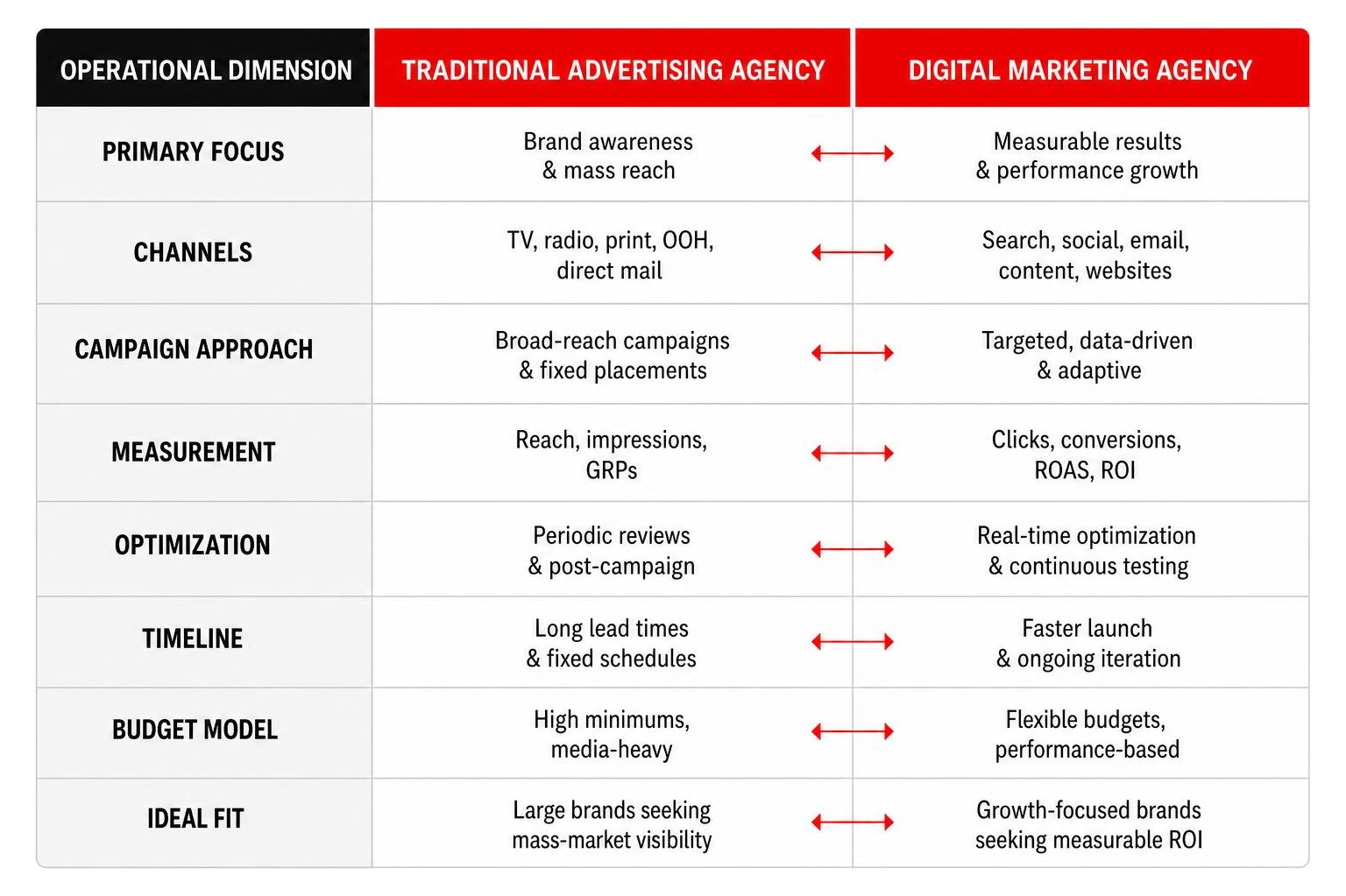
A frequent point of confusion for business owners is deciding between a traditional advertising firm and a dedicated digital marketing partner. While both aim to grow your business, their core operational approaches, delivery mechanisms, and campaign measurement models differ substantially.
Understanding these structural differences helps prevent misaligned expectations:
| Operational Dimension | Traditional Advertising Agency | Digital Marketing Agency |
|---|---|---|
| Primary Focus | Brand awareness, market positioning, and mass media messaging | Performance channels, audience acquisition, and conversion optimization |
| Core Delivery Channels | Television, radio, print, billboards, PR campaigns | Organic search (SEO), paid search (PPC), social ads, email, CRM |
| Targeting Precision | Broad demographic segments and geographic markets | Micro-segmented behavioral data, search intent, and first-party lists |
| Measurement & Attribution | Brand lift studies, reach, recall, and broad sales correlation | Direct revenue attribution, CAC, LTV, ROAS, and real-time conversion tracking |
| Optimization Velocity | Campaign-based with quarterly or seasonal creative iterations | Continuous real-time optimization via weekly performance sprints |
If your primary objective is long-term category positioning or high-level visual branding, learning how to choose a brand advertising agency will guide you toward traditional creative teams. However, if you need measurable leads, online sales, and real-time revenue tracking, a digital performance agency is almost always the better choice.
Core Capabilities Offered by Top Digital Agencies
Modern digital agencies do far more than just launch occasional ad sets or format monthly blogs. Today’s market leaders build integrated multi-channel engines designed to capture traffic across every stage of the buyer journey.
When reviewing service packages, look for integrated execution across these core disciplines:
- Search Engine Optimization (SEO) & AI Visibility: Capturing intent-driven search traffic across traditional search engines like Google and emerging AI search channels (Generative Engine Optimization). Explore our dedicated SEO services to see how modern search strategies scale brand visibility.
- Paid Search & Social Advertising: Managing targeted ad budgets on platforms like Google Ads, Meta, and LinkedIn with continuous creative testing and custom landing page development.
- Email & Lifecycle Automation: Nurturing leads using sophisticated behavioral triggers, CRM integration, and personalized email sequences to maximize repeat customer revenue.
- Conversion Rate Optimization (CRO): Applying user behavior analytics, heatmap tracking, and continuous A/B testing to convert more existing site visitors into paying customers.
Strategic Differentiation: Growth Architect vs Tactical Vendor

The most important distinction when evaluating the best marketing agencies is determining whether a firm operates as a tactical vendor or a true growth architect.
A tactical vendor executes isolated assignments — they will post five social graphics a week or write four blog posts a month without evaluating how those tasks impact your balance sheet. In contrast, a growth architect takes ownership of your entire acquisition ecosystem. They analyze unit economics, Customer Acquisition Cost (CAC), and Customer Lifetime Value (LTV) to engineer scalable revenue streams.
Data from industry research highlights why this distinction matters:
- Advanced Segmentation Lift: Brands that implement advanced customer segmentation techniques achieve up to 10% higher revenue growth compared to peers relying on broad messaging.
- Incrementality Testing: Growth architects use incrementality testing and media mix modeling rather than relying on vanity click metrics to verify true return on ad spend.
- Velocity of Execution: Top growth agencies replace passive monthly check-ins with fast performance sprints, constantly testing ad creatives and landing page variations to improve campaign efficiency.
Financial Investment: Pricing Models and In-House Comparison
Understanding marketing agency pricing structures ensures you allocate capital effectively while avoiding surprise fees. Based on industry pricing benchmarks compiled by platform directories like Clutch, typical monthly retainers for high-performing digital marketing agencies range between $5,000 and $50,000 per month, depending on project scope, channel complexity, and strategic oversight.
On an hourly basis, specialized digital marketing services — including SEO, paid search management, content strategy, and email automation — average between $100 and $149 per hour.
Agencies typically structure their commercial engagements under one of four primary pricing models:
- Monthly Retainer: A fixed recurring monthly fee for ongoing management, campaign execution, and strategic optimization across designated channels.
- Project-Based Pricing: One-time fixed fees for discrete deliverables, such as website redesigns, technical site audits, or initial brand identity development.
- Performance / Outcome-Based Pricing: Pricing structures tied directly to agreed-upon KPI benchmarks, lead volumes, or revenue share arrangements.
- Project-Based Digital Audits: Entry-level audit engagements designed to evaluate existing channel health, audit past vendor efficiency, and build an actionable growth roadmap before committing to long-term monthly retainers.
For business owners evaluating initial agency investments, reviewing realistic budget frameworks through our guide on hiring a marketing agency provides deep clarity on expected cost structures.
In-House Marketing vs Partnering with the Best Marketing Agencies
A frequent strategic crossroad for growing companies is choosing whether to build an internal marketing department or hire an external agency team. While an in-house team offers immediate physical access and deep dedicated focus on a single brand, the financial overhead can quickly overwhelm small to mid-sized budgets.
Here is a side-by-side comparison of the investment and operational realities:
| Evaluation Factor | In-House Marketing Team | External Digital Agency |
|---|---|---|
| Direct Overhead Costs | High payroll, payroll taxes, health benefits, retirement, and recruitment expenses. | Single predictable monthly retainer or flat contract fee with zero payroll overhead. |
| Skill Set Depth | Limited to the individual capabilities of 1–3 internal hires. | Immediate access to a full team of specialized channel experts (SEO, PPC, CRO, copywriting, analytics). |
| Software Stack Costs | Full enterprise software stack licenses must be purchased directly ($1,000–$5,000+/month). | Agency absorbs enterprise software costs across its broader portfolio. |
| Scalability & Agility | Slow to scale; adding new skill sets requires lengthy recruitment and onboarding cycles. | Highly agile; campaign resources and channel allocations can pivot quickly as goals evolve. |
| Execution Velocity | Subject to internal distractions, administrative duties, and operational bottlenecks. | Focused entirely on campaign execution, strategic optimization, and clear monthly KPI delivery. |
Vetting Guide: Red Flags, Vetting Questions, and Selection Frameworks
Choosing the wrong agency partner costs far more than lost retainer fees — it wastes valuable market momentum. Protecting your business requires learning to recognize common operational red flags early in the sales process.
Watch out for these critical agency warning signs:
- Guaranteed Top Search Rankings: No legitimate agency can guarantee #1 rankings on search engines due to constantly changing search algorithms. Agencies offering these promises often rely on risky, short-term tactics that can penalize your domain long-term.
- Vanity Metric Reporting: Be wary of account managers who celebrate high impression numbers or click counts while ignoring lead quality, sales pipeline volume, and net revenue impact.
- Opaque Data & Locked Accounts: Never permit an agency to set up ad accounts or analytics properties within proprietary agency containers that you cannot access or own. You should always maintain full administrative ownership of your digital assets and raw data.
- Rigid 12-Month Lock-In Contracts: Be cautious of vendors that force long-term contracts before demonstrating initial campaign traction. Leading agencies often offer month-to-month retainers or initial 90-day pilot windows because their performance keeps clients on board.
- Account Manager Silos: If an agency prevents you from speaking directly with the specialists managing your search campaigns or paid accounts, execution speed and technical accuracy often suffer.
Key Questions to Ask Before Hiring an Agency
Before signing any proposals, conduct a thorough vetting call. Ask these direct, performance-focused questions to pressure-test an agency’s operational maturity:
- “How do you measure campaign success, and how will our reporting connect directly to actual revenue and bottom-line profit?”
- “Can we review a real-time reporting dashboard or view a anonymized client report from the past 30 days?”
- “Will our team own all ad accounts, analytics properties, custom creative assets, and landing page code directly from day one?”
- “What is your process for conducting performance sprints and testing new ad creatives or search strategies?”
- “How do you handle channel attribution when multiple marketing touchpoints contribute to a single conversion?”
- “Who will be our direct day-to-day point of contact, and will we have access to the channel specialists actually doing the work?”
Frequently Asked Questions About Marketing Agencies
How much should a business expect to pay for a top marketing agency?
Most small to mid-sized businesses should expect to invest between $5,000 and $50,000 per month for full-service digital marketing management from a top-tier agency. Specialized single-channel retainers (such as standalone local SEO or paid ad management) typically range from $2,000 to $8,000 per month. Hourly rates across reputable North American agencies average $100 to $149 per hour. Initial project-based audits or strategic roadmaps usually cost between $2,500 and $10,000.
What is the main difference between a digital agency and an ad agency?
A digital agency focuses primarily on performance-driven online channels — such as organic search (SEO), paid search advertising, social ads, conversion rate optimization, and email marketing automation — where direct user actions and conversions can be tracked in real time. A traditional ad agency focuses heavily on broad brand strategy, creative storytelling, mass media buying (TV, radio, outdoor), and public relations designed to build widespread brand awareness.
What red flags indicate a poor fit when choosing a marketing agency?
Major red flags include guarantees of top Google rankings, refusal to grant full administrative access to your ad or analytics accounts, relying exclusively on vanity metrics like impressions rather than revenue metrics, pushing rigid 12-month retainers without a trial period, and high staff turnover that causes frequent changes in account management.
Conclusion
Finding the right partner among the best marketing agencies isn’t about choosing the firm with the slickest sales presentation. It’s about selecting a transparent team that understands your industry economics, respects your budget, and builds integrated growth engines focused on measurable revenue.
Whether you need enterprise-level scale, local search visibility, or modern AI search strategy, focus on agencies that offer transparent dashboard reporting, clear raw data ownership, and contract structures aligned with your long-term profit goals.
At Clayton Johnson SEO, we help business leaders cut through market noise, build high-converting search strategies, and turn digital channels into predictable revenue drivers. Explore our full suite of performance growth solutions across our comprehensive marketing agencies resources, or reach out to our team today to review your current channel health and map out your path to scalable growth.