What Is an Amazon Ad Agency and What Services Do They Offer?
An amazon ad agency is an operational partner that handles your marketplace strategy, execution, and ad spend management. While standard digital agencies focus on Google Search or meta social platforms, specialized Amazon partners build strategies around Amazon’s unique ranking algorithm, conversion mechanisms, and catalog infrastructure.
The core service suite offered by a leading amazon ad agency typically includes:
- Sponsored Products & Sponsored Brands Management: Building granular campaign structures based on high-intent search terms, controlling keyword match types, and setting location or dayparting rules.
- Amazon DSP (Demand-Side Platform): Executing programmatic display, video, and audio campaigns off-Amazon and on Amazon-owned properties (like Prime Video and Twitch) to reach audiences at every stage of the funnel.
- Listing Optimization & Amazon SEO: Aligning backend keywords, titles, and bullet points with Amazon’s indexing requirements to improve organic sales velocity alongside paid ads.
- Creative & CRO Services: Designing high-converting storefronts, standard visual assets, and Premium A+ Content. Premium A+ Content alone can lift conversion rates significantly, driving up to a 20% lift in sales compared to an 8% lift from standard basic A+ Content.
- Catalog Health & Operations: Resolving Buy Box suppressions, handling SKU hygiene, disputing vendor chargebacks, and maintaining optimal Inventory Performance Index (IPI) scores.
- Advanced Analytics & AMC: Deploying custom query code within Amazon Marketing Cloud to stitch together shopper touchpoints and unlock incrementality metrics.
To scale effectively, brands often need to integrate their marketplace ad strategy with broader Paid Search Services. For an overview of specialized providers, you can browse an Amazon Ad Agency Directory or examine end-to-end solutions through a full-service marketplace strategy.
| Feature / Metric | Full-Service Amazon Agency | Independent Consultant | In-House Team |
|---|---|---|---|
| Execution Depth | Full tactical execution (PPC, DSP, Creative, Ops) | Strategic advice and audits (Execution left to client) | Day-to-day execution limited by team bandwidth |
| Tech Stack & Tools | Direct AMC access, API tools, proprietary software | Relies on basic client software or native interfaces | Limited to tools within internal budget constraints |
| Cost Structure | Monthly retainer + % of ad spend | Hourly rates or project-based fixed fees | Fixed salaries, benefits, and software overhead |
| Category Intel | Cross-industry benchmarks and market-level data | Broad strategic vision across limited brand sets | Deep brand knowledge, isolated category context |
The Amazon Ads Ecosystem: Partners, Tools, and Modern Tech
The Amazon advertising landscape relies heavily on technology integration. To deliver consistent performance, an amazon ad agency must navigate Amazon’s partner programs and advanced analytics architecture.

Amazon organizes external service providers into the Amazon Ads Partner Network. Within this system, agencies demonstrate technical proficiency by obtaining verified partner status or Advanced Partner badges. These badges signal that an agency manages substantial ad spend, maintains certified personnel, and consistently delivers account growth.
Leveraging AI and Amazon Marketing Cloud
The introduction of native agentic AI–such as Amazon’s Ads Agent–and Amazon Marketing Cloud (AMC) has changed how top agencies manage campaigns. Agentic AI refers to autonomous systems capable of executing multi-step marketing workflows based on natural language directions.
When testing AI recommendations:
- 65% of beta advertisers saw delivery improvements when implementing targeting recommendations from Ads Agent.
- Advertisers achieved an average of 18% lower CPM and 16% lower CPA.
- Query development time inside AMC plummeted from hours of manual SQL coding to minutes of natural language prompts.
Modern agencies use AMC SQL queries to build custom lookalike audiences, map non-linear path-to-purchase steps, and launch hyper-targeted Amazon DSP campaigns to win back cart abandoners. Successful implementations are documented across several growth agency case studies.
Amazon Ads Partner Classifications and Badges
When auditing potential partners, it helps to understand how Amazon classifies ecosystem participants:
- Independent Agencies: Focused hands-on service teams offering end-to-end PPC, DSP, listing optimization, and catalog management.
- Technology Providers: Software companies building direct API tools for automated bidding, inventory synchronization, and reporting dashboards.
- Media Agencies: Enterprise firms handling massive cross-channel media budgets incorporating Amazon DSP alongside traditional TV and display channels.
- Specialized Consultants: Strategic advisors providing high-level marketplace guidance, JBP (Joint Business Planning) assistance, and account audits.
- Creative Agencies: Studios specializing in product photography, 3D renders, video production, and storefront design built for Amazon’s user experience.
Strategic Frameworks: TACoS Optimization and ROI Measurement
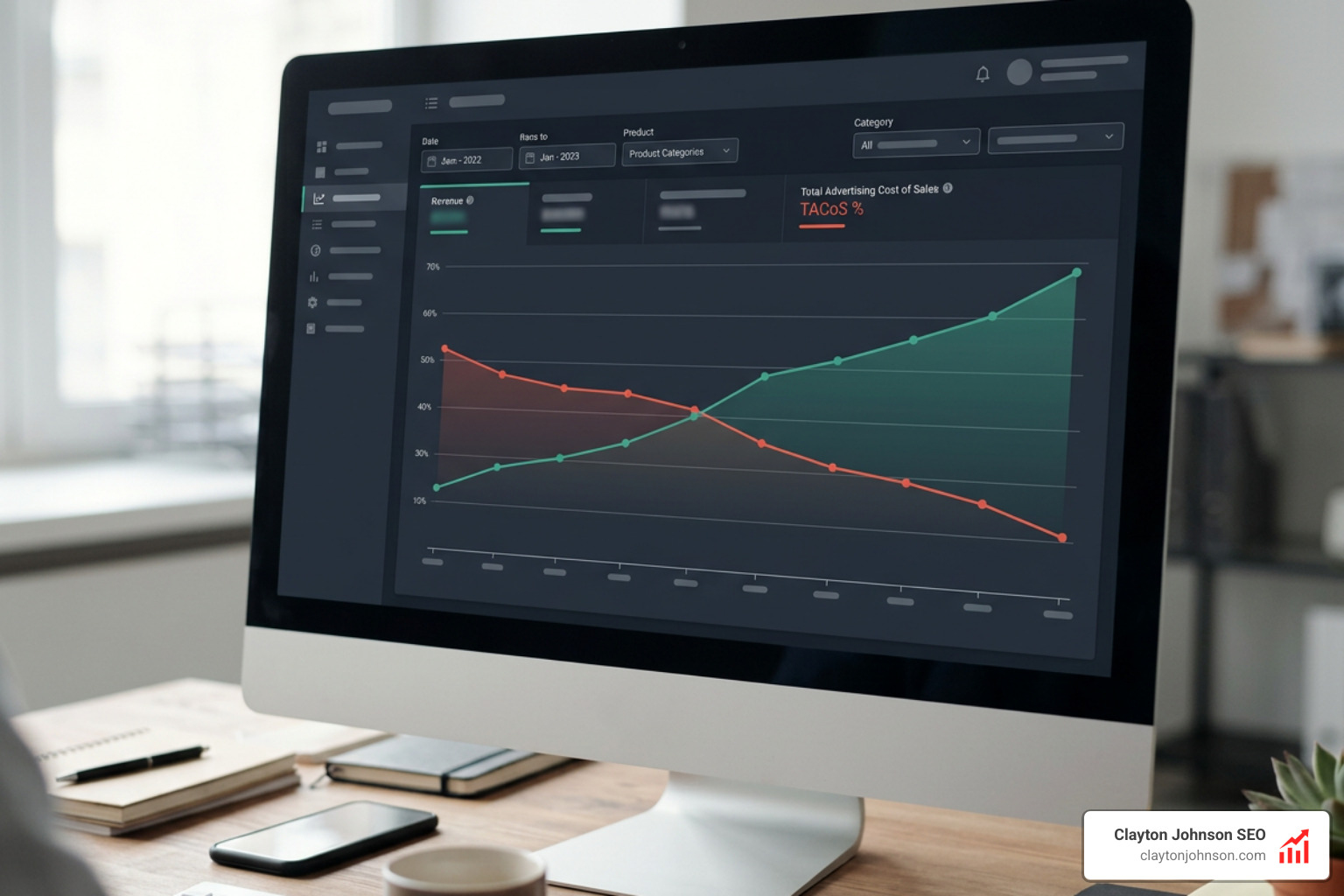
For years, brands judged PPC campaign success strictly by Advertising Cost of Sale (ACoS). However, optimizing exclusively for low ACoS can strangle total growth. A modern amazon ad agency manages campaigns using Total Advertising Cost of Sale (TACoS) to protect total profit margins.
$$\text{ACoS} = \frac{\text{Ad Spend}}{\text{Direct Ad Revenue}} \times 100 \quad \mid \quad \text{TACoS} = \frac{\text{Ad Spend}}{\text{Total Channel Revenue}} \times 100$$
While healthy campaign ACoS generally sits in the 15–30% range depending on product margins, mature Amazon brands aim to keep overall TACoS between 10% and 15%. If TACoS drops while total sales increase, ad spend is successfully driving organic keyword rank and organic sales velocity.
Agencies also leverage Amazon’s aggressive placement rules, such as boosting “Rest of Search” bids up to 900%, to capture placements that competitors overlook. Evaluating performance requires rigorous financial alignment, which you can explore through our guide on ROI Measurement Frameworks or by collaborating with a dedicated full-service growth partner.

Key Criteria When Choosing an Amazon Ad Agency
Selecting an agency requires evaluating strategic alignment rather than falling for slick sales pitches. Prioritize these core capabilities during your search:
- Profit-First Financial Focus: The agency must track break-even ACoS, net contribution margin per ASIN, and overall P&L outcomes rather than reporting inflated vanity ROAS.
- Category-Level Intelligence: Look for agencies with category benchmarks that reveal how competitor bidding patterns fluctuate throughout the day.
- Creative Alignment with Algorithms: Visual assets must be designed to convert search traffic. Agencies focused on creative management link visual CTR metrics directly to ad strategy.
- Bid-Level Control and Automation: Ensure the team combines human strategy with rule-based and programmatic bid adjustments.
Before committing, review our comprehensive Guide to Comparing Marketing Agencies.
Agency Fee Models and Timeline Expectations
Understanding agency fee structures prevents margin surprises down the road. Common pricing frameworks include:
- Flat Monthly Retainer: A set fee (typically $2,500–$10,000/month) based on account scope and catalog complexity. Ideal for predictable operational budgeting.
- Percentage of Ad Spend: The agency charges a baseline retainer plus 5–15% of total monthly ad spend. This model aligns agency resources with scaling budgets.
- Hybrid / Performance-Based: A base retainer paired with a percentage of total revenue growth or TACoS target achievements.
What does the execution timeline look like?
- Days 1–14 (Data Baseline): Account auditing, policy checks, keyword tracking setup, and campaign restructuring. Initial data begins accumulating.
- Days 30–60 (Rank Traction): Bidding adjustments take effect, indexation expands, and organic positions start climbing.
- Day 90+ (Scaling Maturity): AMC audience segments activate, TACoS stabilizes within target bands, and full-funnel DSP campaigns scale predictably.
Account Governance, Security, and Compliance
Delegating operational control to an amazon ad agency should never mean surrendering account ownership or exposing your business to security risks.
Partnering with an Amazon Ad Agency vs In-House Management
Building an in-house team requires hiring PPC managers, graphic designers, copywriters, and data analysts. For many brands, maintaining this team creates high payroll overhead and leaves the business vulnerable to industry turnover.
Conversely, an external amazon ad agency provides an entire team of specialists for less than the cost of a full-time internal hire. Agencies bring cross-category intelligence, established DSP seats, and direct contact avenues with Amazon agency account managers to resolve listing suppressions quickly.
Security Protocols and Vetting Red Flags
Data integrity is critical. Research indicates that nearly 60% of vendor-linked security breaches can be prevented through strict access controls and contractual parameters. Furthermore, with over 35% of Amazon sellers receiving policy violation notices, poor agency execution can lead to account suspensions.
Watch out for these agency red flags:
- Demanding Master Account Credentials: Never give an agency your primary Seller Central or Vendor Central login credentials. Always grant access via Secondary User Permissions.
- Shadow Accounts: Insist that all campaigns, historical data, and AMC instances remain inside your primary Amazon account so you retain total asset ownership if you ever part ways.
- Contract Locks with Missing AMC Access: Be wary of multi-year contracts that prohibit performance audits or limit access to your raw campaign reporting data.
- Focusing Purely on Top-Line Revenue: Beware of agencies that celebrate high revenue numbers while ignoring climbing TACoS and shrinking net margins.
Frequently Asked Questions About Amazon Advertising Agencies
How long does it take to see measurable results from an Amazon PPC campaign?
Initial data accumulates within 7 to 14 days following campaign launch or restructuring. Measurable improvements in click-through rate and keyword indexing typically occur within 30 to 60 days, while full strategy optimization and stable TACoS performance usually take 90 days.
What is a healthy TACoS benchmark for an established Amazon brand?
A healthy Total Advertising Cost of Sale (TACoS) for a mature brand generally ranges between 10% and 15%. However, new product launches or aggressive market-share expansion efforts may target TACoS rates of 20% to 30%+ during early launch phases before tapering down as organic sales velocity builds.
How do agencies protect brand accounts from policy violations and listing suppressions?
Agencies maintain compliance by monitoring product claims, restricting banned terms in listings, enforcing Buy Box protection against unauthorized sellers, and ensuring listing variations adhere strictly to Amazon Terms of Service.
Conclusion
Finding the right amazon ad agency can turn paid spend from a margin-draining expense into a predictable engine for organic marketplace dominance. By moving beyond isolated campaign ACoS metrics and focusing on full-funnel TACoS management, custom AMC analytics, and strict account governance, your brand can capture market share while protecting bottom-line profits.
At Clayton Johnson SEO, we help growing companies align paid acquisition channels with long-term digital growth frameworks. Ready to elevate your agency strategy? Explore Marketing Agency Solutions today to scale your online footprint.